


75% automation on access requests sounds aggressive until you look at how much of the work is just routing, approving, group assignment, and cleanup. And reducing administrative overhead in access management usually has less to do with hiring another IT admin, and more to do with removing the tiny manual touches that happen 200 times a month.
A lot of IT teams try to fix access work with better policies. Fair enough. Policies matter. But if the policy still ends with someone chasing an approver in Slack, checking a spreadsheet, adding a user to an Okta group, and pasting proof into Jira, you haven't reduced the workload. You've just documented it better.
I’ve seen this pattern in growth teams a lot. The company scales, the app stack expands, hiring picks up, and suddenly access management feels like a second service desk living inside the first one. And nobody budgeted for that.
Key Takeaways:
- Reducing administrative overhead in access management starts by counting manual touches, not tickets.
- Access requests should route through one intake path, with required context captured before IT sees the work.
- Group-based provisioning through your identity provider is the cleanest way to remove copy-paste admin work.
- Time-bound access works better than policy-only least privilege because revocation actually happens.
- Access reviews should confirm what already changed, not become the first time anyone notices stale access.
- Jira and Slack can carry the workflow, but the identity provider should execute the access change.
- The goal isn't fewer controls. The goal is controls that don't create another queue.
Why Access Admin Work Keeps Growing Inside Jira Teams
Access admin work grows because every new employee, app, role, and audit creates another decision point. The ticket count is visible, but the hidden cost is the number of human touches behind each request. Reducing administrative overhead in Jira-heavy teams means finding those touches and deciding which ones should disappear.

Access Requests Aren’t the Real Workload
A ticket doesn't look expensive. One person asks for Figma editor access. Another asks for GitHub admin access for 24 hours. Someone else needs a finance tool because they moved teams. On paper, that's three requests. Easy.
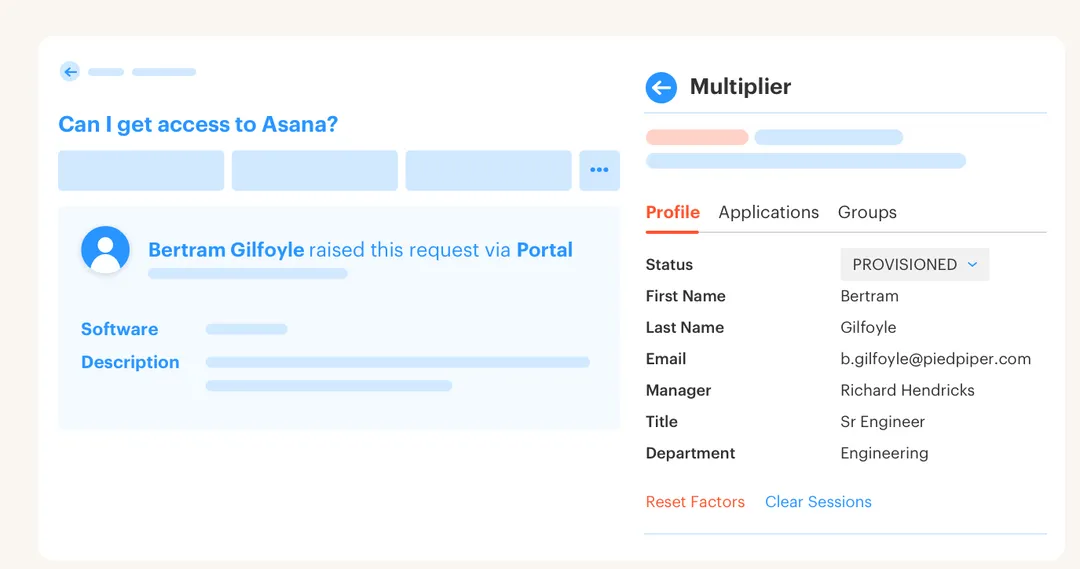
The problem is everything around the request. Someone has to figure out whether the app is sanctioned, which role maps to the actual need, who owns the approval, whether the requester’s manager should weigh in, which group controls the access, and whether access should expire. Then someone has to do the group assignment and leave enough evidence for audit. One ticket turns into six small decisions. Multiply that by 300 requests and you’ve got a queue that looks normal but behaves like a sinkhole.
I like to think about access work like airport security. The line isn't slow because one person takes too long to walk through the scanner. The line is slow because bags need bins, laptops come out, belts come off, someone forgets a water bottle, and every exception creates a little pileup. Access management works the same way. The request is the traveler. The admin overhead is all the stuff around them.
If your team is trying to quantify reducing administrative overhead in access management, don't start with ticket volume. Start with touch count:
- 0 touches: Auto-approved and provisioned through an identity group
- 1 touch: Approval only, provisioning automated
- 2 touches: Approval plus manual provisioning
- 3+ touches: Approval chase, clarification, provisioning, evidence capture, cleanup
Anything above 2 touches deserves scrutiny. Anything above 3 touches is probably broken.
The Hidden Tax Shows Up in Approvals and Revocations
Manual access work usually hides in two places: waiting for decisions and cleaning up after decisions. Approval latency feels normal because people are busy. Revocation work feels optional because nobody is screaming for it today. That combination is where admin overhead gets ugly.

Picture a workplace technology manager on a Tuesday morning. Jira has 42 open access tickets. Slack has 11 pings asking, "Any update on this?" Two managers haven't approved requests from last week. A finance app owner is on PTO. The actual provisioning work might take 5 minutes per request, but the surrounding work eats the morning. By lunch, the manager has done a ton of coordination and very little actual IT work. Not a great trade.
The security side is worse. Standing access grows quietly. Someone needed admin rights during an incident and kept them. Someone moved departments and retained access to the old tool. Someone left a project but still has access to the repo. NIST’s guidance on access control and least privilege is pretty clear that access should be limited to what users need to perform assigned tasks, and the control only works if it’s enforced in the operating model, not just written down in a policy (NIST SP 800-53 Rev. 5).
To be fair, manual review has a place. If someone requests production access, finance admin access, or sensitive customer data, you probably want a human decision. Totally valid. The mistake is treating every request like that same high-risk request, because then your team spends the same effort on Zoom viewer access as they do on elevated database access.
If your low-risk requests and high-risk requests follow the same path, your workflow is punishing the easy work.
Want a quick look at what a Jira-native access workflow can look like once the routine work stops bouncing between tools? Learn more about Multiplier.
Policy Without Enforcement Becomes Another Queue
Policy-heavy access management feels responsible at first. You write the rule. You define the approver. You document least privilege. You build the access review calendar. And for a while, everyone feels better because the process is now official.
Then reality hits. A policy that says "admin access expires after 24 hours" doesn't revoke access by itself. A policy that says "managers must approve access" doesn't chase a manager. A policy that says "inactive licenses should be reclaimed after 30 days" doesn't remove the user from the group. Someone still has to do the work, and that someone is usually IT.
The counterintuitive part is that automation-first least privilege is often safer than policy-first least privilege. I know that sounds backwards. But a simple automated rule that removes time-bound access after 24 hours beats a beautiful policy that relies on someone remembering to clean it up next week. One actually changes the system. The other creates intent.
A fintech team with nearly 1,200 employees ran into this exact mess. Hundreds of routine access requests came through Slack, email, and Jira. IT had to chase approvals and manually assign Okta groups. After moving requests into a self-service app store with automated routing and provisioning, they cut access request workload by 80%. That's not a policy win. That's an operating model win.
The next question is pretty simple: which parts of your access workflow deserve human judgment, and which parts are just admin drag?
How Lean IT Teams Reduce Access Overhead Without Losing Control
Lean access operations separate judgment from execution. Humans decide when risk requires context, while systems handle routing, provisioning, expiry, and evidence. Reducing administrative overhead in access management works when the workflow is designed around repeatable paths instead of heroic follow-up.
Find the Requests That Should Never Reach an Admin
Start with the boring stuff. Seriously. The fastest path to reducing administrative overhead in access management is identifying the requests that consume time but rarely require judgment. If 60% of your tickets are for standard app roles, those shouldn't need an admin to interpret, route, provision, and close every time.
I’d run a 30-day review before changing anything. Pull every access ticket and tag it by app, role, approver, provisioning method, and whether IT had to ask a follow-up question. Don't overcomplicate it. A spreadsheet is fine for the diagnosis. The pattern you’re looking for is repetition. If the same app-role combination appears at least 10 times in 30 days and approval is predictable, it belongs in a standard catalog path.
Ask five questions:
- Does the requester usually know what app they need? If yes, put it in a catalog.
- Does the role map cleanly to an identity provider group? If yes, automate provisioning.
- Does the approver follow a clear rule? If yes, route it automatically.
- Does access need to expire? If yes, make duration required.
- Does IT ask for missing context more than 20% of the time? If yes, fix the intake form before automating.
The exception matters. Some requests are messy because the business process is messy. If app ownership is unclear or role definitions are vague, automating too early just makes the confusion move faster. In that case, clean up ownership first. Then automate.
Route Approvals Where People Already Respond
Approvals fail when they ask busy people to leave their normal flow. A manager will answer a Slack DM in 30 seconds, but ignore a portal notification for 3 days. Not because they’re careless. Because nobody lives in approval portals all day.
The practical rule is simple. If an approval is needed in under 24 hours, send it to the place where the approver already works. For a lot of companies, that's Slack. For some, it's email. For Jira-heavy IT teams, JSM also works well. The wrong answer is adding a separate IGA portal that employees and managers only remember during onboarding week or audit week.
A good approval path has three parts. The approver sees the app, role, requester, business reason, and duration. They can approve or deny without hunting for more context. The decision writes back to the ticket automatically. If any one of those is missing, IT becomes the glue again.
One AI company grew from 100 to 400+ employees in two years and had access requests tracked in Slack channels and Notion boards. Notifications got missed. IT chased people. Provisioning lagged. After moving to a catalog and automated approval workflow integrated with Okta, they processed 3,800+ requests in a year, with 75% fully automated. A four-person IT Ops team supporting 420+ employees is possible when approval routing isn't a part-time job for everyone involved.
Use Identity Groups as the Execution Layer
The cleanest access workflows use the identity provider as the execution layer. Jira can capture the request. Slack can capture the approval. But Okta, Entra ID, or Google Workspace should be the place where access actually changes. Otherwise, you're building a nice front door that still opens into manual work.
Group-based provisioning gives you a deterministic path. App role equals identity group. Approval moves the ticket to the right status. The workflow adds the user to the mapped group. The app receives access through SAML or SCIM where supported. And the ticket records what happened. Not glamorous. Very effective.
I’d use a 3-bucket model:
- Standard access: Common roles, low risk, auto-approved or manager-approved
- Sensitive access: App owner approval required, provisioning still automated
- Privileged access: Time-bound by default, stricter approval, automatic removal
The threshold I like is 80%. If 80% of requests for an app fit standard or sensitive patterns, map those roles to groups and automate them. Keep the weird 20% manual until the pattern is clearer. That prevents the classic automation mistake, where teams try to automate every edge case and spend 6 months designing a monster.
A security team might object here, and they're not wrong. Group sprawl can become its own problem if nobody owns naming, cleanup, and review. The fix isn't avoiding group-based provisioning. The fix is having a rule that every access group must map to one approved app role, one owner, and one review path. No owner, no automation.
Put Expiry Dates on Risky Access by Default
Time-bound access is where least privilege stops being theoretical. If someone needs elevated access for an incident, project, or data pull, the request should include a duration before approval. One hour. Six hours. Twenty-four hours. Pick the window that matches the work.
The decision rule is pretty direct. If access increases blast radius, make it temporary. Production admin, security tools, finance systems, customer data exports, privileged repo access. All of it. Standing access should be the exception, not the default. And if someone truly needs permanent access, they should have to explain why.
The operational win is bigger than people expect. Revocation is one of those tasks that everyone agrees matters, but nobody wants to own manually. Automatic expiry removes the follow-up ticket, the reminder, the awkward Slack message, and the audit scramble later. The access ends because the workflow says it ends.
Think about it like a hotel keycard. Nobody expects the front desk to remember every guest and manually deactivate cards after checkout. The system issues the card for a stay, then the card stops working. Temporary access should work the same way. If the window was approved for 24 hours, the privilege should disappear after 24 hours without someone setting a calendar reminder.
A good starting rule is to require expiry for any role with admin, owner, billing, production, export, or delete permissions. If the role name contains one of those words, force a duration. Crude? A little. Better than relying on memory? Absolutely.
Treat Reviews as Cleanup, Not Discovery
Access reviews get painful when they become the first time anyone looks at who has access. Quarterly certification shouldn't be an archaeological dig. It should be a confirmation pass over a system that has already been enforcing good rules for months.
The old pattern is brutal. Export users. Match them to apps. Send spreadsheets to managers. Wait. Chase. Interpret comments. Remove access manually. Save evidence somewhere. Repeat next quarter. Nobody enjoys this. Reviewers rubber-stamp because the context is weak, and IT ends up doing the cleanup after the campaign.
A better review gives the reviewer context at the point of decision. User, department, title, group, app, last login, and a recommendation. Keep or revoke. If they revoke, the system should remove the group membership and log the evidence. The review becomes a control loop instead of a spreadsheet project.
Use a red flag threshold before the review even starts. Any user with no login activity for 30 days should be marked for review. Any user with access outside their department pattern should be flagged. Any privileged role with no recent ticket should be challenged. You don't need perfect analytics. You need enough signal to stop treating every user-app pair as equal.
IBM’s annual data breach reporting has consistently shown that identity and access issues are a major part of security exposure, especially when credentials and permissions are poorly controlled (IBM Cost of a Data Breach Report). Access reviews don't fix that alone. But reviews backed by automated revocation actually reduce the stale access that creates risk.
If you want to see the workflow from request to approval to provisioning without adding another portal, See how Multiplier works.
Measure Admin Load by Touches, Not Ticket Count
Ticket count is a bad measure of access workload. A team can close 500 tickets and still be buried if each ticket requires chasing, provisioning, commenting, screenshotting, and cleanup. The better measure is admin touches per completed request.
I’d track four numbers every month. Average touches per request. Percent of requests with zero-touch provisioning after approval. Percent of requests requiring clarification. Percent of access grants with automatic expiry. Those numbers tell you whether reducing administrative overhead in access operations is actually happening, or whether tickets are just moving through Jira faster.
Set benchmarks that force decisions:
- Clarification above 15% means intake forms are weak
- Manual provisioning above 40% means group mappings are underbuilt
- Approval wait above 24 hours means routing is broken
- Revocation follow-up above 10% means expiry rules are missing
The story you want is simple. More requests can come in without admin touches rising at the same rate. That's how lean IT scales. At Videoamp, growth from 100 to 500 employees created a Tuesday surge of access tickets after onboarding. Once the company moved to a self-service app catalog inside Jira Service Management, they made 20 sanctioned apps available, processed 500+ app requests in 6 months, and saved 70+ hours of IT productivity. The lesson isn't "catalogs are nice." The lesson is that intake quality and predictable routing remove admin work before it ever reaches the queue.
Reducing administrative overhead in access management isn't about making IT work faster. It's about making sure IT doesn't touch work that the system can handle cleanly.
How Multiplier Automates Jira Access Governance
Multiplier automates Jira access governance by turning requests, approvals, provisioning, expiry, and evidence into one JSM-based workflow. Employees use a catalog in Jira or Slack, approvers decide in context, and identity provider groups execute the change. The admin overhead drops because the handoffs stop multiplying.
App Catalog Requests With Slack Approvals
Multiplier starts with the Application Catalog inside Jira Service Management. Employees browse approved apps, choose roles like Viewer, Editor, or Admin, and submit the request from JSM or Slack. The important part is that the request starts with structure. App, role, approver, and context are captured before IT has to interpret anything.
That matters for teams reducing administrative overhead in access requests because intake quality drives everything downstream. If a request says "Need access to analytics," IT has to ask follow-up questions. If the catalog says "Looker, Viewer role, 24-hour access, manager approval," the path is obvious. Approvers can act in Slack or JSM, and the decision stays tied to the Jira issue.
The real win is adoption. A separate portal might be powerful, but if employees don't use it, IT still gets Slack pings and side-channel requests. Putting the catalog where people already ask for help removes the training burden. Not zero effort. Nothing is. But much less change management than asking everyone to remember another access system.
Group-Based Provisioning and Time-Based Revocation
Multiplier provisions access through identity provider group mappings in Okta, Entra ID, or Google Workspace. Once the Jira issue reaches the configured approved status, the mapped group change happens through the identity provider, and the ticket records the outcome. For SSO apps that rely on group-based access, that removes the manual admin step that used to take 5 to 30 minutes per request.

The time-based access feature is the bigger shift for least privilege. A requester can choose a duration, like 1, 6, or 24 hours. After approval, access is granted through the mapped group and removed when the timer expires. That directly solves the revocation problem from earlier. No follow-up ticket. No "did we remove that?" moment. The Jira issue shows the request, approval, grant, and removal.
Access Reviews and Auto Reclaim add the cleanup layer. Reviews happen in JSM with user context like groups and last login, and revoke decisions remove users from relevant identity provider groups. Auto Reclaim can identify inactive users based on identity provider login data and revoke access after a grace period, available on the Advanced edition. For teams carrying stale licenses and old entitlements, that turns cleanup from a quarterly scramble into a regular operating motion.
If the goal is fewer manual touches, not fewer controls, Get started with Multiplier.
The Cleaner Path to Lower Admin Load
Reducing administrative overhead in access management comes down to one shift: stop treating every request like a custom project. Standard requests need structured intake, predictable approval, group-based provisioning, and clean evidence. Risky requests need the same thing, plus expiry by default.
A lot of teams try to solve access work by adding more policy. I get why. It feels safer. But policy without execution just creates more admin work for IT to carry later. The better path is automation-first least privilege, where the system handles the routine work and humans step in where judgment actually matters.
That’s how access operations scale without turning Jira into a backlog of tiny, annoying decisions. Less chasing. Less cleanup. Fewer standing privileges. And a much calmer IT queue.
Frequently Asked Questions
How do I set up automated provisioning with Multiplier?
To set up automated provisioning with Multiplier, start by integrating it with your identity provider like Okta or Google Workspace. Then, create an access request workflow in Jira Service Management (JSM) where employees can submit requests through the Multiplier application catalog. Once requests are approved, Multiplier will automatically provision access by adding users to the appropriate identity provider groups. This eliminates manual steps and helps streamline the process, ensuring that access is granted quickly and accurately.
What if I need to revoke access quickly?
If you need to revoke access quickly, ensure that you are using Multiplier's time-based access feature. When users request access, they can select a specific duration (like 1, 6, or 24 hours). Once the time expires, Multiplier automatically revokes access without any manual follow-up required. This setup minimizes the risk of standing privileges and ensures that access is only granted for the necessary time frame.
Can I track access requests in real-time?
Yes, you can track access requests in real-time using Multiplier within Jira. When an access request is submitted, a Jira ticket is created automatically, and you can monitor its status throughout the approval and provisioning process. Approvers receive notifications in JSM or Slack, allowing for quick decisions. This integration keeps everything centralized, so you have a clear audit trail and visibility into all access requests.
When should I conduct access reviews?
You should conduct access reviews regularly, ideally quarterly, to ensure that access permissions remain appropriate. Using Multiplier's Access Review feature, you can create campaigns directly within Jira. This allows you to assign reviewers, track progress, and automate the removal of access for users who no longer need it. By integrating access reviews into your regular workflow, you maintain a clean and secure access environment without the hassle of manual tracking.
Why does my team need a self-service app catalog?
A self-service app catalog simplifies the access request process for your team. With Multiplier, employees can browse approved applications and request access directly through Jira or Slack. This reduces the administrative burden on IT by ensuring that requests are structured and include all necessary context upfront. It also speeds up the approval process, as requests are routed to the right approvers without delays, helping your team operate more efficiently.


