

72% of employee help centers fail at the exact moment they're supposed to help: when someone needs something slightly outside the default path. And if you've worked in Jira Service Management lately, you've probably seen this yourself this week. A request comes in, the form is vague, the help center looks clean on the surface, and your team still ends up chasing details in Slack.
Customizing employee help centers sounds like a design task. It isn't. It's an access, workflow, and governance problem wearing a UX costume.
Key Takeaways:
- Customizing employee help centers usually fails when teams focus on branding before request logic.
- If employees still need Slack, email, or DMs to finish a request, your help center isn't actually customized enough.
- A good employee help center should reduce clarification loops by at least 30% within 30 days.
- The fastest way to improve help center performance is to redesign around top request paths, not department org charts.
- For access requests, the winning pattern is one intake layer, one approval path, and one audit record.
- Jira-native governance works better than a separate portal when your team already lives in Jira and Slack.
- Automation-first least privilege beats policy docs that no one can enforce in daily work.
Why Most Employee Help Centers Still Create More Work
Customizing employee help centers should reduce back-and-forth, speed up access, and make support easier to run. In practice, most teams customize the surface, not the system. That leaves you with nicer tiles, slightly better forms, and the same manual mess underneath.

Pretty portals hide broken request paths
A lot of teams start with logos, categories, and homepage layout. Fair point. That stuff matters because first impressions matter, and if the portal looks chaotic, adoption drops fast. But once you get past the homepage, the real test is simple: can someone make the right request, with the right context, without needing a side conversation?
That's where most employee help centers break. An employee clicks "Software Access," sees 18 vague options, picks the closest one, and writes "Need Figma asap" in a text field. Then IT has to ask which role, which team, how long they need it, who approves it, and whether it's even an approved app. So the request that should take 2 minutes turns into a 20-minute thread across Jira and Slack.
I've seen this pattern a lot. Teams think they have an adoption problem. What they really have is a request design problem.
The real problem isn't customization. It's missing operational logic
Most people frame customizing employee help centers as a content and layout exercise. The real issue is that the help center is often disconnected from the approval and provisioning logic behind it. So the front door is customized, but the house behind it is still unfinished.
That split creates drag everywhere. Intake happens in the portal. Approval happens in Slack or email. Provisioning happens in Okta or Entra. Evidence gets stitched together later for the auditor. If four systems are required to complete one routine request, your employee help center didn't simplify work. It just moved the mess one step earlier.
A strong diagnostic question helps here. Look at your 20 most common requests from the last 30 days. Count how many required a human to ask a follow-up question before work could start. If that number is above 6, your help center is under-designed for real usage. If it's above 10, people are probably routing around it already.
If you want to see what Jira-native access governance looks like in practice, Learn more about Multiplier.
The cost shows up in queue time, access risk, and audit cleanup
A mid-market fintech team in the knowledge base hit this exact wall after growing to nearly 1,200 employees. Requests were arriving through Slack, email, and Jira. Managers had to be chased down. IT agents were manually assigning Okta groups. That kind of setup doesn't just slow response time. It creates a second hidden cost: nobody trusts the record.
And that matters. Because once teams stop trusting the ticket as the full system of record, they start compensating. Screenshots. Side notes. Spreadsheets. Manual reminders. Then quarterly access reviews become archaeology.
There's a case to be made for a separate governance tool if you're a huge enterprise with very specialized needs. That's valid. But for most mid-market and high-growth teams already running on Jira, the split is the bottleneck. The help center can't be truly customized if the real work still happens somewhere else.
What Customizing Employee Help Centers Actually Means
Customizing employee help centers means shaping the request experience around how work really gets done, not around your internal org chart. That includes request paths, required context, approval logic, time limits, and what record becomes the source of truth. Good customization feels simple to the employee because the complexity was handled upstream.
Start with request volume, not departmental ownership
Most teams organize help centers by who owns the work internally. IT. HR. Security. Workplace. Finance. That makes sense from an admin perspective. It's usually wrong from an employee perspective.
Employees don't think in operating models. They think in jobs to be done. I need a laptop. I need Figma. I'm starting Monday. I lost access. I need admin rights for 6 hours. That's the level your help center has to match.
Here's an easy test. Pull the last 90 days of requests and rank them by volume. If your top 10 request types account for 60% or more of ticket volume, build the help center around those top paths first. Don't start with a perfect taxonomy. Start with the obvious demand. A portal that handles the top 10 requests cleanly will outperform a beautifully structured portal that handles 50 requests vaguely.
This is also where a surprising connection shows up. Employee help center quality is often an approval design issue in disguise. If a request path feels confusing, sometimes the form isn't the problem. The team is trying to hide messy approval rules behind a generic request type.
Build forms that remove at least one follow-up round
A customized help center form should eliminate one full round of clarification. That's the benchmark I'd use. If it doesn't do that, you're adding clicks without reducing work.
So for access requests, don't ask open-ended questions if the answer can be selected. Ask for the app, the role, the duration, and any business reason only where risk justifies it. If elevated access is needed, make duration mandatory. If an app has three common roles, show those roles. Don't make people type them freehand.
There's a limit here, of course. Overbuilding forms can make the experience worse. If a request takes more than 90 seconds to submit for a routine app, completion rates start dropping and people jump back to Slack. That's why the best help center customization is selective. Add fields only when they remove downstream work. Not because they feel thorough.
A good before-and-after measure is this:
- Average submission time for the requester
- Number of agent clarification comments per ticket
- Time from submission to actionable status
If submission time rises by 20 seconds but clarification comments drop by 50%, that's a good trade. If both go up, you made the form worse.
Treat access requests differently from general help tickets
Not every help center workflow should be customized the same way. Password resets, policy questions, equipment issues, and app access all have different failure modes. The mistake is forcing them through one generic employee support model.
Access requests deserve stricter structure because they carry security and audit consequences. If a request can grant standing privilege, touch production data, or assign a paid license, then the help center should capture enough information to support approval, provisioning, and evidence in one flow. General "submit a request" patterns don't cut it there.
A cybersecurity team in the reference material was trying to cut privileged access exposure. Their issue wasn't lack of policy. It was long-lived access with too much manual follow-up. Once duration became part of the request and expiry became part of execution, privileged access dropped sharply. The best employee help center customizations don't just improve intake. They enforce better operating behavior.
The best portals mirror real employee language
This sounds small. It isn't. The wording in your employee help center has a huge effect on request quality.
If your category says "Identity lifecycle exceptions," employees will hesitate. If it says "Change access for an employee," they'll know where to click. If your app request says "Request software access," they understand it instantly. Good customization often looks boring because it removes internal jargon.
One practical rule: if a new hire wouldn't understand the label on day three, rename it. Also, if more than 15% of requests land in "Other," your categories are too internal or too vague. That bucket should stay below 10% once a help center is mature.
Teams spend weeks on automation and then keep labels that only the admin team understands. Language is workflow design too.
How High-Output Teams Customize Help Centers That Actually Work
The strongest employee help centers work like operating systems, not bulletin boards. They route common work cleanly, push routine approvals into the flow, and make the ticket itself the record. That's why some lean IT teams handle growth without adding headcount while others drown at 400 employees.
Diagnose your current maturity before you redesign anything
Before you start customizing employee help centers, figure out which stage you're actually in. A lot of teams jump straight to redesign when the real issue is process drift.
You can sort yourself pretty quickly with five questions:
- Are more than 25% of requests still starting outside the portal?
- Do agents manually ask for missing info on more than 30% of access tickets?
- Do approvers act in the same system where the request lives?
- Is provisioning tied to the approval record, or handled separately?
- Can you export audit evidence from the workflow without screenshots?
If you answered no to 3, 4, and 5, your problem isn't portal polish. It's system fragmentation. If you answered yes to most of them but request quality still stinks, then the redesign should focus on categories, forms, and language.
This diagnostic stops teams from fixing the wrong layer. The homepage is rarely the bottleneck.
Standardize the top 5 paths before customizing the long tail
A separate portal often sells the dream of full coverage on day one. In real life, that usually creates a bloated experience. The better move is to nail the repeatable paths first.
A practical threshold: if a request type appears 15 or more times per month, it deserves a structured path. Below that, you can often leave it in a more flexible queue until patterns emerge. This keeps the help center tight and usable while still giving you room to expand.
A high-growth AI company in the reference material processed 3,800-plus access requests in a year and automated 75% of them with a four-person IT ops team. That didn't happen because every possible workflow was perfected up front. It happened because the common paths were tight, approvals were embedded, and provisioning stopped being manual.
Scale usually comes from standardizing the obvious, not modeling every edge case.
Make approvals fast enough that people stop bypassing the portal
Employees bypass help centers when the official route is predictably slower than a DM. If the portal adds a day and Slack gets an answer in 10 minutes, people will keep going around you.
Set a hard rule for routine access requests. If the app is low risk and the approver is clear, approval should happen inside 4 business hours. If you can't hit that, remove friction from the path before adding more policy. Every extra reviewer after the second usually adds delay faster than it adds control.
There's an exception. For high-risk apps, slower is fine if the decision quality is better. But say that clearly in the request path. Employees can tolerate stricter workflows when they understand why. They hate unpredictable ones.
Midway through a redesign, this is where many teams realize the help center isn't the thing being customized. The approval operating model is.
If you want to see a Jira-and-Slack approach to this kind of workflow, See how Multiplier works.
Use time limits as a design choice, not just a security feature
Most teams treat temporary access as a security control added later. That's backwards. Time limits should be part of employee help center customization from the start, at least for elevated access.
Why? Because duration changes behavior. When a requester has to choose 1 hour, 6 hours, or 24 hours, the system stops pretending elevated access is a permanent entitlement. That one choice improves approval quality and reduces cleanup later.
If you're deciding where to apply this first, use a simple rule. Any request tied to admin rights, production systems, finance systems, or sensitive data should be time-bound by default. Routine low-risk SaaS access can stay open-ended if business use is ongoing. Not every access path needs expiry. But the risky ones definitely do.
The teams that enforce least privilege consistently aren't the ones with the longest policy doc. They're the ones who make the lower-risk behavior the default click path.
Design the record so audits become a byproduct
This is the part most people ignore until quarter end. A customized employee help center should produce a useful audit record as work happens. Not later. Not in a spreadsheet cleanup sprint.
That means the ticket needs to hold the request, approver, action taken, and final state in one place. If your team still has to collect screenshots, copy Slack approvals into comments, or recreate who changed what in Okta, the help center is underbuilt for governance.
A day-in-the-life version of this is painfully common. Friday afternoon, the auditor asks for proof that elevated access was approved, granted, and revoked on time. One person checks Jira. Another searches Slack. Someone else opens the identity provider. Then a spreadsheet appears. Three hours later you have an answer you still don't fully trust. Sound familiar?
Customizing employee help centers isn't just about better employee experience. It's one of the fastest ways to clean up audit operations too.
How Multiplier Turns Jira Into a Real Governance Front Door
Multiplier turns Jira Service Management into a real access governance front door by connecting the request experience, approval path, provisioning flow, and audit record in one place. Instead of customizing employee help centers as a thin intake layer, you can make Jira and Slack the actual system where work gets requested, approved, executed, and evidenced.
A Jira-native app catalog fixes the intake problem first
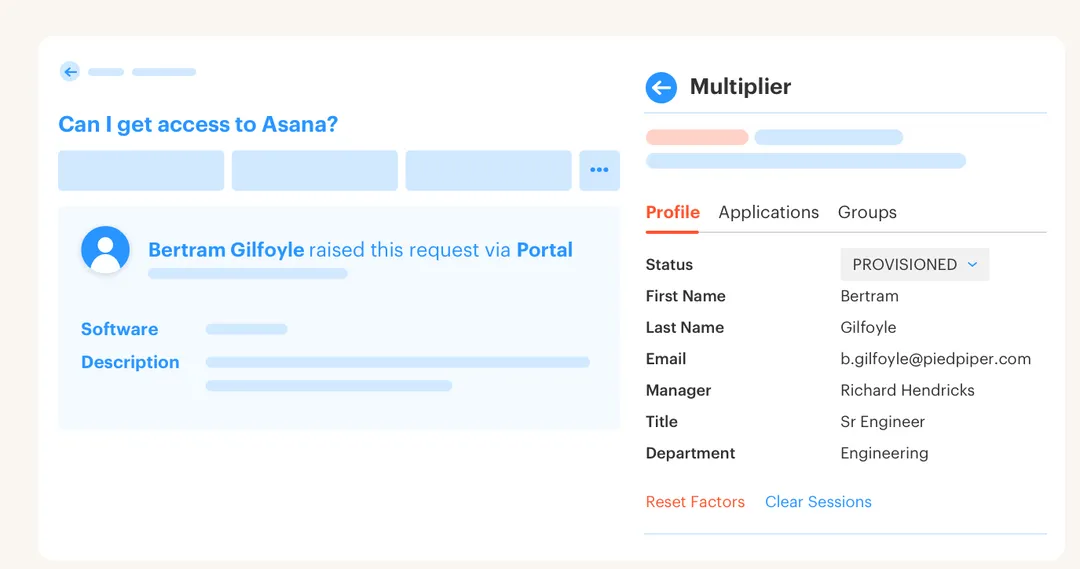
Multiplier's Application Catalog gives employees a Jira-native self-service way to request approved apps and roles through JSM or Slack. Apps can be synced from Okta, Entra, and Google Workspace, and each role maps to an identity provider group. That removes the vague "Need access ASAP" ticket that creates manual follow-up loops.
If your team is trying to improve customizing employee help centers for access use cases, this is the first practical win. The request starts with structured choices, not free-text guessing. And for teams that aren't ready to automate everything on day one, the catalog can still centralize requests and create a clean audit trail even where provisioning remains manual.
Approval, provisioning, and expiry stay tied to the Jira issue
Multiplier's Approval Workflows route requests to the right approver in Jira or Slack, and its Slack App lets people request and approve access without leaving chat. Once approved, Automated Provisioning uses identity provider group mappings to add or remove access through Okta, Entra, or Google Workspace. That cuts the old copy-paste step that turns lean IT teams into ticket clerks.

For higher-risk access, Time-Based Access makes duration part of the request and removes group membership automatically at expiry. The ticket isn't just evidence of a request anymore. It becomes the full operating record of approval, grant, and revocation. That's how you move from policy-heavy least privilege to operational least privilege.
Reviews and cleanup stop living in spreadsheets
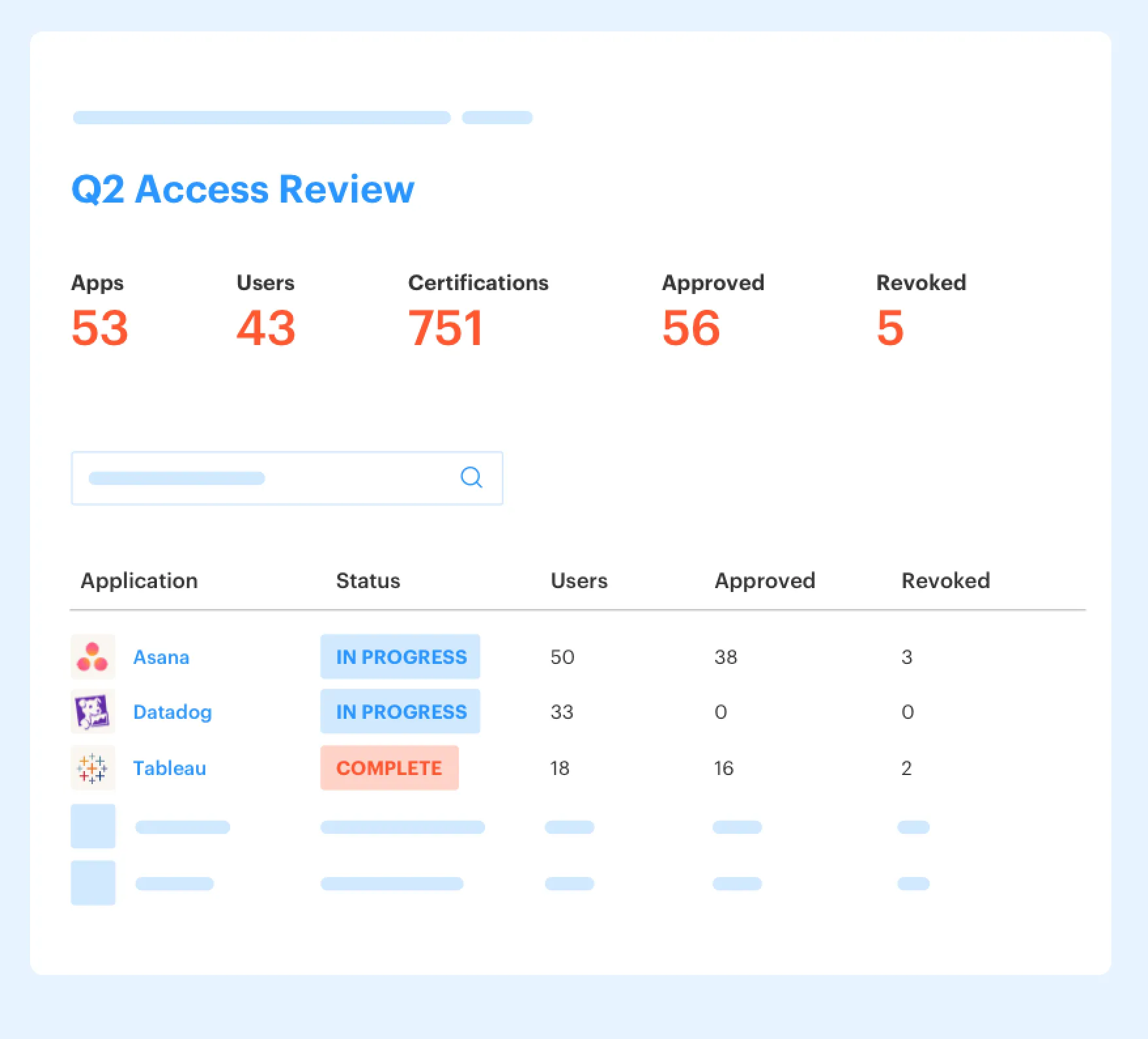
Multiplier keeps the cleanup side inside the same system. Access Reviews run in JSM with reviewer dashboards that show user attributes, groups, last login, and recommendations. Reviewers mark Keep or Revoke, and revocations can be executed through the identity provider with the result written back to Jira. Admins can export results as CSV for auditors or push evidence to systems like Vanta.
Then there's Auto Reclaim on the Advanced edition, which uses identity provider login telemetry to identify inactive users, warn them, and revoke access if they stay inactive after the grace period. That ties directly back to one of the hidden costs from earlier: licenses and privileges that stick around because nobody has time to clean them up manually.
For teams trying to automate 75% or more of routine access requests and still stay audit-ready, this is the kind of architecture that actually holds up. If that's what you're aiming for, Get started with Multiplier.
Customization Should Reduce Work, Not Relabel It
Customizing employee help centers is worth doing only if it changes the operating math. Fewer follow-up questions. Faster approvals. Less standing access. Cleaner audit evidence. If you redesign the portal and your team still works across Jira, Slack, email, spreadsheets, and your identity provider by hand, you didn't customize the system. You relabeled the mess.
The simpler path is usually the better one. Put governance where the work already happens. Then make the safest path the easiest one.
Frequently Asked Questions
How do I customize request forms to reduce follow-ups?
Start by identifying common requests and what info is actually needed to act on them. The goal is to eliminate at least one round of clarification per ticket. Instead of open text fields, use dropdowns for roles and apps. Multiplier's Application Catalog takes this further by presenting a visual selection of approved applications, so employees pick the right option instead of typing vague requests.
What if my help center still requires follow-up questions?
If follow-up questions are still common, the issue is usually unclear request paths rather than the portal itself. Review your top 10 request types and check whether each form actually captures everything needed to start work. Multiplier's Approval Workflows route requests directly to the right approvers in Jira or Slack, which reduces the back-and-forth that happens when requests land in the wrong queue.
Can I automate access requests in my help center?
Yes. Multiplier integrates with Jira Service Management so employees can submit requests through the Application Catalog, select the app and role they need, and have access provisioned automatically via identity provider groups once the request is approved. No manual steps, and every request is documented in Jira.
When should I implement time-based access for requests?
Any request tied to admin rights, production systems, finance tools, or sensitive data should have a time limit by default. Multiplier handles this through Time-Based Access: the requester picks a duration (1, 6, or 24 hours), and group membership is automatically removed at expiry. It's one of the most effective ways to reduce standing privileges without adding manual cleanup work.
Why does my help center need to mirror employee language?
Because unclear labels create hesitation, and hesitation creates workarounds. If a category only makes sense to your admin team, employees will guess wrong or route around the portal entirely. Use plain language that reflects what employees are actually trying to do. A simple rename from "Identity lifecycle exceptions" to "Change access for an employee" can meaningfully reduce misrouted requests.


