


Your AI agent doesn't need admin access to become a security problem. Give it the same standing permissions as a power user, and every prompt, plugin, and workflow becomes a possible path to data it was never meant to touch. The real mistake most teams make with over-privileged AI systems is treating access like a setup task instead of a live risk. Once the access is granted, the blast radius is already there.
The mistake is treating AI like another employee account. It isn't another employee account. It's a high-speed actor sitting inside your identity stack, your ticket queue, your docs, your code, and your customer data.
Over-privileged AI systems are really an access design problem. Not an AI problem. And if you manage that access with the same old mix of Jira tickets, Slack approvals, identity provider changes, and audit spreadsheets, you're going to lose track fast.
Key Takeaways:
- Treat AI access like privileged access, not normal SaaS access.
- If an AI system can read, write, and trigger actions across more than 3 systems, it needs time-bound access.
- The real risk isn't just broad access. It's broad access with no expiry, no owner, and no clean evidence trail.
- Jira and Slack already hold most of the access workflow, so moving governance somewhere else often creates more gaps.
- Over-privileged AI access should be reviewed by app owner, business purpose, duration, and last use.
- Audit evidence should be created during the request, approval, grant, and revocation flow, not rebuilt later.
Why Over-Privileged AI Access Breaks Governance
Over-privileged AI access breaks governance because AI systems can act faster, across more tools, with less human memory of why access was granted. Human users forget to close tickets. AI workflows forget nothing, but they also don't know when their permission is no longer justified. That's where standing access turns into audit risk.

The Real Issue Isn't AI, It's Standing Privilege
Most security conversations around AI start with model risk, data leakage, or prompt injection. Fair enough. Those are real problems. But in access governance, the more boring issue is usually the one that hurts you first: the AI system got too much access, for too long, with weak evidence around who approved it and why.
I've seen this pattern before in normal SaaS access. A team starts small. One admin group. One shared service account. One approval in Slack because the request is urgent. Then six months later nobody knows whether the access still belongs there. With over-privileged AI systems, that same pattern gets worse because the account isn't just sitting there. It may be reading tickets, updating records, sending messages, creating summaries, or triggering other workflows. Pretty quickly, your "assistant" becomes a privileged operator.
A good threshold: if an AI system can access more than 3 business systems, write to any system of record, or trigger identity changes, treat it as privileged access. Not normal access. Not "just a bot." Privileged. That one decision changes the workflow. You add owner approval, duration, purpose, and review cadence before it gets access.
Why Jira Tickets Don't Save You by Themselves
Jira tickets are great for intake and accountability, but tickets alone don't enforce access. They record that someone asked for something. They don't always prove the right person approved it, the right group was assigned, the access expired, or the revocation actually happened. That's the gap where over-privileged AI access starts to drift.

Picture a workplace technology manager at 4:42 p.m. on a Thursday. A product team wants an AI assistant connected to Jira, Confluence, Slack, and a customer support tool before Monday. The request lands in Jira, the approval happens in Slack, IT adds the account to a group in Okta, and someone says they'll clean it up after the pilot. Three weeks later the pilot is now "kind of production," the owner changed teams, and audit evidence is a scattered mess. Annoying. Also very normal.
That workflow isn't broken because Jira is bad. It's broken because the governance action lives outside the ticket. If the ticket says "approved" but the identity provider group assignment happens manually, you've created a gap between intent and reality. For teams already using Jira and Slack as the place where access work actually happens, Learn more about Multiplier in the context of keeping approval, provisioning, and evidence tied to the same access record.
The Audit Problem Shows Up Late
Audits expose over-privileged AI systems because auditors ask simple questions that messy workflows answer poorly. Who approved access? What role was granted? Why did the AI need it? When did it expire? Who reviewed it after the business purpose changed? If those answers live in 4 different places, your audit prep becomes archaeology.
The NIST AI Risk Management Framework makes a useful point here: AI risk needs governance, mapping, measurement, and management. Access is part of that. You can't govern an AI workflow if you don't know what it can touch. And you definitely can't measure risk if approvals, group assignments, and revocations are split across Jira comments, Slack threads, and identity provider logs.
A simple rule works well: if you can't produce the full access story in under 10 minutes, the control isn't audit-ready. Not because auditors are impatient. Because a control that takes hours to reconstruct probably wasn't designed into the workflow. It was patched together later.
How to Govern AI Access Without Slowing Work
AI access governance works when you treat every AI system as a requestable, approvable, time-bound actor with a clear owner and mapped entitlements. The goal isn't to block useful AI work. The goal is to make the safe path faster than the workaround, especially for teams already drowning in access tickets.
Start With a Red Flag Check Before You Approve Anything
A useful first move is to diagnose whether the AI request is normal access or privileged access. Don't start with the tool. Start with what the AI can do. Over-privileged AI systems usually reveal themselves through scope, write access, and unclear ownership before anything bad happens.
Ask 5 questions before approval. Can it access customer, employee, financial, or source code data? Can it write back into any system? Can it trigger messages, tickets, provisioning, or workflow transitions? Does it need access for more than 24 hours? Is there a named human owner who will be accountable during reviews? If you answer yes to 2 or more, route it through a privileged access workflow.
The threshold matters. A read-only AI summarizer for public knowledge base articles doesn't need the same process as an AI workflow that can update tickets and read customer records. Some teams prefer to review every AI request manually, and I get why. It feels safer. But blanket review creates backlog, and backlog creates side channels. The better move is risk-based routing.
Use this split:
- Low risk: Read-only access to approved internal content, reviewed every 90 days.
- Medium risk: Access to internal systems with business data, owner approval required.
- High risk: Write access, admin roles, customer data, employee data, or workflow triggers, time-bound by default.
- Restricted: Identity changes, production access, financial actions, or sensitive datasets, short windows only.
Map AI Access to Groups, Not One-Off Permissions
Group mapping is boring. That's why it works. When AI access is assigned through identity provider groups, you can approve, grant, revoke, and review the entitlement as a known object. When IT grants access one app at a time, you lose the structure that makes governance repeatable.
The pattern I like is simple. Create groups by system, role, and risk. For example, ai-jira-read, ai-confluence-read, ai-support-write, and ai-admin-temporary. Then map each AI request to the right group instead of letting someone freestyle permissions inside each app. It makes the access easier to approve and much easier to remove later.
Over-privileged AI access often comes from vague roles like "admin," "integration user," or "service account." Those names are too broad. If the AI needs to summarize tickets, it probably doesn't need project admin. If it needs to answer policy questions, it probably doesn't need write access to employee records. The rule: if the group name doesn't tell you what the AI can do, the group is too vague.
A practical naming format:
- Actor: AI, bot, integration, service account
- System: Jira, Slack, Confluence, GitHub, Salesforce
- Permission: read, write, admin, export
- Duration: standard, temporary, emergency
Make Time-Bound Access the Default for AI Workflows
AI systems with too much access become dangerous when temporary experiments turn into permanent privileges. The fix is not another policy doc. The fix is expiry. If the AI access is for a pilot, an incident, a data migration, or a special analysis project, put a timer on it from day one.
My default rule: anything high risk starts with 1, 6, or 24 hours. Anything medium risk starts with 7 or 30 days. Anything permanent needs a real owner, a clear business purpose, and a review cycle. If someone can't explain why the AI needs permanent access, it doesn't get permanent access.
There is a tradeoff here. Time-bound access can annoy people if the workflow is clunky. Engineers hate asking twice for something they still need. Security folks hate cleaning up access that never should have stayed open. Both sides are right. The way through is to make extensions easy when the original request was approved and the purpose hasn't changed.
The decision rule is clean:
- If access supports a one-time task, use hours.
- If access supports a project, use days.
- If access supports an ongoing workflow, use a named owner and review schedule.
- If access changes production, customer, or identity data, use short windows and re-approval.
Put Approvals Where People Already Work
Approval delays don't usually happen because approvers are careless. They happen because the approval lives in a place people don't check. Email gets buried. Separate portals get ignored. Someone leaves a Slack thread open and tells themselves they'll come back to it. They don't.
For over-privileged AI systems, slow approvals create a weird incentive. The more annoying the approval process is, the more likely people are to ask for broad standing access so they don't have to come back later. That's how a 2-hour task turns into a permanent admin grant. We've all seen some version of it.
A good access workflow should meet people where the decision happens. If managers and app owners already live in Slack and Jira, put the approval there. The approval should show the app, role, duration, requester, business purpose, and risk tier. No hunting. No "can you send me more context?" If the approver needs to ask 3 follow-up questions, the request form is broken.
Approval quality improves when the context is complete:
- Who owns the AI system?
- What system does it need?
- What role or group will be granted?
- How long does it need access?
- What action can it perform?
- What happens when the timer expires?
Review AI Access by Usage, Not Just Ownership
Quarterly reviews often become rubber-stamping because reviewers see names and roles without enough context. AI access makes that worse. A reviewer sees ai-support-bot with access to 12 groups and thinks, "Probably fine." Not great. Fine is how over-privileged AI systems survive forever.
Usage context changes the review. Last login, group membership, department owner, app owner, risk tier, and recommendation all matter. If an AI account hasn't used access in 30 days, revoke or downgrade it. If an AI workflow has admin access but only performs read tasks, downgrade it. If no owner can explain the need, revoke it. Harsh? Maybe. But orphaned AI access is not a governance strategy.
The Verizon Data Breach Investigations Report keeps showing how credentials and privilege abuse remain central to security incidents. AI doesn't erase that problem. It gives privileged credentials more ways to act. That's why reviews need to focus on actual access and actual use, not just whether someone recognizes the account name.
A review threshold that works:
- 30 days inactive: Flag for revocation or owner justification.
- 90 days inactive: Revoke unless an exception is approved.
- No owner: Revoke or quarantine immediately.
- Admin access with no write activity: Downgrade.
- Standing high-risk access: Convert to time-bound access.
Build Audit Evidence as a Byproduct
Audit prep should not feel like someone dumping a box of receipts on the table. Yet that's how access audits often feel. Screenshots from the identity provider. Slack approvals. Jira comments. CSV exports. A spreadsheet that everyone hates but nobody can kill.
The better pattern is to make the evidence appear while the work happens. Request created. Approver assigned. Approval decision logged. Identity provider group changed. Timer started. Access revoked. Review completed. Every event belongs to the same record, because the record is what explains the access story.
That's the shift. You don't rebuild the story during audit week. You preserve it during normal work. And once teams understand that, the entire access design changes. AI access isn't a special spreadsheet category anymore. It becomes another governed workflow with stronger rules, shorter windows, and better proof.
A simple evidence checklist:
- Request: Business purpose, owner, system, role, risk tier.
- Approval: Approver identity, decision, timestamp, channel.
- Provisioning: Group changed, target identity provider, success or failure.
- Expiry: Duration, revocation timestamp, exception if extended.
- Review: Keep or revoke decision, reason, reviewer.
If you're trying to connect that evidence chain across Jira, Slack, and your identity provider, See how Multiplier works after you've mapped which AI access requests should be time-bound versus standing.
How Multiplier Automates Access Governance in Jira
Multiplier automates access governance in Jira by turning requests, approvals, provisioning, expiry, and evidence into one connected workflow. It works through Jira Service Management, Slack, and identity provider groups. That matters because over-privileged AI access needs control at the exact moment access is requested, approved, granted, and removed.
App Catalog and Group-Based Provisioning
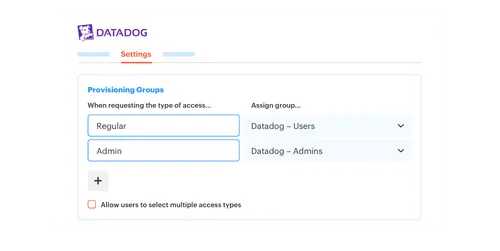
Multiplier gives employees a Jira-native app catalog where they can request approved applications and roles. The important part for AI governance is the mapping. Each catalog role maps to one or more identity provider groups in Okta, Entra ID, or Google Workspace, so the approved request becomes a specific group change instead of a manual guess.

That directly addresses the messy pattern from earlier. Instead of someone approving an AI tool in Slack, then another person adding a broad group in the identity provider, the request can move through Jira with the app, role, approver, and group mapping already defined. Multiplier then provisions through the identity provider when the Jira issue reaches the approved status. The ticket gets the outcome, which gives IT and audit a cleaner trail.
A customer like Videoamp is a good example of the operational side. As they grew from 100 to 500 employees, Tuesdays filled the IT queue with access requests that lacked enough detail. A self-service app catalog inside Jira Service Management gave employees a clearer way to request sanctioned apps and gave IT a better record of who asked for what. Same lesson applies to AI access. Better intake prevents bad grants.
Time-Based Access and Slack Approvals
Multiplier supports time-based access where requesters choose a duration, like 1, 6, or 24 hours, and access is removed from the mapped identity provider group when the window expires. For over-privileged AI systems, that's the difference between "we'll remember to clean it up" and the system removing access when the job is done.
Approvals can happen in Jira Service Management or Slack, with managers, app owners, or specific users assigned as approvers. That matters because the approval should be fast without becoming sloppy. The approver sees the request, acts where they already work, and the access change stays tied to the Jira issue. No separate portal. No mystery approval trail.
Stavvy is the stronger security example. They cut privileged access by 85% and had 1,300+ access requests automatically revoked after approved windows. Not because someone wrote a better policy. Because the workflow made temporary access the normal path. If your AI systems are starting to look like permanent privileged users, the same model applies.
Reviews, Reclamation, and Lifecycle Records
Multiplier also supports access reviews in Jira Service Management, where reviewers can see user attributes, group memberships, last login, and recommendations before choosing keep or revoke. For AI access, that review context is the difference between a checkbox exercise and a real decision. If the AI account hasn't used access, or the owner can't justify it, revocation can be enforced through the identity provider group.
Auto Reclaim can identify inactive users based on identity provider login activity and revoke access after a warning and grace period. That feature is available on the Advanced edition, and its value depends on accurate identity provider telemetry. Still, the mechanism matters. Unused access should not survive because nobody had time to run a spreadsheet.
Post Functions can also trigger identity lifecycle actions from Jira workflow transitions, which is useful when access governance expands beyond app requests into onboarding, transfers, and offboarding. For AI systems, the same idea applies: when the workflow changes, the identity action should happen from the ticket. If that sounds like the operating model you're trying to build, Get started with Multiplier while the access map is still simple enough to fix.
Build AI Access Controls Before Audit Week
Over-privileged AI systems are not solved by telling people to be careful. They are solved by designing access so broad grants are harder to create, easier to expire, and easier to prove. Start with the red flag check. Map access to identity provider groups. Make high-risk AI access time-bound. Put approvals in Jira and Slack. Review by usage, not memory.
The bigger point is pretty simple. AI is going to create more access requests, not fewer. If your governance process already struggles with humans, it won't magically hold up when AI workflows start touching the same systems at higher speed. Build the control into the workflow now, before your next audit asks why the bot still has admin access.
Frequently Asked Questions
How do I set up time-bound access for AI systems?
To set up time-bound access for AI systems using Multiplier, follow these steps: 1) When submitting an access request through the Jira Service Management (JSM) portal or Slack, select the desired duration (like 1, 6, or 24 hours) for the access. 2) Ensure that the request includes all necessary details, such as the app, role, and business purpose. 3) Once approved, Multiplier will automatically provision the access and set a timer to revoke it when the duration expires. This helps minimize the risk associated with over-privileged access.
What if my AI system needs access to multiple applications?
If your AI system requires access to multiple applications, it's important to treat it as privileged access. Use Multiplier to create a group mapping based on the required applications. For example, you can set up groups like `ai-jira-read`, `ai-confluence-write`, etc. This way, you can manage permissions more effectively and ensure that the AI system only has the access it needs. When submitting requests, make sure to specify all applications and roles to streamline the approval process.
How do I automate access requests for new AI tools?
To automate access requests for new AI tools, use the Application Catalog feature in Multiplier. This allows employees to browse a visual catalog of approved applications directly in the JSM portal. 1) Employees can select the AI tool they need and the corresponding role. 2) The request is then submitted, creating a Jira ticket automatically. 3) Approvals can be routed to the appropriate managers or app owners, ensuring a smooth and efficient process without manual intervention.
When should I conduct access reviews for AI systems?
Access reviews for AI systems should typically be conducted quarterly or whenever there are significant changes in usage patterns. With Multiplier's Access Review feature, you can create campaigns that allow reviewers to assess access based on last login dates and usage context. 1) Set up a campaign in JSM, selecting the apps in scope. 2) Assign reviewers who can mark access as 'Keep' or 'Revoke' based on their assessments. 3) This helps ensure that any unnecessary access is promptly removed, maintaining security and compliance.
Why does my AI system need a clear owner for access?
Having a clear owner for your AI system's access is crucial for accountability and governance. The owner can ensure that access is justified and reviewed regularly. With Multiplier, you can assign a named human owner during the access request process. This owner will be responsible for approving access and justifying its necessity during reviews. This practice helps prevent over-privileged access and ensures that permissions are aligned with business needs.


