


Every company with more than 50 employees has a privilege creep problem. They just don't know it yet. The access that made sense six months ago, the admin role someone needed for a migration, the production database read access for a one-time debug, is still sitting there. Active. Unused. And invisible to everyone except the attacker who finds it.
Privilege creep is the silent accumulation of access rights that employees collect over time and never give back. It's not malicious. It's not even negligent, most of the time. It's just what happens when granting access is easy and revoking it is nobody's job. And if you're running a growing team on Jira and Okta, you've probably got more standing privileges right now than you'd be comfortable explaining to an auditor.
Key Takeaways:
- Privilege creep isn't a people problem. It's a systems problem. Access accumulates because revocation isn't automated.
- The average employee at a mid-market company accumulates 3-5 unnecessary entitlements within their first year of role changes.
- Time-bound, just-in-time access is the single most effective control against creep, because it removes the need for manual cleanup entirely.
- Access reviews catch what's already wrong. Automated expiry prevents it from going wrong in the first place.
- If your access request process lives in one tool and your provisioning lives in another, you've created the exact gap where creep thrives.
- Prevention starts with making temporary access the default, not the exception.
Why Privilege Creep Is a Systems Failure, Not a People Failure
Privilege creep happens when access accumulates faster than it gets removed, and in most organizations, that gap is structural. The root cause isn't careless employees or lazy IT admins. It's that granting access is a workflow with a ticket, an approver, and a clear trigger, while revoking access has none of those things.

The Accumulation Pattern Nobody Tracks
Picture a mid-level engineer who joined your company 18 months ago. During onboarding, she got access to GitHub, AWS staging, Datadog, and Confluence. Normal stuff. Three months in, she joined a cross-functional project and got added to a Salesforce group for dashboard access. Six months later, she needed temporary production database access for an incident. Her manager approved it in Slack. The incident resolved in four hours. The access is still there today.

Multiply that by every employee, every role change, every project rotation, every incident escalation. A company with 300 employees and 40 SaaS apps can easily have 2,000+ unnecessary entitlements floating around at any given time. Nobody granted those entitlements with bad intent. The system just doesn't have a mechanism to pull them back.
Why Manual Revocation Always Fails
Some teams try to solve this with process. Quarterly access reviews. Offboarding checklists. Reminder emails. And sure, those help at the margins. The problem is that manual revocation depends on someone remembering, someone having time, and someone knowing what “appropriate access” even looks like for a role that’s changed three times.
I've seen IT teams spend 15-20 hours preparing for a single quarterly access review, pulling spreadsheets from Okta, cross-referencing with HR data, chasing down managers who don't respond. By the time the review is done, the data is already stale. New hires have joined. People have moved teams. The spreadsheet is a snapshot of a world that no longer exists.
If your revocation process requires a human to initiate every removal, you're always going to be behind. The math doesn't work. Access gets granted on demand, in minutes. Access gets reviewed on a schedule, in weeks. That delta is where creep lives.
The Real Cost Isn't What You Think
Most people frame privilege creep as a security risk. And it is. Overprivileged accounts are the number one vector for lateral movement in breaches, according to Verizon's Data Breach Investigations Report. But the cost goes beyond security.
There's the compliance cost. SOC 2 and ISO 27001 auditors want evidence that you enforce least privilege. When your access data is scattered across Okta admin consoles, Jira tickets, and Slack threads, assembling that evidence becomes a multi-day exercise every quarter. There's the license cost. Unused SaaS seats that nobody reclaimed because nobody knew they were unused. One fintech company discovered they were paying for 340 unused Figma licenses simply because access was granted during onboarding and never reviewed. And there's the operational cost. Every unnecessary entitlement is a potential support ticket, a potential misconfiguration, a potential data leak that your team has to investigate.
The frustration is real. You know the access landscape is messy. You know standing privileges are piling up. You just don't have a system that makes cleanup automatic.
How High-Performing Teams Prevent Privilege Creep Before It Starts
Preventing privilege creep requires shifting from a grant-and-forget model to a grant-and-expire model. The teams that actually maintain least privilege aren't the ones with the best policies. They're the ones where temporary access is the default path, and permanent access requires justification.
Diagnose Whether You Have an Intake Problem or a Governance Problem
Before you redesign workflows or buy tools, run a simple diagnostic on your current access landscape. Pull your identity provider's group membership data and ask three questions about each entitlement: Was this access requested through a formal process? Is there a documented business reason for ongoing access? Has the user actually logged into this app in the last 30 days?
If the answer to any of those is no, you've found creep. In my experience, when teams actually run this exercise, they find that 30-50% of entitlements fail at least one of those questions. That number tends to be higher at companies that have gone through rapid hiring, reorgs, or acquisitions in the last 12 months. The pattern is consistent: the faster you grow, the faster creep compounds.
Make Temporary Access the Default, Not the Exception
The single most effective control against privilege creep is making time-bound access the standard request path. Instead of granting access indefinitely and hoping someone remembers to revoke it, you grant access for a specific duration and let it expire automatically.
This sounds obvious. It's not. Most organizations treat time-bound access as a special case, something you set up for contractors or for production environments with extra sensitivity. Regular employees requesting regular apps get permanent access by default. That's the design flaw.
If you flip the default, something interesting happens. Most access requests are actually short-term needs. The engineer who needs Datadog for an incident. The product manager who needs Salesforce for a quarterly review. The designer who needs admin access to update a template. When you offer a duration picker (1 hour, 6 hours, 24 hours, 1 week), most people pick an appropriate window. They don't want permanent access. They just want to get their work done.
The teams that get this right see a measurable drop in standing privileges within 90 days. Stavvy, a fintech company, cut privileged access by 85% after implementing time-bound access as the default path. That's not a policy change. That's a structural change in how access works.
Automate Provisioning Through Your Identity Provider
Here's where most prevention strategies fall apart. You can have the best request workflow in the world, with approvals, time limits, and documentation. But if the actual provisioning step, adding the user to the right Okta group or Entra ID group, still requires a human to log into the admin console and do it manually, you've introduced a gap.
That gap creates two problems. First, it slows down access. The employee waits. The IT admin context-switches. The ticket sits in a queue. Second, it breaks the revocation chain. If a human provisioned the access manually, the system has no record of what was done, which means it can't automatically undo it when the time window expires.
Automated provisioning via identity provider groups closes both gaps. When a request is approved, the system adds the user to the mapped IDP group. When the time window expires, the system removes them. No human in the loop. No screenshots for evidence. No forgetting.
The conditional rule here is straightforward: if your access request process and your provisioning process live in different systems with no automated bridge between them, you will have privilege creep. Full stop. The manual handoff is where entitlements get stuck.
Build Access Reviews That Actually Catch Drift
Even with time-bound access and automated provisioning, you need a periodic check. People get permanent access for legitimate reasons. Roles change. Apps get added. The goal of an access review isn't to catch everything. It's to catch the drift that accumulates between the automated controls.
The difference between a useful access review and a rubber-stamp exercise comes down to one thing: context. When a reviewer sees a list of 200 users and groups with no usage data, they click “Keep” on everything because they don't have enough information to make a different decision. When they see that a user hasn't logged into an app in 90 days, the decision is obvious.
Effective access reviews show the reviewer three things: what access the user has, when they last used it, and whether the system recommends keeping or revoking. That last piece matters more than you'd think. When the system surfaces a recommendation based on login activity, reviewers are 3-4x more likely to actually revoke unused access compared to reviews with no recommendation. The cognitive load drops. The decision becomes easy.
Close the Lifecycle Gaps: Onboarding, Transfers, Offboarding
Privilege creep doesn't just come from ad hoc requests. It comes from lifecycle events that nobody orchestrates cleanly. An employee transfers from engineering to product management. Their engineering access should be removed. Their product management access should be granted. In practice, the new access gets added immediately because there's a ticket for it. The old access lingers because there's no trigger to remove it.
Offboarding is usually handled reasonably well, because there's a clear event (termination) and a clear process (disable the account). Transfers are the blind spot. The employee doesn't leave. Their manager changes. Their team changes. Their access needs change. But the system treats it as a non-event.
If your organization processes more than 10 internal transfers per month, you need automated lifecycle orchestration, not just an offboarding checklist. The transfer event should trigger a review of current entitlements and provision the new role's baseline access simultaneously. Without that, every transfer is a privilege creep event.
Set Inactivity Thresholds and Enforce Them
One more layer that most teams skip: automated license reclamation based on actual usage. This is different from access reviews, which happen on a schedule. Inactivity-based reclamation runs continuously, monitoring login telemetry from your identity provider and flagging users who haven't touched an app in a defined window.
The threshold depends on the app. For collaboration tools like Slack or Confluence, 30 days of inactivity is a reasonable signal. For specialized tools like a BI platform or a design tool, 60 days might be more appropriate. The key is setting the threshold, notifying the user with a grace period, and then automatically revoking if they don't log in.
This catches a category of creep that access reviews miss: the slow fade. Someone used Figma heavily last quarter. They haven't opened it in six weeks. They're not going to proactively tell IT they don't need it anymore. And no reviewer is going to flag an entitlement that was clearly legitimate three months ago. Continuous monitoring catches what periodic reviews can't.
How Multiplier Prevents Privilege Creep Inside Jira
Multiplier embeds the entire prevention framework described above directly into Jira Service Management and Slack, so the controls live where your team already works.
Time-Bound Access That Revokes Itself
Multiplier's time-based access feature makes temporary the default. When an employee requests access through the JSM app catalog or Slack, they select a duration. After approval, Multiplier adds them to the mapped identity provider group immediately. When the window expires, it removes them automatically and logs the entire lifecycle, request, approval, grant, and revocation, to the originating Jira issue. No manual follow-up. Auditors get clean proof of enforced expiry without anyone assembling evidence after the fact.
Automated Provisioning and Deprovisioning via Your IDP
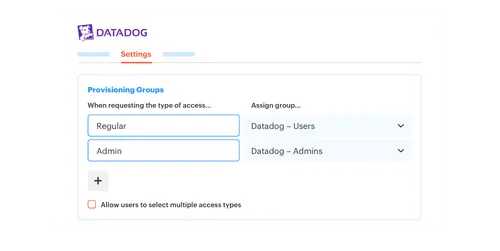
Every catalog role maps to one or more identity provider groups in Okta, Entra ID, or Google Workspace. When a request hits the “Approved” status in Jira, Multiplier calls the IDP API to add the user. When access expires or is revoked in a review, it calls the API to remove them. The Jira ticket gets updated with success or failure comments automatically. Provisioning and revocation happen through the same automated path, which eliminates the gap where creep typically takes root.

Access Reviews with Usage Context and One-Click Revocation
Multiplier's access review campaigns run inside JSM. Reviewers see user attributes, group memberships, job titles, departments, last login dates, and system recommendations on a single dashboard. When they click “Revoke,” Multiplier removes the user from the relevant IDP groups, creates a Jira ticket documenting the change, and updates the campaign's progress tracker. Results export as CSV for auditors or push directly to Vanta. No spreadsheets. No screenshots. The review and the enforcement happen in the same system.
The Path from Standing Privileges to Least Privilege by Default
Privilege creep isn't inevitable. It's the predictable result of systems designed for granting access but not for removing it. The fix isn't better policies or more diligent admins. It's structural: make temporary access the default, automate provisioning through your identity provider, run access reviews with real usage data, and let inactivity-based reclamation handle the slow fade.
The companies that maintain least privilege at scale aren't working harder. They've just closed the gap between how fast access gets granted and how fast it gets revoked. When those two speeds match, creep stops accumulating. And that changes everything downstream: cleaner audits, fewer standing privileges, lower license spend, and a security posture you can actually defend.
Frequently Asked Questions
How do I set up time-based access requests in Multiplier?
Time-based access in Multiplier works from the request form. Enable the feature for an application, and requesters will see a duration picker (1 hour, 24 hours, 1 week) when submitting through JSM or Slack. After approval, Multiplier provisions the access automatically and removes it when the timer runs out. No reminder needed, no manual cleanup.
What if I need to revoke access for a user who transferred roles?
Role transfers are a common source of privilege creep because new access gets added but old access stays. Multiplier's lifecycle orchestration ties the transfer event in Jira to both actions: remove the old role's access bundle and provision the new one. Set it up once per role pair and the system handles it from there.
Can I streamline access reviews with Multiplier?
Multiplier's access review campaigns run inside JSM. Create a campaign, pick the apps you want to certify, and assign reviewers. They'll see each user's access alongside last login data and a revocation recommendation. One click to keep or revoke. Changes are logged back to Jira and can export to CSV for auditors.
When should I set inactivity thresholds for license reclamation?
Set inactivity thresholds based on how often people actually use the tool. 30 days works for most collaboration apps. For specialized tools with quarterly usage patterns, 60 to 90 days is more appropriate. Multiplier's Auto Reclaim monitors login activity from your identity provider, sends a warning before removing access, and creates a Jira ticket when it revokes a license.
Why does automated provisioning matter for access management?
Manual provisioning breaks the revocation chain. If a human added the user to an Okta group outside the system, the system can't automatically remove them later. With Multiplier, every approval triggers an IDP API call to add the user, and every expiry or revocation triggers the removal. The whole lifecycle stays automated because it started automated.


