


Your hybrid IDP setup for access governance isn't the problem. The problem is every access request leaves a different trail depending on whether it started in Jira, Slack, Okta, or Entra ID. By audit season, IT isn't proving a clean process. They're rebuilding one from fragments.
I’ve seen this pattern a lot, the team isn’t bad, and the process isn’t lazy. Usually, the company grew fast, bought tools fast, merged teams fast, and then access governance became this weird pile of “someone knows where that lives.” Which is fine for a while.
Then you hit the audit. Or the security review. Or the first privileged access cleanup where nobody wants to own the answer.
Key Takeaways:
- Hybrid identity setups break when approvals, provisioning, expiry, and review evidence live in different systems.
- The real risk isn’t having multiple identity providers. It’s not having one access record that ties the request to the change.
- Time-bound access should be the default for privileged roles, admin permissions, and sensitive systems.
- Access reviews work better when reviewers see usage context, not just names in a spreadsheet.
- Automate the access paths that repeat at least 10 times per month before touching edge cases.
- Jira and Slack can carry the access workflow if identity provider groups remain the source of enforcement.
Why Hybrid Identity Stacks Break Audit Readiness
Hybrid identity stacks break audit readiness because the evidence gets split across too many places. Jira has the ticket, Slack has the approval nudge, the identity provider has the group change, and a spreadsheet has the quarterly review. When those pieces don’t connect, access governance becomes reconstruction work.

The hidden tax is not the extra identity provider
The extra identity provider isn’t always the problem. A company can run Okta for corporate apps, Entra ID for Microsoft, and Google Workspace for groups, and still have a pretty sane setup. The mistake is treating each system as if it can prove the full lifecycle by itself. It can’t. Not really.
Picture an IT admin on a Tuesday morning. A new product hire asks for Figma Editor access in Slack, the manager approves in the thread, someone adds the user to a group in Okta, and the Jira ticket gets updated later if anyone remembers. Two months later, finance asks why the license is still active. Security asks who approved it. The admin now has to search across three systems and hope the Slack thread still makes sense. Fun stuff.

If your hybrid IDP setup has no single request record, use a simple test. Pick 10 recent access grants and ask whether you can prove four things in under 5 minutes per request: who asked, who approved, what changed, and whether the access still exists. If more than 2 of the 10 fail, the audit problem is already there. It just hasn’t been expensive yet.
The teams that fix this early usually start by turning Jira into the access record, not the identity brain. That distinction matters, Identity providers should enforce the change, and Jira should explain why the change happened. For teams trying to make that split practical inside their existing service desk, the access record pattern is worth seeing in motion through Learn more about Multiplier.
Access requests become audit debt when evidence splits
Audit debt builds the same way product debt does. One shortcut looks harmless. Ten shortcuts become a pattern. A few hundred shortcuts become a quarter-end panic where IT is rebuilding history from screenshots, comments, exports, and memory.
I’m not saying spreadsheets are useless. They’re actually fine for a first pass when a company has 50 people and 20 apps. Fair point. The issue is that spreadsheet reviews don’t enforce anything. A reviewer can mark “remove,” and unless that decision triggers a real identity change, you’ve created a decision artifact, not a control. That’s a big difference.
A useful threshold: once you have more than 100 employees or more than 50 sanctioned SaaS apps, quarterly spreadsheet access reviews start to lose signal. Reviewers rubber-stamp because the context is thin. They see a name, an app, maybe a role, and a stale department. They don’t see last login, group membership, why the person got access, or whether the role was supposed to expire.
NIST account management guidance keeps coming back to the same operational idea: accounts need lifecycle controls, review, and removal when access is no longer required. The hard part isn’t agreeing with that. Everyone agrees with it in principle. The hard part is making it happen when your evidence is scattered.
Audit debt is just access work you postponed until someone with a clipboard asked for proof.
Standing access grows because cleanup has no owner
Standing access grows when nobody owns the end date. Access gets granted for a project, an incident, a quarter-end push, or a customer escalation. Then the project ends, the incident closes, the customer call is over, and Access stays.
A fintech team in the Multiplier customer base hit a version of this after funding and acquisitions. Long-lived privileged access had piled up, and the company needed a way to grant access only when needed, then remove it after the approved window. After moving to just-in-time access, they reduced privileged access by 85% and saw 1,300+ access requests automatically revoked after approved windows. That number matters because revocation is where governance usually fails.
The analogy I like is physical keys. If someone needs the server room for 1 hour, you don’t hand them a permanent key and schedule a meeting next quarter to ask if they still need it. You sign out the key, log who approved it, and get it back when the job is done. Hybrid identity setups should work the same way. Digital keys just make the cleanup easier to ignore.
If access can expire safely, it should have an expiry. Admin roles, production access, finance systems, security tools, data warehouses, and customer data systems should rarely be permanent by default. The next question is how to build that without making everyone hate IT.
How to Govern Access Across Mixed Identity Providers
Govern access across mixed identity providers by separating intake, decisioning, enforcement, and review. Jira can hold the request and evidence, Slack can speed up approvals, and identity provider groups can enforce access. The goal is not one perfect tool. The goal is one traceable access lifecycle.
Start by mapping access to identity groups, not apps
80% of the governance pain usually comes from unclear group mapping. Someone asks for “Salesforce access,” but that could mean Viewer, Editor, Admin, Finance Ops, Sales Ops, or API access. If those roles aren’t mapped to identity provider groups, IT has to interpret every request manually. That’s where mistakes creep in.
Start with a diagnostic. Pull your top 25 requested apps from the last 90 days and answer these questions: does each app have clear roles, does each role map to an identity provider group, does every group have an owner, does the requester know which role to choose, and can IT remove the access by removing group membership? If an app fails 3 or more questions, don’t automate it yet. Clean up the mapping first.
The order matters more than people think. A lot of teams try to automate app access before they’ve made the access model deterministic. Then the automation just moves bad decisions faster. I’ve made this mistake in other systems. You feel productive because things are moving, but the underlying mess is still there.
A practical first pass looks like this:
- Pick the 10 apps with the highest request volume.
- Define 2 to 4 requestable roles per app.
- Map each role to one identity provider group.
- Assign one human owner for each app.
- Hide or block roles that nobody can explain.
If a role can’t be explained in one sentence, it’s probably not ready for self-service.
Use time limits wherever access can expire safely
Temporary access works when the job has a clear end. Privileged admin access for an incident, write access for a migration, finance system access for month-end, and production database access for investigation all fit the pattern. The requester needs access now. They don’t need it forever.
The rule I like: if the access creates material risk and the task is shorter than 7 days, make it time-bound. For high-risk admin roles, start with 1, 6, or 24 hour windows. For project work, use 7 or 30 days. Anything longer should force a stronger reason or go through a different approval path.
Some teams push back here because expiry can feel annoying. That’s valid. If someone’s work gets interrupted every few hours because the access window is too short, the process becomes the problem. The better move is to match duration to the work pattern, then allow extensions when the original approval still applies. Short windows for incidents. Longer windows for planned project work. Permanent access only when the role truly requires it.
Time limits also change the emotional load on IT. You stop carrying a mental list of cleanup tasks. The system removes access when the window ends. Not glamorous. Very effective.
Put approval authority where decisions already happen
Approval workflows fail when the right person never sees the request. In theory, the app owner approves. In practice, the request sits in email, gets buried in Slack, or waits on a manager who doesn’t know what the role means. Then IT gets blamed for being slow.
Approval routing should follow risk. Low-risk apps can auto-approve or go to the manager. Higher-risk roles should go to the app owner or a named security approver. Privileged access should require someone who understands the blast radius. If you need more than 2 approval levels for normal software access, the workflow is probably compensating for unclear policy.
Atlassian’s own framing of Jira Service Management is built around service work, queues, SLAs, and request flows. That’s why access requests fit naturally there, the employee already knows where to ask, and IT already knows where work gets tracked. The missing piece is connecting that request to identity enforcement.
One useful test: measure approval latency by app and approver type. If manager approvals average under 4 hours but app owner approvals take 2 days, don’t add reminders first. Check ownership. Stale app ownership is a governance problem disguised as a notification problem.
The request path should be boring. Employee asks in the normal place, approver clicks in the normal place, and IT doesn’t have to become the messenger.
Run reviews from live usage context, not memory
Access reviews are painful because reviewers are usually asked to make decisions with almost no useful context. They get a spreadsheet full of names and roles, then they’re expected to know whether each person still needs access. Nobody really knows. So they keep too much.
A better review gives the reviewer live context: department, job title, group membership, last login, original request, and recommended action. If someone hasn’t logged in for 90 days, the default recommendation should be revoke unless there’s a known exception. If someone changed departments, the reviewer should see that before approving another quarter of access.
Microsoft’s overview of identity governance in Entra ID shows the broader category moving toward lifecycle controls, reviews, and entitlement governance. That’s the right direction. Still, for Jira-heavy companies, the review decision has to connect back to the service record or the team ends up exporting from one place and explaining in another.
Use a simple review rule. Any app with customer data, financial data, source code, admin controls, or security logs gets reviewed at least quarterly. Lower-risk apps can be reviewed twice a year. Apps with automated inactivity reclamation can rely more on exception review, because unused access is already being cleaned up between campaigns.
Memory is a bad control. Usage context is better.
Decide which requests deserve automation first
Not every access request deserves automation right away, Some requests are too rare, and Some are too messy. Some need judgment that can’t be captured in a clean rule yet. Trying to automate everything at once is how teams burn months and end up with a fragile setup.
Use volume and risk as the filter. If an app gets more than 10 requests per month and the approval path is predictable, automate intake and approval first. If provisioning is group-based through Okta, Entra ID, or Google Workspace, automate the identity provider change next. If the app is high-risk but low-volume, start with time-bound access and stronger evidence before chasing full automation.
A good rollout order usually looks like this:
- High-volume, low-risk apps with clear roles.
- High-volume apps with manager or app owner approval.
- Privileged roles that need time-bound access.
- Quarterly access reviews for sensitive systems.
- License cleanup for inactive users.
A fast-growing AI company in the Multiplier customer base gives a useful benchmark. After moving access requests into Jira Service Management with Okta-backed automation, they processed 3,800+ requests in a year, with 75% fully automated. A 4-person IT Ops team supported 420+ employees. That’s the kind of ratio you’re looking for.
If you’re staring at a hybrid identity mess and trying to decide where to begin, the fastest win is usually the app catalog plus group-backed provisioning path. You can see the request flow, approval model, and identity provider handoff in one walkthrough here: See how Multiplier works.
How Multiplier Connects Jira to Identity Governance
Multiplier connects Jira to identity governance by making Jira Service Management the place where access is requested, approved, reviewed, and evidenced. Identity providers still enforce access through groups. The difference is that the access lifecycle is tied to the Jira issue, not scattered across chat, portals, and spreadsheets.
A Jira-native catalog gives employees one front door
Multiplier’s Application Catalog gives employees a self-service app catalog inside JSM, with approved apps shown as requestable tiles. Employees can pick an app, choose a role like Viewer, Editor, or Admin, and submit the request from Jira or Slack. Behind the scenes, the catalog syncs apps and groups from Okta, Entra ID, or Google Workspace, and each role maps to identity provider groups.
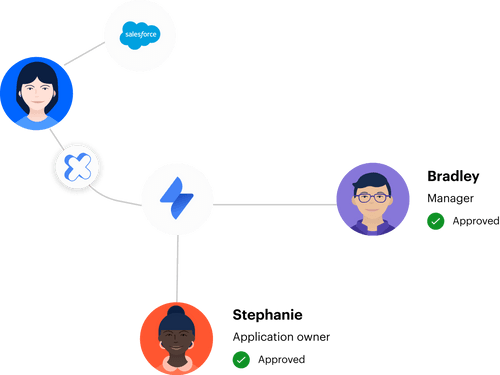
That matters in hybrid IDP setups for growing companies because the employee experience stays simple while enforcement stays tied to the right identity system. The approver acts in JSM or Slack. After approval, Multiplier provisions through the mapped identity provider group and writes the result back to the Jira issue.
The catalog is also a good concession point. If your app ownership is messy, a catalog won’t fix that by itself. You still need clean owners, clear roles, and good group mappings. But once those exist, the catalog gives employees one front door and gives IT one place to track the work.
Time-bound access and reviews close the loop
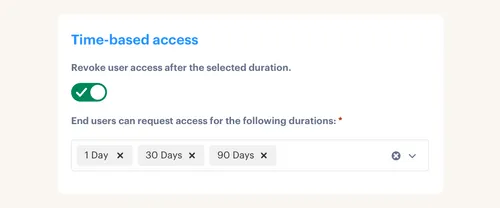
Multiplier’s Time-Based Access lets requesters choose a duration such as 1, 6, or 24 hours when the app is configured for temporary access. Once approved, Multiplier adds the user to the mapped identity provider group, starts the timer, removes the user when the window expires, and records the revocation on the Jira issue. Automatic revocation requires access to be managed through identity provider group membership, which is the right boundary to understand.
Access Reviews work the same way from a governance angle. Admins create campaigns in JSM, select approved applications, assign reviewers, and give reviewers context like user attributes, groups, last login, and recommendations. Reviewers mark Keep or Revoke. For supported identity provider group access, Multiplier removes users from relevant groups and creates Jira evidence for the change.
That combination solves the two places hybrid governance usually fails: expiry and certification. Time-bound access handles the “should this still exist tomorrow?” problem. Access reviews handle the “should this still exist this quarter?” problem. Different motions. Same access record.
For teams that already live in Jira and Slack, the adoption curve is the real advantage. Employees request in the place they already know. Approvers can act from Slack. IT gets a Jira issue with the request, approval, provisioning result, and revocation evidence in one thread. If that’s the operating model you want, Get started with Multiplier and look at the catalog, time-based access, and access review flow together.
Build Audit Readiness Into the Access Flow
Hybrid identity setups aren’t going away. Companies will keep using Okta, Entra ID, Google Workspace, Jira, Slack, and a pile of SaaS apps because that’s how modern work actually looks. The mistake is pretending the audit story can be rebuilt later from whatever traces those systems leave behind.
Build the evidence while the work happens. Map access to identity provider groups. Put requests and approvals in Jira. Use Slack for speed, not as the system of record. Make risky access expire. Run reviews with usage context. Start with the 10 apps causing the most repeat work.
That’s how hybrid IDP setups for access governance stop being a quarterly scramble. Access gets granted fast, removed when it should be, and explained without archaeology.
Frequently Asked Questions
How do I automate access requests with Multiplier?
To automate access requests using Multiplier, start by setting up the Application Catalog in Jira Service Management (JSM). 1) Ensure your approved applications are synced from your identity provider like Okta or Google Workspace. 2) Employees can then browse the catalog, select the app and role they need, and submit their request directly through JSM or Slack. 3) Once the request is approved, Multiplier will automatically provision access by adding the user to the appropriate identity provider group, streamlining the entire process and reducing manual intervention.
What if I need to revoke access after a project ends?
If you need to revoke access after a project, use Multiplier's Time-Based Access feature. 1) When granting access, set a specific duration (e.g., 1, 6, or 24 hours) that aligns with the project timeline. 2) Once the time expires, Multiplier automatically removes the user from the mapped identity provider group, ensuring that access is revoked without manual follow-up. This helps maintain security by minimizing standing privileges and reducing the risk of unauthorized access.
Can I run access reviews using Multiplier?
Yes, you can run access reviews with Multiplier's Access Reviews feature. 1) Create a new access review campaign in JSM, selecting the approved applications you want to include. 2) Assign reviewers who will evaluate user access based on live context like last login and group membership. 3) Reviewers can mark access as 'Keep' or 'Revoke', and Multiplier will automatically update the identity provider groups based on their decisions, providing a clear audit trail in Jira.
When should I consider implementing time-bound access?
Consider implementing time-bound access for roles that involve high-risk tasks or sensitive data. 1) If a task is expected to take less than a week, set access to expire automatically after the task is completed. 2) For example, if a user needs admin access for a specific incident, grant it for a short duration (like 1 or 6 hours). 3) This approach not only enhances security but also helps in managing licenses more effectively by ensuring that access is only available when necessary.


