


A 90-day access review checklist sounds useful until every revoke decision still turns into a Jira ticket, an identity provider search, and a spreadsheet cleanup. If you've lived through one audit like that, you already know the checklist wasn't the problem. The follow-through was.
Access review checklists for Jira-heavy IT teams need to do more than remind reviewers to click "keep" or "revoke." They need to prove who reviewed access, show why the decision was made, and actually remove access when someone shouldn't have it anymore.
The part that gets missed is the money side. Every stale license is a tiny leak. A few inactive users in one app doesn't look scary, but multiply that across 30, 50, 100 SaaS tools, and suddenly procurement is asking why IT keeps paying for people who haven't logged in for months.
Key Takeaways:
- Access review checklists fail when they stop at review decisions and don't enforce revocation.
- The most useful checklist starts with app scope, reviewer ownership, last login activity, and group membership data.
- If a reviewer can't decide in under 2 minutes per user, the checklist is missing context.
- License reclamation should be tied to real login activity, not gut feel or quarterly spreadsheet cleanup.
- Jira-heavy teams should keep access review evidence in Jira so audits don't become screenshot hunts.
- The best review process combines periodic certification, automatic revocation, and day-to-day license cleanup.
Why Access Review Checklists Break in Jira-Heavy Teams
Most access review checklists document effort without changing access. The checklist says the right things, but the work still lives across Jira, Slack, the identity provider, and three spreadsheets nobody trusts. That gap creates a bad pattern: reviewers certify access, IT chases cleanup, and auditors still ask for proof.

The checklist usually proves activity, not control
Picture an IT manager at 9:47 PM on a Sunday, three days before the SOC 2 auditor lands. She's got 14 browser tabs open: Jira, Okta, the review spreadsheet, four SaaS admin consoles, and a Slack DM from the CFO asking about Figma seats. The checklist says 312 users were reviewed. It doesn't say whether a single one of them actually lost access. That's the problem in one scene.
Most access review checklists for SaaS apps are built like audit homework. Did you identify apps? Did you assign reviewers? Did each reviewer sign off? Did someone save the spreadsheet? Great. You can prove people touched the process.
Access governance isn't a paperwork exercise. Or at least it shouldn't be. The goal is to know who has access, whether they still need it, and whether risky or unused access was removed. If the checklist ends before revocation happens, you're counting expired badges at the front desk while letting people keep walking into the building. Looks controlled from far away. Not so much up close.
Here's a sharper test. Pick 10 users marked "revoke" in your last review. If you can't prove within 15 minutes that access was removed, who approved the removal, and where the evidence lives, your checklist is too shallow. That's the audit gap. Not the missing column in the spreadsheet.
Reviewers can't make good calls without usage context
A manager staring at a list of 47 users and app names is guessing. They may know whether someone reports to them. They probably don't know whether that person logged into the tool last week, changed roles, joined a new project, or still belongs to three old groups from a past team. So they click "keep." Safer. Faster. Less annoying.
I've seen this same pattern in sales and marketing systems. When people lack context, they don't make sharper decisions. They make safer ones. The cost of being wrong feels higher than the cost of leaving access alone, every time, even when the math says otherwise. Without last login dates, department, job title, group membership, and app owner input, reviewers rubber-stamp.
Is the manager being lazy? Not really. They're being rational with the information you handed them.
If you're already reviewing access inside Jira and don't want another governance portal sitting beside your service desk, Learn more about Multiplier from the access review angle, not as another standalone tool to babysit.
The real waste is usually hiding in inactive licenses
License waste rarely shows up as one giant line item. It shows up as 7 people who haven't used a design tool in 60 days, 11 people still sitting in a sales app after moving teams, and 4 contractors who kept access after the project ended. Small leaks. Everywhere.
A mid-market IT team can run a clean quarterly review and still miss daily waste. Why? Because the review is periodic, while usage changes constantly. Someone stops using an app in January, the next campaign runs in March, finance asks questions in April, and IT starts rebuilding the history in May. By then, the money is gone, and so is the chance to catch it cleanly.
Luno is a good version of the broader pattern. Rapid growth pushed hundreds of access requests through Slack, email, and Jira, and IT had to chase approvals and assign groups by hand. They later reduced IT workload on access requests by 80% with automated routing and provisioning. Different workflow, same lesson: manual access work doesn't just slow IT down, it creates hidden cost in every follow-up, stale grant, and missing record. Which raises a fair question for the next section, what does a checklist that actually removes access look like?
How to Build Access Review Checklists That Actually Remove Access
A useful access review checklist starts with decisions that can be enforced. Start with app scope, reviewer ownership, usage context, and revocation paths before asking anyone to certify access. Once those pieces are clear, the checklist becomes an operating system for least privilege, not a quarterly scramble.
Start with the apps that create the most audit and spend risk
30 apps in one review sounds thorough. It usually creates noise. Start with the apps where a bad access decision costs real money or creates real exposure. Finance tools, customer data systems, developer platforms, admin consoles, and high-cost SaaS apps should come before generic productivity tools.
The threshold I like is plain. If an app costs more than $25 per user per month, contains customer or financial data, or includes admin roles, it belongs in the first access review checklist. If it misses all three, push it to the next wave. Some teams won't like that because it feels incomplete. Fair. The tradeoff is focus. A smaller review with real revocations beats a giant review where everyone clicks through to make the deadline.
Your first pass should define scope like this:
- High-cost apps: Any app where unused licenses are visible to finance.
- Sensitive apps: Tools with customer, employee, financial, or production data.
- Privileged roles: Admin, owner, billing, export, developer, or security roles.
- Recently changed teams: Departments with heavy hiring, transfers, or contractor churn.
- Apps with unclear ownership: Tools where no one knows who should approve access.
That last one matters more than people think. If no one owns the app, no one owns the cleanup. And if no one owns cleanup, stale access becomes normal.
Give reviewers enough context to decide in under 2 minutes
A reviewer should be able to make a keep or revoke decision in under 2 minutes per user. If they can't, the access review checklist is missing the information they need. Not more policy language. More context.
The core fields are boring, which is why they work. Name, job title, department, group membership, and last login. In Multiplier access reviews, reviewers can also see recommendations like revoking users inactive for 90+ days. For higher-risk apps, add the business reason for access and whether the user is full-time, contractor, or vendor. That gives reviewers a frame of reference. Without it, they have to ask around, and every "let me check" turns into another delay.
The most useful checklist question isn't "does this user need access?" Too vague. Ask: "Would I approve this exact access again today?" Slightly different question. Much better answer. If the answer is no, revoke.
One exception. For apps with poor login telemetry, don't pretend the data is better than it is. Mark the app as manually verified and require a stronger reviewer reason. Bad data plus automation is how you create false confidence, which is worse than admitting the process still needs human judgment.
Separate certification from cleanup ownership
Access reviews get messy when the person making the decision isn't the person removing access. The reviewer marks "revoke," then IT gets a follow-up task, then someone searches the identity provider, then maybe the group is removed, then someone updates the sheet. Maybe. If the queue is busy, it slips.

Split the checklist into two parts. First, certification: who reviewed, what they decided, and why. Second, enforcement: what access changed, where it changed, and when the evidence was recorded. A lot of teams only build the first half because it's the part auditors ask for. The second half is where least privilege actually happens.
A working access review checklist should answer these cleanup questions:
- Who executes revocation?
- Which identity provider group controls the entitlement?
- What happens if the app isn't SSO-backed?
- Where is the ticket or record of removal?
I'd argue the SLA should be 3 business days for standard apps and same day for privileged access. Longer than that, and you're carrying known-bad access after it was already flagged. That's a strange risk to accept.
Multiplier is strongest when revocation is tied to identity provider groups and the documentation is created automatically. In access reviews, revoke decisions can remove users from the relevant IDP groups and create Jira tickets documenting the change. That closes the gap between review and action better than a checklist that stops at "decision made."
Use login activity to reclaim licenses before the quarterly review
Quarterly reviews are too slow for license cleanup. If someone hasn't logged into a paid app for 30 or 45 days, you don't need to wait for the next certification campaign to ask a basic question: are they still using it? That can happen continuously.
The rule I like is simple. If an app has reliable login data and costs real money, set an inactivity threshold. 30 days for expensive, role-specific tools. 60 or 90 days for tools that people use less often but still need occasionally. Give users a grace period before removal, because false positives happen. Someone may be on leave. Someone may use the app once a quarter for reporting. Fine. Build that into the process.
The sequence looks like this:
- Pull last login activity from the identity provider.
- Flag users who cross the inactivity threshold.
- Notify the user before removal.
- Exclude groups that shouldn't be auto-removed.
- Revoke access if the user stays inactive after the grace period.
- Record the removal in the same system used for audit evidence.
That one workflow changes the tone of the CFO conversation. You're no longer saying, "We review access quarterly." You're saying, "We remove unused licenses based on actual usage." Much stronger.
Multiplier supports that through Auto Reclaim on the Advanced edition. Admins define inactivity thresholds, grace periods, and exclusions, then Multiplier emails inactive users a warning and revokes access through IDP group changes if they stay inactive. A Jira ticket documents the removal, which keeps finance, IT, and audit looking at the same evidence trail.
Keep audit evidence where the access work happens
Spreadsheets feel easy until the auditor asks for the story behind one access change. Then you're piecing together a Jira ticket, a Slack approval, an identity provider screenshot, and a CSV export from the review. Everyone knows the drill. Nobody enjoys it.
The access review checklist should force evidence into the system of record. For Jira-heavy teams, that usually means the Jira issue or campaign record should show the reviewer decision, reason, revocation action, identity provider change, timestamp, and any exceptions. The reviewer shouldn't need to export a file just to prove the work happened. The evidence should be created while the work happens.
That's also why separate IGA portals can create a weird split. They may handle governance deeply, and there's a real case for them in very large, complex enterprises with dozens of compliance frameworks running at once. No argument there. If your team has a dedicated GRC function and 50+ apps under SOX scope, a heavyweight portal probably earns its keep. For everyone else, when employees request access in Jira, approvers live in Slack, IT works in JSM, and audit evidence gets rebuilt later, the portal becomes another place to reconcile. The work moved. The proof didn't.
For teams already committed to Jira Service Management, the stronger path is to keep the review workflow Jira-native. Multiplier runs access reviews in JSM, lets reviewers work from the Help Center, tracks campaign progress and exceptions, creates documentation tickets for revocations, and supports CSV export when auditors ask for it.
Run a small review before you launch the big one
The first campaign shouldn't include every app. That feels productive, but it hides process problems until they're too big to fix. Start with 3 to 5 apps, include one high-cost SaaS app, one sensitive data app, and one app with messy ownership. You'll learn more from that mix than from a giant spreadsheet with 500 rows.
By the end of the pilot, measure four things. How long did reviewers take per user? How many revoke decisions were made? How many revocations were actually completed? How many exceptions needed manual follow-up? If revoke decisions are high but completed removals are low, the checklist is working as a review tool and failing as an enforcement tool. Those are two different jobs.
The point isn't that every company needs a giant governance program on day one. Access work changes when requests, approvals, provisioning, and reviews stop living in separate places. That's the shift worth chasing, and it's also the bridge into how this looks when Multiplier runs the review inside the tools your team already uses.
How the Platform Runs Reviews Inside Jira
The platform approach turns checklist decisions into Jira-native workflows with usage context and enforced changes. Instead of reviewing in a spreadsheet and cleaning up later, reviewers decide inside JSM, access changes execute through identity provider groups, and evidence stays attached to the work record.
Access reviews with usage context and enforced revocation
Multiplier runs access reviews inside Jira Service Management, which matters because most IT teams already live there. Reviewers see user attributes, group membership, last login, and recommendations before deciding whether to keep or revoke access. That context makes the decision faster and less political, because the reviewer isn't starting from a blank spreadsheet.
The stronger part is what happens after "revoke." Multiplier can remove users from the relevant identity provider groups for supported SSO-backed access, create Jira tickets documenting the change, and update campaign progress with completion and exceptions. That ties directly back to the checklist failure we talked about earlier. A revoke decision without enforcement is just intent. A revoke decision with an executed group removal is control.
There are limits, and they matter. If access was granted manually outside identity provider group membership, automatic removal may not apply. For those apps, the checklist should mark the item as manual and require proof of cleanup. That's not a weakness in the approach. That's being honest about where automation can enforce and where IT still needs a controlled exception path.
License cleanup based on real login activity
Multiplier also supports Auto Reclaim for teams on the Advanced edition. It uses last login data from connected identity providers, lets admins set inactivity thresholds, grace periods, and group exclusions, then notifies users before access is revoked. If the user stays inactive after the grace period, the access is removed and a Jira ticket documents the action.
That maps neatly to the finance problem. Instead of waiting for a quarterly access review checklist to catch unused licenses, IT can reclaim access continuously based on actual usage. For expensive apps, that changes the operating rhythm. Review campaigns handle certification. Auto Reclaim handles day-to-day waste. Different jobs, one source of truth.
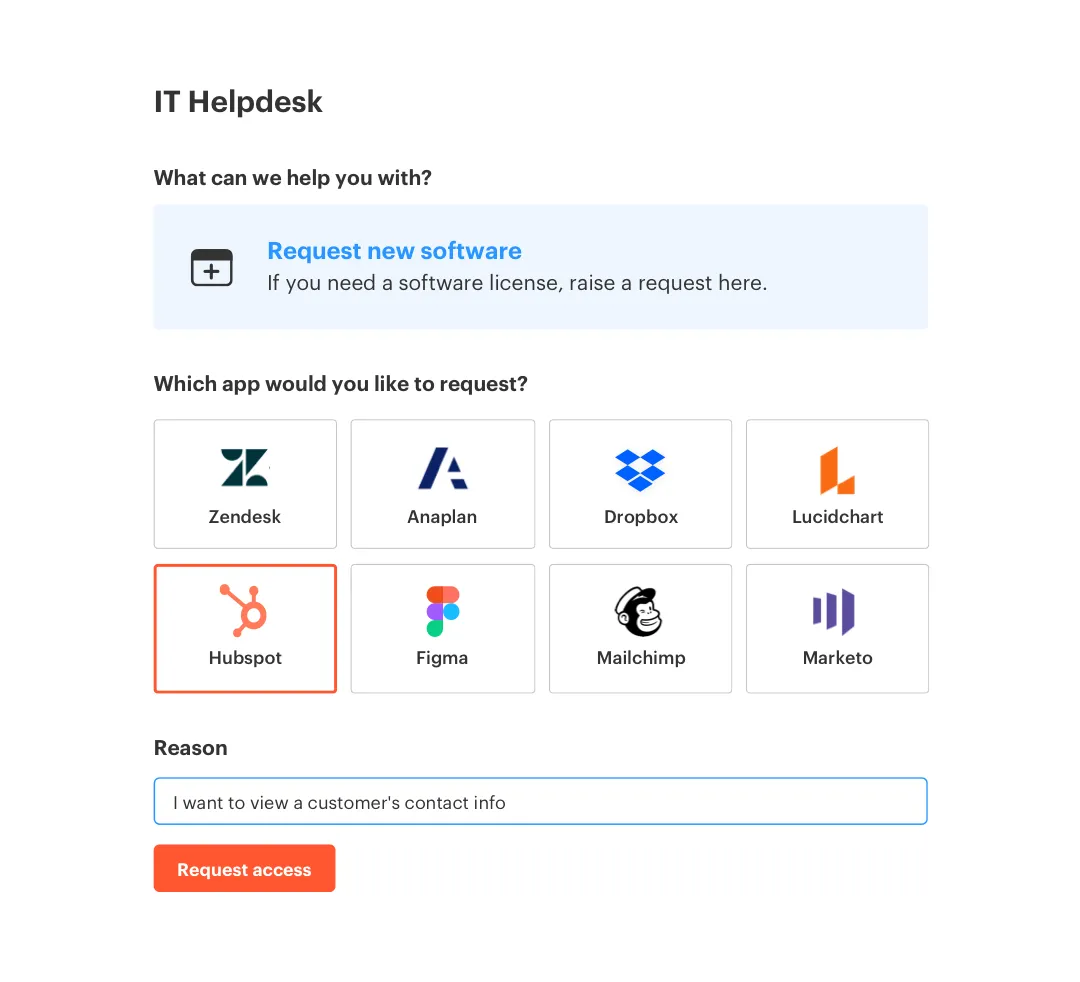
Multiplier's access catalog, approval workflows, and identity provider group provisioning also keep intake and changes connected. Employees request sanctioned apps through JSM or Slack, approvers act in the flow, and provisioning happens through Okta, Entra ID, or Google Workspace groups when the request is approved. If your checklist already points to Jira as the source of truth, Get started with Multiplier is the clean next step because the evidence, approvals, and changes stay in the same operating lane.
Build Reviews That Revoke Access, Not Just Prove Effort
Access review checklists for Jira-heavy teams should lead to cleaner access, lower SaaS waste, and audit evidence that's ready before anyone asks. If the checklist only proves reviewers looked at a list, it isn't doing enough.
Start small. Pick 3 to 5 apps, add usage context, define revoke ownership, and measure whether removals actually happen. Once that works, expand the checklist across more apps and connect it to license reclamation. That's when access reviews stop being quarterly cleanup theater and start becoming a real control.
Frequently Asked Questions
How do I set up an access review campaign in Multiplier?
In Jira Service Management, go to the Access Reviews section and click "New Review." Name the campaign, add the apps to review, assign reviewers, and set your dates. Reviewer decisions, revocation actions, and documentation all stay inside JSM — the same system as the rest of your IT work.
What if I need to reclaim licenses for inactive users?
Use Multiplier's Auto Reclaim. Set an inactivity threshold (30 days works for most high-cost apps), define a grace period so users get a heads-up before access is revoked, and configure group exclusions for people who use apps infrequently. If someone stays inactive past the grace period, access is revoked and a Jira ticket documents the action. It runs in the background while you focus on quarterly review campaigns.
Can I automate access requests through Slack?
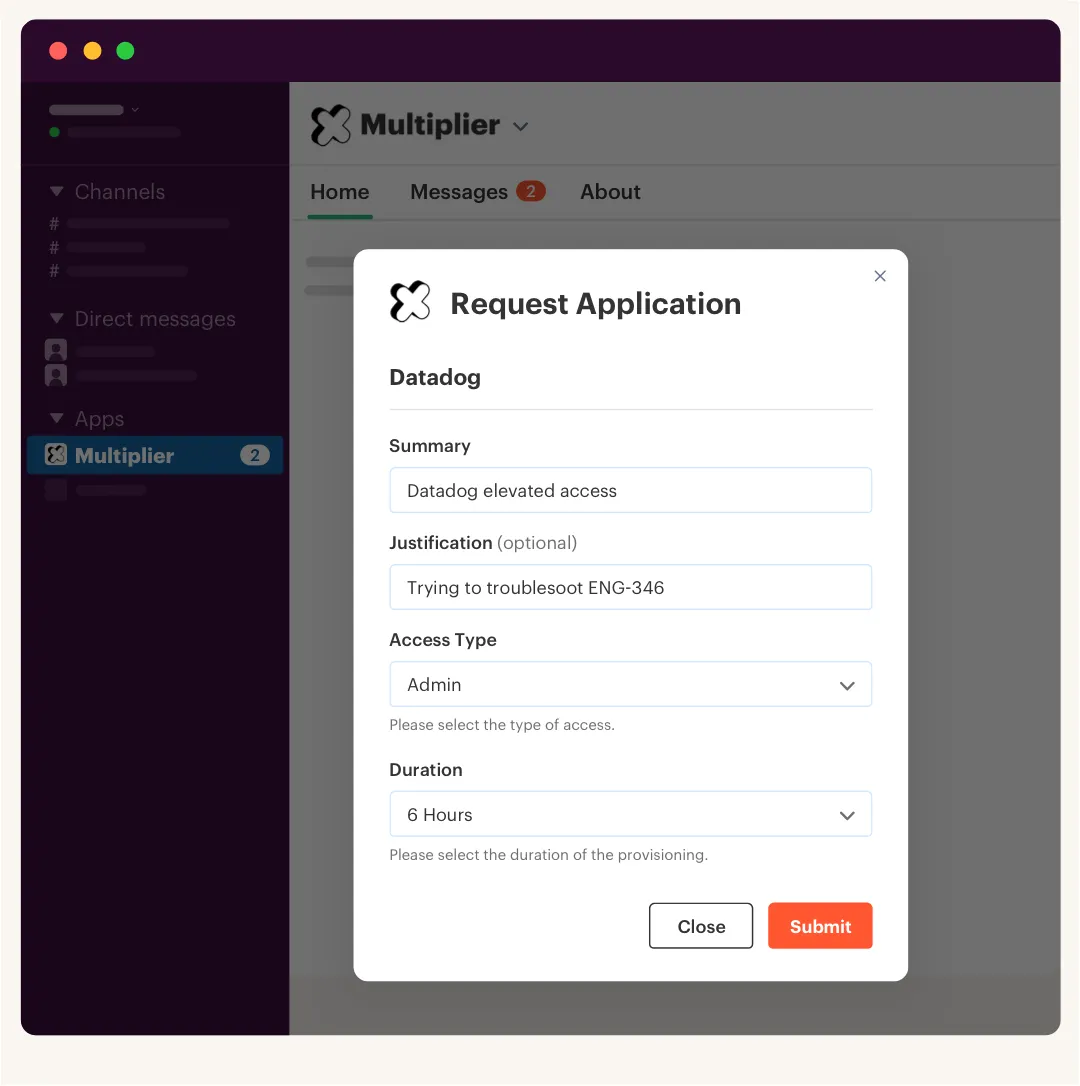
Yes. Install the Multiplier Slack app and employees can type /request to pull up the app catalog and submit a request without leaving Slack. A Jira ticket is created automatically and approvers get notified in Slack. The request, approval, and provisioning stay connected — no email threads, no manual group updates.
When should I conduct access reviews?
Quarterly is the baseline, but apps with admin roles or customer data are worth reviewing more often. Start with 3 to 5 apps before rolling it out to your full stack — you'll surface process gaps before they scale. For license waste between campaigns, Auto Reclaim handles that continuously so you're not waiting months to catch someone who changed teams in January.
Why does my access review checklist need to include last login data?
Without last login data, reviewers guess. They see a name and an app but don't know if that person logged in last week or hasn't touched it in six months. The safe move is always "keep," which is exactly how stale access builds up. Add last login dates and the decision gets obvious: someone inactive for 90 days in a $30/month app gets revoked, not rubber-stamped.


