


Last Tuesday at 9:14 AM, someone on your IT team probably approved an access request they couldn't fully verify. Automated onboarding and deprovisioning sounds like the fix, but if the workflow still ends in Slack threads, screenshots, and spreadsheet clean-up, you didn't automate the control. You automated the handoff.
That's the trap. A lot of companies think the goal is faster access. Faster is good. The real goal is controlled access that starts, changes, expires, and leaves evidence behind without someone rebuilding the story later.
Key Takeaways:
- Automated onboarding and deprovisioning only works when approvals, identity changes, and evidence live in the same workflow.
- Chat bots can speed up requests, but they don't solve governance unless they connect to Jira, your identity provider, and audit records.
- If deprovisioning depends on someone remembering to remove access later, it's not automated enough.
- The best access review process is the one where review decisions trigger revocations and write evidence automatically.
- Start by mapping employee lifecycle events, then decide which access should be standard, approved, time-bound, or reviewed.
- If you already run Jira Service Management, identity governance should probably live there instead of in another portal.
Why Automated Access Still Breaks During Onboarding
Automated access breaks during onboarding because most teams automate the request, not the full lifecycle. The Jira ticket gets created, maybe a Slack approval fires, and then someone still has to add groups, check roles, or clean up later. The process looks modern from the outside, but the control layer is still manual.

Picture the IT lead at a 350-person SaaS company on a Monday at 8:47 AM. Six new hires started today. By 10:30, her Slack has 14 access threads, three of which are tagged urgent because someone can't get into Salesforce before a 1 PM pipeline call. She approves them in Slack, opens Okta in another tab, assigns groups manually, then drops a comment in Jira saying "done." Wednesday, the auditor asks who approved the CFO's contractor getting NetSuite read access. Nobody can find the Slack thread. That's the failure mode, every week.
The hidden problem isn't onboarding volume. It's that onboarding, approvals, provisioning, and deprovisioning are treated like separate jobs. They pass through Jira, Slack, Okta or Entra, maybe Google Workspace, and then a spreadsheet when the auditor shows up. Every handoff creates a place where access can stall, drift, or get missed.
If you want to see what Jira-native governance looks like when access requests don't bounce across tools, Learn more about Multiplier.
The Chat Bot Trap
Chat-first access sounds great because people already live in Slack. I get the appeal. Nobody wants another portal, and nobody wants employees filing vague tickets like "need access please" with no role, no business reason, and no app owner attached. A Slack bot can make the front door easier.

The mistake is treating the front door like the whole house. If the Slack request doesn't create a governed ticket, route to the right approver, provision through the identity provider, and record the outcome, you still have a broken governance model. You just made the broken model faster. Funny how often that happens.
Try this. Pick 10 approved access requests from last month and try to answer four questions in under 15 minutes:
- Who approved the access?
- What exact role or group was granted?
- Was the access still needed after 30 days?
- Where is the proof of removal if it ended?
If you can't answer those from the system of record, your automated onboarding and deprovisioning process is really just ticket routing with better notifications.
The Audit Trail Usually Gets Built After the Fact
Evidence gets messy when it isn't created as part of the work. Someone approves in Slack, someone provisions in the identity provider, someone comments in Jira, and then someone else exports a spreadsheet three months later. By then, the story has gaps.
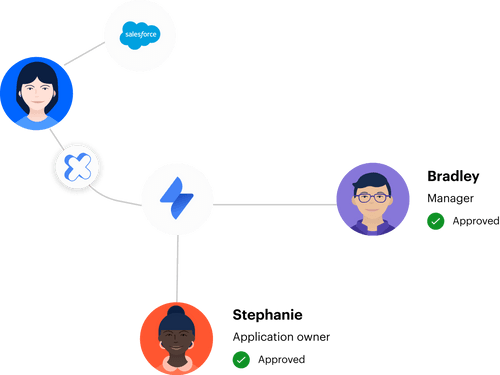
The risk isn't only compliance. It's also operational. When access evidence is scattered, IT teams start granting broader access because it's faster than dealing with one-off approvals all day. Security teams push back, managers get annoyed, and employees wait. Everyone is acting rationally inside a bad system.
A fintech team like Stavvy is a good example of why this matters. After funding and acquisitions, long-lived privileged access became a real concern, so they moved toward time-bound access and cut privileged access by 85%. That number matters because it shows the difference between policy and enforcement. Policy says "least privilege." Enforcement removes access when the window closes.
The Split Between ITSM and Identity Is the Bottleneck
Jira is where the work starts, but the identity provider is where the change happens. When those systems don't share context, a ticket becomes a reminder for a human to do identity work somewhere else. That gap is where access governance gets expensive.
There's a reason frameworks like NIST SP 800-53 Rev. 5 spend so much time on access control, account management, and review evidence. Access isn't just a service desk task. It's a control. Controls fail when the evidence lives outside the workflow that executed the change.
I'm not saying every company needs a heavyweight IGA suite. Honestly, a lot of mid-market teams don't have the time, budget, or patience for that kind of rollout. The better question is more basic: if work already starts in Jira, why should governance live somewhere else?
How to Build Automated Onboarding and Deprovisioning That Holds Up
Automated onboarding and deprovisioning holds up when every access event has four parts: a trigger, an approval rule, an identity action, and an evidence record. Miss one, and the process starts leaking. Nail all four, and onboarding stops being a ticket pile.
The approach I prefer is pretty simple. Don't start with tools. Start with decisions. Which access should be granted by default? Which access needs an owner to approve it? Which access should expire automatically? Which access should show up in quarterly reviews? Once those answers are clear, automation becomes much easier to build.
Diagnose Where Access Is Really Breaking
Pull the last 30 access tickets, not your policy document. Policies usually sound clean. Tickets tell the truth. You'll see vague requests, missing approvers, role confusion, delayed group assignments, and deprovisioning comments like "removed manually" with no proof attached.
Sort each request into one of four buckets. Standard access should be granted through a known role. Sensitive access should require explicit approval. Temporary access should have a duration before it's granted. Unused access should be reviewed or reclaimed based on activity. If more than 20% of requests don't fit a bucket, your catalog is too loose or your roles aren't defined well enough.
Five diagnostic questions to answer before changing anything:
- Can a new hire get role-based access without IT interpreting the request?
- Can an approver see enough context to say yes or no without asking follow-up questions?
- Does the identity change happen through a group or workflow, not manual clicking?
- Does temporary access expire without someone setting a calendar reminder?
- Can an auditor trace request, approval, grant, and removal from one record?
If you answer no to two or more, don't start by adding another portal. Fix the lifecycle path first.
Separate Default Access From Exceptional Access
A sales hire needing Slack, Zoom, Jira, and Salesforce is not the same problem as an engineer needing 6 hours of production database access. Treating them the same creates either too much friction or too much standing privilege. Default and exceptional access should never share a path.
Default access should map to job role, department, location, or team. It should be boring. If a new customer support rep always needs the same five apps, you shouldn't make IT approve those five apps every time. Put them into a standard onboarding workflow and only create exceptions when someone asks for access outside the normal bundle.
Exceptional access needs tighter rules. If access is privileged, expensive, sensitive, or rarely used, add an approver and a time limit. My rough rule: if a person needs access for less than 7 days, make the request time-bound by default. If a role grants admin rights, make the requester choose a duration like 1, 6, or 24 hours before the approval even happens.
The before and after is pretty obvious:
- Before: "Give me admin access to investigate an issue."
- After: "Give me Admin for App X for 6 hours, approved by the app owner, removed automatically after expiry."
- Before: "New hire needs the usual tools."
- After: "New hire in Marketing Ops gets the mapped app bundle tied to their department and role."
Not fancy. Just clearer. And clear beats clever in access governance.
Use Jira as the System of Record, Not a Waiting Room
Jira shouldn't be a place where identity work waits for a human. It should be the record that drives the work. That means the ticket needs enough structure to trigger approvals, provision groups, revoke access, and prove what happened later.
This is where a lot of teams accidentally create drift. They use Jira for intake, Slack for approvals, Okta or Entra for group changes, and spreadsheets for reviews. Each system is useful. The problem is the gaps between them. If the ticket doesn't know what changed in the identity provider, the audit trail is incomplete.
A better workflow looks like this:
- Employee requests access from a sanctioned catalog in Jira or Slack.
- The request captures app, role, duration, and business reason.
- Jira routes approval based on app owner, manager, or named approver.
- Approved requests trigger the identity provider group change.
- The ticket records approval, provisioning, errors, and revocation.
For a closer look at how Jira, Slack, and identity provider group changes can sit in one governed flow, See how Multiplier works.
The point isn't that Jira magically solves identity governance. It doesn't. The point is that Jira already has the operational context. If approvals and evidence live there, and identity changes execute from there, IT isn't reconstructing history later.
Make Deprovisioning Event-Based, Not Memory-Based
Deprovisioning fails when it depends on memory. Someone leaves the company. Someone changes teams. Someone finishes a project. Someone had temporary access for an incident. If removal depends on a person remembering the cleanup step, access will linger. It just will.
Event-based deprovisioning works better because the trigger is tied to a real change. Employee terminated? Disable the account and remove key groups. Transfer to Finance? Remove old department groups and add the new ones. Temporary access expired? Remove the mapped group membership. In each case, the trigger matters more than the reminder.
The strongest automated onboarding and deprovisioning programs use different triggers for different risks:
- New hire start date: grant standard role-based access.
- Manager approval: grant access that needs business context.
- Time expiry: remove temporary or elevated access.
- Department transfer: update role-based groups.
- Termination event: disable account and remove access.
- Inactivity threshold: reclaim SaaS licenses that aren't being used.
The key threshold I like is 30 days of inactivity for license review, not automatic removal for every app. Some apps are seasonal or required for compliance even if login is rare. Fair point. The stronger rule is: if login data is reliable and the app isn't exempt, flag inactive access at 30 days and give the user a grace period before removal.
Run Access Reviews With Usage Context
Access reviews fail when reviewers only see names and app lists. They rubber-stamp because they don't have enough context. I would too. If you ask a manager to review 80 users across 12 apps with no last login, no department, no role, and no recommendation, you're asking them to guess.
A useful access review should show the reviewer what they need to decide. User, title, department, group membership, last login, and a recommendation based on inactivity or risk. Then the reviewer should be able to keep or revoke access without creating another task for IT. Decision and enforcement should be one motion.
The rule I'd use: if a reviewer marks "Revoke," the system should remove the group membership and write the evidence back to the review record. If revocation becomes a separate ticket queue, you'll lose the control right at the point where it matters most. Review campaigns should reduce access, not produce prettier spreadsheets.
A mid-market team doesn't need 40 pages of access review theory. They need a workflow that answers:
- Who has access?
- When did they last use it?
- Who decided to keep or revoke it?
- Was the revoke action actually completed?
- Can we export the evidence if an auditor asks?
That's the part most teams miss. Access review isn't a meeting. It's an enforcement workflow.
Keep the Human Approval Where Judgment Matters
Full automation sounds nice until you automate the wrong decision. Some access should be auto-approved because the risk is low and the pattern is clear. Some access should absolutely wait for a human because the request needs judgment. The trick is knowing which is which.
I'd draw the line using risk and reversibility. Low-risk access that maps cleanly to a role can move fast. High-risk access, admin access, financial systems, production systems, and sensitive data should route to a named approver. If the access can be time-bound, make the duration required before approval. That makes the approval easier because the approver isn't saying yes forever.
A simple approval matrix works:
- Auto-approve standard tools for a known role.
- Manager approval for role-adjacent apps.
- App owner approval for sensitive systems.
- Security approval for privileged or production access.
- Time-bound approval for temporary elevated access.
Critics of automation worry, reasonably, that faster access means weaker control. That's a fair read, and honestly true if automation only removes friction. It stops being true when automation adds structure, forces role selection, requires duration on risky access, and records the exact identity change. Speed without control is a problem. Speed with enforcement is the whole point.
How Multiplier Turns Jira Into the Governance Layer
Multiplier turns Jira Service Management into the governance layer by connecting access requests, approvals, identity provider group changes, access reviews, and evidence in one Jira-native workflow. Employees can request access in JSM or Slack, while IT keeps the system of record inside Jira instead of rebuilding proof later.
The product fit is pretty straightforward. If your team already runs Jira Service Management, the access workflow doesn't need to start in one place and get governed in another. Multiplier sits inside JSM, syncs apps and groups from Okta, Entra ID, or Google Workspace, and uses Jira issues as the record for access decisions and changes.
Access Reviews With Enforced Revocation
Multiplier's Access Reviews are the big piece for compliance teams because review decisions don't have to become manual follow-up work. Reviewers see users, groups, job titles, departments, last login data, and recommendations in JSM. They can mark Keep or Revoke, and revocations remove users from the relevant identity provider groups when the access is managed that way.
That matters because it closes the loop from review to action. In the old workflow, a reviewer might mark a spreadsheet, then IT has to interpret the spreadsheet, remove access in the identity provider, and prove it happened. With Multiplier, the campaign progress, decision, revocation action, and evidence stay tied to Jira. For audits, that's a lot cleaner.
Multiplier also supports CSV exports and evidence pushes to systems like Vanta, tied directly to the completed access review workflow. The important part is not the export itself. The important part is that the evidence was created while the work happened, not rebuilt at the end of the quarter. That's how you get away from screenshot archaeology.
Provisioning, Time Limits, and Slack Approvals in One Flow
Multiplier's Application Catalog gives employees a sanctioned place to request apps and roles from JSM or Slack. Each catalog role maps to identity provider groups, and approved requests can trigger group changes through Okta, Entra ID, or Google Workspace. For routine onboarding, that removes the copy-paste work that usually slows IT down.

Time-Based Access handles the temporary side. A requester can choose a duration like 1, 6, or 24 hours, and after approval, Multiplier adds the user to the mapped group, starts the timer, and removes the membership when the window expires. That callback to the earlier problem matters. If temporary access used to depend on someone remembering cleanup, the expiry is now part of the workflow.
Multiplier's Slack App keeps approvals close to where managers and app owners already respond, but the Jira issue stays the system of record. That avoids the chat bot trap. Slack can be the action surface, while Jira holds the workflow and evidence. If you're ready to replace manual access cleanup with governed Jira workflows, Get started with Multiplier.
Build the Workflow Before the Portal
Automated onboarding and deprovisioning isn't really about faster tickets. It's about making sure every access change has a reason, an approver when needed, an identity action, and evidence that survives audit season. Once those pieces are connected, the process gets faster because the system isn't forcing humans to stitch it together.
My take is simple. If your company already runs on Jira Service Management, don't send identity governance into another portal unless you have a very specific reason. Put the workflow where the work already happens. Make access easy to request, hard to over-grant, automatic to remove, and boring to audit.
Frequently Asked Questions
How do I set up time-based access for temporary roles?
When employees request access from the Multiplier catalog in JSM or Slack, they pick a duration (1, 6, or 24 hours). Once approved, Multiplier provisions the access and removes it automatically when the timer expires. No calendar reminders, no manual cleanup step.
What if I need to revoke access outside of the regular review cycle?
Find the relevant ticket in Jira and trigger revocation directly from it. Multiplier removes the user from the appropriate identity provider groups and logs the action on the ticket. The whole thing stays in one record — no separate cleanup task.
Can I automate access requests for non-SSO applications?
Yes. For non-SSO apps, the provisioning step stays manual, but you can still route requests through the catalog, capture approvals in Jira, and maintain a full audit trail. The governance layer works even when the identity change requires a human to flip the switch.
When should I consider using the Auto Reclaim feature?
When SaaS licenses are going to waste and nobody's sure who still needs them. Auto Reclaim flags users who haven't logged in within a set period, notifies them, and revokes access if they don't respond. It creates a Jira ticket documenting the removal, so the audit trail is clean without anyone having to chase it down.
Why does my access review process feel disjointed?
Usually because approvals, provisioning, and documentation are happening in separate tools. Multiplier pulls it all into Jira: campaigns assign reviewers, track decisions, and trigger revocations in one place. The evidence stays linked to the original request — not rebuilt from screenshots the week before an audit.


