


30 days is enough time for SaaS waste to become normal, especially when the role of automation in access governance is treated like a nice-to-have. You pay for unused seats, keep old access alive, and then everyone acts surprised when the audit turns into a spreadsheet cleanup project.
Most IT teams don't have an access problem because they lack policies. They have an access problem because the work lives in Jira, Slack, Okta, Entra, Google Workspace, email, and someone's memory. Once work spreads across that many places, the policy is basically a suggestion.
Key Takeaways:
- Automation matters most when it enforces the decision, not just routes the request.
- License waste is usually an access governance problem hiding inside finance reports.
- If revocation requires a human reminder, standing privilege will come back.
- The cleanest access workflow starts in the service desk and executes through the identity provider.
- Time-bound access beats broad access because it removes the need to remember cleanup later.
- The role of automation in least privilege is making the right action happen every time.
Why Manual Access Governance Breaks Inside Ticket Queues
Manual access governance breaks because the request, approval, provisioning, revocation, and evidence usually live in different systems. Jira captures the ask. Slack captures the nudge. The identity provider captures the change. A spreadsheet captures the audit story later, if someone remembers. That gap is where SaaS waste and standing access start.

The Hidden Cost Isn't the Ticket Volume
Picture an IT admin at 8:47 AM Tuesday with 47 open access tickets, three approval threads buried in Slack DMs, and two new hires starting in 13 minutes. She toggles between Jira and Okta, copies a group name wrong, fixes it, and the GitLab grant lands 90 minutes late. Nobody got hurt. But that hour is gone, and tomorrow's queue is already building.

A lot of IT leaders look at scenes like that and assume the problem is ticket volume. I get why. If you're getting hundreds of routine requests a month, the queue looks like the obvious enemy. Volume isn't always the killer though. The killer is that every ticket needs a person to interpret it, chase the approval, make the group change, and prove it happened.
Videoamp saw this as they grew from 100 to 500 employees. Tuesdays became the day the IT queue filled up with access tickets that didn't have enough detail to act on. They ended up processing 500+ app requests in 6 months after moving to a self-service access catalog, saving 70+ hours of IT productivity. Small cuts, repeated enough times, become a real cost.
If you want to see where the waste actually is, run this check for two weeks:
- Count every access request that needs a follow-up question.
- Count every approved request that still needs manual provisioning.
- Count every ticket where the evidence lives outside the ticket.
- Count every app seat assigned to someone who hasn't logged in for 30 days.
If more than 25% of requests hit two or more of those buckets, the queue isn't your problem anymore. The workflow is broken. If you want to see what that looks like in Jira-native access governance, See Multiplier on the Atlassian Marketplace.
Policies Don't Matter Much Without Enforcement
Security teams love policies because policies feel clear. Fair. Necessary. Honestly, some of them are. You need rules for who gets admin access, how long they keep it, who approves it, and how you prove the decision later. A policy without operational enforcement, though, turns into a PDF with good intentions.
NIST's Zero Trust Architecture guidance is useful here because it pushes the idea that access should be continuously evaluated, not granted once and forgotten. That's a big shift. Old access governance assumes approval is the important moment. Better access governance treats approval as one moment in a longer chain: request, decision, grant, expiry, review, revoke.
I might be overstating it a bit, but not by much. The real role of automation in access decisions isn't to make approvals faster. It's to make the approved policy happen without relying on memory. Because memory is where least privilege goes to die.
How Automation Changes Access Governance Without Losing Control
Automation changes access governance by turning access decisions into enforceable workflow actions. The goal isn't to remove judgment from IT or security. The goal is to stop wasting human judgment on repeatable steps like group assignment, expiry tracking, license cleanup, and evidence collection.
Diagnose the Work Before You Automate It
Not every access request deserves the same level of control. A request for a viewer role in a design tool shouldn't move like production database access. One is routine. The other can create real risk. Treating both the same is how teams either slow everything down or approve too much by default.
A simple access map works well here. Not fancy. Just useful. Pull the last 100 access tickets and mark each one by risk, repeatability, and cleanup need. Low-risk and repeatable requests are automation candidates. High-risk requests need approval plus expiry. Low-use paid apps need license reclamation. Anything with unclear ownership needs a catalog cleanup before automation, because automating confusion just makes confusion faster.
The decision rule is pretty simple:
- If the request happens more than 10 times a month, standardize the intake.
- If the app has paid seats, connect access data to login activity.
- If the role is privileged, make access time-bound by default.
- If the change must be audited, write the decision and action into the ticket.
- If the app owner can't be named in 30 seconds, don't automate yet.
This is where teams often get nervous. They think automation means losing control. Fair concern, and worth taking seriously. If your automation just rubber-stamps requests, that's a real problem you've now made faster. If automation only executes after the right approval and records the change, you actually get more control than the manual process had, because every decision is logged the moment it happens.
Use the Identity Provider as the Enforcement Layer
Jira is great for intake and workflow. Slack is great for fast decisions. Okta, Entra ID, and Google Workspace are where access actually lives. The identity provider should be the place where approved access becomes real, because it already holds the group memberships that grant permissions. When those systems are connected properly, access stops being a copy-paste task.
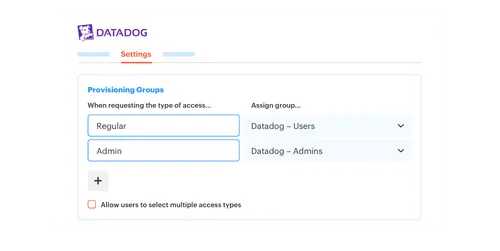
The practical version looks like this: each catalog role maps to one or more identity provider groups. When a request reaches the approved status, the user gets added to the mapped group. When the access expires or gets revoked, the group membership gets removed. The service desk remains the record of the request, and the identity provider becomes the source of truth for enforcement.
That matters because manual provisioning creates weird gaps. Someone approves a ticket, then IT gets pulled into an incident. The group change happens 3 hours later. Or the grant happens, but the ticket never gets updated. Or the requester gets a broader role than they needed because the admin wasn't sure which group mapped to which permission. I've seen this kind of thing enough times to know it's not about bad IT teams. It's about forcing good people to run a process with too many handoffs.
A useful threshold: if a service desk agent has to open the identity provider for more than 20 routine group changes per week, you've got enough repeatability to justify automation. Not because 20 is magical. At that point, the work is no longer judgment. It's execution. Let the system execute.
Make Time the Default Control for Risky Access
Time-bound access sounds obvious once you see it working. If someone needs elevated access for an incident, a deployment, or a sensitive data task, they usually don't need it forever. They need it for 1 hour, 6 hours, or maybe 24 hours. After that, the access should disappear on its own.
The old model assumes someone will come back and clean it up. They won't. Not because they're lazy. The moment the incident ends, the team moves to the next fire. The access stays. Then it shows up in the next review, and everyone tries to remember why it was granted in the first place. Great use of everyone's time, obviously.
A better rule: any privileged role that isn't needed weekly should require a duration. If the user needs it often, review whether the role is actually part of their job. If they need it occasionally, make it just-in-time. If they need it once, make it expire the same day. Very few teams regret shrinking the access window.
Stavvy is a good example. After growth and acquisitions, they had long-lived privileged access hanging around. They moved to time-limited access and reduced privileged access by 85%, with 1,300+ access requests automatically revoked after approved windows. That's the role of automation in least privilege at work. Not more policy. Better default behavior.
Reclaim Licenses Based on Usage, Not Gut Feel
SaaS waste rarely looks dramatic at first. One inactive user in a project management tool. Three old licenses in a design app. A former contractor still assigned to a paid group because the offboarding ticket didn't mention that app. Nobody panics over one wasted seat. Multiply that across 80 apps and the CFO starts asking why software spend keeps creeping up.
Usage-based reclamation fixes a very specific problem: finance wants savings, IT wants fewer manual reports, and security wants less stale access. Login activity gives everyone a better starting point than guessing. If a user hasn't logged into an app for 30 days, send a warning. If they still don't log in after the grace period, revoke the access and document the action.
There are exceptions worth naming. Executives may need access to tools they use rarely. Some compliance users might need dormant access for specific reporting windows. Build exclusions for those groups. The point isn't to blindly remove every idle account. The point is to stop treating every license as permanent until someone manually proves otherwise.
The check I prefer is monthly:
- List apps with paid seats and identity provider login data.
- Set an inactivity threshold by app, often 30, 60, or 90 days.
- Exclude groups where access must be retained despite low login volume.
- Notify users before removal.
- Revoke only after the grace period ends.
- Keep a ticket record for finance and audit.
The surprising part is that SaaS license optimization and least privilege are basically the same motion. Remove access that isn't being used. You save money and reduce risk at the same time. Doesn't happen often. Take the win.
Keep Evidence Inside the Normal Workflow
Audit evidence is painful when it's rebuilt after the fact. Someone exports identity provider logs. Someone else screenshots Jira comments. A third person updates a spreadsheet with reviewer decisions. Then everyone hopes the timestamps line up. I've been in enough audit prep cycles to know that "we'll clean it up later" usually means a few very long evenings in a conference room arguing about which version of the spreadsheet is current.
Evidence should be a byproduct of the work. Request created. Approver assigned. Approval recorded. Group change executed. Expiry applied. Revocation completed. Access review decision captured. If those events live in the ticket record, the audit story is already there. If they're spread across five places, you're doing archaeology.
Atlassian has been pushing more employee lifecycle work into Jira Service Management, including onboarding and offboarding workflows, because service desks are already where employees ask for help. Their write-up on Vuori's employee lifecycle work in Jira Service Management is a good example of the broader shift. Access governance follows the same pattern. Put the work where the work already happens.
A good audit-readiness test is harsh but useful: pick 10 users at random and try to answer four questions in under 15 minutes. Who approved their access? What exactly changed? When should it expire? Was unused access removed? If you can't answer from the service desk and identity provider records, your process might be functional day to day, but it's not audit-ready.
Don't Automate Broken Ownership
Ownership is the part everyone tries to skip. It's also the part that bites you later. If nobody owns an app, nobody knows who should approve access. If nobody owns a role, nobody knows whether Viewer, Editor, or Admin is appropriate. If nobody owns cleanup, access turns permanent by default.
Before building automation, assign app owners and role owners for the top 20 apps by request volume or spend. You don't need to boil the ocean. Start where the requests and money are. For each app, define the approved roles, approval path, default duration, and whether license reclamation applies. Then connect those rules to workflow.
The conditional rule is pretty straightforward:
- If an app has high request volume, put it in the catalog first.
- If an app has high risk, require owner approval and time limits.
- If an app has high spend, apply inactivity checks.
- If an app has unclear ownership, keep it manual until ownership is fixed.
Some teams prefer to automate first and clean up later. I understand the instinct. When the queue is painful, speed feels like the priority. Automation magnifies whatever logic you give it, though. Clean logic gives you scale. Messy logic gives you faster mess.
How Multiplier Automates Access Governance in Jira
Multiplier automates access governance by keeping requests, approvals, provisioning, expiry, reviews, and evidence inside Jira Service Management and Slack. It executes approved changes through Okta, Entra ID, or Google Workspace group mappings, so the workflow stays fast while the identity provider remains authoritative.
Catalog, Approval, and Provisioning Work Together
Multiplier's Application Catalog gives employees a Jira-native place to request sanctioned apps and roles, instead of asking in random Slack threads or filing vague tickets. The catalog syncs apps and groups from the identity provider, and only approved apps appear for request. That matters because the request starts with clean context. App, role, requester, approver, ticket. All in one flow.

Once the request is approved, Multiplier provisions through identity provider groups. For SSO apps, the role maps to one or more groups, and the approved Jira status triggers the group change. The ticket gets updated with the outcome, which cuts out the manual "done, see screenshot" routine. Luno saw this pattern pay off after growing to nearly 1,200 employees, with an 80% reduction in IT workload for access requests that used to take 5 to 30 minutes each.
The Slack App fits the way people already work. Requesters can open the catalog from Slack, and approvers can act from Slack DMs while Jira remains the system of record. Multiplier doesn't replace judgment. It removes the swivel chair work after judgment happens. Access requests move faster because the boring part is automated.
Time Limits and Auto Reclaim Close the Loop
Multiplier's Time-Based Access lets requesters choose a duration like 1, 6, or 24 hours when temporary access is needed. After approval, Multiplier adds the user to the mapped identity provider group and starts the timer. When the window expires, it removes the group membership and records the change in Jira. That's a big deal for least privilege because cleanup no longer depends on someone remembering.
Auto Reclaim handles a different but related problem: unused paid access. Multiplier ingests last-login data from connected identity providers for in-scope apps, applies inactivity thresholds and grace periods, notifies users, and revokes access if they stay inactive after the warning period. It also creates a Jira ticket documenting the removal. Finance gets cleaner license data. IT gets fewer manual cleanup tasks. Security gets less stale access hanging around.
The important boundary: Multiplier provisions through identity provider groups, not by directly logging into every SaaS app and changing permissions there. Auto Reclaim also depends on accurate last-login data from the identity provider, and it's available on the Advanced edition. That's a real limitation. For teams already running Jira Service Management and Okta, Entra ID, or Google Workspace, the operating model is very clean: approve in the workflow, enforce through the identity provider, prove it in Jira.
If you want access requests, time-bound provisioning, and usage-based license cleanup living in the same workflow, Get Multiplier on the Atlassian Marketplace.
Build Least Privilege Where the Work Already Happens
The role of automation in access governance isn't to make IT look more modern. It's to make the correct access decision actually happen, every time, without relying on human memory, side-channel approvals, or quarterly cleanup heroics.
Start with the top 20 apps by request volume or spend. Define owners, roles, approval rules, expiry rules, and inactivity thresholds. Then automate the parts that are repeatable: intake, routing, group changes, revocation, and evidence. Keep humans in the judgment moments. Remove them from the copy-paste moments.
That's how you cut SaaS waste and reduce standing privilege at the same time. Same motion. Better outcome.
Frequently Asked Questions
How do I set up time-based access for users?
To set up time-based access with Multiplier, you can follow these steps: 1) When a user submits a request via the Application Catalog in Jira or Slack, they can choose a duration for access, such as 1, 6, or 24 hours. 2) After the request is approved, Multiplier will automatically provision access and start a timer to revoke it after the chosen duration. 3) This ensures that access is temporary by default, minimizing the risk of standing privileges. By using this feature, you can streamline access management while maintaining security.
What if a user needs to extend their access duration?
If a user needs to extend their access duration with Multiplier, they can do so easily. 1) The user should submit a new request for the same application before the current access expires. 2) If the previous request was already approved, Multiplier can automatically extend the access duration without requiring re-approval, provided your policies allow it. 3) This reduces friction during critical tasks and ensures users have the access they need when they need it.
Can I automate license reclamation for inactive users?
Yes, you can automate license reclamation with Multiplier's Auto Reclaim feature. Here’s how: 1) Set inactivity thresholds for each application, such as 30 days without login. 2) Multiplier will send notifications to users who exceed this threshold, giving them a chance to log in before access is revoked. 3) If they remain inactive after the grace period, Multiplier will automatically revoke their access and create a Jira ticket documenting the removal. This helps optimize your SaaS spend and reduces stale access.
When should I use the Application Catalog for access requests?
You should use the Application Catalog in Multiplier for access requests when: 1) You want to streamline the intake process by providing employees with a single, user-friendly interface to browse and request access to approved applications. 2) You need to ensure that requests include the right context, such as the application and role, to minimize back-and-forth communication. 3) This feature helps maintain centralized control and auditability for every request, making it easier for IT to manage access efficiently.
Why does access governance need automation?
Access governance requires automation to reduce manual errors and improve efficiency. Here’s why: 1) Automation helps enforce policies consistently, ensuring that access is granted based on predefined rules without relying on human memory. 2) It streamlines processes by integrating requests, approvals, and provisioning within Jira, eliminating the need for multiple tools and reducing context switching. 3) This leads to faster access for users, better compliance with security policies, and a more efficient IT operation overall.


