


Moveworks vs Okta Identity Governance is not a clean “which one is better?” decision, because these tools solve two different access management problems. If you compare them like-for-like, you’ll probably pick the wrong thing and then spend the next 6 months patching the gap with tickets, Slack messages, and spreadsheets.
Moveworks is mainly an AI employee support platform that can route and automate requests across business systems, including access-related requests, through conversational channels like Slack, Teams, web, and embedded experiences (Moveworks product release). Okta Identity Governance is mainly identity governance software for access requests, certifications, and governance controls inside the Okta ecosystem (Okta Identity Governance release notes). Different job. Different buyer. Different failure mode.
[Table: Decision factor] — See "Table Embed Codes" in Oleno to copy the HTML for this table.
Key Takeaways:
- Moveworks fits teams that want AI-led employee request intake across IT, HR, finance, and support operations.
- Okta Identity Governance fits Okta-centered identity teams that need access requests, certifications, and governance controls.
- If access reviews are a core requirement, Okta is closer to the governance system of record.
- If employee self-service is the main goal, Moveworks is more naturally aligned with that motion.
Moveworks and Okta Identity Governance Solve Different Access Problems
Moveworks and Okta Identity Governance overlap around access requests, but they’re not built for the same access management job. Moveworks starts from employee support and automation, while Okta starts from identity governance. A password reset request and a quarterly SOX access review may both involve access, but operationally they’re different animals.

Think of it like a busy airport. Moveworks is closer to the front desk that gets people to the right counter quickly. Okta Identity Governance is closer to the security checkpoint, checking who should be allowed through, who approved it, and what evidence needs to exist later. Both matter. Confusing them creates weird airport behavior, like asking the front desk to run passenger screening.
I’ve seen this pattern in a bunch of operational software categories. The tool with the better front door gets pulled into jobs it was never meant to own. Fair enough. People love convenience. But convenience doesn’t automatically create governance, especially when auditors ask for proof 3 months after the access decision happened.
Where Moveworks overlaps with identity workflows
Moveworks overlaps with identity workflows when employees use conversational self-service to ask for access, status updates, or help completing tasks. Its platform is built around agentic AI, reasoning, and automation across enterprise systems (Moveworks dynamic AI platform release). That makes it useful when the access request is one of many employee service tasks flowing through a shared support layer.

A typical scenario looks like this. Someone asks in Slack, “Can I get access to the finance app?” The employee doesn’t want to find a portal, search a catalog, or figure out who owns the approval. They just want the thing done. Moveworks is designed for that kind of front-door experience, where the assistant understands the request and triggers work through connected systems.
The diagnostic question is simple: if 70% of your access problem is “employees don’t know where to ask,” conversational intake matters a lot. If 70% of your access problem is “we don’t know who still has access and why,” intake won’t fix the root issue. That’s the fork in the road.
Look for these signals before you classify Moveworks as an access management system:
- Employees ask for access in Slack or Teams more often than the formal portal.
- IT wants one assistant for many service tasks, not only identity workflows.
- Your biggest current metric is ticket deflection or request speed.
- Reviews, certifications, and SoD controls are owned somewhere else.
- Governance evidence is already handled by a separate identity or audit process.
Where Okta Identity Governance goes deeper on governance
Okta Identity Governance goes deeper when the work requires formal access requests, certifications, entitlement oversight, and identity controls inside Okta. Okta ties governance into its broader identity platform, with updates covering access governance and identity security (Okta Identity Governance release notes). That’s a different operating model than conversational support.
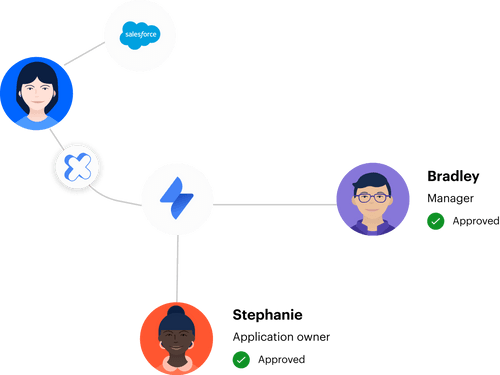
Here’s the practical difference. An employee request asks, “Can Jane get access to Salesforce?” Governance asks, “Should Jane still have this role, who approved it, did the approval match policy, and can we prove the removal happened when it should have?” The first question is service delivery. The second is control.
The threshold I’d use: if you have recurring access reviews for regulated apps, Okta belongs in the conversation before a general employee support platform. If you’re running SOC 2, ISO 27001, SOX, or customer-driven access evidence requests, the system that stores policy and proof matters more than the system that makes the first interaction feel easy.
Some teams will still prefer an assistant-led front end. That’s valid. The tradeoff is that the governance system still has to exist somewhere, and if it’s not where the request starts, your team owns the handoff.
What buyers should evaluate before choosing
Buyers should evaluate the system of record before evaluating the user interface. The access management decision breaks when teams start with “Where will employees ask?” instead of “Where will approvals, changes, reviews, and evidence live?” That one ordering mistake creates more rework than most feature gaps.
A simple test works. Pick one sensitive app and trace a single user through 4 moments: request, approval, provisioning, and review. If you can’t show who approved access, what changed, when it changed, and whether it was reviewed later without jumping across 3 systems, you don’t have an access governance workflow. You have a coordination trail.
Run the evaluation this way:
- Choose one high-risk app, not a low-risk productivity tool.
- Map the request channel employees actually use.
- Identify where the approval decision is stored.
- Confirm where provisioning happens.
- Check where quarterly review evidence is exported.
- Measure how many manual screenshots or spreadsheets appear.
This is where the comparison gets more honest. Moveworks can be a strong front door for service tasks. Okta can be a strong governance layer for Okta-centered identity teams. But the decision is really about where access work becomes auditable.
The next question is what this split costs when IT and identity teams live inside it every week.
Why This Comparison Matters for IT and Identity Teams
This comparison matters because access requests now sit between employee experience, security control, and audit evidence. If the wrong system owns the wrong part of the flow, IT gets speed without proof or governance without adoption. The damage usually appears later, during reviews, offboarding, or customer security questionnaires.
At 9:17 on a Tuesday, an employee asks for access in Slack because the formal portal feels slow. IT approves in one place, provisions in another, and tracks the exception in a sheet because the auditor will need it later. Nobody planned a fragmented workflow. It just happened. Quietly.
Frankly, this is the part teams underestimate. The tool decision looks like software selection. It’s actually an operating model decision. Where do people ask? Where does policy execute? Where does proof live? If those are 3 different places, you’re buying coordination work.
The operational cost of fragmented request and approval flows
Fragmented access workflows cost time because each request creates hidden handoffs between intake, approval, provisioning, and evidence. The visible ticket might take 10 minutes. The invisible work can take much longer when someone has to chase an app owner, update an identity group, and document proof for later.
The mistake is assuming the request is the unit of work. It isn’t. The unit of work is the whole access lifecycle. Request, approval, provisioning, review, revocation. Miss one and the request may look complete while the risk remains open.
A useful benchmark: if more than 2 systems are required to prove one access decision, your audit process is already fragile. Not broken in a dramatic way. Just brittle. It depends on people remembering side steps. And people forget, especially during onboarding spikes, acquisitions, and budget season when everyone is moving too fast.
The hidden cost shows up in these places:
- Approvers respond in Slack, but the ticket lacks the final decision.
- Provisioning happens in the identity provider, but the request record doesn’t show the group change.
- Reviews happen quarterly, but reviewers lack usage context.
- Revocations are approved, but someone still has to execute them manually.
- Audit evidence gets rebuilt from screenshots instead of generated from the workflow.
I’m sympathetic to why this happens. Nobody wakes up excited to add process. The status quo feels faster until the first messy review cycle arrives.
Why governance depth matters beyond chat-based self-service
Governance depth matters because access work doesn’t end when the employee gets the app. For lower-risk tasks, a conversational workflow may be enough. For sensitive systems, the long-term question is whether access stays appropriate, time-bound, reviewed, and traceable.
Moveworks has a strong story around employee support automation and AI-driven task execution across enterprise systems (Moveworks Quick GPT release). Okta Identity Governance has a stronger native fit when the work is certifications, governance controls, and identity-platform alignment (Okta identity governance overview). That’s not a criticism of either product. It’s just category truth.
Here’s the decision rule I’d use. If the request is low-risk, high-volume, and mostly about routing, optimize for the employee front door. If the request affects financial systems, production data, customer data, or privileged tools, optimize for governance evidence first. You can always improve the front door later. Rebuilding missing evidence after the fact is painful.
There’s a case to be made that employees won’t use a governance-heavy system. True. Adoption matters. But the answer isn’t to skip governance. The answer is to put governance behind the workflow so the employee doesn’t feel the weight of it.
How pricing and deployment model change the decision
Pricing and deployment model change the decision because these tools carry different implementation shapes. Moveworks is typically evaluated as an enterprise AI support platform with custom pricing, while Okta Identity Governance is evaluated as part of an Okta identity investment with public starter pricing references in available buyer materials ([Okta getting started guide]).
Budget clarity matters earlier than people think. If you need to justify access governance to security and compliance, per-user governance pricing may be easier to model. If you’re funding a broad employee support initiative, a custom enterprise AI platform may make sense because the value case spans IT, HR, finance, and internal knowledge.
Use a 90-day test before committing. Can your team deploy a real access request flow, connect the approval to provisioning, run one review cycle, and export evidence within the first quarter? If not, the deployment model may be too heavy for your current operating capacity.
The trap is buying for the executive demo. The demo shows a clean request. The real work starts when 400 employees, 80 apps, 12 approvers, and one auditor all touch the same process.
Now let’s look at each product without pretending they’re trying to be the same thing.
Moveworks Overview
Moveworks is strongest when the access request is part of a broader employee support automation strategy. Its platform is positioned around AI agents, reasoning, and task execution across enterprise systems (Moveworks product release). For access management buyers, that means request intake can feel simple, but formal governance still needs careful validation.
Moveworks strengths for employee support and request intake
Moveworks has a clear advantage when employees live in chat and expect support to come to them. Its public materials describe conversational and AI-led automation across internal service workflows, which is useful for reducing the friction of asking for help (Moveworks ITSM resource). In access terms, that makes it a strong way to capture demand before it becomes a messy ticket.
Picture a 6,000-person company where employees ask for everything in Slack. Laptop help. HR questions. Finance approvals. App access. If the business wants one intelligent front door, Moveworks fits that mental model. The win is not “identity governance depth.” The win is reducing the number of places employees have to remember.
What I like about this category is obvious. People use the path of least resistance. If the assistant can understand the request, route it, and trigger work in connected systems, you remove a bunch of tiny delays that create support noise.
Moveworks is worth evaluating when these are true:
- You want AI-led support across IT, HR, finance, and other service teams.
- Slack, Teams, web, or embedded experiences are preferred employee channels.
- Request deflection and faster employee answers are board-level priorities.
- Access management is one workflow among many, not the only workflow.
- A separate identity governance layer already handles reviews and controls.
Moveworks limitations for formal identity governance
Moveworks is not positioned in the provided sources as a full identity governance platform for access certifications, SoD controls, and structured access reviews. Its materials focus more on employee support automation, AI agents, and enterprise task execution (Moveworks dynamic AI platform release). That distinction matters if your access workflows are audit-driven.
The failure mode is subtle. The employee gets a great experience, IT gets fewer tickets, and everyone feels progress. Then a review campaign starts and the governance team still has to answer basic questions: who owns this app, who approved this access, when should it expire, and what evidence proves revocation happened?
Use this red-flag checklist. If 3 or more are true, don’t treat conversational support as your governance layer:
- Your reviewers need app ownership, usage context, and entitlement details.
- You run recurring access reviews for regulated systems.
- You need separation-of-duties checks before approval.
- You need time-bound access with automatic removal.
- Auditors expect a single trail from request through revocation.
This doesn’t make Moveworks a poor fit. It makes it a front-end and automation layer, not the identity governance record. Different job.
Moveworks pricing and deployment considerations
Moveworks pricing is not publicly listed in the provided sources, so buyers should assume a custom enterprise sales process. That usually makes sense for broad AI support deployments where scope, integrations, channels, and business units vary. It’s less convenient when the buyer only needs a narrow access request workflow and wants budget clarity up front.
Deployment also needs honest scoping. AI employee support tools get more valuable when they connect deeply into the systems employees ask about. That means implementation quality depends on integrations, permissions, knowledge sources, routing logic, and support team readiness. Honestly, this is where some buyers overestimate speed. The assistant is the interface. The operating work is underneath.
A practical evaluation threshold: if the first deployment needs more than 5 departments before access workflows show value, separate the access use case from the broader employee support program. Prove one sensitive access flow first. Then expand.
How Multiplier is Different: Multiplier is built around Jira Service Management as the operating layer for access requests, approvals, provisioning, and audit evidence. Verified capabilities include a Jira-native application catalog, approval workflows tied to managers or app owners, Slack-based requests and approvals, and automated provisioning through identity provider groups.
The bigger question: what if the buyer already lives inside Okta and wants governance first?
Okta Identity Governance Overview
Okta Identity Governance is the stronger fit when access management needs to sit inside an Okta-centered identity stack. It supports identity governance workflows such as access requests and certifications, with updates documented through Okta’s governance release notes (Okta OIG release notes). For Okta customers, the ecosystem fit can reduce architectural friction.
Okta Identity Governance strengths for access governance
Okta Identity Governance starts from the identity system, which gives it a natural advantage for teams already running workforce identity through Okta. Access requests, governance workflows, and platform identity context belong close together when identity teams need policy enforcement and auditability ([Okta platform release overview]). For a security team, that proximity can matter more than interface convenience.
The strongest use case is an Okta-centered company with compliance pressure. Security wants certifications. IT wants provisioning through known identity connectors. Compliance wants review evidence. Employees want access without waiting forever. Okta Identity Governance can bring those concerns closer to the identity backbone.
The decision mechanism here is pretty clean. If Okta is your source of identity truth, and your main problem is governance depth, start your evaluation with Okta Identity Governance. If your main problem is employee request experience across many service domains, compare it with a broader support automation layer.
Okta Identity Governance tends to fit when:
- Okta Workforce Identity is already the main identity platform.
- Access reviews and certifications are required.
- Security cares about governance controls more than conversational intake.
- Provisioning should stay close to Okta-managed apps and directories.
- Compliance teams want evidence from the identity system itself.
Okta Identity Governance limitations and tradeoffs
Okta Identity Governance can be less natural when the access workflow starts and ends in Jira, Slack, or ITSM operations rather than inside the identity platform. Okta’s identity ecosystem is a strength, but that same center of gravity can create handoffs if service teams manage requests somewhere else. The risk is not missing governance capability. The risk is operational distance.
Consider a team where employees file requests in Jira Service Management, managers approve in Slack, IT provisions through Okta, and auditors ask for the Jira ticket later. Okta may hold the identity-side record, but the operational story still spans systems. Someone has to reconcile it. Fun? Not really.
There’s also the complexity question. Governance platforms carry more policy structure because they’re meant to support review campaigns, controls, and audit needs. That’s good when you need it. Heavy when you don’t. If your team only needs lightweight app requests for a small set of tools, the governance overhead may feel like too much at first.
The tradeoff is worth it when identity control is the priority. It’s harder to justify when the access workflow is mainly an IT operations problem buried inside JSM queues.
Okta Identity Governance pricing and ecosystem fit
Okta Identity Governance has public starter pricing references at $6 per user/month in available getting-started materials, while broader packaging can vary by edition and buyer scope ([Okta getting started guide]). That gives buyers more initial pricing visibility than a fully custom enterprise support platform.
Pricing still shouldn’t be evaluated in isolation. The real question is how much of your identity stack already runs through Okta. If Okta is central, governance inside that ecosystem may reduce integration work. If your operations team lives in Jira and treats Okta as the provisioning layer, then the user and evidence workflow may still require another design decision.
A useful rule: if Okta owns the identity decision and Jira only tracks the service ticket, Okta-first governance is logical. If Jira owns the work and Okta only executes the group change, Jira-native access management deserves serious attention.
How Multiplier is Different: Multiplier focuses on making access governance operational inside Jira Service Management rather than requiring a separate governance destination for employees. Verified features include Jira-native access reviews, time-based access with automatic revocation, post functions for no-code lifecycle orchestration, and app-catalog-driven request intake through JSM or Slack.
Now we can put the three operating models side by side without pretending one category covers every use case.
How Multiplier Fits Jira Service Management Access Workflows
Multiplier fits teams that already run access work through Jira Service Management and want requests, approvals, provisioning, reviews, and audit records tied to that operational flow. Moveworks emphasizes AI-led employee support, and Okta emphasizes identity-platform governance. The Jira-native path is for teams that want access control where IT work already happens.
[Table: Feature category] — See "Table Embed Codes" in Oleno to copy the HTML for this table.
If your access workflow already starts in Jira and approvals already happen around JSM issues, Learn more about Multiplier in the context of your current service desk setup rather than evaluating it as another standalone governance portal.
How Multiplier is different for Jira-native access requests
Multiplier is different because it treats Jira Service Management as the place where access work should live, not just as a ticket inbox. The request, approval, provisioning action, and evidence trail can stay connected to the issue that started the work. That changes the operating model.
The practical benefit is boring in the right way. An employee requests an app. The approval goes to the right manager or app owner. Provisioning happens through identity provider group assignment. The issue retains the access history. Later, when someone asks why the user had access, the trail isn’t hiding across chat, email, and a spreadsheet.
I’d use this threshold: if more than half your access requests already touch JSM, don’t evaluate access governance without testing the Jira-native path. Otherwise, you may buy governance depth and still leave the service team doing swivel-chair work.
Verified workflows Multiplier supports today
Multiplier supports the access workflows that usually create friction for Jira-heavy IT teams: app catalog request intake, Slack-based requests and approvals, identity-provider group provisioning, time-based access with automatic revocation, Jira-native access reviews, and no-code lifecycle orchestration through Jira workflow actions. This is not trying to replace the identity provider. It uses the identity provider to execute access changes while keeping the operational record in Jira.

That distinction matters. Some products want to become the new portal. Some want to become the new identity brain. Multiplier is more opinionated: keep the work in JSM, route approvals where people respond, provision through the identity provider, and keep audit evidence attached to the issue. If you’ve ever rebuilt audit proof from Slack threads and screenshots, you know why this matters.
The supported workflow pattern looks like this:
- Employee requests access through JSM or Slack.
- The request routes to a manager, app owner, or named approver.
- Approved access maps to identity provider groups.
- Temporary access expires automatically.
- Access reviews run in Jira with revocation follow-through.
- Lifecycle changes trigger no-code Jira post functions.
If you’re comparing this against a broad AI support platform or an identity-first governance suite, See how Multiplier works against one real access request, one temporary access case, and one review cycle. That test will tell you more than a feature checklist.
Fit by team type and evaluation path
The strongest fit is a Jira Service Management-first IT operations team that wants access work to feel native to the service desk. These teams usually have Okta, Entra ID, or Google Workspace already handling identity, but the day-to-day work happens in Jira and Slack. That’s the gap.
The honest limitation: if your identity team wants every governance workflow inside Okta, Okta Identity Governance may be the cleaner architectural choice. If your executive mandate is to deploy one AI assistant across many employee support domains, Moveworks may fit the broader transformation. Multiplier makes the most sense when access management is operationally stuck between JSM tickets, Slack approvals, identity groups, and audit evidence.
Use this buyer map:
- Choose Moveworks when employee self-service across many departments is the main initiative.
- Choose Okta Identity Governance when Okta-centered identity governance is the main initiative.
- Choose Multiplier when Jira Service Management is already the access operations hub.
- Run a proof using one sensitive app, one temporary access case, and one review cycle.
- Require evidence export before you call the workflow production-ready.
This is the part I’d push on in a buying committee. Don’t ask, “Which tool has more features?” Ask, “Where does the access decision become operationally complete?”
A Practical Recommendation for Access Management Buyers
The practical recommendation is to choose based on the system that should own the access lifecycle, not the interface that looks cleanest in a demo. Moveworks is strongest for AI-led service intake, Okta is strongest for Okta-centered governance, and Jira-native access management fits when JSM owns the work.
If I were running the evaluation, I’d build a 3-part proof. First, test a normal app request. Then test temporary privileged access with expiry. Then test a review where the reviewer needs context and the revocation has to happen. Most tools look fine on the first test. The second and third tests expose the real fit.
A final concession, because it matters. No single workflow model is perfect. Identity teams often prefer governance systems because they centralize policy. IT operations teams often prefer JSM because that’s where work already gets done. Employees prefer chat because they don’t want another portal. All three instincts are reasonable. The buying mistake is pretending only one of those realities exists.
If your team wants access requests, approvals, time-bound provisioning, access reviews, and audit records inside Jira Service Management, Get started with Multiplier by testing it against the exact workflow your team runs today.
The cleanest access management decision is the one where the request, the approval, the change, and the proof all stay connected. Everything else becomes archaeology later.
Frequently Asked Questions
How do I set up automated access requests with Multiplier?
To set up automated access requests with Multiplier, first, ensure it’s installed in your Jira Service Management (JSM) instance. Next, create an application catalog by syncing your identity provider (like Okta) to display approved applications. Employees can then request access via the JSM portal or Slack. After setting up roles for each app, configure approval workflows to route requests to the appropriate managers or app owners. This streamlines the request process and ensures that all changes are logged in Jira for audit purposes.
What if I need to revoke access automatically?
If you need to revoke access automatically, you can use Multiplier's Time-Based Access feature. When employees request access, they can specify a duration (like 1, 6, or 24 hours). Once approved, Multiplier provisions the access and sets an automatic timer to revoke it when the time expires. This helps maintain least privilege by ensuring that access is only granted for the necessary duration, reducing the risk of overprovisioning.
Can I track access reviews in Jira with Multiplier?
Yes, you can track access reviews directly in Jira using Multiplier's Access Review feature. To do this, create an access review campaign in Jira, select the applications to include, and assign reviewers. Reviewers will receive notifications and can easily mark access as 'Keep' or 'Revoke' within the JSM interface. This keeps all access decisions and changes documented in one place, simplifying audits and ensuring compliance.
When should I consider using Multiplier for access management?
Consider using Multiplier for access management when your organization already relies on Jira Service Management for IT operations. If your team frequently handles access requests through multiple channels (like Slack or email) and struggles with manual provisioning, Multiplier can automate these processes. It integrates with your identity provider to streamline requests, approvals, and provisioning, all while maintaining a clear audit trail in Jira.
Why does Multiplier integrate with identity providers?
Multiplier integrates with identity providers like Okta to automate provisioning and ensure that access changes are executed efficiently. This integration allows Multiplier to manage user group memberships automatically based on approvals made in Jira. By connecting directly to your identity provider, Multiplier helps eliminate manual errors, speeds up access requests, and maintains compliance by keeping an accurate record of all changes within Jira.


