


75% of access requests being fully automated sounds like a tooling win, but the real win is that nobody has to rebuild the audit trail later. Automating access request processes only works when the request, approval, provisioning, expiry, and evidence all live in the same operating flow.
A lot of IT teams try to fix access requests by adding another portal. I get why. Dedicated tools feel safer. But if employees still ask in Slack, managers still approve in email, and auditors still get spreadsheets, you haven't fixed the workflow. You just added another place to check.
Key Takeaways:
- Access request automation breaks when intake, approvals, provisioning, and evidence live in different systems.
- The biggest hidden cost isn't the approval delay. It's rebuilding audit evidence after the work already happened.
- Least privilege works better when access has an expiry by default, especially for admin roles and sensitive systems.
- If you're running on Jira Service Management, access governance should be designed around Jira tickets, not bolted on beside them.
- Start automating access request processes by mapping the whole path from request to revocation, not just the approval step.
Why Access Request Automation Breaks Outside Jira
Access request automation breaks when the ticketing system and identity system don't share the same record. The request starts in Jira, the approval happens somewhere else, and the actual group change happens inside Okta, Entra, or Google Workspace. That split creates slow access, standing privileges, and messy audit evidence.

The Real Bottleneck Is the Split Between ITSM and Identity
Most teams don't have an access request problem first. They have a handoff problem. Someone asks for access in Jira, someone nudges the manager in Slack, someone checks a spreadsheet to find the right group, then someone logs into the identity provider and makes the change. It feels normal because every step is familiar—that's exactly why it persists.
I’ve seen this pattern in a lot of ops workflows. The team thinks the bottleneck is volume, so they buy a tool to route requests faster. But routing faster doesn't solve much if the approval and the actual identity change still sit in different places. The work is like a relay race where every runner has to stop, rewrite the baton label, and explain what happened before handing it off. Not exactly fast.
The Atlassian view of service management is built around requests, workflows, ownership, and service delivery, which is why Jira Service Management becomes the natural front door for IT work. Access governance usually gets treated as a separate category. Fair enough, identity has its own depth. But when the employee experience already starts in Jira, pulling governance away from that record creates the exact mess you were trying to reduce.
If you're trying to bring access governance into the flow your team already uses, Learn more about Multiplier.
The Audit Problem Shows Up Months Later
A Tuesday morning access request looks harmless. A product manager needs Figma Editor access for a campaign launch. The Jira ticket says “need access,” the manager says “approved” in Slack, and IT adds the user to a group in Okta. Everybody moves on. Six months later, an auditor asks who approved the access, when it was granted, whether it was still needed, and who removed it.
That’s when the work comes back. Not the request work. The archaeology work. Someone searches Jira comments, screenshots Slack, exports identity group membership, and tries to line up timestamps that were never designed to tell one clean story. It’s boring work, and honestly, it’s where good IT teams lose a lot of time.
One AI company grew from 100 to 400 employees and had access requests tracked in Slack channels and Notion boards. They eventually processed 3,800+ access requests in a year, with 75% fully automated after changing the workflow. The interesting part isn't just the automation rate. The interesting part is what stopped happening: missed notifications, manual provisioning delays, and the constant “where did that approval happen again?” problem.
Standing Privilege Is Usually an Operations Failure
Least privilege sounds like a security policy. In practice, it’s an operations design problem. If granting access takes too long, people ask for broader roles. If removing access requires manual cleanup, access stays around. If nobody owns the expiry date, standing privilege becomes the default.
Security frameworks have been saying this for years. NIST’s access control guidance includes least privilege as a core control in SP 800-53, but the control only works if the workflow can enforce it. A policy that says “remove access when no longer needed” doesn't do much if removal depends on someone remembering after a production incident or onboarding sprint.
A fintech team dealing with privileged access had exactly that issue after growth and acquisitions. Long-lived access was hanging around because it was easier to leave it than re-request it. After moving to time-bound access, they cut privileged access by 85% and had 1,300+ requests automatically revoked after approved windows. That’s the part most teams miss. Revocation has to be part of the request, not a separate cleanup project later.
How to Automate Access Requests Without Losing Control
Automating access requests without losing control means designing the full lifecycle before turning on automation. Intake, approval, provisioning, expiry, review, and evidence need one clear path. If any one piece sits outside the system, the team still ends up doing manual reconciliation later.
Start With a Red Flag Check Before You Touch Automation
7 red flags usually tell you whether automating access request processes will actually reduce work or just make a bad process move faster. The obvious signals are slow approvals and ticket backlog. The less obvious signals are missing approvers, unclear app ownership, manual group lookup, no expiry dates, access reviews done in spreadsheets, and audit evidence collected after the fact.
I’d start with the messy questions before I’d start with tooling. Where does the request begin? Who approves it? Where does the identity change happen? Where does the evidence live? Who removes the access later? If you can't answer those five questions in under 10 minutes for your top 20 apps, automation is going to expose the gaps pretty quickly.
Run the check against your last 25 access tickets. Not the ideal workflow in your documentation. The actual tickets. Look for what happened, who touched it, and what evidence was created without anyone doing extra work. Then sort each issue into one of three buckets:
- Ready to automate: requester, app, role, approver, and group mapping are clear.
- Needs cleanup first: request path is clear, but app ownership or group mapping is missing.
- Keep manual for now: access is sensitive, unclear, or not tied to identity provider groups.
That last bucket matters. Some access should stay manual for now, especially non-SSO apps or weird edge cases. The goal isn't to automate everything on day one. The goal is to automate the requests where the decision path is obvious and the evidence can be captured cleanly.
Map Roles to Groups, Not People to Apps
A workplace tech lead at a 500-person company doesn't want to spend Tuesday assigning users to apps one by one. They want a request to say “Figma Editor,” route to the right owner, then translate into the correct identity provider group. That sounds basic, but a lot of teams skip the mapping layer and end up automating tickets without automating access.
The cleaner model is role to group. Each approved app role maps to one or more groups in Okta, Entra, or Google Workspace. When the request is approved, the system adds the requester to the mapped group. When access expires or gets revoked, the system removes the group membership. The app access flows from the identity provider, not from someone remembering what button to click inside a SaaS admin page.
A simple rule works well here: if a role gets requested more than 10 times per quarter, map it. Under that threshold, manual handling may be fine because the maintenance cost can outweigh the gain. Above that threshold, every repeated request becomes a tax. We might be wrong on the exact number for every company, but 10 per quarter is a good forcing function because it separates real patterns from one-off noise.
The mapping audit should include:
- App name: the sanctioned tool employees can request.
- Role name: Viewer, Editor, Admin, or whatever your team uses.
- Approver: manager, app owner, or specific user.
- Identity group: the group that grants the role.
- Expiry rule: permanent, 24 hours, 7 days, or custom.
Make Expiry the Default for Risky Access
What happens when someone needs production access for 6 hours? Most teams either overthink it or overgrant it. They create a ticket, debate the risk, approve the request, and then nobody wants to be the person blocking urgent work. So access gets granted. And because cleanup is separate, it stays.
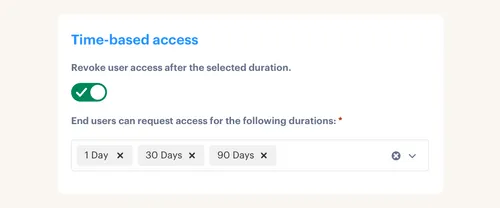
The better pattern is to make duration part of the request. If access is admin-level, production-related, finance-related, or tied to sensitive data, the requester should choose a window before approval. 1 hour, 6 hours, 24 hours. Pick the few durations your team can defend in an audit and make them the default options. Don't give people 17 choices. They won't choose better because the menu is longer.
The conditional rule is pretty simple. If the access creates material risk, require an expiry. If the access is low-risk and needed for daily work, route it through normal approval. If the same person keeps requesting the same temporary access every week, review whether the role design is wrong. Sometimes repeated temporary access is a sign that the job actually needs a standing role. Sometimes it’s a sign the team is using admin access as a shortcut.
There's a real tradeoff here. Time-bound access can annoy engineers during incidents if the expiry window is too short. That’s valid. The fix isn't removing expiry. The fix is choosing sane durations and allowing extensions when the prior request was already approved. Security theater makes teams slower. Time-bound access with a clear path keeps the work moving.
Keep Approvals Where People Already Respond
Approval workflows fail when they ask busy people to change habits. Managers don't wake up excited to log into a new identity portal. App owners don't want another queue. If the approval request doesn't show up where they already work, it gets missed, then IT starts chasing, then the requester starts complaining. The cycle repeats every time.
For teams already living in Jira and Slack, approvals should happen in Jira and Slack. The ticket is the record. Slack is the nudge. The approver gets the context, clicks approve or deny, and the ticket moves forward. Simple. The point isn't chat for the sake of chat. The point is reducing the gap between decision and evidence.
I’d set a 15-minute rule for approval nudges on high-volume access requests. If the approver hasn't acted after 15 minutes, send a reminder or escalate based on the app’s risk. Low-risk apps can have looser SLAs. Admin roles should have tighter ones. And if an app owner misses more than 20% of approvals in a month, the owner model is broken. Assign a backup or move the first approval to the requester’s manager.
The process I prefer looks like this:
- Employee requests a sanctioned app from Jira or Slack.
- The workflow identifies the approver based on app and role.
- Approver acts in Jira or Slack.
- Provisioning runs through the identity provider.
- The ticket records the approval, change, and status.
Midway through an access automation project, you should be able to see which requests are clean candidates for zero-touch provisioning and which still need human judgment. If you want to compare that flow against your current Jira setup, See how Multiplier works.
Treat Access Reviews as Cleanup and Feedback
Access reviews shouldn't be quarterly punishment. They should be feedback on whether your access request process is working. If every review finds the same stale users, the problem isn't the review. The problem is that access didn't expire, usage wasn't checked, or revocation was never tied back to the original workflow.
A good access review gives reviewers enough context to make a decision without hunting. User, app, group, job title, department, last login, and a clear keep or revoke action. If the reviewer has to open five systems to decide, they'll rubber-stamp. I don't blame them. Nobody has time to investigate 400 line items in a spreadsheet and feel great about the quality of that decision.
Use thresholds. If a user hasn't logged into an app in 90 days, mark it as a revoke recommendation. If an app contains sensitive customer data, review it monthly or after team changes. If an app is low-risk and has strong time-bound access controls, quarterly review may be enough. The threshold matters less than making the rule explicit and repeatable.
The review should feed back into the catalog:
- Roles with frequent revocations should get shorter default durations.
- Apps with unclear owners should be removed from auto-approval.
- Groups with stale membership should be remapped.
- Repeated manual exceptions should become new catalog options.
That’s how automating access request processes gets better over time. The request workflow creates evidence. The review checks whether the workflow is producing the right access. Then the catalog gets tighter.
Build the Audit Trail as a Byproduct
The strongest audit trail is the one created while the work happens. Not after. Not in a spreadsheet. Not from someone’s screenshots the week before the audit. The ticket should show who requested access, who approved it, what group changed, when it changed, whether it expired, and who revoked it later.
I get why teams rebuild evidence manually. They don't trust the workflow enough yet. Or their tools don't connect cleanly. But manual evidence collection is one of those things that looks cheap until the audit starts. Then suddenly your most experienced IT people are spending days proving work they already did.
A simple evidence rule works well: if an access event can't be explained from one ticket, the workflow isn't audit-ready. That doesn't mean every technical detail has to live in the ticket. It does mean the record should point to the decision, the action, and the outcome. One story. One place.
For SOC 2, ISO, SOX, or customer security reviews, that matters. The auditor isn't asking because they enjoy screenshots. They want proof that access was approved, granted correctly, reviewed, and removed when it should be removed. When the ticket carries that proof, audits stop becoming a seasonal scramble.
How Multiplier Keeps Access Governance Inside Jira
Multiplier keeps access governance inside Jira by turning requests, approvals, provisioning, reviews, expiry, and evidence into Jira-native workflows. The platform uses Jira Service Management as the system of record, then executes approved changes through Okta, Entra ID, or Google Workspace. That keeps least privilege tied to the ticket.
Jira-Native Requests With Identity Provider Provisioning
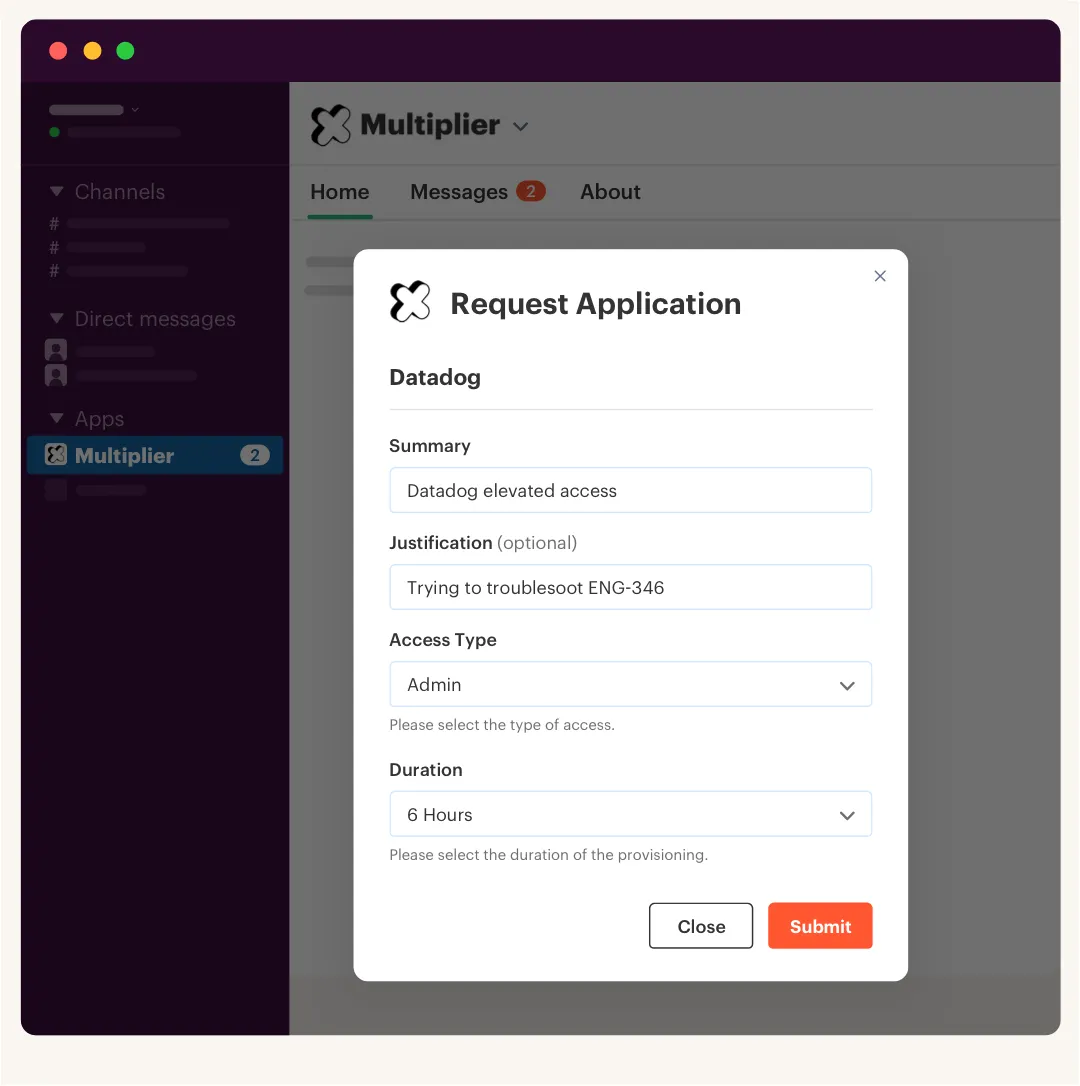
The Application Catalog gives employees a sanctioned place to request access from Jira Service Management or Slack. Apps appear as approved options, roles can map to identity provider groups, and submissions create Jira issues with the right context attached. That matters because automating access request processes starts with clean intake. Bad intake creates bad automation.

Automated Provisioning then removes the manual group-change step after approval. When the Jira issue reaches the configured approved status, the system calls the identity provider and adds the user to the mapped group. For SSO apps, that group membership carries access through the identity provider. The ticket also records success or failure comments, which gives IT a clear trail without asking someone to paste proof later.
Approval Workflows keep the decision in the same path. Managers, app owners, or specific users can approve in Jira or Slack, depending on how the workflow is configured. Not every app should be auto-approved, and that’s the right call. Higher-risk roles still need human judgment. The difference is that the judgment and the execution don't drift into separate systems.
Time-Bound Access and Reviews Create the Evidence Trail
Time-Based Access is where least privilege becomes practical. Requesters choose a duration like 1, 6, or 24 hours, approval happens, access is provisioned through the mapped identity provider group, and revocation happens when the timer expires. The limitation is worth saying clearly: automatic revocation requires access to be provisioned through identity provider group membership. Purely manual grants can't be removed that way.
Access Reviews bring the same Jira-native model to certification work. Admins create campaigns for approved apps, assign reviewers, and give them user attributes, group memberships, last login, and recommendations. Reviewers mark keep or revoke, and revocations can remove users from the relevant identity provider groups while Jira records the change. Admins can export results as CSV for auditors or push evidence to systems like Vanta.
Auto Reclaim handles another common leak: unused licenses. Based on login telemetry from connected identity providers, inactivity thresholds can trigger warning emails and then revoke access if the user stays inactive after the grace period. For teams dealing with SaaS sprawl, that ties cost control back into governance instead of turning it into a separate spreadsheet exercise. If your Jira queue is full of repeat access work and audit prep is still manual, Get started with Multiplier.
What Changes When Access Requests Run on Evidence
Access request automation changes the most when evidence is created during normal work. Employees get access faster, IT stops chasing routine approvals, security gets less standing privilege, and auditors get a cleaner record. The workflow becomes easier to run because the right behavior is built into the request path.
The old model made sense when teams were smaller. A few apps. A few employees. A few approvals. Once you have hundreds of employees, dozens of SaaS tools, and regular compliance checks, the old model starts to cost more than it saves. And the weird part is that the cost doesn't always show up as money first. It shows up as delays, missed revocations, and smart people doing admin work that a workflow should have handled.
So the move isn't “buy more governance.” The move is narrower than that. Put governance where the work already happens, make access temporary when risk is high, connect approvals to identity provider changes, and make audit evidence a byproduct. That’s how access gets faster without getting sloppy.
Frequently Asked Questions
How do I set up time-based access for sensitive applications?
To set up time-based access for sensitive applications using Multiplier, follow these steps: 1) In your Jira Service Management portal, navigate to the Application Catalog and select the application you want to configure. 2) Ensure that time-based access is enabled for that app, allowing requesters to choose durations like 1, 6, or 24 hours when submitting their access requests. 3) Once approved, Multiplier will automatically provision access and set a timer to revoke it once the duration expires. This helps enforce least privilege and reduces the risk of standing access.
What if I need to revoke access before the expiry date?
If you need to revoke access before the expiry date, you can do this directly through the Jira ticket associated with the access request. Simply locate the ticket, and if you have the necessary permissions, you can manually revoke access by removing the user from the mapped identity provider group. Multiplier will document this change in the ticket, ensuring that your audit trail remains intact. This allows you to maintain control over access even when circumstances change.
Can I automate access reviews in Multiplier?
Yes, you can automate access reviews in Multiplier by using the Access Review feature. Start by creating an access review campaign in your Jira Service Management. Select the applications you want to include, assign reviewers, and set a start and end date for the review. Once launched, reviewers will receive notifications and can mark users as 'Keep' or 'Revoke' based on their access needs. Multiplier will automatically remove users from the relevant identity provider groups when revocations are made, streamlining the review process.
When should I consider using the Auto Reclaim feature?
Consider using the Auto Reclaim feature when you want to optimize your SaaS spend and reduce unused licenses. This feature is particularly useful if you have a large number of applications and users. Set inactivity thresholds (like 30 days) and grace periods for users. When a user exceeds the inactivity threshold, Multiplier will notify them, and if they remain inactive, it will automatically revoke their access. This process helps ensure that you are only paying for licenses that are actively being used.
Why does my access request process feel slow?
Your access request process might feel slow due to fragmented workflows. If requests are coming from multiple channels like Slack, email, and Jira, it can create bottlenecks. To streamline this, use Multiplier's Application Catalog to centralize requests in Jira Service Management. This allows employees to submit requests in one place, and approvals can be routed directly to the right approvers within Jira or Slack, reducing delays and improving efficiency.


