


If your access process needs 6 screenshots to prove 1 approval happened, the process is already broken. And if you're ensuring compliance through automated tickets but still cleaning up access by hand, you're really just automating the front door while leaving the side door open.
Most IT and security teams don't lose control because they lack policy. They lose control because access work is split across Jira, Slack, Okta, spreadsheets, and memory. Which is a terrible system. If you're trying to see what Jira-native governance looks like in practice, Learn more about Multiplier.
Key Takeaways:
- Compliance gets easier when access expiry is built into the request, not remembered later.
- Just-in-time access works best for admin roles, production systems, finance apps, and customer data.
- Approval speed matters, but revocation speed matters more.
- If access lasts longer than the task, you're creating standing privilege.
- Automated compliance through Jira works when the ticket, approval, provisioning, expiry, and evidence stay connected.
Why Automated Compliance Breaks When Access Never Expires
Automated compliance breaks when teams automate approvals but leave access cleanup manual. The request looks controlled, the approval looks documented, and the audit trail looks fine at first. Then 90 days later, the person still has admin access because nobody owned the revocation.

The real risk isn't the request, it's the leftover access
Most teams think the access request is the compliance event. I don't think that's right. The real compliance event is the full lifecycle: who asked, who approved, what changed, when it changed, and when it ended. If the ending is missing, the record is incomplete.
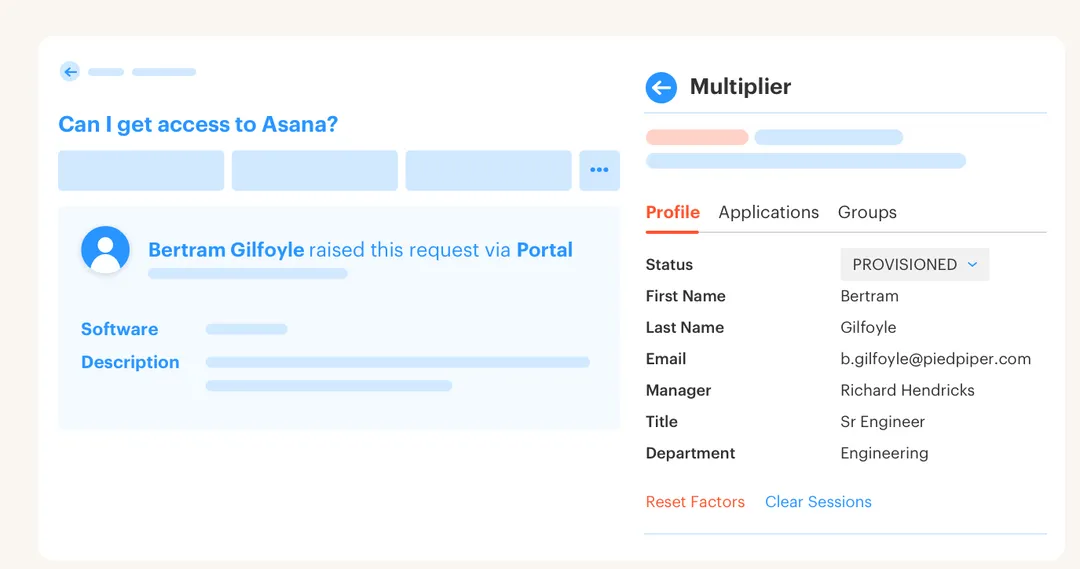
I've seen this pattern in fast-growing companies a lot. IT does the hard work of building request types in Jira. Security defines approvers. Managers get pinged in Slack. Then the actual access grant happens in the identity provider, and expiry gets tracked in a spreadsheet or, worse, in someone's head. That works at 50 employees. It starts to fail at 500.
A workplace technology manager opens Jira at 8:47 AM and sees 19 access tickets from new hires, transfers, and engineers needing production access for an incident. Three were approved in Slack. Two need app owner review. Four need Okta group changes. One asks for "temporary admin" with no end date. By lunch, the manager has done the work, but the evidence is scattered across 5 places. That's the part people underestimate. The work gets done, but the proof gets messy.
Separate IGA portals create more governance work
Separate identity governance portals sound cleaner on paper. Honestly, I get the appeal. A dedicated system feels more serious, and for very large enterprises with deep identity teams, that can be true. The downside is that most access work doesn't start there. It starts where employees already ask for things, which is usually Jira or Slack.

That split creates a weird operational tax. Jira has the request. Slack has the approval nudge. Okta or Entra has the group assignment. The IGA tool has the certification campaign. The spreadsheet has the auditor notes. Nobody designed it to be messy, but it becomes messy because every handoff creates another place for context to fall out.
The access stack starts to look like an airport security line where the boarding pass, passport check, baggage scan, and gate approval all happen in different terminals. Sure, every station has a job. But the traveler just wants to board the plane, and the airport needs one record showing the right person went through the right checks. Access governance has the same problem.
The better question isn't "which portal owns governance?" The better question is "where does the work already happen?"
How to Build Automated Compliance Around Access Expiry
Automated compliance works when access is designed around expiry, not just approval. The goal isn't to make every request faster for the sake of speed. The goal is to make the safe path the normal path, so least privilege happens without heroic follow-up.
Diagnose whether your access process is actually governed
A simple test will tell you a lot. Pick 10 access requests from the last 30 days. For each one, ask whether you can prove the requester, approver, exact entitlement, grant time, revocation time, and business reason without opening more than 2 systems. If you can't, your process is more manual than it looks.
The threshold matters. If more than 2 out of 10 requests are missing either an expiry date or proof of removal, start with time-bound access before you touch quarterly reviews. Reviews catch old risk. Expiry prevents new risk. That's a very different thing.
I like using 5 questions:
- Can an employee request the exact role they need, not just the app?
- Can the approver see why the access is needed?
- Can the grant happen through the identity provider, not manual app changes?
- Can access expire automatically after 1, 6, or 24 hours for risky roles?
- Can an auditor follow the whole story from the original ticket?
If the answer is no on expiry, you don't have just-in-time access yet. You have approved standing access with nicer paperwork.
Use duration as the policy, not an afterthought
The strongest access policy is usually a time window. Not a paragraph in a security doc. Not a quarterly reminder. A real duration attached to the request before approval happens. If someone needs production access for an incident, they shouldn't get it forever because everyone was too busy to clean up later.
A practical rule: default high-risk access to 1 or 6 hours, and force a reason for anything over 24 hours. Admin roles, database access, financial systems, customer data, and deployment permissions should rarely be granted without an end time. If the work takes longer, the requester can extend it. That's still better than granting broad access and hoping someone remembers.
A fintech team dealing with privileged access reduced standing privilege by 85% after moving to a just-in-time model. They also had 1,300+ access requests automatically revoked after approved windows. The interesting part isn't just the security gain. It's the operating model. Access became something you borrow for a reason, not something you collect forever.
Worth saying the tradeoff out loud. Time-bound access can annoy people at first. Engineers don't love asking twice during a long incident. Fair. But if the extension path is fast and the original request was already approved, the friction is tiny compared to the risk of long-lived access piling up across the company.
Keep the ticket, approval, and identity change connected
Ensuring compliance through automated workflows only works when the system of record actually sees the change. If Jira says "approved" but the identity provider change happens manually, your evidence has a gap. Someone still has to prove the group assignment happened, and someone still has to prove it was removed.
The clean version is boring, which is exactly why it works. The employee requests an app and role. The approver approves. The identity provider group changes. The ticket records the change. The expiry removes the group membership. The ticket records that too. Nothing magical. Just connected.
For teams using Jira Service Management, Okta, Entra ID, or Google Workspace, the identity provider should be the enforcement point. Jira should hold the work record. Slack can speed up the decision. Each tool has a job. The mistake is letting all 3 become partial sources of truth.
NIST's access control guidance is pretty clear on this idea, even if the language is more formal than most people would ever say out loud. Account management needs creation, modification, disabling, and review controls, not just approval. The relevant control family in NIST SP 800-53 Rev. 5 is a good reference point if you're building evidence for auditors.
Separate low-risk access from privileged access
Not every request deserves the same path. That sounds obvious, but a lot of teams still run Figma viewer access and production admin access through basically the same approval process. Then everyone complains the process is slow, so IT starts bypassing steps to keep people moving.
Use 3 buckets instead. Low-risk access can be auto-approved if the requester matches the right department, role, or group. Medium-risk access should go to a manager or app owner. High-risk access should require explicit approval plus a short time window. If you can't explain why an app is in one bucket, it's probably in the wrong bucket.
The numbers can be simple:
- Low risk: standard employee tools, default role, no sensitive data, no admin rights.
- Medium risk: business systems with customer, finance, or employee data.
- High risk: admin roles, production systems, privileged groups, data exports.
A 4-person IT Ops team at a fast-growing AI company processed 3,800+ access requests in a year and automated 75% of them. That didn't happen because every request became equally important. It happened because repetitive, low-risk work stopped consuming the team, and higher-risk access could get the controls it actually needed.
If your team is still treating every request the same, See how Multiplier works.
Make access reviews prove enforcement, not intent
Access reviews often become a ritual. Export users. Send spreadsheet. Ask app owners to keep or revoke. Chase responses. Copy results somewhere else. Everyone knows some access gets removed, but the process still feels like cleanup after the real work already happened.
A better access review has usage context and enforcement in the same workflow. If a user hasn't logged in for 90 days, the reviewer should see that. If the reviewer chooses revoke, the identity provider group removal should actually happen. If the removal happens, the evidence should attach to the same record. Otherwise, you're asking reviewers to make decisions without enough context, then asking IT to do a second round of manual work.
Use this rule: if a review decision creates another ticket for someone else to interpret later, the review isn't enforcing governance yet. It's just documenting intent. And intent doesn't reduce access.
SOC 2 auditors won't expect every company to run access reviews the same way, but they will care whether controls are designed and operating. The AICPA Trust Services Criteria are useful here because they push teams to show repeatable control activity, not one-off heroics.
Automate license cleanup where usage data exists
SaaS waste and compliance risk are more connected than people think. An unused license is often also unused access. If someone hasn't logged into an app for 30, 60, or 90 days, the company may be paying for a license they don't need, while also carrying an entitlement that shouldn't exist.
Don't start with every app. Start with the apps where your identity provider has reliable last-login data. Then set a clear inactivity threshold. For lower-risk tools, 30 days may be fine. For sensitive apps, shorter windows may make sense, but only if the business can tolerate it. Executives, contractors, and certain service accounts may need exclusions, and that's okay. The point isn't blind revocation. The point is consistent cleanup.
The before and after is pretty stark. Before, IT exports usage, asks people if they still need access, waits, follows up, revokes manually, and writes notes. After, inactive users get warned, a grace period runs, access is removed if they don't respond, and a ticket records the action. Same control. Way less chasing.
One caveat. Login data isn't perfect. Some apps don't report it well. Some users have legitimate low-frequency access. So don't pretend automation removes judgment. It removes the repetitive part, which gives your team more time for the judgment calls that actually deserve human attention.
How Multiplier Enforces Time-Bound Access in Jira
Multiplier enforces time-bound access by keeping requests, approvals, provisioning, expiry, and evidence inside Jira Service Management. It provisions through identity provider groups, supports Slack-based approvals, and records access changes on the Jira issue. That gives IT and security a cleaner way to prove compliance through automated enforcement.
Time-based access turns approval into expiry
Multiplier's Time-Based Access lets requesters choose a duration, like 1, 6, or 24 hours, when they submit access requests. After approval, Multiplier adds the user to the mapped identity provider group and starts the timer. When the window expires, it removes the group membership and writes the revocation back to the Jira issue.
That matters because the access request no longer ends at "approved." It ends at removal. For privileged access, production systems, admin roles, and sensitive datasets, that changes the whole control. You don't need someone to remember cleanup after an incident. The system handles the expiry when the approved window ends, as long as the access was granted through identity provider group membership.
Multiplier also supports requests and approvals in Slack, with Jira still acting as the system of record. Employees can request access from the catalog, approvers can approve or deny from Slack or JSM, and the resulting ticket keeps the record tied together. The workflow feels natural because people aren't being forced into a separate IGA portal for routine work.
Automated provisioning keeps evidence tied to the ticket
Multiplier provisions access through Okta, Entra ID, or Google Workspace groups mapped to catalog roles. When a Jira issue reaches the approved status, Multiplier calls the identity provider to add the user to the right group. For time-bound access, the same connection removes the user when the window expires.

The Application Catalog also matters here. Employees request approved apps and roles from a Jira-native catalog, instead of sending vague Slack messages like "can I get access to Salesforce?" That forces cleaner input up front. App owner, manager, or named-user approvals can route the decision, and the identity change stays attached to the originating issue.
For access reviews, Multiplier runs certification campaigns in JSM with user attributes, group memberships, last login, and reviewer decisions in one place. Reviewers can mark Keep or Revoke, and revocations can remove users from relevant identity provider groups. For license cleanup, Auto Reclaim can use identity provider login telemetry, inactivity thresholds, grace periods, and exclusions to revoke unused access and create the Jira record.
If you want time-bound access, identity provider provisioning, and audit evidence living in the same Jira workflow, Get started with Multiplier.
The Access Compliance Work Moves Into Jira
Compliance doesn't get easier because you add another portal. It gets easier when the access lifecycle is controlled where the work already happens. Request, approval, provisioning, expiry, review, and evidence need to live in one connected flow.
The big shift is moving from approved access to expiring access. Once access has a timer, least privilege becomes operational instead of theoretical. And once the identity change writes back to Jira, the audit trail stops being a reconstruction project.
That's the work. Put governance where people already ask for access, make risky access temporary by default, and let the record build itself as the work happens.
Frequently Asked Questions
How do I set up time-based access in Multiplier?
To set up time-based access in Multiplier, follow these steps: 1) When submitting an access request via the Jira Service Management portal or Slack, select the desired duration for access (like 1, 6, or 24 hours). 2) After approval, Multiplier will automatically provision access and start a timer to revoke it once the duration expires. 3) The one requirement: access must be provisioned through identity provider groups. That's what Multiplier revokes when the timer runs out.
What if I need to extend access for a user in Multiplier?
If you need to extend access for a user in Multiplier, you can do so easily if the original request was already approved. Just submit a new request for the same access, and Multiplier can automatically extend the access duration without requiring re-approval, as long as it falls within your configured policies. This feature minimizes friction during incidents, without blowing up the compliance model.
Can I automate license cleanup with Multiplier?
Yes. Use Multiplier's Auto Reclaim feature. Set an inactivity threshold per app — 30 days is a common starting point for lower-risk tools. Multiplier notifies inactive users, runs a grace period, then revokes access if they don't log in. Each removal gets documented in a Jira ticket. Same control as a manual review, without the spreadsheet export and follow-up chasing.
When should I conduct access reviews using Multiplier?
Quarterly is the standard baseline, though the cadence should match your risk profile and audit requirements. Set up review campaigns in Jira Service Management. Reviewers see user attributes, group memberships, and last login data in one place — no spreadsheet export needed. When a reviewer chooses Revoke, the identity provider group change happens automatically.
Why does Multiplier integrate with identity providers?
Because that's where access actually lives. Jira can hold the request and approval, but if the group membership in Okta, Entra ID, or Google Workspace doesn't change, nothing has actually changed. Multiplier connects the approval to the group change automatically, so the Jira ticket and the identity provider stay in sync. That's what makes the audit trail real — traceable from request to approval to group membership to removal.


