


Your audit shouldn't start 2 weeks before the auditor shows up. It should already be sitting in Jira, attached to the access request, the approval, and the identity provider change that actually happened. Most IT teams treat evidence like a cleanup job, when it should be a byproduct of the workflow. So how do you set that up without adding another portal everyone has to remember?
Chasing approvals works for a while. At 100 employees, you can wing it. At 500, you're living in Jira, Slack, Okta, email, and a spreadsheet that no one trusts. By the time audit season hits, everyone is pretending the process was cleaner than it actually was.
Key Takeaways:
- Set up access requests where employees already work, usually Jira and Slack.
- Map every requestable role to an identity provider group before automating approvals.
- Treat approval, provisioning, expiry, and audit evidence as one workflow.
- Use time-bound access for elevated roles so standing privilege doesn't pile up.
- Run access reviews from the same system that creates and removes access.
- If evidence has to be rebuilt later, the workflow is broken now.
Why Jira Access Requests Break Before Audits
Jira access requests break because most teams only solve intake, not the full access lifecycle. A ticket captures the ask, but it doesn't prove the right person approved it, the right group changed, or the access ended when it should have. That gap becomes obvious during audits, usually at the worst possible moment.

Ticket Intake Is Not Governance
A Jira ticket feels official. That's why this problem sneaks up on people. Someone requests access, the ticket gets created, an approver comments "approved," and an IT admin adds the user to the right Okta or Entra group. Looks fine enough. Everyone moves on.
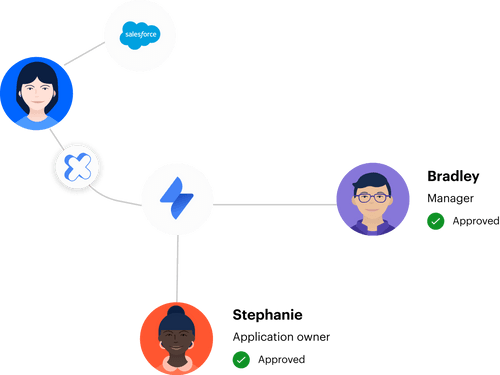
The actual governance happened outside the ticket. The approval might be in Slack, the group change happened in the identity provider, and the evidence might be a screenshot. The expiry date, if there was one, lives in someone's head or a calendar reminder they may or may not trust. So when someone asks how do you set up a clean audit trail, the answer isn't "make better tickets." The answer is "stop splitting the workflow across 4 places."
I've seen teams convince themselves that because Jira is involved, they're covered. That's a reasonable read. Jira is the system of record for a lot of IT teams, and most employees already know how to file a request there. If Jira only records the request and not the decision, the provisioning action, and the revocation, you're basically using it as a front desk. Useful, but incomplete.
For teams trying to keep Jira as the front door while reducing manual work behind it, the better question is how do you set the request up so approval and provisioning are connected from day one. That's the operating model worth looking at, and Learn more about Multiplier if you want to see what that looks like inside JSM.
The Spreadsheet Shows Up When the System Fails
It's 4:47 PM on a Thursday, two days before a SOC 2 evidence deadline. An IT manager has Jira open on one monitor, Okta on another, Slack search on the third, and a half-finished spreadsheet on the laptop. They're trying to reconstruct 38 access changes from the last quarter, and 11 of them have no clear approval trail. They aren't doing governance anymore. They're doing archaeology. And frankly, it feels ridiculous because the company already has systems that should know the answer.
Spreadsheets are usually a symptom, not the root problem. They show up because the team can't answer basic questions from the system they already use: who requested access, who approved it, what group changed, when it changed, and whether it was removed. Once those answers live in 5 places, someone builds a spreadsheet to make it all look coherent.
The cost isn't just audit prep. The hidden cost is trust. Security stops trusting IT's evidence. IT stops trusting app owners to respond on time. Employees stop trusting the access process, so they ask around in Slack or borrow access from someone else. Bad pattern.
The fix is to make evidence a byproduct of the normal workflow, not a quarterly reconstruction project. If the Jira issue captures the request, approval, identity provider change, and eventual removal, the audit trail exists because work happened, not because someone rebuilt it later.
How Do You Set Up Access Requests That Actually Govern
A strong Jira access workflow starts with the access model, not the form fields. You define what employees can request, who can approve it, what identity provider group grants it, and when it should expire. Once those are clear, automation becomes much safer.
Start With the Access Menu, Not the Ticket Form
Most teams start by asking what fields should go on the Jira form. Reasonable instinct. You need the requester, app name, business reason, manager, urgency, maybe a role. Start there and you end up with a prettier ticket and the same manual mess behind it.
Start with the access menu instead. Which apps are sanctioned? Which roles are valid? Which roles are low risk enough to auto-approve? Which ones need an app owner or manager? Which ones should always expire after 1 hour, 6 hours, or 24 hours? That work feels slower at first, but it makes everything after it easier.
A simple diagnostic works well here. Before you build the Jira request type, answer these questions:
- Can the requester choose from approved apps only? If not, IT will keep cleaning up messy free-text requests.
- Does every role map to a group in Okta, Entra, or Google Workspace? If not, provisioning can't be consistent.
- Is there one clear approver per app or role? If not, tickets will stall.
- Does elevated access have a default expiry? If not, standing privilege will grow.
- Can the ticket show what changed after approval? If not, audit prep stays manual.
If you answer "no" to 2 or more of these, your access workflow isn't ready to automate yet. Automating broken inputs just creates broken outputs faster.
At Videoamp, the pattern was pretty clear. The company grew from 100 to 500 employees, and Tuesdays became a repeatable access backlog after new hires started. Requests came in without enough detail, ownership was unclear, and IT became the bottleneck. Once they moved to a self-service app catalog in Jira, they processed 500+ app requests in 6 months and saved 70+ hours of IT productivity. Not because the ticket form was magical. Because the request options were structured up front.
Map Roles to Identity Provider Groups Before You Automate
Automation only works when the inputs are clean. If "Figma access" can mean Viewer, Editor, Admin, contractor access, or a random one-off exception, then automating the approval won't solve much. You'll just move confusion faster.
The practical move is to map each requestable role to one or more identity provider groups. Viewer maps to one group. Editor maps to another. Admin maps to a tighter group with stronger approval. When the Jira issue reaches the approved status, the system should know exactly which group membership to add or remove. No guessing.
A lot of teams get stuck here. They want automation, but their identity provider groups are messy. Some groups are named badly. Some apps have duplicate groups. Some roles don't map cleanly to what users actually need. Annoying? Very. Cleaning up the group model is the work. Without it, how do you set up access automation that doesn't create risk? You don't.
A useful rule: if an IT admin has to interpret the request after approval, it isn't ready for automation. The request should already contain the app, role, approver, duration if needed, and mapped group. The admin shouldn't be the translation layer.
Separate Low-Risk Access From Privileged Access
A new hire asking for Zoom shouldn't go through the same approval path as an engineer asking for production database access. When everything gets treated as high risk, low-risk work clogs the queue. When everything gets treated as low risk, privileged access gets sloppy.
Segmentation works better. Low-risk apps can be requestable from the catalog with manager or app owner approval. Medium-risk roles may need a business reason and named owner. Privileged access should usually be time-bound, with tighter approval and automatic removal. Not forever access. Not "remember to remove it later." Actual expiry.
Stavvy is a good example of why this matters. After funding and acquisitions, they had long-lived privileged access they needed to reduce. They moved to a just-in-time access model and cut privileged access by 85%, with 1,300+ access requests automatically revoked after approved windows. That number matters because it shows the mechanism. Access didn't get safer because someone wrote a better policy. It got safer because expiry was built into the workflow.
Some security teams prefer broad standing access because it avoids operational friction. I get it. During incidents, nobody wants an access process slowing people down. The better answer isn't permanent access for everyone who might need it someday. The better answer is fast temporary access with approval, logging, and automatic removal.
Make Slack a Decision Point, Not a Side Channel
Slack is where work happens. Ignoring that is silly. Approvers don't want to live in another portal just to click approve on routine access requests. If they already work in Slack all day, approvals should meet them there.
The catch is that Slack can't become the system of record. If someone approves in a DM and the Jira ticket doesn't capture it, you've made the process faster and weaker at the same time. Bad trade. Chat should be the decision surface, while Jira remains the record.
I like a simple boundary here. Slack is for notification and action. Jira is for workflow state and evidence. The identity provider is for the actual access change. Keep those roles clean and the system becomes much easier to reason about.
For a team that already has Jira and Slack adoption, the midpoint is usually obvious: bring the approval to chat, but write the decision and provisioning result back to the ticket. That keeps the workflow fast without turning audit evidence into Slack search.
Build Audit Evidence Into Every State Change
Audit readiness is usually treated like a reporting problem. That's backwards. The report is only as good as the workflow that produced it. If the workflow is fragmented, the report becomes a cleanup exercise.
Every meaningful state change should write evidence somewhere durable. Request submitted, approver assigned, approval granted, group added, access expired, group removed, review decision made, and revocation completed. Each of those events should connect back to the original request or review record.
The test is simple. Pick 10 random access changes from the last 90 days and ask if you can answer these questions in under 10 minutes:
- Who requested access?
- What access did they request?
- Who approved it?
- What identity provider group changed?
- Was access removed, and when?
If that takes more than 10 minutes, your audit process is already too manual. You may not feel it today. You will feel it when the auditor asks for a sample and the team starts hunting through screenshots.
Use Reviews to Clean Up What Requests Miss
Access reviews are not a substitute for good request workflows. They catch what slips through. People change roles, teams reorganize, apps get abandoned, contractors leave, and exceptions pile up. Even a clean access request process needs a review layer.
The mistake is running reviews in spreadsheets while requests happen in Jira. Reviewers mark keep or revoke in a sheet, IT then creates tickets or manually removes groups, someone later updates the sheet, every handoff creates a gap, and gaps are where revocations get missed.
A better review workflow keeps the reviewer decision and the revocation action close together. Show the reviewer the user, group, department, job title, last login, and recommendation. Let them keep or revoke. Then execute the revoke through the identity provider and record the action back in Jira. That's the loop.
If you're wondering how do you set the right review cadence, use risk and change rate. High-risk apps should be reviewed more often. Stable, low-risk apps can run quarterly or semi-annually. Apps with lots of role changes need more frequent review than apps with fixed membership. A working rule of thumb: if more than 15% of a review ends in "revoke," you're reviewing too infrequently, and if less than 2% does, you're probably reviewing too often. The point isn't to review everything constantly. The point is to review the places where stale access actually costs you.
How Multiplier Automates Jira Access
Multiplier automates Jira access governance by connecting JSM requests, Slack approvals, identity provider group changes, and audit evidence in one workflow. It doesn't replace your identity provider. It uses Okta, Entra ID, or Google Workspace groups as the control point.
Jira-Native Requests With Identity Provider Provisioning
Multiplier's Application Catalog gives employees a Jira-native place to request sanctioned apps and roles. The important part is the mapping behind the catalog. Each role can map to identity provider groups, so once the right approval happens, provisioning is not a manual copy-paste step anymore.

Multiplier then calls the identity provider to add or remove the user from the mapped group when the Jira issue reaches the configured approved status. For SSO apps, that group membership can drive downstream access through the identity provider. The Jira issue gets updated with the result, which gives IT a cleaner record than "approved in Slack, changed in Okta, screenshot later."
That directly addresses the mess from earlier. Instead of Jira being intake only, Jira becomes the workflow record. Instead of IT interpreting every approved request, the role-to-group mapping makes the change predictable. Instead of rebuilding evidence, the ticket carries the request, approval, and provisioning result together.
Time-Bound Access and Reviews Without Spreadsheet Cleanup
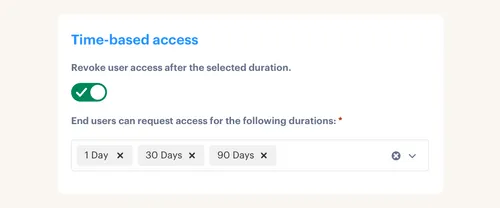
For elevated roles, Multiplier's Time-Based Access lets requesters choose a duration like 1, 6, or 24 hours. After approval, access is granted through the mapped identity provider group, and removal happens when the window expires. The revocation is recorded back to the Jira issue, which matters because expiry without proof is just a promise.
Multiplier also runs access reviews in JSM. Reviewers can see user attributes, groups, last login, and recommendations, then choose keep or revoke. When they revoke access for supported identity provider group-based apps, the removal happens through the identity provider and the evidence stays tied to Jira. For teams still living in quarterly spreadsheets, that alone can remove a lot of painful cleanup.
The late-stage value is pretty practical: access requests, approvals, provisioning, expiry, reviews, and revocations all tie back to the place IT already works. If you want that model instead of another portal sitting beside Jira, Get started with Multiplier.
Build Audit Readiness Into the Workflow
Access governance gets a lot easier when you stop treating Jira as a ticket inbox and start treating it as the operating layer for access. The request should create the record. The approval should live on that record. The identity provider change should write back to that record. Expiry or revocation should be visible without a spreadsheet hunt.
The real win isn't just faster access. It's cleaner control. When people ask how do you set up Jira access governance properly, the answer is pretty straightforward: define the requestable access, map it to identity provider groups, route approvals where people already work, and make evidence appear as work happens. That's how you stop rebuilding the audit after the fact.
Frequently Asked Questions
How do I set up time-bound access with Multiplier?
To set up time-bound access using Multiplier, start by defining the access duration options for your applications, such as 1, 6, or 24 hours. When employees submit a request through the Multiplier Application Catalog, they can select their desired duration. Once the request is approved, Multiplier will automatically provision access and set a timer to revoke it once the time expires. Elevated access stays temporary, with no lingering permissions. Make sure to monitor the Jira ticket for updates on the access grant and revocation.
What if an approver is unavailable during a request?
If an approver is unavailable, you can set up a fallback approver in your Multiplier approval workflow. This ensures that the request doesn't stall. Admins can designate default approvers globally or override them on a per-app basis. When the primary approver is unavailable, the request will automatically route to the fallback approver, keeping the process moving smoothly. This way, you can avoid delays in access provisioning and keep things moving.
Can I integrate Slack approvals with Multiplier?
Yes, you can integrate Slack approvals with Multiplier. When a request is submitted, approvers receive notifications in Slack with options to approve or deny the request directly from the chat. This feature keeps approvals fast without requiring approvers to jump between platforms. Just ensure that your Multiplier Slack app is properly installed and configured to mirror the Application Catalog from Jira. Evidence stays tied to the Jira ticket where it belongs.
When should I conduct access reviews using Multiplier?
You should conduct access reviews using Multiplier regularly, especially for high-risk applications. A good rule of thumb is to review access quarterly for stable, low-risk apps and more frequently for apps with high turnover or role changes. Multiplier's Access Review feature allows you to create campaigns that streamline this process, giving reviewers the context they need. This helps maintain a clean access environment and keeps access in line with your security requirements.
Why does Multiplier require role-to-group mapping?
Multiplier requires role-to-group mapping to ensure that access provisioning is accurate and consistent. Each role requested by an employee must map to a specific identity provider group. This mapping eliminates confusion during the approval process and ensures that the right level of access is granted. Without proper mapping, IT admins may have to interpret requests, which can lead to errors. By establishing clear mappings, you can automate provisioning and maintain a reliable audit trail.


