


55 minutes. That’s roughly what a quarterly access review can turn into per app owner when the evidence is scattered across Jira tickets, Slack threads, spreadsheets, and your identity provider. And if you’re trying to implement granular access control with that setup, you’re not really implementing control. You’re implementing delay.
Most teams think access governance needs its own portal. I think that’s backwards. The moment you split requests in Jira, approvals in Slack, provisioning in Okta or Entra, and evidence in spreadsheets, you’ve created the exact mess you’re trying to govern.
Key Takeaways:
- Granular access control breaks when requests, approvals, provisioning, and evidence live in different systems
- If elevated access doesn’t expire automatically, it usually becomes standing access by accident
- If app owners can’t review access with last-login context, reviews become rubber stamps
- Access reviews work better when revocations execute from the review itself, not as a separate cleanup task
- Jira-native governance is often faster to adopt because it fits where teams already do the work
- Identity-provider group mapping is the practical path to granular access control at scale
- The best audit trail is the one created as a byproduct of the workflow, not rebuilt later
Why Separate Portals Break Granular Access Control
Granular access control means the right person gets the right access for the right amount of time, with proof. That’s the whole job. The problem is most companies try to implement granular access control by layering more tools on top of already fragmented workflows.

A pretty normal day looks like this. An engineer needs elevated access to a production tool at 2:15 PM. They open a Jira request, their manager approves in Slack, someone from IT later checks a spreadsheet to find the right group, then adds the user in Okta, and nobody sets an expiry because they’re trying to keep the queue moving. Three weeks later, that access is still there. Audit comes around, and now someone is piecing together screenshots to explain what happened. Sound familiar?
The split between ITSM and IGA is the real bottleneck
The usual diagnosis is “we need better policy” or “we need a stronger review process.” I don’t buy that. The real bottleneck is the split itself.
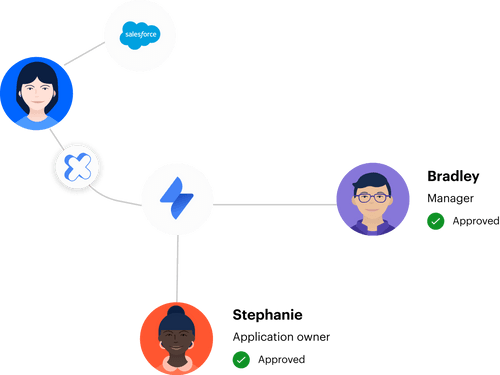
When governance lives outside the service desk, every request becomes a handoff problem. And handoffs are where speed dies. If you’ve got more than 50 access requests a week and more than 2 systems involved in each one, you should assume latency is coming from coordination, not from the actual approval logic. That’s the first thing I’d check.
There’s a fair point in favor of separate IGA suites. They can go very deep on controls. That part is true. But if your team is still managing intake in Jira and approvals in Slack, a separate portal often adds one more place people have to remember to use. The control model gets stronger on paper and weaker in daily operations.
Manual expiry is where least privilege quietly fails
Least privilege sounds great in policy docs. In the real world, it usually falls apart at expiry.

If privileged access is supposed to last 1 hour, 6 hours, or 24 hours, and the revocation depends on a human remembering to remove a group later, you don’t have just-in-time access. You have temporary intent and permanent risk. That’s a big difference.
A fintech team in the KB had exactly this problem. Long-lived privileged access had piled up after growth and acquisitions. Once they shifted to time-bound access, they cut privileged access by 85% and had more than 1,300 requests auto-revoked after approved windows. That’s what control looks like when the workflow enforces the rule instead of asking humans to remember it.
If you want to Learn more about Multiplier, that’s the angle I’d focus on first: not “how do we add more policy,” but “where does expiry actually happen?”
Access reviews become theater without action built in
Quarterly reviews are where a lot of governance programs pretend they’re working.
App owners get a CSV. Or a spreadsheet. Or a pile of tickets. They don’t have usage context, they don’t know who still needs what, and they’ve got 20 other priorities. So they scan, approve most of it, and move on. Then IT has to interpret those decisions and manually revoke access later. That’s not a review system. That’s a paperwork system.
The hidden cost is trust. Once your reviewers know their clicks don’t actually enforce anything, the review quality drops fast. And that’s when audits start feeling like archaeology. You’re digging through old records trying to reconstruct intent.
That’s the real problem this article needs to solve. Not more governance. Better operating mechanics.
What You’re Actually Solving When You Implement Granular Access Control
Implement granular access control by tying entitlement, duration, reviewer context, and enforcement to the same workflow. That’s the direct answer. If those pieces live apart, the process slows down and the control weakens at the same time.
Most teams frame this as a permissions design project. I think that misses the point. It’s really an operating model problem. You’re deciding whether access control is something people have to remember to do right, or something the workflow makes hard to do wrong.
Start by diagnosing where your current model breaks
Before changing tooling, I’d ask five questions.
- Where does an access request start?
- Where does the approval happen?
- Where is the actual grant executed?
- Where is expiry set?
- Where is evidence collected for audit?
If your answers span 4 or 5 different systems, your current model is already telling you why it’s slow. If expiry is “manual follow-up,” fix that first. If review decisions don’t trigger revocations, fix that second. Those two gaps create most of the standing privilege mess I’ve seen.
A useful threshold here: if more than 10% of elevated requests stay open past their intended duration, stop debating review frequency and automate revocation. You won’t spreadsheet your way out of that.
Granular access control is really four controls working together
People talk about granularity like it’s one thing. It isn’t. It’s four separate controls that need to line up.
First, scope. What app or resource is being requested, and at what role level. Viewer is different from Admin. Permanent is different from 6 hours.
Second, routing. Who has to approve this. Manager, app owner, or a specific person. If every request goes to the same generic queue, you don’t have precision. You have backlog.
Third, enforcement. Does approval actually trigger the right group assignment through the identity provider, or does someone still have to do the work by hand later?
Fourth, cleanup. Does access expire automatically or get reviewed with enough context to remove what’s stale?
Miss one of those and the whole thing gets fuzzy. That’s why so many “granular access control” projects still end with standing access and cleanup sprints.
The root cause isn’t bad intent. It’s missing workflow design
I’ve got some sympathy for teams that end up here. The old way exists for a reason. Jira handles intake well. Slack is where people are. Okta or Entra is the source of truth for groups. Spreadsheets are easy when you’re small. It all feels reasonable at first.
Then you hit growth. A company in the KB onboarded 387 employees in eight months. Another went from 100 to 500 employees and saw onboarding requests swamp IT every Tuesday. That’s the moment the patchwork stops being “good enough” and starts costing real time, real money, and real audit pain.
So no, the old way isn’t irrational. It just stops working much earlier than most teams expect. At around 200 to 300 employees, especially if you’re adding apps quickly, the coordination tax starts showing up everywhere.
The shift you need is simple: treat access control like a system, not a collection of approvals.
How to Implement Granular Access Control Without Creating More Friction
Implement granular access control by standardizing request intake, mapping roles to identity-provider groups, making elevated access time-bound by default, and running reviews where revocations can execute immediately. That’s the model. The details matter, but the sequence matters more.
This is where most advice gets too abstract. So let’s make it practical.
Put request intake into a single front door
A single intake path cuts ambiguity before it cuts labor. If employees can request access in Slack, email, DMs, or random Jira forms, you’ll spend half your time normalizing bad input.
What works better is one request path with sanctioned apps, defined roles, and enough structure to route correctly. A catalog approach does this well because it forces the request to include the app, the role, and sometimes the duration upfront. No guessing later.
A good rule here: if the same application gets requested more than 8 times a month, stop treating it like an exception and add it to a standardized catalog. Below that threshold, manual handling might be fine. Above it, the repeat volume justifies structure.
One advertising company in the KB processed 500 plus app requests in six months after moving to a self-service access catalog inside Jira Service Management. They saved 70 plus hours of IT productivity and lowered resolution times. That’s not because the requests disappeared. It’s because the input got cleaner.
Map roles to identity-provider groups before you automate anything
This is the part teams skip because it’s a little tedious. And it’s also the part that determines whether automation works.
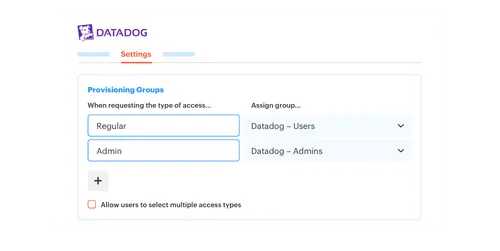
If your access roles aren’t mapped clearly to Okta, Entra, or Google Workspace groups, your “automation” still depends on humans interpreting requests. That’s brittle. Granular access control needs deterministic mapping. Request this role, join this group. End of story.
I’d break apps into three buckets:
- Low-risk, high-volume apps that can use default approval or even auto-approval if your policy allows it
- Medium-risk apps that need manager or app-owner approval
- High-risk or privileged access that needs explicit approval plus duration
That bucketing matters because not every app deserves the same workflow. If every request gets the maximum approval chain, your team will work around the system. If every request gets the minimum, you’ll accumulate risk. The right split is usually based on impact, not app popularity.
A lot of teams want perfection here. You don’t need perfection. You need consistency. Start with the 20 apps that create 80% of request volume and get the mappings clean there first.
Make elevated access temporary by default
This is probably the highest leverage move in the whole system.
If an app or role is sensitive enough that you wouldn’t want broad standing access, then the default should be time-bound. Not optional. Default. Give people 1 hour, 6 hours, or 24 hours based on the work. If they need an extension, make that part of the workflow too.
Why does this matter so much? Because permanent access is the path of least resistance in most organizations. Once granted, it tends to stay. So if you want to implement granular access control in a way that actually reduces standing privilege, duration has to be part of the entitlement, not a side note.
There is a tradeoff. Time-bound access can feel like extra friction to engineers or admins in the moment. That’s valid. If someone needs the same elevated role every single day, forcing hourly requests is silly. In that case, redesign the role or use a longer window. The point isn’t to create pain. The point is to avoid accidental permanence.
That nuance matters. Good access control isn’t “lock everything down.” It’s “match access duration to actual need.”
Run access reviews with usage context, not blind spreadsheets
Reviews improve when the reviewer can answer one question fast: does this person still need this access?
That’s why last login, department, title, group membership, and recommendations matter. Without that context, reviews drag. With it, they move. If a reviewer sees an inactive user who hasn’t logged in for 90 plus days, the decision gets a lot easier.
One practical rule: if your review artifact doesn’t show last login and reviewer ownership in the same screen, expect rubber stamping. People are busy. If the data isn’t right there, they won’t go hunting for it.
And this is the bigger shift. A review should not end with “someone from IT will handle revocations later.” The review should be the action point. Keep or revoke. Done. That’s the difference between governance theater and governance.
If you want to See how Multiplier works, look at the handoff between review decision and actual revocation. That’s where a lot of programs either become real or stay cosmetic.
Use a red-flag test before you expand the program
You don’t need a giant maturity model to know if your rollout is healthy. Watch for a few red flags.
- Review completion takes more than 10 business days for a modest app set
- More than 15% of requests need manual clarification after submission
- Privileged access requests don’t include a duration
- Revocations from reviews happen in batches later, not from the review itself
- Auditors still ask for screenshots because the ticket record isn’t enough
If you’re seeing 2 or more of those, your issue isn’t user training. It’s design.
Honestly, this surprised me more than anything else when looking at these workflows over the years. Teams usually assume slowness comes from approvers. A lot of the time it comes earlier, from unclear intake, and later, from manual cleanup. The approval itself is often the shortest part.
That changes what you fix first.
How Multiplier Puts Granular Access Control Inside Jira
Multiplier puts granular access control inside Jira Service Management by connecting requests, approvals, provisioning, time limits, and reviews to the same system of record. Changes still execute through your identity provider, but the workflow and evidence live in Jira, where your team already works.
That matters because the costs we talked about earlier are mostly coordination costs. Chasing approvals. Forgetting expiry. Rebuilding evidence. Running blind reviews. Multiplier is built to remove those handoffs.
Time-bound access and approval routing are built into the request flow
Multiplier’s Application Catalog gives employees a Jira-native place to request sanctioned apps and roles through JSM or Slack. Each role maps to identity-provider groups, which makes the request specific enough to enforce cleanly later. Then Approval Workflows route the request to the right person, whether that’s a manager, an app owner, or a specific user, with actions available in Jira and Slack.
For elevated roles, Time-Based Access makes duration part of the request itself. A user can request 1 hour, 6 hours, or 24 hours. Once approved, Multiplier adds the user to the mapped identity-provider group and starts the timer. When time expires, it removes that group membership and records the change in the Jira issue. That’s a big shift. Expiry stops being a cleanup task and becomes part of the grant.
Access reviews happen in Jira with context and enforced revocation
This is the piece I think is most important for this article. Multiplier’s Access Reviews run as Jira-native campaigns. Reviewers get a JSM dashboard showing user attributes, groups, last login, and recommendations, then choose Keep or Revoke. When they revoke, Multiplier can remove users from the relevant identity-provider groups, create Jira tickets documenting the change, and update campaign progress in real time.
That closes the loop most teams leave open. Review, decision, action, evidence. Same system.
Multiplier can also automate provisioning through identity-provider groups after approval, which removes the manual “now someone has to go do the thing” step that slows requests down. And if your team is also trying to reduce waste, Auto Reclaim can identify inactive users based on identity-provider login data, warn them, and revoke access after the grace period while creating a Jira ticket documenting the removal. That feature is available on the Advanced edition.
For teams already living in Jira and Slack, this is the practical version of governance. Not a separate portal. Not a side process. Just the workflow, tightened up. If that’s the direction you want, Get started with Multiplier.
Granular Access Control Works Better When the Workflow Enforces It
Most teams don’t fail to implement granular access control because they don’t care. They fail because the workflow asks humans to hold too much of the system together.
That’s why I keep coming back to the same point. Identity governance belongs in Jira, not another portal. When requests, approvals, provisioning, reviews, and evidence are connected, you move faster and get tighter control at the same time. That’s usually the opposite of what people expect. But it’s what actually happens when the operating model is right.
Frequently Asked Questions
How do I set up time-bound access for applications?
To set up time-bound access with Multiplier, start by defining the access duration options (like 1 hour, 6 hours, or 24 hours) for each application in your Application Catalog. When employees request access, they'll select the duration as part of their submission. Once approved, Multiplier automatically provisions access and sets a timer to revoke it after the chosen duration expires. This ensures that elevated access is temporary by default, reducing the risk of standing privileges.
What if my team needs to review access more frequently?
If your team requires more frequent access reviews, you can create multiple access review campaigns in Multiplier. Set different schedules for each campaign based on the application's risk level or usage frequency. Reviewers will receive notifications and can easily access the review dashboard within Jira, where they can see user attributes and make informed decisions to keep or revoke access. This streamlined process helps maintain security while reducing the manual effort typically associated with reviews.
Can I automate access requests through Slack?
Yes, you can automate access requests through Slack using Multiplier's Slack App. Employees can simply type '/request' in any Slack channel to access the same application catalog available in Jira Service Management. They can select the app and role they need, and the request will automatically create a Jira ticket. This integration reduces context switching and makes it easier for teams to manage access requests directly within the tool they use daily.
When should I consider using the Auto Reclaim feature?
Consider using the Auto Reclaim feature if your organization is facing challenges with unused software licenses. This feature automatically identifies inactive users based on their last login data from your identity provider. You can set inactivity thresholds and grace periods to notify users before revoking access. If your team is on the Advanced edition of Multiplier, this can help optimize your SaaS spend and ensure that licenses are only allocated to active users.
Why does my access review process feel inefficient?
Your access review process may feel inefficient if it relies on manual spreadsheets or lacks context for decision-making. To improve this, use Multiplier's Access Reviews, which integrate directly into Jira. This allows reviewers to see user attributes, last login dates, and recommendations all in one dashboard. By streamlining the review process and linking decisions to automated revocations, you can enhance efficiency and accountability in your access governance.


