


Most teams think implementing request type templates is an admin cleanup project. It isn't. It's usually the point where you find out whether your access process is actually governed, or whether you've just dressed up chaos in a nice Jira form.
If you felt this pain this week, you already know the pattern. Someone submits a request, half the fields are missing, approvals happen somewhere else, provisioning happens manually, and when audit season shows up, your “system” turns out to be comments, screenshots, and guesswork.
Key Takeaways:
- Request type templates only work if they collect enough detail to trigger the right approval and provisioning path
- If a request still needs a human to interpret what the requester meant, the template is too vague
- The fastest access flows usually start with fewer request types, not more
- If you provision through your identity provider, changes are faster, more consistent, and easier to audit
- Chat bots and SaaS management tools can move tickets around, but they don't solve governance on their own
- The best templates are tied to roles, durations, approvers, and evidence requirements from day one
Why implementing request type templates often fails
Implementing request type templates fails when teams treat the template as the workflow. It isn't. A template is just the intake layer. If the fields don't map to approval logic, provisioning logic, and audit evidence, you're still doing manual work with a prettier front end.

A good form can still hide a bad process
I've seen this a lot. An IT team spends two weeks cleaning up Jira request types. They rename categories, add icons, tighten up the wording, maybe add a mandatory field or two. It looks cleaner. People feel better. Then the real requests start coming in.
Monday morning, a new hire needs Figma, Salesforce, GitHub, and a finance tool. The manager picks the wrong request type, leaves “business justification” as one sentence, and doesn't know which access level is needed. IT has to chase for details, then figure out who owns the app, then go into Okta or Entra and make the change manually. The template didn't fail because the form was ugly. It failed because it didn't reduce ambiguity.
A simple test works here. Look at your last 20 access tickets. If more than 5 required back-and-forth to clarify app, role, duration, or approver, your request type template is under-specified. That's a real threshold. At 25% clarification rate, the admin work starts compounding fast.
The hidden cost is not ticket volume
Most teams blame volume. Fair point. More employees means more access requests. But volume is rarely the core problem.
The real problem is interpretation. Every time a service desk agent has to translate “I need access to analytics” into the right app, role, and policy path, you've inserted judgment into a process that should be deterministic. That's where mistakes happen. Wrong role. Wrong approver. No expiry. No clean evidence trail.
A fintech team in the knowledge base had the classic version of this. Long-lived privileged access had piled up after growth and acquisitions. The issue wasn't that they lacked a request channel. The issue was that the request path wasn't forcing temporary, risk-based access by default. Once they moved to time-bound access with enforced expiry, privileged access dropped by 85%. That doesn't happen because the wording on the form got nicer. It happens because the workflow got stricter.
If you want a blunt rule: if elevated access can be requested without a duration field, don't call it least privilege.
Chat-first intake makes this worse when governance is missing
Slack is where work happens. I get why teams start there. It's fast. Low friction. Everyone already uses it. There's a real case for that.
The catch is this: chat bots and SaaS management alone don't give you governance, time-bound enforcement, or auditability. They can collect intent. They don't reliably enforce policy. And once approvals live in one place, provisioning in another, and evidence in a spreadsheet, you are back to the same old mess.
The reason implementing request type templates matters is not because templates are exciting. They're not. It matters because the template decides whether every request enters a controlled lane or a vague one. And vague lanes create manual cleanup later. So what should the template actually capture?
The real job of request type templates
Request type templates should collect the minimum amount of information needed to make the next action obvious. Not “more information.” The right information. That's a different standard.
Start by diagnosing which request types deserve a template
Before you create or clean up anything, sort requests into three buckets: frequent and low risk, frequent and high risk, infrequent and weird. This diagnostic matters because each bucket needs a different template design.
Frequent and low risk requests should be highly structured and as close to automatic as possible. Frequent and high risk requests need the same structure, but with tighter approvals and often a duration field. Infrequent and weird requests should not get over-engineered. Give them a catch-all path with manual review. Honestly, this surprises people. They try to template everything, and that creates a bloated portal no one wants to use.
A practical threshold: if a request appears fewer than 3 times per month, don't build a dedicated request type yet. Keep it manual until the pattern is real. If it appears 10 or more times per month, it deserves a structured path.
Build fields that remove interpretation
A good request type template answers four questions up front: what app, what role, for how long, and who should approve. If one of those is missing, someone later has to guess.
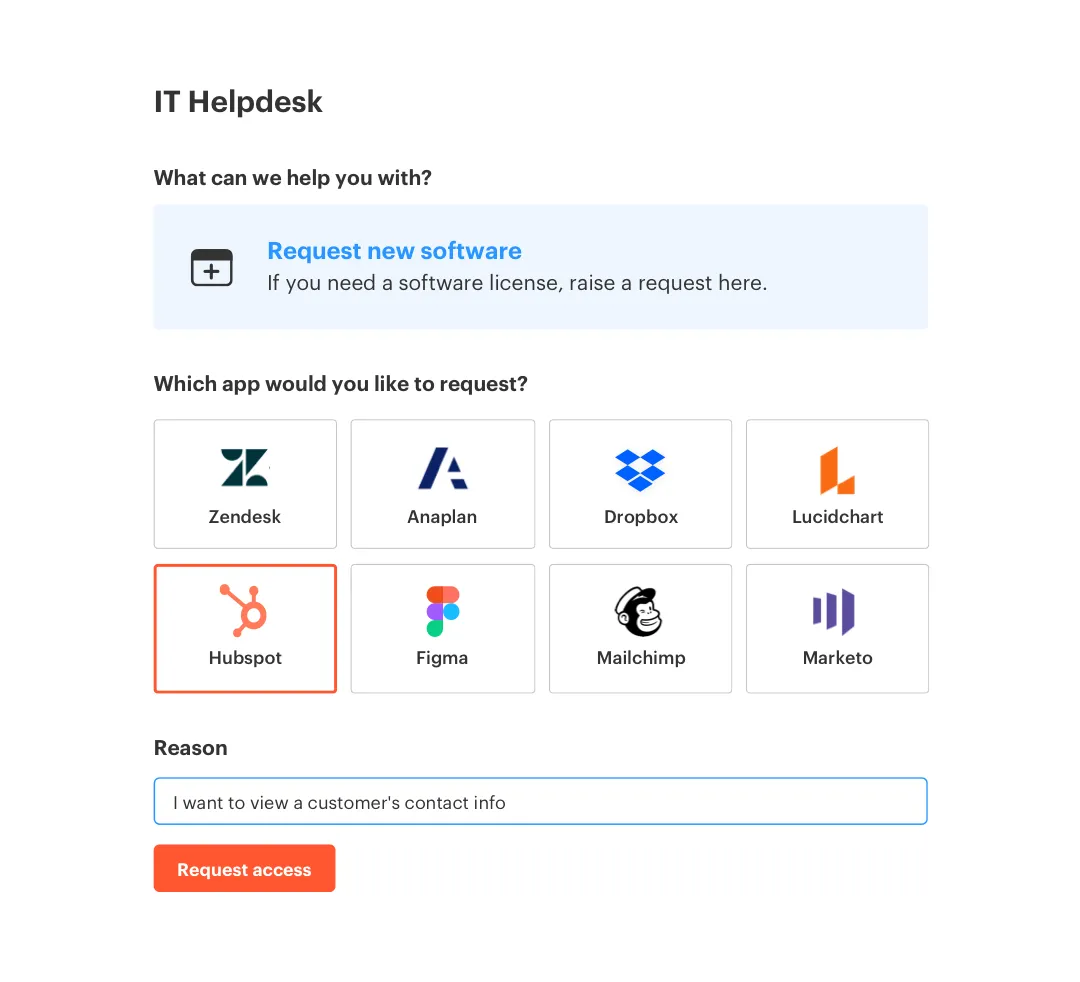
That means “Need access to marketing tools” is not a request type. “Request access to Figma” can be. Better yet, let the user choose from approved applications and roles. Then the role should map to an identity provider group, not a free-text instruction for IT to decode later. That's why provisioning through the identity provider matters so much. It turns a vague request into an authoritative group change.
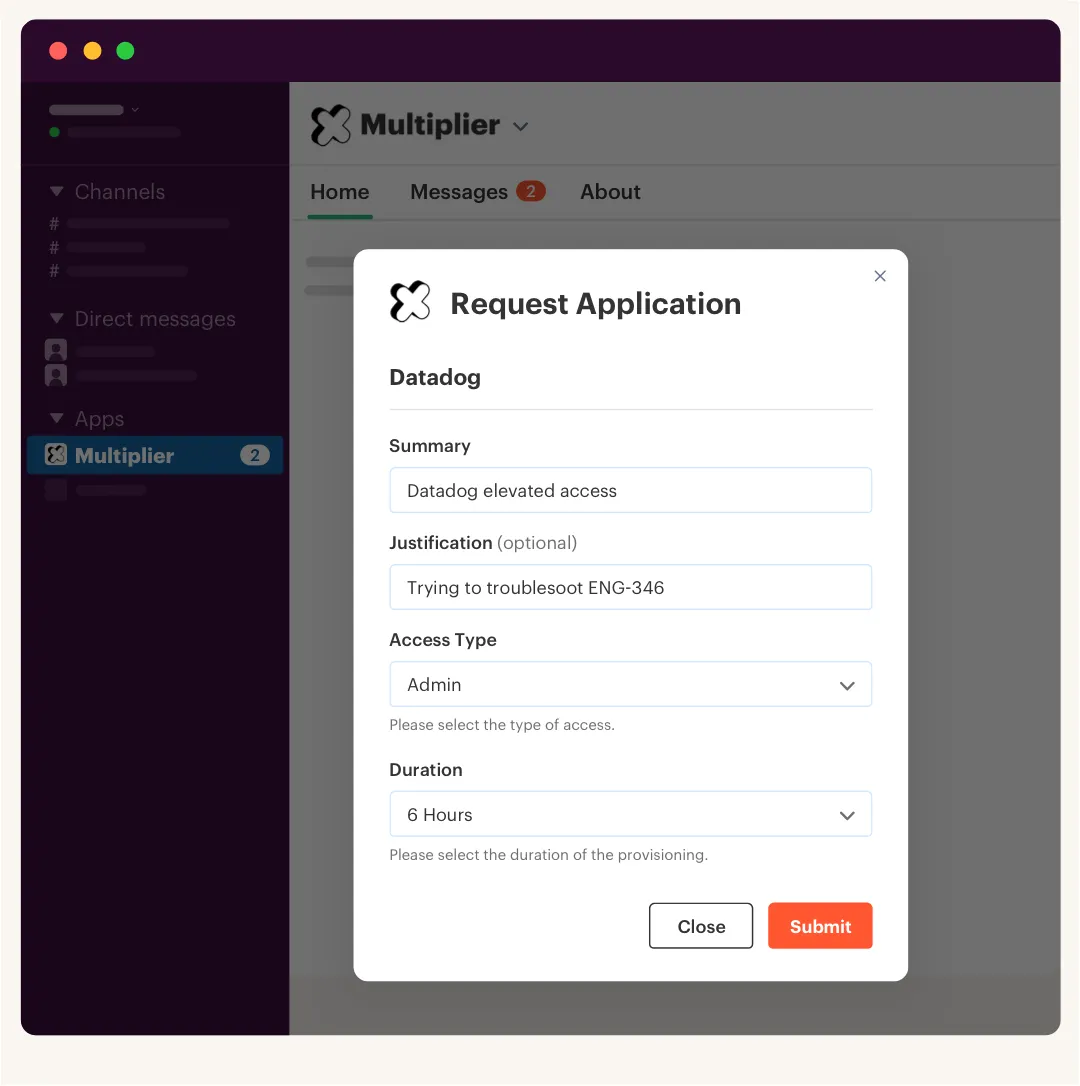
The most useful field isn't “additional notes.” It's a duration selector for anything privileged or temporary. Use hard choices like 1 hour, 6 hours, 24 hours, 7 days. If your team lets users enter free-form expiry dates for elevated access, you'll spend forever cleaning exceptions.
Use fewer templates than your instinct says
When teams start implementing request type templates, they usually overbuild. Ten request types becomes thirty. Then fifty. Now employees don't know where to click, and IT is maintaining taxonomy instead of fixing workflow.
In my experience, the sweet spot for a mid-market team is often 8 to 20 high-volume request types, then one or two fallback categories for edge cases. Once you go past 25, usability drops unless you have serious discipline around ownership and naming.
Think of it like a restaurant menu. A two-page menu is manageable. A twelve-page menu usually means the kitchen is compensating for weak focus. Same thing here. If your portal needs a training session to explain where to request Zoom access, the design is already broken.
The template should decide the route, not the agent
A request type template should determine what happens next based on the fields chosen. That's the whole point. If the service desk agent still has to decide whether the manager, app owner, or security team should approve it, you've left the hard part unresolved.
One high-growth AI company in the background material had app requests coming through Slack and getting tracked in Notion. Notifications were missed. Manual provisioning dragged on. After shifting to a more structured flow tied to Okta and approval logic, they processed more than 3,800 requests in a year, with 75% fully automated. A four-person IT team supported 420-plus employees. That's not just scale. That's template design doing real work.
So the next question is obvious. Once you've got the right request types, how do you keep them from becoming another backlog?
What strong request type templates include
Strong request type templates include enough structure to trigger approval, provisioning, revocation, and evidence without extra translation. Weak ones collect text. Strong ones collect decisions.
Role mapping beats free-text every time
The biggest mistake is letting users describe access in their own words when the system could offer structured choices. People will write “editor access,” “full access,” “same as Sarah,” or “whatever marketing usually gets.” None of that is usable.
Use pre-defined roles tied to IDP groups. If you're implementing request type templates for SSO apps, each role should map to one or more groups in Okta, Entra ID, or Google Workspace. Then approval triggers a specific group action, not a human guessing at intent. That's why the identity provider should stay authoritative. The group assignment is the control point. The ticket is the record of why it happened.
If your team can't explain what group each role maps to, stop building more templates and fix that first.
High-risk access needs time built in
Privileged access without a clock on it is just standing privilege with better branding. A lot of teams know this in theory. They still don't bake it into the request.
For admin roles, production systems, finance tooling, or customer data access, the template should force a duration choice. If the access is under 24 hours, you can usually justify faster approvals. If it's longer than 7 days, it probably deserves a second look. That's a strong conditional rule. Short window, faster path. Long window, more scrutiny.
A security team at a fintech company used that logic to shift elevated access from permanent grants to just-in-time access. Over 1,300 requests were automatically revoked after approved windows. That's the kind of control auditors understand immediately because the evidence is tied to the grant and the removal, not reconstructed after the fact.
Approval logic should follow risk, not org chart neatness
Most companies start with manager approval for everything because it's easy to understand. And sometimes that's fine. Low-risk SaaS access often can run that way.
Still, manager approval is weak for apps where the manager doesn't really understand the data sensitivity, licensing impact, or segregation-of-duties risk. App owner approval often makes more sense there. For some shared tools, a named approver is cleaner than trying to infer ownership from team structure.
Use a simple rule. If the risk is low and the use case is obvious, route to the manager. If the app is expensive, sensitive, or regulated, route to the app owner or a specific reviewer. If the request is privileged and temporary, pair approval with a duration requirement. That combination does more than a generic “manager must approve” checkbox ever will.
Every template should answer the auditor's future question
This is where most implementations quietly break. The team builds a nice request form for operations, but not for evidence. Then six months later, someone asks, “Why did this person get access, who approved it, when did it expire, and where's the proof?”
You can save yourself pain by forcing every request type template to answer those questions up front. Reason for access. Selected role. Named approver path. Duration if relevant. Linked issue trail. If the request can't produce those facts later, the template isn't complete.
A good gut check is this: could an auditor understand the full life of the access from the Jira issue alone? If not, the process is still leaking.
Which leads to the bigger shift. Templates by themselves don't solve the operational mess. The surrounding system has to make those fields actionable.
A better way to implement request type templates
Implementing request type templates works when you design backward from the outcome. Not from the form. Start with the final state you need, then make the request type capture the inputs that produce it.
Design from the revocation event backward
This is the part people rarely do. They start from intake. I think that's backwards.
Start with the end state. For a clean access process, you need a record of who requested access, who approved it, what group changed, when the access started, and when it ended or was reviewed. Once you know that, the template fields become obvious. You're not asking users for “helpful context.” You're asking for the minimum data required to complete and prove the lifecycle.
The same applies to request type templates tied to temporary or privileged access. If you can't point to the automatic revocation condition before the template goes live, you're shipping an incomplete control.
Keep the system of record singular
One reason separate IGA portals frustrate teams is that the record gets split. The request is in Jira. The approval is in chat or email. The provisioning action is in the identity provider. The audit evidence ends up in a spreadsheet. Four systems. One mess.
A better model keeps the ticket as the operational record and the identity provider as the authoritative execution layer. Jira captures intent, approvals, timestamps, and issue history. The identity provider executes the group assignment or removal. That split actually makes sense because each system is doing what it's good at. Anything else creates reconciliation work.
That's why I don't think chat bots alone are enough. They can speed up clicks. They don't solve authoritative provisioning or evidence continuity by themselves.
Pilot on one onboarding lane first
Don't start with every team, every app, every exception case. That's where good projects go to die.
Start with a repeatable onboarding lane. New engineering hires. New sales hires. One department. One bundle of common apps. Then measure three things for 30 days: clarification rate, approval time, and manual provisioning rate. If clarification rate stays above 20%, rewrite the template. If approval time stays above 24 hours for low-risk apps, simplify the approval path. If manual provisioning is still above 30% for SSO-connected apps, your role mapping isn't finished.
That kind of pilot is boring. Which is exactly why it works.
Treat request types as product surfaces
Your service catalog is a product. That's the mindset shift. Employees are the users. IT is the operator. Security is the stakeholder with control requirements. If nobody owns adoption, naming, and completion quality, the catalog will decay.
We saw this with a company that grew from 100 to 500 employees. Tuesdays became a flood of access tickets with missing details and unclear ownership. Once they centralized sanctioned apps in a self-service catalog, they processed more than 500 app requests in six months and saved 70-plus hours of IT time. That outcome didn't come from more policy documents. It came from a cleaner user path.
If you want implementing request type templates to stick, assign an owner who reviews request completion data monthly. Not once a year. Monthly. Because bad templates don't announce themselves. They just create extra work in small doses until everyone assumes that's normal.
How Multiplier turns templates into governed workflows
Multiplier works when you want request type templates to do more than collect information. It ties the request, approval, provisioning action, and audit record together inside Jira Service Management, while using the identity provider as the place where access actually changes.
Multiplier makes the intake path structured and auditable
Multiplier's Application Catalog gives employees a Jira-native self-service experience where they browse approved applications, choose roles, and submit requests through JSM or Slack. That matters because implementing request type templates gets much easier when the user isn't guessing what to ask for. The app, role, and workflow are already structured.
Those requests create Jira issues, which means the evidence starts at intake instead of being rebuilt later. If your current process still depends on Slack messages, screenshots, and side notes, this is a cleaner path. And if you're trying to get governance into day-to-day operations, not another portal, that's a big shift.
Multiplier provisions through the identity provider, not around it
This is the piece I like most in this model. Multiplier's Automated Provisioning uses identity provider group mappings so approved requests trigger the right group changes in Okta, Entra ID, or Google Workspace. That's important because authoritative provisioning should happen through the IDP. It keeps changes fast, consistent, and auditable.

Instead of a service desk agent reading a ticket and manually figuring out what to do, the mapped role drives the action. Jira records what happened. The IDP executes the change. For time-bound access, Multiplier can add the user to the mapped group, start the timer, and remove the membership when it expires. That closes one of the biggest gaps in most request template projects: revocation.
Approval Workflows and the Slack App also tighten the operational loop. Approvers can act in Jira or Slack, but the Jira issue remains the system of record. That's a cleaner setup than approvals floating around in chat without durable evidence.
Multiplier keeps the audit trail attached to the work
Multiplier also connects the back half of governance, not just the front. Access Reviews run in JSM, so reviewers can keep or revoke access with user context and last-login data visible in the workflow. Review outcomes update the record, and results can be exported as CSV or pushed to systems like Vanta. That's useful because the real goal isn't just faster requests. It's continuous audit evidence that already exists when someone asks for it.
If you want to go further, Auto Reclaim can identify inactive users from identity provider login telemetry, warn them, then revoke access and generate the Jira ticket trail. And for broader lifecycle work, Post Functions let teams trigger supported identity actions from Jira transitions without scripts. Different use case, same principle: work in Jira, execute through the identity layer, keep evidence on the issue.
If you want to see that model in action, Get started with Multiplier.
The best templates remove judgment from routine access
Implementing request type templates is worth doing when the template removes ambiguity, drives the right approval path, and triggers authoritative changes through your identity provider. If it just collects text more neatly, you haven't fixed much.
That's the bigger point. Good governance doesn't come from adding another portal or another bot. It comes from making the right path the easy path inside the systems your team already uses. When the request, approval, provisioning, revocation, and evidence all connect, access gets faster and audits get a whole lot less painful.
Frequently Asked Questions
How do I create effective request type templates?
To create effective request type templates, start by identifying the essential fields needed for each request. This typically includes the application, role, duration, and approver. Use Multiplier's Application Catalog to present these options clearly, allowing employees to select from approved applications and roles. This structured approach reduces ambiguity and ensures that requests are routed correctly. Avoid overcomplicating templates — focus on a manageable number of request types to keep the process user-friendly.
What if my team struggles with ambiguous requests?
If your team is facing ambiguity in access requests, consider revising your templates to capture more specific information. Use Multiplier's features to enforce structured choices for applications and roles. For instance, instead of allowing free-text requests, provide a dropdown of approved applications. This helps eliminate guesswork and ensures that requests are clear and actionable. Regularly review the clarification rate of past requests to identify common points of confusion and adjust your templates accordingly.
Can I automate access provisioning for new hires?
Yes, you can automate access provisioning for new hires using Multiplier. Start by integrating Multiplier with your identity provider, such as Okta or Google Workspace. When a new hire submits a request through the Application Catalog in Jira Service Management, Multiplier can automatically provision access based on the mapped roles. New employees get the right access without manual back-and-forth, and onboarding moves faster.
When should I use time-based access for requests?
You should consider using time-based access for requests that involve sensitive or elevated permissions. With Multiplier, you can set duration options (like 1, 6, or 24 hours) during the request submission. This approach enforces least privilege by ensuring that access is temporary, minimizing the risk of standing privileges. It’s particularly useful for roles that require access to sensitive data or systems, as it allows you to automatically revoke access once the time window expires, keeping your systems secure.
Why does my team need structured approval workflows?
Structured approval workflows are essential to ensure that the right people are making access decisions based on risk levels. With Multiplier, you can route approvals to specific users or app owners rather than relying solely on manager approval. This is particularly important for high-risk applications where the manager may not fully understand the implications of access. By mapping approval workflows within Jira Service Management, you can streamline the process, reduce delays, and maintain a clear audit trail for compliance.


