


By the time a 400-person company has 80 SaaS apps, access stops being an IT task and turns into a governance problem. That’s usually where permission creep from manual approvals starts showing up, because every exception becomes a permanent entitlement unless someone remembers to clean it up.
And almost nobody remembers.
The mistake is thinking the fix is more policy. More policy gives you nicer documents. It doesn’t revoke the admin role someone got for a 2-hour incident six months ago. Automation-first least privilege works better because it turns the desired behavior into the default behavior.
Key Takeaways:
- Permission creep from manual access work usually starts with small exceptions that never get removed.
- The real problem isn’t approval quality. It’s that approvals, provisioning, reviews, and evidence live in different places.
- If access isn’t time-bound or reviewed with usage context, your quarterly review becomes archaeology.
- Good access governance starts with a clean request path, clear owners, identity provider group mapping, and automatic revocation.
- Access reviews should happen where IT already works, with decisions tied to tickets and changes enforced through the identity provider.
- Jira-native governance works because it makes the access record and audit record the same thing.
Why Manual Access Creates Permission Creep
Manual access creates permission creep because every handoff adds a chance for access to stay longer than intended. The request starts in Jira or Slack, the change happens in Okta or Entra, and the evidence gets rebuilt later. Once those steps split, cleanup becomes optional.

The access request looks harmless at first
A product manager asks for temporary admin access at 9:14 AM because a customer escalation needs a fast fix. The manager approves in Slack. IT adds the user to the right group in the identity provider, then plans to remove it after lunch. Three meetings happen, one incident call starts, and the access is still there 60 days later.
I’ve seen versions of this pattern in almost every ops-heavy team. Nobody is being lazy. The process just relies on memory at the exact point where memory is least reliable. Permission creep from manual approvals isn’t usually a dramatic failure. It’s a stack of reasonable one-off decisions that never get a proper ending.
The simple test is painful: pull 20 elevated access grants from the last 90 days and check whether each one has a business reason, an approver, a grant timestamp, a planned expiry, and proof of revocation. If more than 3 are missing one of those five fields, the issue isn’t documentation. It’s workflow design.
Spreadsheets make audits look cleaner than they are
Spreadsheets are useful for analysis, but they’re a bad system of record for access governance. They tell you what someone believed at the time of review, not what actually changed in the identity provider. And when reviewers mark “revoke” in a spreadsheet, someone still has to perform the revocation somewhere else.

The gap matters because security teams are being asked to prove least privilege, not just describe it. NIST’s zero trust guidance is pretty clear about continuous evaluation and minimizing implicit trust. A quarterly spreadsheet review with manual cleanup doesn’t really match that world, even if the spreadsheet is very nicely formatted.
Think of it like an airport boarding pass. The pass is useful, but it’s not the plane taking off. Your spreadsheet might say access should be removed, but until the identity provider group changes, the user still has the seat. That’s where audits get weird. The paper says one thing. The system says another.
If your Jira tickets already hold the request context, the approver, and the timing, that’s the place to start tightening the record rather than creating another review trail somewhere else. For teams already living in Jira, Learn more about Multiplier is worth a look because the request record can become the governance record.
Policy-heavy least privilege breaks without enforcement
Least privilege sounds great in a policy doc. Everyone agrees with it. Then the first production incident hits, and the team grants broad access because the narrow path is too slow. Fair enough. When customers are waiting, nobody wants to debate entitlement design for 45 minutes.
The problem comes after the incident. If temporary access doesn’t expire on its own, “temporary” becomes a story people tell themselves. That’s permission creep from manual cleanup in plain English. The access was correct when granted. It became wrong because nothing forced the ending.
A useful benchmark: any access grant above normal role access should have a default expiry of 24 hours or less unless someone can name the reason it needs to be longer. If the business reason is project-based, set the expiry to the project milestone. If nobody can name the milestone, don’t pretend it’s temporary.
How to Stop Permission Creep Before Reviews
You stop permission creep before reviews by designing access so cleanup happens during the normal workflow, not after the fact. That means requests need owners, approvals need context, provisioning needs to run through the identity provider, and risky access needs an expiry before it’s granted.
Diagnose whether your access process is already leaking
Take a sample of 30 access requests from the last month. Not the perfect ones. Just the next 30 in the queue. For each one, ask whether the request has the app, role, business reason, approver, provisioning action, and removal condition in one place. If you need three systems to answer, you’ve found the leak.
The red flags are usually pretty obvious once you look. Access gets requested in Slack but approved in Jira. App owners live in a spreadsheet. IT provisions through Okta or Google Workspace, then comments “done” on the ticket. Reviews happen later in CSVs, with reviewers guessing whether people still need access.
Use this quick check:
- If more than 20% of requests need follow-up questions, fix the request form.
- If more than 10% of approvals go to the wrong person, fix ownership.
- If any elevated access has no expiry, treat that as a standing privilege.
- If review decisions don’t trigger revocation, your review is advisory.
- If audit evidence requires screenshots, the system isn’t producing evidence.
Honestly, the screenshot thing is the giveaway. Once people are taking screenshots to prove work happened, the workflow is already broken. The better model is boring: the ticket shows who asked, who approved, what changed, and when it was removed.
Start with the request path before touching automation
A clean request path beats a clever automation every time. If requesters can’t choose the right app, role, duration, or reason, automation just makes bad inputs move faster. I’d rather see a simple catalog with 20 sanctioned apps than a giant portal where employees pick from 400 confusing options.
At Videoamp, the pattern was very familiar. The company grew from 100 to 500 employees, and Tuesdays became the day the IT queue filled up with access requests from new hires. The requests didn’t always include enough detail, and ownership wasn’t always clear. They solved the first-order problem by putting sanctioned apps and roles into a self-service catalog inside Jira Service Management, then routing requests with the right context from the start.
The decision rule is pretty simple:
- Start with the 20 apps that create the most tickets.
- Give each app 2 to 4 role options, not 15.
- Require a business reason for elevated roles.
- Assign one accountable owner per app.
- Add duration choices for sensitive access.
Some teams will argue that employees should be able to request anything. There’s a case for that, especially in smaller companies where the app stack is still changing every month. The sharper point is that sanctioned access should be easy, and unsanctioned access should create a review path. If both paths feel the same, people will pick whatever gets them access fastest.
Map roles to identity provider groups
Role mapping is where access governance becomes real. The request says “Figma Editor,” but the identity provider group is what actually grants access. If those two things aren’t mapped cleanly, IT ends up translating requests by hand, and that’s where mistakes enter.
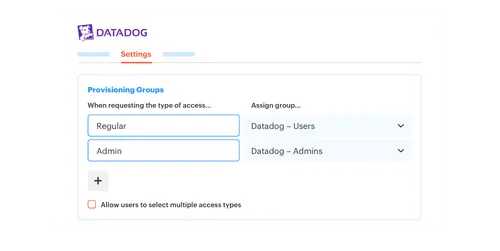
The practical approach is to map every catalog role to one or more identity provider groups. Viewer maps to a low-risk group. Editor maps to a higher-risk group. Admin maps to a group that requires stronger approval and a shorter duration. The group becomes the control point, which matters because the identity provider is where access can be added, removed, and audited reliably.
A good mapping review asks:
- Does every role map to a real group?
- Does every privileged group have an owner?
- Does every admin role require approval?
- Does every temporary role have an expiry option?
- Does removal from the group actually remove access in the app?
The last question is the one people skip. Don’t. If group removal doesn’t revoke the actual entitlement, you don’t have automatic deprovisioning for that app. You have a partial workflow. That can still be useful, but you need to label it correctly and treat cleanup differently.
Make time-bound access the default for risky roles
Time-bound access works because it removes the cleanup debate. The user gets access for the work they need to do. The clock starts. Access ends. Nobody has to remember the follow-up task after the incident, the onboarding rush, or the late Friday request.
This is where policy-heavy least privilege usually loses to automation-first least privilege. A policy says admin access should be temporary. A time-bound workflow makes the requester choose 1, 6, or 24 hours before the grant happens. Different world. Same goal, but one depends on human discipline and the other depends on system behavior.
Stavvy is a good example. After funding and acquisitions, they needed to reduce long-lived privileged access while still moving quickly. They used time-limited access tied into Jira Service Management and Slack, and reduced privileged access by 85%. They also had 1,300+ access requests automatically revoked after approved windows. That’s the part that matters. Not just approval. Enforced expiry.
A strong rule: anything that touches production, customer data, finance systems, or admin settings should default to temporary access. If someone needs it permanently, they should have to justify the standing access separately. Not because people are untrustworthy. Because standing privilege expands by default unless the system pushes back.
Run access reviews with usage context, not memory
Access reviews fail when reviewers have to guess. A manager looking at 180 rows in a spreadsheet doesn’t know whether someone used an app last week, changed roles last month, or still sits in the department that needs the tool. They approve too much because revoking the wrong access creates noise.
Usage context changes the review. Last login, department, title, group membership, and recommendations give the reviewer enough signal to make a real decision. Verizon’s Data Breach Investigations Report keeps showing how credential and access issues remain tied to real incidents, so rubber-stamp reviews aren’t just annoying. They miss risk.
The threshold I like: if a user hasn’t logged into an app in 90 days, the reviewer should need a reason to keep access. For expensive SaaS tools, 30 or 45 days might be the better line. For critical systems, inactivity plus privileged role should trigger an even harder look.
There’s a fair objection here. Last login data isn’t perfect. Some tools don’t report usage cleanly, and some users need rare access for legitimate reasons. Agreed. Usage data shouldn’t be the only decision point. It should be the starting point that forces a better conversation than “do they still need this?”
Close the loop between review decisions and revocation
A review decision that doesn’t trigger a revocation is only a suggestion. That sounds harsh, but it’s true. If a reviewer marks “revoke” and IT still has to go remove the user later, the risk remains open until the manual task is done. And manual tasks are where permission creep from manual reviews comes back.
The stronger pattern is to make “revoke” an action, not a comment. Reviewer decides. The workflow removes the user from the mapped identity provider group. The ticket records the decision and the change. The campaign shows progress and exceptions. Audit prep becomes a pull from the system, not a two-week reconstruction project.
For high-growth companies, this matters more than it looks. Synthesia processed 3,800+ access requests in a year with a 4-person IT Ops team supporting 420+ employees, and 75% of those requests were fully automated. That kind of ratio doesn’t happen because people worked harder. It happens because the workflow stops depending on handoffs.
If your audit prep still starts with exports, screenshots, and a Slack search, the missing piece is usually enforcement tied to the review action. That’s the workflow detail to inspect, and See how Multiplier works connects that review decision back to the Jira record and identity provider change.
How Multiplier Enforces Access Governance in Jira
Multiplier enforces access governance in Jira by keeping requests, approvals, access reviews, provisioning actions, and evidence tied to Jira Service Management. It uses your identity provider for actual group changes, so Jira becomes the work record and the identity provider remains the source of access truth.
Access reviews become enforceable Jira workflows
Multiplier’s Access Reviews replace spreadsheet campaigns with Jira-native review workflows. Reviewers see user attributes, group memberships, last login dates, and recommendations inside JSM, then mark Keep or Revoke. When they choose Revoke, Multiplier removes the user from the relevant identity provider group and creates Jira evidence for the change.

That’s the important shift. The review doesn’t live in a spreadsheet while revocation lives somewhere else. Multiplier ties the decision, action, and audit trail to the same operating system your IT team already uses. For teams dealing with permission creep from manual access reviews, that closes the gap where “approved for removal” never becomes removed.
A few capabilities matter most:
- In-Jira access review campaigns: Reviewers work from JSM instead of spreadsheets.
- Usage context for decisions: Last login, user data, groups, and recommendations reduce guessing.
- One-click revocation: Revoke decisions can remove identity provider group membership.
- Audit evidence in Jira: The change is documented where the request and review live.
Multiplier doesn’t magically fix apps that can’t be controlled through identity provider groups. That’s a real boundary. For non-SSO or manual grants, you still need a different cleanup path. But for group-managed access, the control loop is much tighter because approval and revocation aren’t separated by manual work.
Requests and temporary access stay tied to the ticket
Multiplier also handles the intake side through an Application Catalog in Jira Service Management or Slack. Employees request approved apps, choose roles, and submit with the right context. Approvers can act in JSM or Slack, and approved requests can provision through Okta, Entra ID, or Google Workspace group mappings.
Time-Based Access is the part I’d pay attention to for risky permissions. Requesters choose a duration, such as 1, 6, or 24 hours, and Multiplier removes the mapped group membership when the timer expires. That directly attacks the old pattern where temporary access becomes permanent because nobody owns the cleanup.
For the access request mess described earlier, the before and after is pretty clean:
- Before, the request is in Jira, the approval is in Slack, the change is in the identity provider, and the evidence is assembled later.
- After, the request starts in Jira or Slack, the approval updates the Jira issue, the identity provider group changes, and the evidence stays attached to the workflow.
- Before, temporary access depends on someone remembering.
- After, temporary access has an expiry built in.
Multiplier’s Auto Reclaim can also remove inactive licenses based on identity provider login data, with thresholds, grace periods, and exclusions. That’s more of a SaaS spend and cleanup use case, but it supports the same bigger idea. Access shouldn’t sit forever just because removing it is annoying.
For teams already using Jira Service Management as the intake layer, the next logical move is making Jira the governance layer too. The access request, review decision, group change, and audit record can live together, and Get started with Multiplier gives you a practical path to test that inside the system your team already knows.
Build Least Privilege Where Work Already Happens
Permission creep from manual workflows isn’t fixed by writing stricter policy. It’s fixed by changing the workflow so access has owners, context, expiry, and enforceable review actions from the start.
That’s why identity governance belongs in Jira for teams already running IT through Jira Service Management. Not because Jira is magic. Because the work is already there. Requests, approvals, and evidence already pass through it. Once you connect those records to identity provider group changes and in-Jira access reviews, least privilege stops being a quarterly cleanup exercise and becomes normal operating behavior.
Frequently Asked Questions
How do I set up time-based access with Multiplier?
When submitting a request through Jira Service Management or Slack, select the app, the role, and a duration—1, 6, or 24 hours are common options. Once approved, Multiplier provisions the access and sets a timer. When the window closes, the group membership is removed automatically. No follow-up task, no manual cleanup required.
What if I need to change an approver for access requests?
Go to the app's settings in your JSM portal and update the approver—manager or app owner, whoever should own the decision. Notify them so they're not caught off guard. Keeping approver assignments current is one of the cheapest ways to avoid the wrong person rubber-stamping access they don't really understand.
Can I integrate Multiplier with my existing identity provider?
Yes. Register Multiplier as an app in Okta, Azure AD, or Google Workspace, grant the API permissions to manage group memberships, and Multiplier will handle provisioning through your identity provider. Your IdP stays the access source of truth—Multiplier just makes the changes happen automatically instead of manually.
When should I conduct access reviews using Multiplier?
Quarterly is the standard starting point, but high-risk apps warrant more frequent review cycles. Create a campaign in Multiplier, select the apps, and assign reviewers. They'll see last login, group memberships, and Multiplier's recommendations—enough context to make a real decision rather than a guess. Tie the cadence to your SOX or compliance obligations and adjust from there.
Why does my access request need a business reason?
Without a stated reason, elevated access is just a favor—and favors don't survive audits. A business reason creates accountability for both the requester and the approver, and gives you something real to point to during a review or an SOX audit. Embed it directly in your request form through Multiplier so it's required, not optional.


