


Your access controls aren't failing because the policy is weak. They're failing because the context lives in 4 different places, so the person approving access can't see the risk, the license waste, or the expiry window at the moment they make the call. Contextual access controls for SaaS need to answer a basic question: should this person have this role right now, for this reason, for this long? If the workflow can't enforce that automatically, you're not running least privilege. You're running trust with extra paperwork.
Most IT teams don't have an access problem because people are careless. They have an access problem because the work lives in Jira, the approval happens in Slack, the change happens in Okta or Entra, and the cleanup happens never. The policy looks good on a slide. The execution falls apart on a Tuesday.
Ready to get started? Get Multiplier on the Atlassian Marketplace.
Key Takeaways:
- Treat approval as one input, not the control itself.
- Use context like role, app risk, duration, and login activity before granting access.
- Set expiry at the request stage for admin, production, and sensitive data access.
- Map roles to identity provider groups so provisioning and revocation can actually run.
- Use access reviews to catch what policy missed, not to rebuild evidence from scratch.
- Reclaim unused licenses based on real login activity, not spreadsheet guesses.
Why Access Context Breaks Between Jira, Slack, and the IdP
Access context breaks when requests, approvals, provisioning, and evidence live in different systems. Jira knows who asked. Slack knows who approved. The identity provider knows what changed. The problem is that no single workflow connects all three well enough to enforce least privilege at the moment access is granted.

Approval Is Not the Same as Control
Approval feels like control because someone said yes. That sounds obvious, but it matters. A manager approving Figma Viewer access for a designer is not the same thing as a security lead approving 24-hour production access for an engineer during an incident. Same verb. Totally different risk.
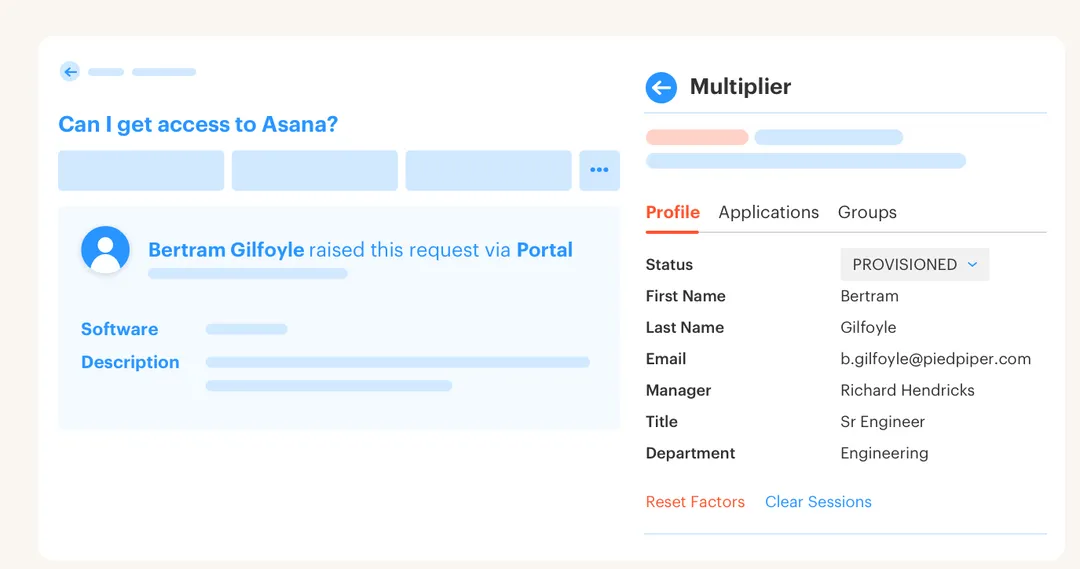
It's Tuesday at 9:14 a.m. A new hire opens a Jira ticket asking for Salesforce access, pings their manager in Slack with a thumbs-up emoji, and someone in IT adds them to an Okta group between standups. The ticket says approved. It doesn't say why the Sales Manager role was picked over Sales User, whether the access should expire, or whether the user actually opens the app after week one. Ninety days later, that account is still active, still licensed at $165 a month, still sitting on customer records. Nobody was lazy. The workflow just didn't force the right questions at the right moment.
A decent contextual access controls for SaaS model starts before approval. Ask four things every time: what app, what role, what duration, and what evidence will prove the change happened. If one of those answers is missing, the request is not ready to approve. The manager might still click yes, but the system should hold the line.
The teams that get this right don't treat access like a door with a key. They treat it like event badges at a conference. A speaker badge, a vendor badge, and an attendee badge all get you into the building, but they shouldn't open the same rooms, they shouldn't carry the same hours, and they definitely shouldn't keep working two weeks after the event ends. Permanent badges to a one-day event is the model most companies are running on. They just don't call it that.
Once the request includes context up front, the next problem becomes obvious: standing access is expensive in ways that don't show up in the security dashboard first.
The Hidden Cost Shows Up in Licenses First
SaaS waste is often the first visible symptom of weak access controls. A user keeps access because nobody checked usage, the license renews because procurement doesn't see inactivity, and IT keeps paying the operational cost of reviewing the same stale entitlements every quarter. It adds up fast.
The finance angle is underrated. Security teams lead with risk because least privilege is the right principle. CFOs feel the pain earlier. They see another SaaS renewal, another seat expansion, another awkward conversation where nobody can explain why 40 people have paid access to a tool only 18 people opened last month.
A practical threshold beats a vague cleanup goal. If a paid app has more than 10% of assigned users inactive for 30 days, flag it for automated reclaim or manager review. If it's an admin or production tool, drop that to 14 days and require time-bound access from the start. If the app has no reliable login telemetry, don't pretend the data is better than it is. Put it into manual review and be honest about the gap.
One high-growth fintech had hundreds of routine requests coming through Slack, email, and Jira as it grew toward 1,200 employees. Standard access requests that took 5 to 30 minutes each don't sound scary in isolation. Multiply that by 600 requests a quarter and you've burned the equivalent of a full-time IT hire on copy-paste work. That's where contextual access controls for SaaS spend and security start to overlap. Same workflow. Two budgets feeling the pain.
If your access process can't tell whether people still use the tools they own, your license report is basically a delayed security signal.
The Audit Trail Breaks at the Handoff
Audit evidence gets weak when the approval record and the access change don't live together. A Jira issue might show a request. The actual group change happened somewhere else. A Slack thread might show the approval. The identity provider has the entitlement. Auditors don't love detective work.
Separate IGA portals exist for a reason. They can be strong at policy, certification, and role modeling, especially in large enterprises with complex governance teams. I wouldn't argue that every company should rip out everything and start over. That would be too simplistic, and frankly, not how IT works.
The issue is operational gravity. Employees already ask for access through the service desk or chat. IT already works tickets. Approvers already respond where they get nudged. If the governance layer sits outside that flow, someone has to reconcile the story later. According to the Verizon Data Breach Investigations Report, human actions and credential misuse remain recurring factors in incidents, which is exactly why access workflows need stronger evidence at the point of change, not after the fact.
A simple test tells you where the audit trail breaks. Pick 10 access requests from last month and try to answer five questions in under 15 minutes: who requested access, who approved it, what exact entitlement changed, when it changed, and whether it was later revoked. If you can't answer all five without jumping tools, the workflow is not audit-ready. It's audit-assembled.
The control is only real if the workflow can prove it happened.
If the handoff is where context gets lost, the answer isn't more policy language. It's a different operating model.
How to Build Contextual Access Controls That Actually Enforce Policy
Contextual access controls work when the request captures enough information to decide, grant, expire, and review access without manual reconstruction. The goal is not more approval steps. The goal is fewer ambiguous requests, fewer standing privileges, and clearer evidence tied to each access change.
Start by Sorting Access Into Three Risk Buckets
Three buckets are enough for most teams to start. Low-risk access can move quickly. Business-critical access needs owner or manager review. Privileged access needs a tighter rule set, usually with an expiry and clearer reason. Don't overbuild the taxonomy at the beginning.
I've watched teams try to create 19 access categories before automating anything. It feels mature. It usually becomes a governance swamp. The better move is to classify access by what happens if the wrong person keeps it too long. Can they view internal docs? Can they change customer data? Can they deploy code or reach production systems?
A useful first pass looks like this:
- Standard access: Common tools and low-risk roles, like Viewer or basic employee apps.
- Sensitive access: Customer data, finance systems, HR tools, or apps with broad internal visibility.
- Privileged access: Admin roles, production access, database access, security tooling, or anything hard to unwind.
The rule is simple. If access could create audit risk, customer risk, or meaningful cost after 30 days of inactivity, it doesn't belong in the standard bucket. If it grants admin power, production power, or broad data access, it should expire by default. Not after someone remembers. By design.
Set Expiry Before You Set Approval Rules
24-hour access should be the default conversation for privileged work, not the exception someone has to fight for. When expiry is baked into the request, the approver decides whether the user should have temporary access, not whether someone will remember to remove it later. Huge difference.
A lot of teams start with approval chains because that feels like governance. Manager approval, app owner approval, maybe security approval for certain tools. Fine. If the access never expires, you've created a slower path to the same standing privilege problem. More approval does not fix permanent access.
Use a duration rule before you design the approver rule:
- If the request is for admin, production, or sensitive data access, require a duration.
- If the duration is under 24 hours and the user is in the right team, route to the app owner or manager.
- If the duration is longer than 7 days, require a stronger reason or review.
- If the same user keeps extending access, check whether the role should be redesigned.
NIST's access control guidance, including AC-6 least privilege in SP 800-53, is very clear on limiting access to what users need. The part that gets missed is operational enforcement. A policy that says "least privilege" but grants permanent admin access because cleanup is manual isn't really least privilege. It's a promise with a calendar reminder attached.
Tie Every Role to an Identity Provider Group
Contextual access controls for modern SaaS break down if the final step depends on someone typing into an admin console. Role-to-group mapping is the boring part. It's also the part that makes automation possible. Without it, your workflow can approve access, but it can't reliably enforce it.
The mechanism is straightforward. Each app role maps to one or more groups in Okta, Entra, or Google Workspace. The request captures the app and role. The approval moves the ticket into the right state. The identity provider group changes, and that group drives the entitlement downstream where supported.
The diagnostic test I like is painfully basic. Pick your 20 most requested apps and check whether each role maps cleanly to an identity provider group. If fewer than 80% do, don't start with a fancy governance project. Fix the mappings. Otherwise, every approval still ends with human glue.
A team scaling from 100 to 500 employees hit this exact wall during onboarding. New hires started Monday, then Tuesday became the access request pileup. The IT queue filled with requests missing enough detail to act on, and ownership was unclear for certain apps. Once they moved to a self-service app catalog with sanctioned apps and mapped roles, more than 500 app requests flowed through the process in 6 months, saving over 70 hours of IT time. Not magic. Cleaner inputs.
When the role maps to a group, the request becomes executable. Before that, it's just a nicely formatted ask.
Use Login Activity Before Buying More Licenses
Login activity is the fastest way to separate real access needs from inherited access. If someone hasn't logged into a paid app for 30 days, the question isn't "should we renew every seat?" The question is "why does this person still have a license?" Procurement should not have to guess.
This is where contextual access controls for cost savings become very practical. Usage data gives IT and finance a shared language. Security cares because unused access creates risk. Finance cares because unused seats waste money. The user often doesn't care at all, which is why asking everyone manually creates such bad data.
Set a reclaim policy by app type:
- Collaboration tools: 30 to 45 days of inactivity, with a short warning window.
- High-cost specialist tools: 14 to 30 days, because shelfware burns budget faster.
- Sensitive systems: shorter thresholds, plus manager or app owner review.
- Executive or special groups: exclude only when there is a real business reason.
The honest limitation is that login data is only as good as the source. Some apps don't send useful telemetry through the identity provider. Some users access tools through service accounts or shared workflows, which makes the signal messy. Don't force automation on bad data. Use automated reclaim where telemetry is reliable, and push the rest into a review queue.
That tradeoff matters. Bad automation creates trust issues. Good automation starts where the signal is strong, then expands.
Keep Reviews Close to the Work
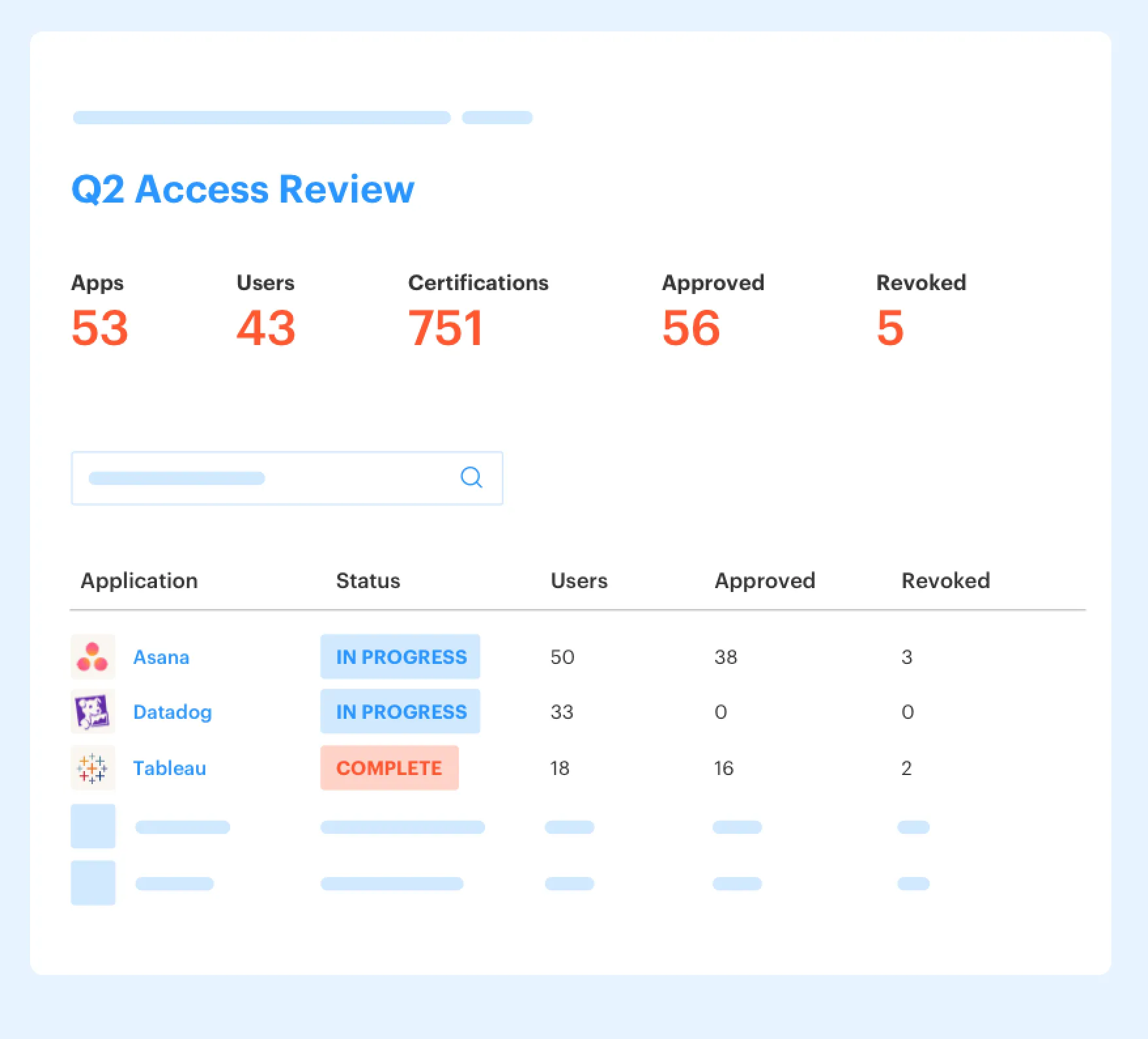
Access reviews should validate current access decisions, not rebuild the history from three systems. The reviewer needs the user, role, last login, department, and recommendation in one place. If the reviewer has to open five tabs to decide Keep or Revoke, rubber-stamping becomes very tempting.
Quarterly reviews get a bad reputation because they're often spreadsheet theater. Someone exports users from the identity provider, sends rows to app owners, collects comments, chases missing responses, then manually removes access. Everyone knows the process is fragile. Everyone still does it because audit needs evidence.
A better review asks a tighter set of questions:
- Does the user still need the app for their current role?
- Has the user logged in recently?
- Is the assigned role higher than the work requires?
- Is the access permanent when it should be time-bound?
- Can revocation happen from the review action itself?
That last question is the big one. If a reviewer clicks Revoke but IT still has to process the removal later, the review is only half done. The decision and the enforcement need to be connected, or you create another backlog. And backlog is where old access goes to live forever.
I might be too opinionated here, but access reviews should feel more like cleaning up a live system than completing a compliance ritual. The best reviews teach you where your request process is too loose.
Automate the Boring Parts, Leave Judgment to Humans
Automation-first least privilege beats policy-heavy approaches because policy without enforcement depends on memory. Humans should decide exceptions, risk, and business need. Machines should handle routing, group changes, expiry, notifications, and evidence. That's the split.
The mistake is trying to automate judgment. You don't need a system to decide whether a finance admin role is risky. You already know it is. You need the workflow to ask for duration, route to the right owner, apply the group change, remove it at expiry, and leave behind proof. That is the boring stuff. Also the stuff people forget.
A practical automation sequence looks like this:
- Capture app, role, requester, reason, and duration in the request.
- Route approval based on app owner, manager, or named approver.
- Provision through the identity provider group after approval.
- Expire temporary access automatically.
- Reclaim inactive licenses based on reliable login data.
- Feed exceptions into periodic access reviews.
The exception is early-stage companies with very few apps and very few employees. A spreadsheet might work when you have 20 people and 12 tools. No shame in that. Once access requests become daily work, or once compliance enters the picture, the spreadsheet becomes a weird little second job for IT.
The goal isn't to make access slower. The goal is to make the safe path faster than the workaround.
How Multiplier Enforces Access From Jira
Multiplier enforces access from Jira by connecting JSM requests, Slack approvals, identity provider group changes, and audit evidence in one workflow. The product does not replace your identity provider. It uses Okta, Entra, or Google Workspace groups to provision, revoke, review, and reclaim access from the Jira record.
Jira Requests Become IdP Group Changes
The useful part is not just that employees can request apps from a catalog. The useful part is that the catalog creates structured, executable requests. App, role, approver, duration, and mapped group are captured before the ticket moves forward. That removes a lot of the back-and-forth that makes IT queues feel heavier than they should.

Multiplier's Application Catalog shows approved apps in Jira Service Management or Slack, then maps roles like Viewer, Editor, or Admin to identity provider groups. Once the configured approval status is reached, automated provisioning adds the user to the mapped group and writes the result back to the Jira issue. For SSO apps, that group-based change can flow through the identity provider into the app. For manual or non-SSO apps, the request can still create a trackable approval and evidence path, which is useful, but not the same as direct app provisioning.
That boundary matters. Multiplier provisions through identity provider groups. It doesn't directly click around inside every SaaS app. I actually like being explicit about that, because it keeps the architecture clean. The identity provider stays authoritative, Jira stays the record of work, and Slack is where approvals can happen without losing the audit trail.
For teams buried in 5 to 30 minute access tickets, the shift is pretty simple: stop making IT translate every request by hand.
Time Limits and License Reclaim Close the Loop
The access process only works if it has a clean ending. Granting access is the easy part. Removing it on time is where most teams fail, because revocation competes with every other ticket in the queue. That is how temporary exceptions turn into permanent entitlements.
Multiplier's Time-Based Access lets requesters choose durations like 1, 6, or 24 hours when the app is configured for it. After approval, access is provisioned through the mapped identity provider group, and the timer removes the user from that group when the window expires. Auto Reclaim handles a different but related problem: unused SaaS licenses. It uses last-login data from connected identity providers, applies inactivity thresholds and grace periods, warns users, then revokes access and creates a Jira ticket if they remain inactive.
That matters because the workflow does not stop at intake and approval. It also handles enforced expiry for temporary access and inactivity-based cleanup for unused licenses, with the request, decision, grant, and revocation tied back to Jira. Multiplier keeps the system of record intact while reducing the manual cleanup work that usually gets skipped.
The close of the loop is the control.
Make Access Decisions Where Work Already Happens
Contextual access controls for Jira-based IT teams work best when access decisions happen where requests already live. Jira holds the request. Slack speeds the approval. The identity provider enforces the change. Once those pieces connect, least privilege becomes a workflow, not a quarterly cleanup project.
The big shift is mental. Stop treating approval as the finish line. Approval is just the point where enforcement should begin. The real access system decides who gets what, for how long, based on what context, with what evidence, and with what cleanup path.
Start with the 20 most requested apps. Map the roles. Add duration rules for sensitive access. Reclaim inactive licenses where login data is reliable. Then use reviews to catch the edge cases the workflow missed.
That is how access governance gets practical. Not heavier. Just harder to ignore.
Frequently Asked Questions
How do I set up time-based access in Multiplier?
To set up time-based access in Multiplier, follow these steps: 1) When submitting an access request through the Jira Service Management (JSM) portal or Slack, select the desired application and role. 2) Choose a duration for the access, such as 1, 6, or 24 hours. 3) After approval, Multiplier will automatically provision access and set a timer to remove the user from the mapped group when the time expires. This ensures that access is temporary and reduces the risk of standing privileges.
What if I need to reclaim unused licenses?
If you want to reclaim unused licenses, you can use Multiplier's Auto Reclaim feature. First, set inactivity thresholds for your applications, such as 30 days without login. Next, Multiplier will monitor login activity and notify users if they exceed the threshold. If they remain inactive after the grace period, Multiplier will automatically revoke their access and generate a Jira ticket documenting the change. This helps optimize your SaaS spend and ensures you’re only paying for active users.
Can I customize approval workflows in Multiplier?
Yes, you can customize approval workflows in Multiplier. To do this, go to your JSM settings and map workflow statuses to 'Waiting for Approval' and 'Approved.' You can designate default approvers globally or override them on a per-app basis, such as assigning the app owner or the requester's manager as approvers. This flexibility allows you to streamline the approval process while making sure that the right people are involved in high-risk access requests.
When should I perform access reviews?
You should perform access reviews regularly, typically on a quarterly basis. Use Multiplier's Access Review feature to create campaigns for your approved applications. Assign reviewers, such as app owners or managers, and launch the campaign. This process allows you to validate current access decisions based on user activity, making sure that only those who still need access retain it. It also helps catch any edge cases that might have slipped through the initial approval process.


