


75% of access requests getting automated sounds like an IT productivity story, but the real win is what disappears from the queue. Improving IT team productivity usually starts with removing the tiny access tasks that eat 5, 10, 30 minutes at a time.
The mistake is treating access work like ticket work. A request comes in, someone chases approval, someone checks the right group, someone updates Okta or Entra, someone writes a note for audit. Multiply that by hundreds of requests a month and suddenly your IT team is running a manual conveyor belt.
Key Takeaways:
- Improving IT team productivity starts with removing repeat access work, not asking IT to move faster.
- Access requests should be complete at intake, with app, role, manager, duration, and business reason captured up front.
- Time-bound access beats standing privilege because revocation happens when the work is done.
- Audit evidence should be created during normal Jira work, not rebuilt in spreadsheets every quarter.
- A self-service app catalog works when approved apps, approvers, roles, and identity groups are already mapped.
- The cleanest productivity gain comes from linking Jira, Slack, and your identity provider into one access workflow.
Why IT Productivity Breaks Around Access Work
IT productivity breaks around access work because the requests look small, but the coordination cost compounds fast. A 10-minute access task is rarely 10 minutes once approvals, identity group changes, ticket updates, and audit evidence are included. For growing teams, the hidden problem is not request volume. It is fragmented execution.

Small Access Tasks Create Big Queue Drag
A single access request looks innocent. Someone needs Figma Editor, GitLab Maintainer, Salesforce Admin, or temporary production access. The ticket is easy enough to understand, so everyone assumes the work is small. Then the requester forgets the role, the manager misses the Slack message, the app owner is on vacation, and IT has to ask three follow-up questions before doing the actual work.

The pattern shows up across IT and ops teams. The work that feels quick becomes expensive because it interrupts the people with context. Access work is the same. It creates a queue tax, where the IT team keeps switching between Jira, Slack, Okta, Entra, Google Workspace, spreadsheets, and audit notes. Context switching is not a small thing. Atlassian research on work fragmentation points to how much time gets burned when teams bounce between tools instead of finishing one clean workflow in one place Atlassian work management research.
A good test is simple: count how many systems an IT admin touches before a request is done. If the answer is more than 3, you don't have an access workflow. You have a scavenger hunt. And scavenger hunts are terrible for improving IT team productivity.
Growth Turns Manual Access Into a Recurring Bottleneck
The painful part is that manual access works for a while. That is the honest concession. If you have 80 employees and a small app stack, a human can keep the queue under control with decent habits and a few saved replies. No need to overbuild.
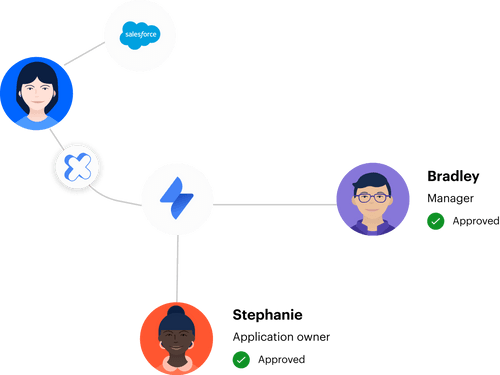
Then the company grows. Videoamp went from 100 to 500 employees, and Tuesdays became the day access requests flooded the IT queue after Monday onboarding. A request for Zoom or Slack was easy. A request for a specialized app with missing details was not. The team had to chase ownership, confirm roles, and clean up the same missing context over and over again. Groundhog day, but with tickets.
The diagnostic threshold worth using is 100 access requests per month. Below that, manual work may still be tolerable. Above that, every missing field starts to matter. If 25% of requests need one follow-up, and each follow-up takes 6 minutes across reading, replying, waiting, and reopening the ticket, that is 150 minutes per 100 requests before provisioning even starts. Not terrible once. Pretty bad every month.
Audit Work Should Not Be Rebuilt After the Fact
Audit work gets painful when evidence is recreated after the access work already happened. The request is in Jira, the approval is in Slack, the group change is in Okta, and the reviewer notes live in a spreadsheet. Security asks for proof and IT becomes the evidence team. Nobody joined IT for screenshot archaeology.
The stronger model is boring in a good way. The request, approval, provisioning change, expiry, review decision, and revocation should all attach to the same record as the work happens. That maps better to least privilege controls like NIST AC-6, which focuses on limiting access to what users need for assigned duties NIST AC-6 least privilege control. You don't want a heroic audit scramble. You want evidence as a byproduct.
To see how this looks inside a Jira setup, learn more about Multiplier.
How High-Output IT Teams Remove Access Friction
High-output IT teams remove access friction by designing access requests as complete workflows, not loose tickets. They standardize intake, route approvals to the right owner, provision through identity provider groups, and set expiry rules for risky access. The productivity gain comes from fewer decisions, fewer follow-ups, and fewer manual cleanups.
Diagnose the Queue Before Buying Another Tool
30 minutes of queue analysis usually tells you more than a month of opinions. Pull the last 50 access tickets and tag each one by the first reason it stalled. Missing role, missing approver, unclear app owner, manual group lookup, no expiry, no audit note. Don't overcomplicate it.
What you're looking for is concentration. If one stall reason appears in more than 20% of tickets, fix that before touching anything else. If missing roles are the issue, build role selection into the request form. If app ownership is unclear, assign an app owner before the app can be requested. If revocation is the issue, make duration mandatory for privileged access. Improving IT team productivity gets easier when you stop treating all access requests as the same kind of work.
A simple diagnostic works:
- Review the last 50 access tickets.
- Mark the first blocker in each ticket.
- Count blockers by type.
- Fix the blocker that appears most often.
- Recheck the next 50 tickets in 30 days.
Most teams try to automate the whole mess at once. Better to find the repeated failure point and remove that first. One blocker showing up 30 times is worth more attention than a beautiful workflow nobody uses.
Make the Request Complete Before IT Touches It
A Workplace Technology manager at a 500-person company opens Jira at 9:12 AM and sees 18 access tickets from new hires. Seven don't name the role. Four don't say whether access should be permanent. Three mention an app name the requester spelled differently than the catalog. The queue looks like work, but really it is missing information disguised as work.
The fix is not asking employees to write better tickets. That never scales. The fix is forcing the decision into the request path. App, role, reason, duration, manager, and app owner should be captured before the ticket gets created or before it can move forward. If you can't route the request from the fields provided, the request is not ready for IT.
Use a minimum viable access request standard:
- App selected from an approved list: no free-text app names unless the catalog has an "other" path.
- Role selected from predefined options: Viewer, Editor, Admin, or whatever maps to your real groups.
- Approver assigned by rule: manager, app owner, or named approver.
- Duration required for elevated access: 1 hour, 6 hours, 24 hours, or a defined business window.
- Reason captured in plain English: enough context for review later.
Some teams push back and say request forms slow employees down. Bad forms do. A 19-field monster form is bureaucracy with a portal UI. The useful version asks only for fields that drive routing, provisioning, expiry, or audit evidence. Anything else is noise.
Separate Routine Access From Risky Access
Not every request deserves the same amount of ceremony. Giving a designer Viewer access to a sanctioned design tool is not the same as granting admin access to production systems for an incident. Treating both as equal is where IT teams lose time and security teams lose confidence.
A practical rule: auto-approve low-risk, pre-mapped roles when the requester's manager is known and the app is approved. Route medium-risk access to the app owner. Require explicit approval and a short duration for privileged access. That gives IT a clean path for common work while keeping the scary stuff controlled.
The risk split usually looks like this:
- Low risk: approved app, standard role, employee in expected department.
- Medium risk: sensitive app, unusual department, paid license impact, broader data access.
- High risk: admin role, production access, finance data, security tooling, customer data exports.
The hidden productivity gain is that IT stops burning time on fake judgment calls. If the policy says low-risk requests follow one path and elevated requests need time-bound approval, the admin is not re-deciding the same thing every day. Repeated decisions are where queue speed goes to die.
Use Time Limits as the Default for Elevated Access
Why does temporary work become permanent access? Usually because the grant is easy and the cleanup is manual. Someone needs admin access for a migration, an incident, or a customer issue. IT grants it quickly. Everyone moves on. Three months later, that person still has the role because no one owned the removal.
Time-bound access changes the shape of the workflow. The requester chooses a duration, the approver reviews the reason, access gets granted, and removal happens when the timer ends. If the work is not done, the user asks for more time. That sounds strict, but it is actually friendlier for IT because cleanup is no longer a memory task.
Use these thresholds:
- 1 hour for break-glass access, security tools, or urgent production checks.
- 6 hours for same-day incident work or migration windows.
- 24 hours for project work that needs a business-day window.
- 7 days max for temporary project access, with a second review if extended.
Some roles are legitimately permanent. A finance admin probably needs ongoing finance system access. A security engineer may need persistent access to specific tooling. The point is not to make everything temporary for the sake of purity. The point is to stop temporary work from becoming standing privilege by accident.
Turn Access Reviews Into Operational Cleanup
Quarterly access reviews fail when reviewers are handed a spreadsheet full of names and expected to make accurate decisions with weak context. They rubber-stamp because they don't know what the user does, when they last logged in, or what group actually controls the entitlement.
Better access reviews behave more like operational cleanup. Reviewers see the app, user, group, department, job title, last login, and a recommendation. They choose Keep or Revoke. If they revoke, the action should remove the identity group membership and write the evidence back into the system of record. No copy-paste marathon.
A solid review rule: if a user has not logged into an app in 90 days and no business owner can explain the need, mark it for revocation. For expensive SaaS apps, tighten the threshold to 30 or 45 days. For critical systems, combine inactivity with role sensitivity. An inactive Viewer is a license issue. An inactive Admin is a security problem.
The moment teams stop treating review as paperwork and start treating it as cleanup, the whole motion gets sharper. Less debate, fewer vague approvals, better evidence.
If your team already lives in Jira and Slack, see how Multiplier works inside that workflow.
How Multiplier Makes Access Work Auditable
Multiplier makes access work auditable by keeping request intake, approvals, provisioning, time limits, reviews, and evidence inside Jira Service Management and Slack. Access changes flow through identity provider groups in Okta, Entra ID, or Google Workspace. The practical gain is simple: less manual queue work, fewer standing privileges, and cleaner audit records.
App Catalog Intake Cuts the Follow-Up Loop
The Application Catalog gives employees a sanctioned list of apps and roles inside Jira Service Management, with the same request path available through Slack. Employees pick the app, choose the role, add the needed context, and submit. Behind the scenes, approved apps and roles map to identity provider groups, so the request is more than a ticket. It is the start of an executable workflow.
Multiplier also routes approvals to managers, app owners, or named users through JSM and Slack. Once approved, automated provisioning adds the user to the mapped identity provider group and records the change on the Jira issue. For teams improving IT team productivity, that matters because the workflow removes the two most annoying jobs: chasing the approver and manually updating the group after approval.
Time-Based Access and Reviews Close the Audit Gap
Time-Based Access handles the part most teams forget: revocation. A requester chooses a duration such as 1, 6, or 24 hours, approval happens, access is granted through the mapped identity provider group, and expiry removes the group membership automatically. The grant and the removal are both recorded in Jira. That is a very different audit story than "we think someone cleaned this up."

Access Reviews carry the same idea into quarterly certification work. Reviewers see user attributes, groups, last login data, and recommendations inside JSM. They mark Keep or Revoke, and revocations remove users from the relevant identity provider groups while creating Jira evidence. Admins can export results as CSV for auditors or push evidence to systems like Vanta.
One caveat: automatic revocation depends on access being provisioned through identity provider group membership. If a tool is manually granted outside SSO, no product can magically remove what it does not control. That boundary matters. The clean path is to map the high-volume and high-risk apps first, then expand coverage as your identity model improves.
For teams ready to move access requests, time-bound access, and audit evidence into one Jira-native workflow, get started with Multiplier.
Make IT Productivity a System, Not a Sprint
Improving IT team productivity is not about asking admins to work faster. It is about removing the repeat coordination that should never hit the queue in the first place. Access work is the perfect place to start because the pattern is measurable: request, approve, provision, expire, review, prove.
Start with the last 50 tickets. Find the blocker that shows up most often. Fix intake, map roles to identity groups, make risky access time-bound, and let audit evidence accumulate while the work happens. That is how IT stops being the manual bridge between Jira, Slack, identity, and spreadsheets.
And once access stops feeling like a pile of tiny interruptions, the team gets back to the work that actually moves the company forward.
Frequently Asked Questions
How do I set up the Application Catalog in Multiplier?
To set up the Application Catalog in Multiplier, follow these steps: 1) Navigate to your Jira Service Management portal and select the request type for access. 2) Ensure that your approved applications are synced from your identity provider, like Okta or Google Workspace. 3) Customize the catalog by adding roles for each app, ensuring that employees can select the appropriate access level (e.g., Viewer, Editor, Admin). This setup streamlines the intake process and ensures that requests include all necessary context from the start.
What if I need to revoke access for a user in Multiplier?
To revoke access for a user in Multiplier, you can use the Access Reviews feature: 1) Create an access review campaign within Jira, selecting the apps in scope for review. 2) Assign reviewers who will assess user access based on their activity and role. 3) Reviewers can mark users for revocation if they haven't logged in for a specified period (e.g., 90 days). Multiplier will automatically remove users from the relevant identity provider groups, ensuring that access is managed efficiently and securely.
How do I implement time-based access with Multiplier?
To implement time-based access in Multiplier, you need to configure your access request forms: 1) During the request submission, allow users to select a duration for access (e.g., 1 hour, 6 hours, or 24 hours). 2) After approval, Multiplier provisions access and sets an automatic timer to revoke it once the duration expires. This method helps enforce least privilege by ensuring that elevated access is temporary and reduces the risk of standing privileges.
Can I automate approval workflows in Multiplier?
Yes, you can automate approval workflows in Multiplier. To do this: 1) Set up default approvers for each application based on your organization's needs, such as app owners or managers. 2) When a request is submitted, Multiplier automatically routes it to the designated approver via Jira or Slack notifications. 3) Approvers can quickly approve or deny requests with one-click buttons, streamlining the process and reducing delays in access provisioning.


