

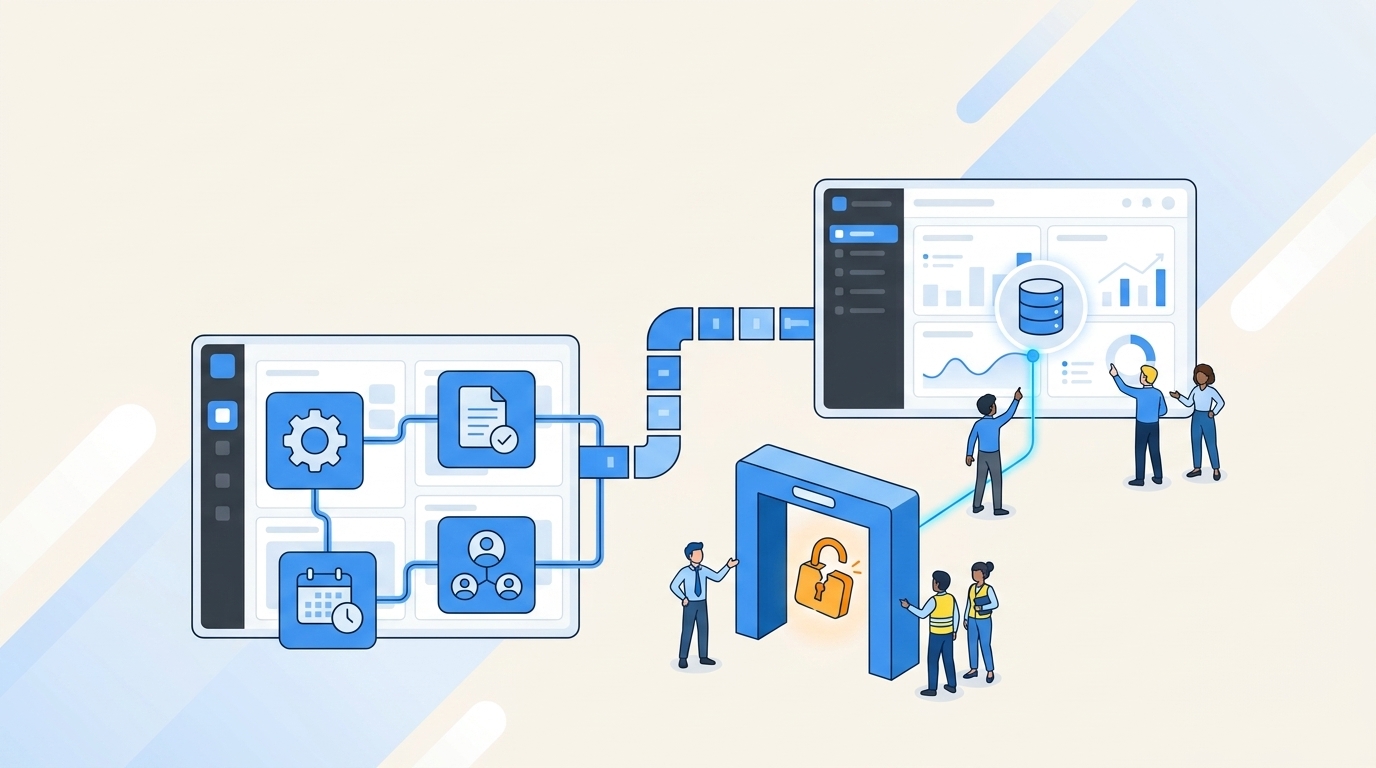
68% of access review work is still done outside the system of record in a lot of companies. And that's the mistake. If you're integrating HR tools for onboarding, transfers, and access governance, the real problem usually isn't your HR stack. It's that approvals, provisioning, reviews, and audit evidence are split across Jira, Slack, your identity provider, and a bunch of spreadsheets.
A lot of teams think adding a chat bot or SaaS management layer solves this. It doesn't. Chat bots and SaaS management can make requests feel faster, but they usually don't enforce time-bound access, they don't run real access reviews with usage context, and they definitely don't leave you with clean audit evidence by default.
Key Takeaways:
- Integrating HR tools for access and lifecycle work breaks down when requests, approvals, provisioning, and evidence live in different systems.
- If access isn't tied to identity provider groups, automatic revocation usually won't happen.
- If your review process still ends in CSV clean-up and screenshots, you don't have a review process. You have audit prep debt.
- Time-bound access works best for elevated roles, production access, and short-lived exceptions. If a role lasts under 24 hours, make expiry the default.
- Access reviews get dramatically better when reviewers see last login, group membership, department, and job title in one place.
- The best operating model is simple: request in Jira or Slack, approve in Jira or Slack, provision through the identity provider, and write evidence back to Jira.
- Tools matter, sure. But the workflow matters more.
Why integrating HR tools for access usually breaks in the handoffs
Integrating HR tools for access and lifecycle work usually fails at the handoff points, not at intake. The request gets created fine. The real mess starts when one team approves in Slack, another provisions in Okta or Entra, and someone else has to rebuild the story later for audit.

The first red flag is where approvals actually happen
You can diagnose this pretty fast. Ask four questions.
- Where does the employee request access?
- Where does the approver approve it?
- Where does the actual provision or revoke happen?
- Where does the auditor look for evidence?
If your answers involve three or four systems, you've got a governance problem, not an integration problem.
I've seen this pattern a lot. A new hire starts Monday. HR triggers onboarding in one system. The employee manager pings IT in Slack for a couple extra apps. Someone opens a Jira ticket after the fact because "we need the paper trail." Then an admin manually adds the user to a group in the identity provider. At quarter end, Security exports a sheet to figure out who still has access. It all technically works. Sort of. But you can feel the drag in it.
That drag compounds. A mid-market team going from 100 to 500 employees hit this hard. Tuesdays turned into backlog day because every new hire needed a fresh wave of app access, half the requests were missing details, and ownership was fuzzy. That's not a tooling issue. That's a system design issue.
Separate portals create separate truth
The common assumption is that a dedicated governance portal gives you more control. Fair point. On paper, it can. In practice, if employees still live in Jira and Slack all day, the separate portal becomes one more place they avoid, bypass, or forget.

That's why the ITSM and IGA split is such a problem. Jira owns the request. Email or Slack owns the approval thread. The identity provider owns the actual change. A spreadsheet owns the review. Then audit asks for evidence and suddenly nobody owns the full story.
This is where integrating HR tools for employee lifecycle work gets weird. HR thinks onboarding is complete because the task is marked done. IT thinks it's complete because the laptop shipped and accounts were created. Security knows it isn't complete because privileged access never expired and nobody can prove who approved what. Same process. Three definitions of done.
And yeah, the old way has merits. A separate suite can make sense if you're a very large enterprise with a long rollout window, a dedicated governance team, and tolerance for heavy change management. Most mid-market teams don't have that luxury. They need the work to happen where the work already happens. That's why governance inside Jira makes more operational sense.
The real bottleneck isn't onboarding software, it's standing access
The surface complaint is usually slow onboarding or messy offboarding. The deeper issue is standing access that nobody revisits. That changes how you should think about integrating HR tools for identity and access work.
Slow access is annoying, but overprovisioned access is expensive
Most teams focus on the wait time. Understandably. New hires need apps on day one. Managers hate delays. IT gets measured on responsiveness.
But the bigger cost often shows up later. Access granted quickly without expiry tends to stick around. Licenses stay assigned. Elevated permissions linger. Former project access stays live long after the work ends. One bad quarter of this and you're paying for unused software while quietly increasing security risk.
A fintech company used a just-in-time model and cut privileged access by 85%. That's the kind of number that changes the conversation. Not because the team suddenly became more policy-heavy. They actually became more practical. If someone needs elevated access for a short window, give it fast, then remove it automatically at expiry. No clean-up task. No "we'll remember later." Later almost never comes.
So here's a blunt rule. If the access need is tied to an incident, a deployment, a production check, or an admin task expected to last less than 24 hours, make the request time-bound by default. Don't debate it case by case. Build the expiry into the workflow.
Reviews fail when reviewers have no context
Quarterly access reviews sound good in theory. In reality, most of them are rubber-stamping exercises because the reviewer is staring at a spreadsheet of names and groups with no context.
That's why the review design matters more than the review cadence. If a reviewer can't see last login, department, job title, current groups, and a recommendation in the same place, they'll keep access just to be safe. And "keep just to be safe" is how least privilege dies.
There's a pretty simple threshold here. If your reviewer has to open more than two tabs to decide whether access should stay, the review flow is too fragmented. Fix the context before you add more certification campaigns.
We were surprised how often teams miss this. They think their review problem is compliance frequency. Usually it's evidence quality and reviewer confidence. Put better context in front of the reviewer, and revocations go up for the right reasons.
Audit pain is usually process debt wearing a compliance badge
Audits feel like compliance pain. A lot of the time, they're really operating model pain.
If your team is taking screenshots, pulling CSVs, and reconciling comments from multiple tools, then your evidence isn't being produced by the workflow. It's being rebuilt after the fact. That's expensive. And risky. And honestly pretty fragile.
One team supporting more than 400 employees with four IT Ops people processed 3,800 plus access requests in a year and automated 75% of them. That tells you something important. Lean teams can absolutely handle scale. But only when approval, provisioning, and evidence are connected.
What's the practical test? Look at your last audit sample. If it took more than 10 minutes to prove who requested access, who approved it, when it was granted, and when it was removed, your governance flow is still too manual.
That's the pressure point. Not more policy. Better workflow.
What a better operating model looks like in practice
A better model for integrating HR tools for access governance is boring in the best way. The request starts in the system employees already use. Approval goes to the right person automatically. Provisioning runs through the identity provider. Reviews happen in the same record system. Evidence gets written as the work happens.
Start by sorting access into three buckets
Don't design one flow for every request. That's where a lot of teams go wrong. You need at least three buckets.
First, standard app access. This is low-risk, repeatable stuff like common business apps with well-defined roles. These should be catalog-driven and, where appropriate, auto-approved or lightly approved.
Second, elevated or sensitive access. Admin roles, production systems, finance tools, customer data. These need explicit approval, a shorter duration window, and automatic revocation tied to expiry.
Third, lifecycle-driven access. Onboarding, transfers, offboarding. These shouldn't depend on someone remembering each app manually. They should be driven by workflow transitions and identity data.
That separation matters. If you treat all three the same, you either over-control low-risk access and create backlog, or under-control sensitive access and create risk. Neither is good.
Here's the rule I'd use. If access is recurring and role-based, route it through a catalog. If it's elevated and temporary, enforce duration at request time. If it's tied to a joiner, mover, or leaver event, trigger it from the lifecycle workflow.
Build the review around decisions, not spreadsheets
Access reviews should be decision systems. Not data dumps.
That means the reviewer should land in one place, see who has access, see whether they've used it, and make a clean keep-or-revoke call. If the revoke decision then kicks off a real removal through the identity provider, great. That's an operating system. If the revoke decision becomes "someone on IT will look into it," that's still manual review with nicer packaging.
There's a case to be made for spreadsheets in tiny environments. Under 50 employees, with a handful of core apps, you can probably survive for a bit. I get it. The second you're dealing with multiple departments, higher turnover, or regular audits, that approach starts breaking fast.
The strongest review flows usually share a few traits:
- reviewers see last login, department, title, and group membership together
- revocation happens from the same workflow
- the system records why access was removed
- campaigns stay scoped to approved apps, not every app under the sun
That scope point matters. Reviewing everything creates noise. Review the apps that matter first.
Make expiry the default for elevated access
This is the big shift. Most teams still treat temporary access as an exception. It should be the default for anything elevated.
Think about how weird the old model is. Somebody needs admin access for a one-hour task. You approve it. IT grants it. Everyone moves on. Six weeks later, they still have it. Nobody intended that. It just happened because the process had no built-in end state.
Time-bound access fixes that. Not philosophically. Operationally.
A good decision rule here is simple:
- If the role is privileged, set a duration before approval.
- If the duration is under 24 hours, remove it automatically at expiry.
- If extensions happen often for the same role, review whether the base role design is wrong.
That third point gets ignored. Repeated exceptions are design feedback. If one team needs the same temporary access every day, you don't have an exception anymore. You have a role modeling problem.
Keep governance in the workflow people already trust
Adoption matters more than people admit. You can build a very elegant governance process and still lose if employees hate using it.
That's why Jira and Slack matter here. Not because chat is magical. It isn't. Chat alone lacks governance, time-bound enforcement, and auditability. But as an approval and request layer attached to Jira, it's incredibly practical.
A request submitted in a familiar portal or through Slack has a much better shot at being done the right way than one buried in a separate governance system nobody loves. Same with approvals. If the manager can approve in the workflow they already live in, cycle time drops. If that action writes back to Jira and triggers the identity provider change, now you've got something useful.
You don't need a prettier process. You need a tighter one.
How Multiplier turns Jira into the control point
Multiplier turns Jira into the control point for access governance by keeping requests, approvals, provisioning, reviews, and evidence tied to the same operating record. That matters a lot when you're integrating HR tools for onboarding and access changes, because the workflow stops fragmenting the moment the request moves.
Time-bound access and provisioning through the identity provider
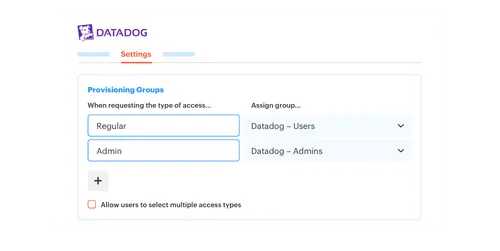
Multiplier's Time-Based Access is one of the clearest examples of this. A requester can choose a duration like 1, 6, or 24 hours during submission. Once approved, Multiplier adds the user to the mapped identity provider group, starts the timer, and removes the group membership at expiry. The change is recorded in the Jira issue.

That solves a very real problem. Elevated access stops becoming a manual reminder task. It becomes a governed workflow with an end state.
Multiplier also handles Automated Provisioning via identity provider groups. Once the request reaches the approved status, it calls Okta, Entra ID, or Google Workspace to add or remove users from mapped groups. For SSO apps, that pushes entitlements downstream through the identity provider. And because it writes success or failure comments back to Jira, the evidence is attached to the original request instead of living in screenshots and side notes.
Worth being precise here. Multiplier provisions through identity provider groups. It does not directly provision inside individual SaaS apps outside that model. That boundary matters.
Access reviews in Jira with the context reviewers actually need
Multiplier's Access Reviews are built around Jira-native campaigns. Admins create a campaign, choose in-scope approved applications, assign reviewers, and launch. Reviewers land in a JSM Help Center dashboard where they can see user attributes, groups, last login, and recommendations before deciding to keep or revoke access.
That's a much better review pattern than sending around another spreadsheet.
And when a reviewer revokes access, Multiplier can automatically remove the user from the relevant identity provider groups, create a Jira ticket documenting the change, and keep progress visible in the campaign dashboard. That's the key message for compliance teams. The review decision and the enforcement action stay connected. Audit evidence is ready because it was produced during the work, not rebuilt after.
A lot of teams start smaller, by the way. They use the Application Catalog to centralize requests in JSM, route approvals through configured Approval Workflows, and let managers or app owners approve in Jira or Slack. Then they add stricter controls like time-based access or review campaigns where the risk is highest. That's usually the smarter rollout path.
If you want to see what that looks like in your environment, Get started with Multiplier.
Why this model gets stronger as you scale
The whole point of integrating HR tools for access, onboarding, and reviews is to reduce friction as headcount grows. If the process gets more manual every quarter, you didn't build a system. You built a temporary workaround.
What works at 80 employees usually breaks at 400. What works at 400 breaks at 1,000 unless the workflow is tied together. That's why the better model is so consistent: requests where employees already work, approvals where managers already work, changes through the identity provider, and evidence written back to Jira as a byproduct.
It's not flashy. It's just sane.
And that's the bigger point. Governance doesn't need to live in another portal to be real. It needs to live in the flow of work, enforce least privilege by default, and make reviews and audits easier instead of heavier. Once you do that, scale gets a lot less scary.
Frequently Asked Questions
How do I set up time-based access requests with Multiplier?
To set up time-based access requests using Multiplier, start by ensuring your application is configured to allow time-based access. When an employee submits a request through the JSM portal or Slack, they'll have the option to select a duration for access (like 1, 6, or 24 hours). After the request is approved, Multiplier will automatically provision access and set a timer to remove it once the duration expires. That keeps standing access from accumulating — access disappears when the timer runs out.
What if my access requests are getting lost in Slack?
If access requests are getting lost in Slack, use Multiplier's Slack App. Employees submit directly through Slack, which creates a Jira ticket automatically. Every request lands in Jira so nothing gets buried in a thread. Approvers get direct notifications and can respond without leaving Slack.
Can I automate user provisioning with Multiplier?
Yes, you can automate user provisioning with Multiplier by integrating it with your identity provider like Okta or Azure AD. Once an access request is approved, Multiplier will automatically add or remove users from the appropriate identity provider groups. That removes the manual steps and keeps provisioning current — your system of record stays accurate without extra work.
When should I conduct access reviews with Multiplier?
You should conduct access reviews regularly, typically on a quarterly basis, to keep user access appropriate. With Multiplier's Access Reviews feature, you can create campaigns that allow reviewers to see user attributes like last login and job title. That context helps reviewers actually decide — not just rubber-stamp — which drives revocations up for the right reasons.
Why does my team need a centralized access request system?
The Application Catalog in Multiplier gives employees one place to request app access. Requests arrive with context upfront, which cuts the back-and-forth. IT gets better oversight and a cleaner audit trail — without chasing down tickets across three systems.


