


Choosing between Jira Service Management and ServiceNow feels a bit like choosing between a speedboat and an aircraft carrier. Both will get you where you need to go, but the right choice depends entirely on your cargo, your crew size, and how quickly you need to arrive.
These two platforms dominate the IT service management (ITSM) landscape. Both appear as Leaders in Gartner's Magic Quadrant. Both have passionate user bases. But they serve fundamentally different organizational needs. This comparison breaks down pricing, implementation timelines, features, and real-world use cases so you can make an informed decision based on your specific situation rather than marketing claims.
What is Jira Service Management?
Jira Service Management is Atlassian's ITSM platform built on top of Jira, the widely-used issue tracking system. Launched in 2020 as a rebrand and expansion of Jira Service Desk, it integrates tightly with other Atlassian products like Jira Software and Confluence.
The platform targets teams of all sizes but has found particular traction with mid-market companies and organizations already using the Atlassian ecosystem. Its core value proposition centers on speed: fast implementation, intuitive interfaces, and quick time-to-value.
Key strengths include:
- Transparent pricing with online tiers and no hidden modules
- Unified platform for Dev, IT Ops, and business teams
- Agile-friendly workflows that don't force rigid ITIL processes
- 5,000+ apps in the Atlassian Marketplace for extensibility
Atlassian claims over 50,000 customers worldwide use Jira Service Management, with more than 60% of them using the platform for non-IT support teams like HR and facilities.
What is ServiceNow?
ServiceNow is an enterprise cloud computing platform that digitizes and unifies organizations. Founded in 2003 (originally as GlideSoft), it has grown into a global powerhouse with around 85% of Fortune 500 companies using its platform.
ServiceNow ITSM is purpose-built for enterprise service management from the ground up. Unlike tools adapted from other use cases, ServiceNow was designed specifically for ITIL-aligned IT service management and has expanded from there.
Key strengths include:
- Comprehensive feature set with virtually unlimited customization
- Single cloud platform extending beyond IT to HR, Security, Customer Service, and more
- Enterprise scale with 11 global datacenter pairs and dedicated instances
- Proven ITIL compliance for organizations with strict governance requirements
ServiceNow positions itself as the platform you won't outgrow. The tradeoff is complexity: more features, more configuration options, and a steeper learning curve.
Jira Service Management vs ServiceNow pricing comparison
Pricing is often the first practical differentiator between these platforms. The approaches couldn't be more different.
Atlassian publishes transparent pricing online with four tiers:
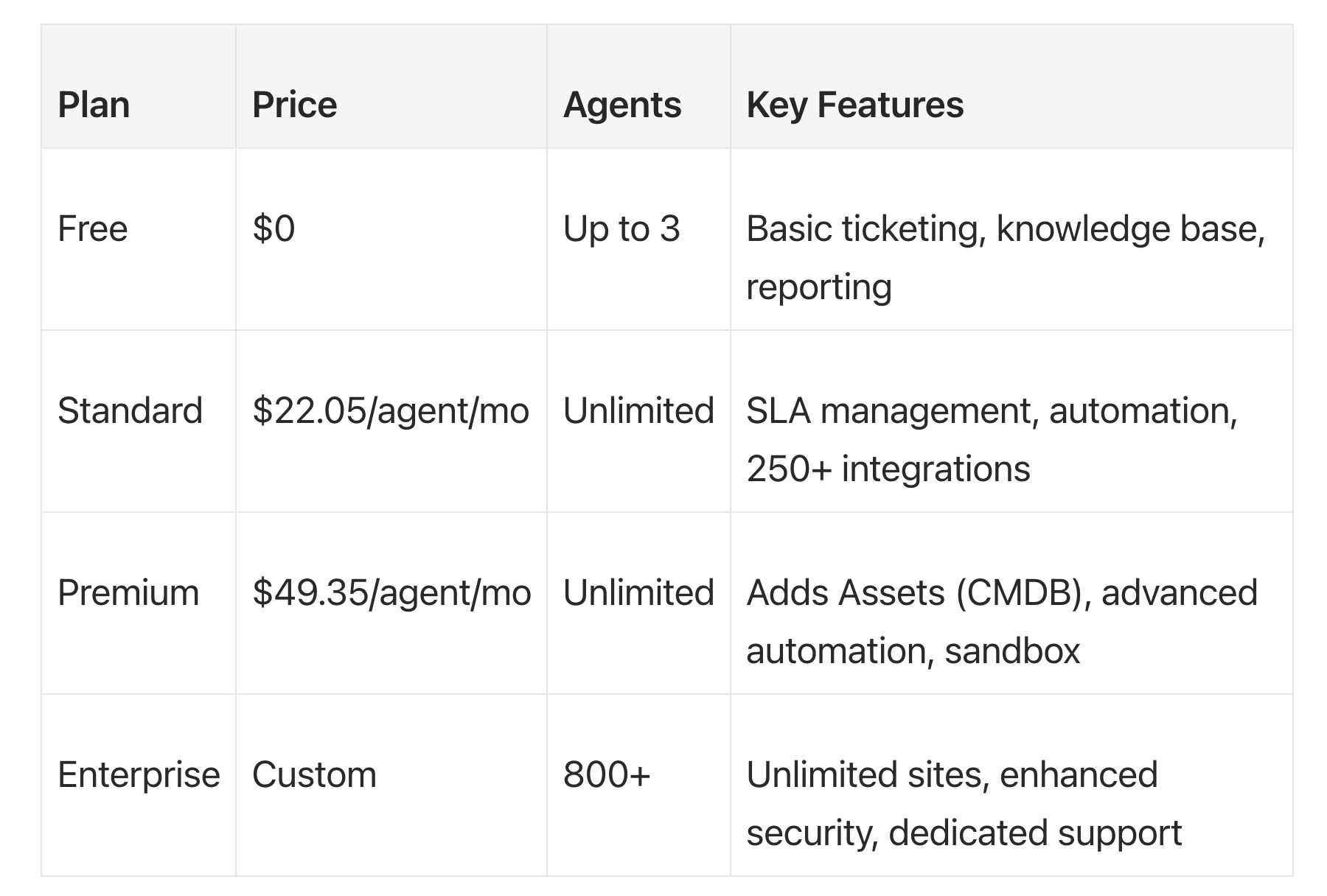
The Premium plan includes Assets (Atlassian's CMDB solution) and advanced automation features that many organizations need. For a 50-agent team on Premium, you're looking at roughly $2,468 per month.
ServiceNow pricing
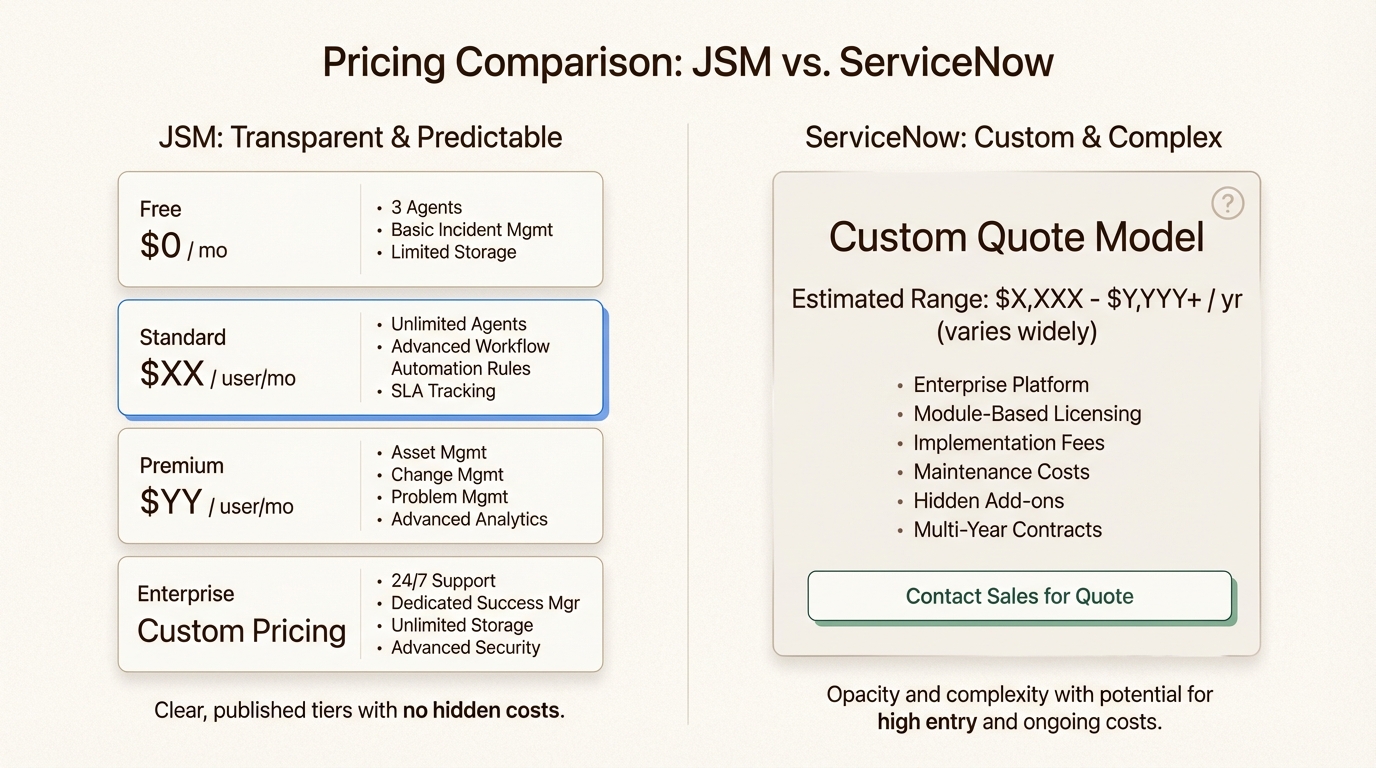
ServiceNow does not publish pricing. You must contact sales for a custom quote based on your organization size, required modules, and implementation complexity.
Industry estimates and forum discussions suggest:
- Mid-market implementations often start in the low six figures annually
- Enterprise deployments can reach seven figures
- Additional modules (ITOM, ITAM, HR Service Delivery) each carry separate costs
- Implementation consulting and training add significant upfront investment
A Ginkgo Bioworks IT leader quoted on Atlassian's site summarized the difference: "All your ITSM competitors are these monolithic solutions that start at a list price of half a million dollars and need an army of consultants to get started."
Value analysis
When evaluating total cost of ownership, factor in:
- Implementation costs: ServiceNow typically requires significant professional services; JSM can often be self-implemented
- Training: ServiceNow's complexity demands more extensive training
- Ongoing administration: ServiceNow often requires dedicated administrators; JSM can be managed by existing IT staff
- Add-on modules: ServiceNow's modular approach means costs scale with features; JSM includes more in base tiers
One Engie Mexico IT engineer reported: "We could implement the Premium version of Jira Service Management and still save $67k on licensing costs in comparison to ServiceNow."
Implementation and time-to-value
How long until your ITSM platform is actually helping users? The answer varies dramatically between these two options.
Jira Service Management implementation
Most JSM implementations follow a predictable timeline:
- Basic setup: Days to weeks
- Full implementation with workflows: 2-3 months
- Complex enterprise rollout: Under 6 months
An Atlassian Certified Expert noted in the community forum that the longest phase tends to be workflow proficiency, which can take upwards of 12 weeks as teams adapt to new processes.
JSM's advantage comes from its intuitive interface and the fact that many users already know Jira. If your development team uses Jira Software, your IT team will find JSM familiar immediately.
ServiceNow implementation
ServiceNow implementations are significantly more complex:
- Typical timeline: 5-18 months according to various sources
- Complex enterprise deployments: Up to 3 years (per Reddit user reports cited by Zapier)
- Requires: Dedicated project team, extensive planning, technical training, organizational change management
ServiceNow offers a full suite of service packages dedicated to consulting, implementation, optimization, and education. This reflects the reality that most organizations need significant help to deploy ServiceNow effectively.
IT consulting company Plat4mation claims an average of three months for implementation, but that's likely for teams with substantial resources dedicated to the project. More realistic timelines for typical organizations range from 6-18 months.
The time-to-value tradeoff
Here's the short version: JSM gets you running quickly with room to grow; ServiceNow requires major upfront investment but offers more depth once deployed.
If you need a functioning service desk in weeks, JSM is the practical choice. If you have 12-18 months to plan and execute a comprehensive IT transformation, ServiceNow's depth may justify the wait.
Jira Service Management vs ServiceNow feature comparison
Both platforms cover ITSM fundamentals: ticketing, incident management, change management, knowledge bases, and reporting. The differences emerge in depth, flexibility, and approach.
Request and incident management
ServiceNow follows strict ITIL-aligned processes. Incident categorization uses machine learning. Workflows are prescriptive and designed for large teams with specialized roles. The service catalog is robust, with complex approval chains and integration options.
Jira Service Management offers more flexibility. Dynamic forms adapt based on user input. The JSM-Jira Software integration means development teams can link tickets directly to code issues. Workflows are easier to customize without coding, though they may require more intentional design for ITIL compliance.
For teams prioritizing ITIL rigor, ServiceNow has the edge. For teams wanting agility and cross-functional collaboration, JSM fits better.
Asset and configuration management
ServiceNow offers a comprehensive CMDB with relationship mapping and dependency tracking. The platform excels at visualizing infrastructure connections and understanding blast radius during incidents. However, ServiceNow Discovery (the automated asset discovery tool) requires a separate subscription.
Jira Service Management includes Assets in Premium and Enterprise plans at no extra cost. Assets Discovery is available as a free Marketplace app. The CMDB capabilities are less extensive than ServiceNow's but sufficient for most mid-market needs.
Knowledge management
ServiceNow is KCS v6 verified, meaning it meets the Consortium for Service Innovation's standards for Knowledge-Centered Service. It integrates with Microsoft Word Online for authoring and offers sophisticated knowledge analytics.
Jira Service Management leverages Confluence for knowledge management. The collaborative editing experience is superior, with rich formatting and team editing features. However, achieving full KCS compliance may require Marketplace apps like Workflows for Confluence.
AI and automation
Both platforms have invested heavily in AI:
ServiceNow offers Now Assist, which provides generative AI for summarizing issues, automating tasks, and providing recommendations. Predictive AIOps helps identify and prevent incidents before they impact users. Robotic Process Automation (RPA) is built into the automation module.
Jira Service Management features Atlassian Intelligence, which includes virtual agent capabilities in Slack, smart request type recommendations, and issue summarization. Automation is genuinely no-code, with a visual rule builder that doesn't require scripting knowledge.
Reporting and analytics
ServiceNow distinguishes between "Reporting" (where are we today?) and "Performance Analytics" (what's happening over time?). The platform offers sophisticated visualizations including heat maps, pivot tables, and semi-donut charts.
Jira Service Management provides solid default reports covering workload, satisfaction, and request resolution. Custom reports are available, though some users find the reporting less extensive than ServiceNow's. Marketplace apps like eazyBI can extend capabilities significantly.
App development and customization
ServiceNow App Engine Studio is a low-code, widget-based development environment. "Citizen developers" can build apps without extensive coding knowledge. Pre-built interfaces and templates accelerate development.
Jira Service Management Forge requires installing a CLI and working with JavaScript, HTML, and CSS. It's more powerful for developers but less accessible to business users without technical backgrounds.
Integration ecosystems
Your ITSM platform doesn't exist in isolation. Here's how each platform connects to the broader tool landscape.
Jira Service Management integrations
The Atlassian Marketplace offers over 5,000 apps. Key integration categories include:
- Development tools: Native connections to Bitbucket, GitHub, GitLab
- Communication: Slack, Microsoft Teams integrations
- Monitoring: PagerDuty, Opsgenie, Datadog
- Identity: Okta, Azure AD, Google Workspace
- Automation: Zapier for connecting to thousands of apps
The JSM-Jira Software integration is particularly valuable for DevOps teams. When an incident requires code changes, tickets flow seamlessly between IT and development teams.
ServiceNow integrations
ServiceNow's IntegrationHub provides pre-built "spokes" for common integrations. The ServiceNow Store offers certified apps. Key strengths include:
- Enterprise systems: SAP, Oracle, Workday
- Cloud platforms: AWS, Azure, GCP
- Security tools: Splunk, CrowdStrike, Palo Alto Networks
- IT operations: SolarWinds, Datadog, Dynatrace
- Custom integrations: Robust API for building custom connections
ServiceNow's single codebase means integrations work consistently across the platform. The IntegrationHub can even connect to Jira if you need to bridge both platforms.
User ratings and satisfaction
According to Gartner Peer Insights:
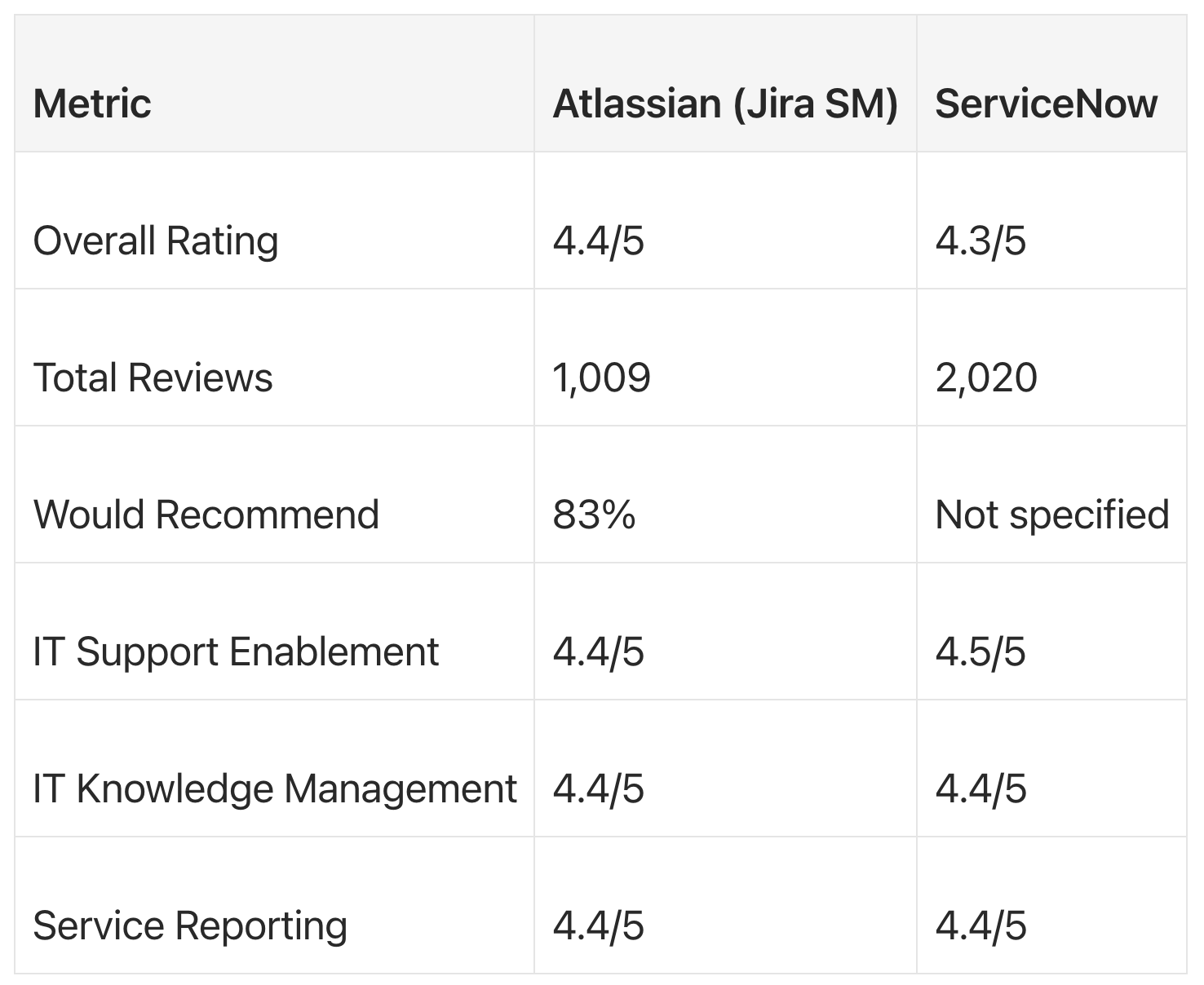
The ratings are remarkably close, with Jira Service Management holding a slight edge in overall satisfaction despite ServiceNow's larger review volume. Both platforms score consistently across capability categories.
Who should choose Jira Service Management?
Jira Service Management fits best for:
Small to mid-market companies (roughly 100-5,000 employees) that need enterprise-grade ITSM without enterprise complexity. The pricing scales reasonably, and you won't pay for features you don't use.
Teams already using Atlassian products. If your developers live in Jira Software and your documentation lives in Confluence, JSM feels like a natural extension rather than a separate tool.
Organizations needing quick implementation. When you need a functioning service desk in weeks, not quarters, JSM delivers.
DevOps-heavy environments. The integration between JSM and development tools streamlines incident response and change management.
Budget-conscious teams. Transparent pricing means no surprise costs at renewal, and the total cost of ownership tends to be significantly lower than ServiceNow.
Companies extending ITSM beyond IT. With over 60% of JSM customers using it for HR, facilities, and other business teams, the platform handles enterprise service management without extra licensing complexity.
If you're implementing JSM and need to add access governance, access request workflows in Jira can extend your service desk to handle identity management without requiring a separate portal.
Who should choose ServiceNow?
ServiceNow is the better choice for:
Large enterprises with complex ITIL requirements. If your organization has dedicated ITIL process owners and strict compliance needs, ServiceNow's prescriptive workflows fit naturally.
Organizations with six-figure ITSM budgets. ServiceNow requires significant investment, but you get comprehensive capabilities in return.
Teams needing extensive customization. ServiceNow's platform can be molded to virtually any workflow or process requirement.
Companies wanting a single platform for multiple functions. ServiceNow extends naturally into HR Service Delivery, Security Operations, Customer Service Management, and more.
Organizations with dedicated ITSM implementation resources. If you have the project team, budget, and timeline to do ServiceNow right, the depth of capability is unmatched.
Highly regulated industries. Financial services, healthcare, and government organizations often find ServiceNow's compliance and audit features worth the investment.
Extending Jira Service Management with access governance
Jira Service Management excels at ticketing and workflows, but organizations often need to bridge the gap between service requests and identity management. That's where specialized tools come in.
Multiplier is an identity governance platform purpose-built for Jira Service Management. It adds capabilities that would typically require separate, expensive enterprise tools:
Access Requests: Turn JSM into an internal "app store" where employees request access to SSO and non-SSO applications. Access requests in Jira include just-in-time (time-bound) access, automated provisioning, and configurable approval workflows.
User Access Reviews: Automate quarterly access audits directly in JSM. Reviewers certify or revoke access without needing JSM agent licenses. Results feed back into Jira with full audit trails for compliance reporting.
Identity Orchestration: Build no-code workflows for employee lifecycle automation. When a new hire ticket is created, automatically create user accounts, assign groups based on role, provision licenses, and handle direct report mappings.
For teams choosing Jira Service Management, Multiplier fills the identity governance gap without requiring a separate platform. Everything stays inside Jira, maintaining the unified experience that makes JSM attractive in the first place.
Making your choice: Jira Service Management vs ServiceNow
Let's break it down.
Choose Jira Service Management if: You want to get up and running quickly, prefer transparent pricing, already use Atlassian tools, or need a platform that scales reasonably without requiring dedicated administrators. It's the pragmatic choice for most mid-market organizations.
Choose ServiceNow if: You have complex enterprise requirements, a substantial ITSM budget, dedicated implementation resources, and need a platform that can handle virtually any service management scenario at massive scale.
Both platforms are solid choices. Both have satisfied customers. The "right" answer depends entirely on your organization's size, budget, timeline, and existing tool ecosystem.
If you're leaning toward Jira Service Management and want to explore how identity governance fits into your service management strategy, check out how access management stays inside Jira with tools designed specifically for the Atlassian ecosystem.
Frequently Asked Questions
Can Jira Service Management handle enterprise-scale ITSM?
Yes, with caveats. JSM serves enterprise customers including Fortune 500 companies. However, very large organizations with complex ITIL requirements and massive scale may find ServiceNow's depth more suitable. JSM works best for enterprises that value agility over prescriptive process enforcement.
Is ServiceNow too expensive for small IT teams?
Generally yes. ServiceNow's pricing model and implementation complexity make it impractical for small teams. Organizations typically need significant ITSM budgets (six figures annually) and dedicated resources to justify ServiceNow. Small teams usually find Jira Service Management or other alternatives more appropriate.
How does Jira Service Management vs ServiceNow compare for DevOps integration?
JSM has the edge for DevOps integration due to its native connection with Jira Software. Development and IT teams can collaborate on the same platform, link incidents to code changes, and maintain visibility across the entire software delivery lifecycle. ServiceNow can integrate with development tools but requires more configuration.
Can we migrate from ServiceNow to Jira Service Management?
Yes, migration is possible and Atlassian provides resources for organizations switching from ServiceNow. The migration typically involves exporting ticket data, recreating workflows in JSM, and training users on the new interface. Many organizations report significant cost savings after migration, though the process requires planning.
Does ServiceNow offer better reporting than Jira Service Management?
ServiceNow offers more extensive native reporting with advanced visualizations like heat maps and pivot tables. However, JSM's reporting is sufficient for most use cases, and Marketplace apps can extend capabilities significantly. The 'better' option depends on whether you need sophisticated analytics out-of-the-box or are willing to configure extensions.
Which platform has better AI capabilities: Jira Service Management or ServiceNow?
Both platforms have invested heavily in AI. ServiceNow's Now Assist offers predictive AIOps and built-in RPA. JSM's Atlassian Intelligence provides virtual agents, smart recommendations, and no-code automation. For most ITSM use cases, both platforms offer comparable AI value, though ServiceNow's AIOps capabilities are more mature for complex enterprise environments.
Can Jira Service Management replace ServiceNow entirely?
For many organizations, yes. JSM can handle core ITSM functions including incident, problem, change, and asset management. However, organizations deeply invested in ServiceNow's broader platform (HR, Security, Customer Service) may find JSM insufficient as a complete replacement. Evaluate your specific module usage before deciding.


