


Your access decision gets worse every hour it sits between the Jira ticket and the identity provider. The approver sees the request, but they don't see the expiry window or the exact group change at the moment they decide. So they approve broad access to unblock the employee, then hope someone remembers to clean it up later. Real-time identity decisions in Jira change the whole motion, because the same ticket carries the approval through provisioning and removal.
Most IT teams don't lose control because they lack policy. They lose control because the policy lives in one tool, the request lives in Jira, the approval happens in Slack, and the actual access change happens in Okta, Entra, or Google Workspace. And then everyone pretends the spreadsheet can glue it all together later.
Key Takeaways:
- Real-time identity decisions in Jira only work when the access change is tied to the ticket that approved it.
- Policy-heavy least privilege fails when revocation still depends on a human remembering to clean things up.
- The faster model is to route approvals where people already work, then provision through the identity provider.
- Time-bound access should be the default for elevated permissions, not a special security project.
- Access reviews get much easier when reviewer decisions and enforced revocations live in the same system.
- The goal isn't another portal. The goal is fewer handoffs between Jira, Slack, and your identity stack.
Why Real-Time Identity Decisions Break Outside Jira
Real-time identity decisions break outside Jira because the decision and the action drift apart. The ticket may say approved, but the identity provider still needs a manual group change. That gap creates standing access, messy audit evidence, and a process everyone knows is broken.

The Approval Is Fast, But the Access Change Isn't
A manager can approve a request in 30 seconds. Great. If IT still needs to open Okta, find the right group, check the spreadsheet, add the user, comment on the ticket, and maybe remember to set a reminder for revocation, you didn't automate access. You just moved the bottleneck.
Picture the IT admin at 2:47 PM on a Tuesday. The Jira queue shows 14 access tickets marked approved. She opens Okta in one tab, the access spreadsheet in another, the Jira ticket in a third, and Slack in a fourth to confirm one approval that came through as a thumbs-up emoji. Each ticket takes 6-8 minutes of clicking. By 4:30, three new requests have come in, and one of them is a privileged grant from last week that nobody revoked. That's the cost hiding under a clean-looking SLA.

Real-time identity decisions in Jira need to include the actual identity change. Not just the approval. Not just the comment. The access grant has to be tied to the request record, and if the access is temporary, the expiry has to be tied to the same record too. Otherwise, your approved status is just a signal for someone to go do more work.
For teams already standardizing access intake inside JSM, the next question is whether the access layer can live there too: Learn more about Multiplier.
The Spreadsheet Becomes the Audit System
Spreadsheets are useful. I'm not anti-spreadsheet. Honestly, half of the early operating systems in a company start in a spreadsheet because it's flexible, fast, and everyone knows how to use it. Fair enough.

The problem starts when the spreadsheet becomes the source of truth for who should have access. At that point, you've created a second system that has to be reconciled with Jira and the identity provider. One column says the user was approved, another column says the access was removed, Jira has a screenshot, Slack has the actual decision, and good luck during audit week. A real-time identity decision in Jira should produce evidence as a byproduct of the workflow. The request comes in, the right person approves, the identity provider group changes, and the ticket records what happened. If the access expires in 24 hours, the removal lands on the same record. That's the whole point.
Long-Lived Access Is Usually an Operations Problem
Security teams talk about least privilege like it's a policy problem. Policy matters. Most long-lived access exists because revocation is operationally annoying. Someone got temporary admin access during an incident, the team moved on, and nobody wanted to open 14 systems to clean it up.
At Stavvy, the issue was privileged access that lasted too long. They needed access only when someone actually needed it, with expiry built in. After implementing time-limited access, they cut privileged access by 85%. That number matters because it shows the real mechanism. Less standing privilege didn't come from writing a stronger policy. It came from making temporary access easier than permanent access.
Here's the counterintuitive part: if secure access is slower than insecure access, people route around it. If temporary access is faster, cleaner, and easier to prove later, people use it. The system wins because the better path is also the easier path.
How to Make Access Decisions Fast Without Losing Control
Access decisions get faster when you separate intake, approval, provisioning, expiry, and review, then connect them through one workflow. Jira should own the request record, Slack can speed up approval, and the identity provider should execute the actual change. That's how real-time identity decisions in Jira stay controlled.
Start With the Request Paths That Repeat Every Week
Before you touch anything, pull the last 100 access tickets and tag them by hand. You're looking for repeat patterns, not your scariest application. Figma editor access, GitHub repo access, Salesforce viewer access, Jira project access, the boring stuff.
Boring requests are where automation pays back fastest. At Luno, routine access requests were coming through Slack, email, and Jira while IT manually chased managers and assigned Okta groups. Some requests took 5-30 minutes each. After centralizing requests and automating the standard path, they reduced IT workload on access requests by 80%. Not because the problem was exotic. Because it was repetitive.
Use a simple frequency rule. If an app shows up more than 10 times in your last 100 tickets, automate it first. If it shows up 5-10 times, build the catalog entry but accept manual provisioning for now. If it shows up fewer than 5 times a quarter, track it for the audit record and move on. The trap is spending a week perfecting an edge case while the high-volume queue keeps burning hours.
A few questions to run the tickets through:
- Which apps show up more than 10 times?
- Which roles are requested again and again?
- Which requests always need the same approver?
- Which ones can be time-bound by default?
- Which ones require manual work because the app isn't SSO-backed?
Make the Identity Provider the Execution Layer
Jira is good at workflow. Slack is good at attention. Your identity provider is good at access enforcement. The mistake is asking one tool to do all three jobs, then wondering why the process feels clunky.
The clean model is pretty straightforward. A user requests access in Jira or Slack, the approval happens against the right workflow, and once approved, the identity provider group changes. For SSO apps, that group membership controls what the user gets. Real-time identity decisions in Jira become much stronger when Jira decides, and the identity provider executes.
Not every app will fit this model. Some non-SSO tools still need manual provisioning, and pretending otherwise is how teams overpromise automation and lose trust. For those apps, you can still use Jira as the intake and evidence layer, then mark the provisioning step as manual. The rule I'd use: if access can be granted through an identity provider group, map it and automate it. If it can't, capture the request, approval, and evidence in Jira, then flag it as a manual fulfillment. Don't blur the two. Blurred systems are where audits get painful.
Put Expiry on the Request, Not in Someone's Memory
Temporary access without automatic expiry is just permanent access with good intentions. Good intentions don't remove group memberships at 2 AM after an incident is over. Someone has to remember. Usually they don't.
Time-bound access works because it flips the default question. Instead of asking, "Should this access ever end?" you ask, "How long do you need it?" That might be 1 hour, 6 hours, or 24 hours for elevated access. The requester chooses the window. The approver sees the context. The system removes the access when the timer expires.
There's a real tradeoff. Some users will complain that time limits add friction, and they're not entirely wrong. If you make someone request access 12 times a day for a core tool, you've made security annoying. The better move is to reserve strict time limits for elevated roles, production systems, sensitive datasets, and expensive licenses where the risk or cost is actually meaningful.
I like a simple threshold. If the access could create security exposure, customer impact, or material SaaS cost above roughly $50/month per seat, it should have an expiry option. If it's low-risk daily work, don't over-govern it. Least privilege works better when it's focused.
Move Approvals Into the Channel People Actually Check
Approvals die in email. Not always, but often enough that every IT team has the same story. The ticket is waiting, the manager missed the notification, the user pings IT, and IT pings the manager. The manager says "approved" in Slack, and nobody updates the ticket. Classic.
Approvals need to happen where people already respond. For most teams, that means Slack. The important bit is that Slack can't become the system of record. If the approval happens in chat but doesn't write back to Jira, you've just created another evidence problem.
A good approval flow has three parts: the approver gets the request in Slack with enough context to decide, the approval action updates the Jira ticket, and the approved status triggers the identity provider change. Don't start by designing 17 approval paths. Start with three: manager approval, app owner approval, and a named security approver for sensitive roles. Three paths cover a lot of ground. You can add nuance later once the basic motion is working.
Use Access Reviews to Catch What Automation Misses
Access reviews aren't there because your request process is bad. They're there because companies change. People switch teams, managers change, tools get deprecated, and licenses sit unused. A clean request workflow reduces the mess, but it won't catch every permission that becomes stale later.
The old review process is usually a spreadsheet sent to app owners once a quarter. Reviewers skim it, keep almost everything, and maybe revoke a few obvious misses. I get why it happens. Nobody wants to spend their week reviewing access line by line when the data is stale and the revocation still requires manual follow-up.
The better review process gives reviewers context at the moment of decision. Who is the user? What department are they in? What groups do they belong to? When did they last log in? If the reviewer clicks revoke, does anything actually happen? Real-time identity decisions in Jira should extend to reviews too, because a review decision without enforced revocation is just another checkbox.
Use a red flag list before each campaign and flag a few risk patterns: users who haven't logged in for 90+ days, users who changed departments in the last quarter, users with admin roles on production systems, and users attached to apps with high license cost. If you review everything with the same weight, reviewers rubber-stamp. If you highlight risk, they pay attention.
Treat License Waste as an Access Signal
SaaS waste is usually treated as a finance problem. That misses the point. Unused licenses are often stale access wearing a budget hat. If someone hasn't logged into an app for 30, 60, or 90 days, the company may be paying for a license and carrying unnecessary access at the same time.
That connection matters. License reclamation and least privilege are often the same motion. Check last login data from the identity provider, notify the user, give them a grace period, and remove access if they don't respond or log in. Finance gets savings, security gets less standing access, and IT gets fewer manual cleanup projects.
Synthesia is a good example of the operating model. They grew from 100 to 400+ employees, had a 4-person IT Ops team, and processed 3,800+ access requests in a year. 75% of those requests became fully automated. That's what happens when access operations move from "someone should check this" to an actual workflow.
The decision rule is simple. If an app has reliable login data and a meaningful license cost, set an inactivity threshold. If the app is high risk, make the threshold shorter, maybe 30 days instead of 90. If the telemetry is weak, don't automate removal blindly. Bad data creates bad revocations, and bad revocations destroy trust fast.
How Multiplier Turns Jira Into the Access Control Point
Multiplier turns Jira into the access control point by connecting requests, approvals, provisioning, expiry, and evidence inside JSM. Employees request approved apps through Jira or Slack, approvers act in the tools they already use, and identity provider group changes keep access controlled and auditable.
The Catalog Makes the Right Request Easy
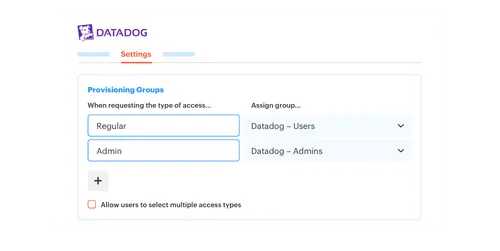
Multiplier's Application Catalog gives employees a Jira-native app store for sanctioned access requests. They can browse approved applications, pick a role like Viewer, Editor, or Admin, and submit through the JSM portal or Slack. Behind the scenes, apps and groups sync from Okta, Entra ID, or Google Workspace, and each role maps to identity provider groups.
That matters because the catalog fixes the intake problem before it becomes an automation problem. Instead of free-form tickets like "Need Figma," the request includes the app, role, requester, approver path, and any time-based duration you've configured. Cleaner input means cleaner approval and provisioning. Pretty basic. Also very important.
Multiplier then routes approvals to managers, app owners, or specific users through Jira and Slack. Once the Jira issue reaches the approved status, automated provisioning can add the user to the mapped identity provider group and write the result back to the ticket. For teams trying to make real-time identity decisions in Jira, that ticket-level evidence is the thing that keeps the process from falling apart later.
Time-Based Access Closes the Loop
Multiplier's Time-Based Access makes temporary access enforceable because expiry is part of the workflow. A requester can choose a duration, such as 1, 6, or 24 hours. After approval, access is provisioned through the mapped identity provider group, and when the window expires, Multiplier removes the group membership and records the change in Jira.
That's the missing loop in a lot of access programs. They approve quickly, grant access eventually, and revoke whenever someone remembers. Multiplier ties the request, decision, grant, and revocation to the same Jira issue. That's how you reduce standing privilege without turning IT into the cleanup crew.
Multiplier also supports access reviews in JSM and Auto Reclaim for unused licenses on the Advanced edition. Reviews show context like user attributes, groups, last login, and recommendations, then can enforce revocations through identity provider groups. Auto Reclaim can use last-login data, inactivity thresholds, grace periods, and exclusions to remove unused access and generate a Jira ticket documenting the action. If the goal is faster access with less standing privilege, the next practical move is to connect the catalog, approval, and expiry flow in one place: Get started with Multiplier.
What Changes When Access Governance Lives With the Work
Access governance changes when the work, the decision, and the evidence live together. The team stops rebuilding proof after the fact, employees get access faster, and security can enforce least privilege through the identity provider instead of chasing cleanup tickets.
The old way made sense for a while. Big IGA portal for governance, Jira for service requests, Slack for speed, and spreadsheets for audit backup. Each tool had a job, but the handoffs created the real cost. At scale, those handoffs become the operating system, and that's where teams start to lose control.
Real-time identity decisions in Jira are really about collapsing the handoff. Not removing judgment. Not skipping approvals. Just making the approved path the enforced path. When that happens, access requests stop being a queue management problem and become a governance workflow that actually runs. That's the win.
Frequently Asked Questions
How do I set up time-based access in Multiplier?
When you submit a request through Jira or Slack, pick the app and role, then choose a duration: 1 hour, 6 hours, or 24 hours. After approval, Multiplier provisions the access through the mapped identity provider group and sets the timer automatically. When it expires, the group membership is removed and the change is written back to the Jira ticket. No reminders, no cleanup tickets.
What if I need to revoke access after approval?
Time-limited access revokes itself when the window closes. For manual revocation, update the ticket status in Jira and Multiplier executes the group removal through the identity provider. Either way, the Jira ticket records what happened and when — that's your audit trail without any spreadsheet maintenance.
Can I automate access requests for multiple applications?
Yes. The Application Catalog syncs approved apps from Okta, Entra ID, or Google Workspace, so employees pick from a pre-approved list instead of filing free-form tickets. Each request comes pre-loaded with the app, role, approver path, and time duration — so IT isn't chasing missing context before they can act.
When should I conduct access reviews with Multiplier?
Quarterly is the baseline, but the right cadence depends on your risk profile. Multiplier runs review campaigns inside Jira so reviewers see user attributes, last login, and group memberships in context — not a blank spreadsheet row. When they click revoke, the identity provider group change happens immediately. That's the part most review tools skip.
Why does my team need to use Slack for approvals?
You don't have to, but approvals die in email. Most managers miss email notifications or catch them too late. Slack approvals are faster because people are already there. The key is that Multiplier writes the decision back to Jira regardless of where the approval happens — so the evidence trail stays in one place even when the approver never touches the ticket directly.


