


95% of access requests don't need a human touching them after approval. Yet somehow the work still bounces through Slack, Jira, Okta or Entra, and then a sad little spreadsheet somebody remembers only when the auditor shows up.
You've probably felt this already this week. A manager approved something in Slack, the admin had to go do the real work by hand, and now reducing manual efforts in access management somehow means adding one more step instead of removing three.
Key Takeaways:
- Reducing manual efforts in access management starts by removing the ITSM to IGA split, not by adding another request layer.
- If more than 25% of your requests still require copy and paste into the identity provider, your process is under-automated.
- Chat bots and SaaS management tools can speed intake, but they don't enforce time-bound access or produce clean audit evidence on their own.
- The fastest teams keep requests, approvals, provisioning, and evidence tied to the same Jira record.
- Time-bound access should be the default for elevated roles. If access only needs to exist for 1, 6, or 24 hours, don't grant it forever.
- Quarterly reviews break when reviewers work from spreadsheets. Reviews run better when the decision and the revocation happen in the same system.
- Lean IT isn't about hiring more admins. It's about automating 75%+ of access requests with Jira, Slack, and your identity provider.
Most Manual Access Work Shouldn't Exist
Reducing manual efforts in access management is mostly a systems problem, not a staffing problem. The teams drowning in requests usually don't have too few people. They have too many handoffs between Jira, chat, identity, and audit evidence.
The old process feels normal because everyone grew up with it
At 8:43 AM on a Monday, an IT admin opens Slack and sees three pings for urgent access. One user needs Salesforce, one needs GitHub, one needs a finance system for "just today." By 9:12, the admin has copied one approval from Slack, checked another in email, added two groups in Okta, left a Jira comment for one request, and forgotten to set an expiry on the temporary one. That's not a workflow. That's a baggage carousel where one suitcase always ends up in the wrong city.
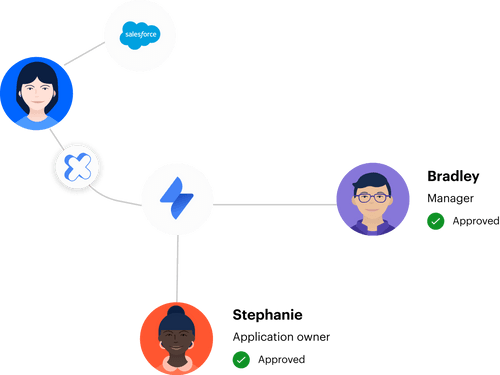
A pretty standard flow still looks like this. Employee asks in Slack. IT says submit a ticket. Manager approves in email. Admin checks the right group in Okta or Entra. Somebody pastes a note into Jira. If the request is sensitive, nobody sets an expiry. Three months later the person still has access.
Low volume hides the damage. At 20 requests a week, you can muscle through it and call it process. At 200, the same setup starts teaching people bad habits. Standing access gets broader, temporary access gets left in place, and the queue just gets longer.
The hidden cost is not just time
Manual access work burns time, sure. The bigger bill is inconsistency, and that bill shows up later when it's more expensive. One admin assigns the narrow group. Another picks the broader one because the naming is confusing. One approver asks for a reason. Another clicks approve from their phone in the elevator.
Pull your last 50 access requests and check three things. How many required a human to touch the IDP after approval? How many show the request, approval, grant, and timing in one place? How many granted permanent access even though the need was clearly temporary? If more than 12 of 50 still require manual provisioning, your process is under-automated. If more than 5 don't have clean evidence in one record, your audit trail is already cracked.
That inconsistency creates a second job no one planned for: cleanup. Cleanup in reviews. Cleanup in offboarding. Cleanup when finance asks why inactive users still have paid licenses. Cleanup when an auditor wants proof and everyone starts hunting through comments, DMs, and screenshots. Manual work always comes back for a second invoice.
Speed problems usually turn into security problems
A mid-market fintech with about 1,200 employees hit this exact wall. Requests came through Slack, email, and Jira. IT chased approvals, manually assigned Okta groups, then tried to reconstruct evidence later. On paper that sounds annoying. In practice, it changes behavior.
People stop following the clean path when the clean path is too slow. Access speed issues are usually security issues wearing a fake mustache. Once the backlog passes about 3 business days for routine app access, admins start favoring broad standing permissions over precise temporary ones because the queue hurts more than the risk feels real. Shortcuts don't appear because teams don't care. They appear because the system rewards them.
Yes, some manual steps are unavoidable for edge-case apps or non-SSO systems. The point isn't to automate 100% on day one. The point is that the 75% to 90% of requests that are repetitive, policy-friendly, and already backed by identity groups shouldn't require a human at all.
The Real Bottleneck Is the Split Between ITSM and Governance
The bottleneck isn't Jira. It isn't your identity provider either. It's the split between where work starts and where governance is supposed to happen. That split is where reducing manual efforts in access management usually dies.
Tickets in one place, controls in another
The default assumption is that identity governance needs its own portal. Clean architecture, separate controls, tidy little box on the diagram. Real life is messier.
The request starts in Jira because that's where employees already go. Approval happens in Slack because that's where managers respond fastest. Provisioning happens in the IDP because that's the authority. Evidence gets rebuilt later because none of those systems share one operational record.
Dedicated IGA suites can offer deeper control models. For a very large enterprise willing to tolerate a long rollout, that can be the right tradeoff. For mid-market teams living in Atlassian, a separate governance portal often creates more operational drag than control value. You don't fix fragmented work by adding one more place to fragment it.
Chat-first does not mean governance-first
What happens when Slack becomes your front door but not your control plane? You get fast intake and slow cleanup.
Chat bots are good at making requests easy to start. They're not good at enforcing duration, tying an approval to authoritative provisioning, or creating usable audit evidence. A manager clicking Approve in a DM is not governance. It's just a signal. Unless that signal triggers the actual group change and writes evidence back to the record, the work just moved downstream.
One blunt test: pick a privileged request from last quarter. Can you show the request, approver, access granted, expiry, and revocation from one record in under 3 minutes? If not, you have a scavenger hunt, not a governed workflow.
The real system of work already exists
Teams often go shopping for a new access layer while already sitting on the right operating stack. Jira already handles intake and SLAs. Slack already handles quick decisions. The identity provider already knows the real groups. The missing piece is orchestration.
Once the Jira issue becomes the place where the request, approval, provisioning status, and evidence live together, the whole motion changes. The ticket stops being a note about the work. It becomes the work. Kill the split and the workflow tightens up fast. Leave it in place and you're hiring humans to act as middleware.
Why Manual Access Work Compounds So Fast
Manual access tasks don't grow linearly. They stack, then they echo. That's why reducing manual efforts in access management feels optional at 100 employees and urgent at 500.

Growth exposes the cracks first
At 100 employees, messy access work looks scrappy. At 500, it looks expensive. At 1,000, it acts like a tax on every new hire, every manager, and every admin.
One ad-tech company hit this wall while growing from 100 to 500 employees. New hires started on Monday. By Tuesday afternoon, the IT queue was jammed with the same app requests: Slack, Salesforce, Figma, HubSpot, GitHub, a few finance tools — plus clarification threads because nobody had standardized which role got which group. The team wasn't lazy. The intake was.
If new hires routinely need the same 8 to 12 apps, stop collecting those requests through free text. Once onboarding generates more than 15 access tickets a week with repeated clarification loops, standardize the intake model first. Otherwise you're mopping the floor while the pipe is still leaking.
Manual provisioning creates delayed mistakes
Copy and paste feels harmless because each step is tiny. Add the user to a group. Leave a comment. Maybe remember the expiry. Tiny steps. Large blast radius.
What makes this nasty is the delay. Provisioning mistakes often surface 30, 60, even 90 days later — during a review, during offboarding, or when finance notices a paid license on someone who hasn't logged in for 45 days. The approval looked fine. The execution drifted. Approvals are visible, but provisioning quality is where the hidden risk lives.
A rough benchmark: if admins spend more than 5 minutes after approval on group assignment, license checks, or expiry cleanup for a standard SSO app, that request type is a candidate for full automation. Under 2 minutes, leave it. Above 5, the manual path is already too expensive.
Manual reviews are where the backlog comes back to bite you
Quarterly reviews are where every shortcut sends you the invoice. Spreadsheets, emailed CSVs, reviewers asking what a group even does, admins carrying out revocations days later — that's not a review cycle, it's forensic accounting for permissions.
Run the review where the access history already exists and the work shrinks. Reviewer sees the user, role, last login, and a recommendation. They click keep or revoke. The change executes. Evidence stays attached. No cleanup ticket afterward.
Don't try to automate every edge case at once. Review only apps provisioned through the IDP first. Auto-execute revocations there. Then expand scope. Sequence beats ambition — trying to run campaigns on apps you can't yet action automatically is how reduction projects stall.
A Better Way to Reduce Manual Efforts in Access Management
This works when the workflow gets rebuilt around one record, one approval path, and one authoritative execution layer. Not glamorous. Very effective.
Standardize intake before you chase full automation
You don't automate chaos. You put rails on it first.
That means sanctioned apps, defined roles, and clear role-to-group mappings. No blank text boxes for "whatever I need." Before: the requester describes access in their own words and the admin translates intent by hand. After: the requester picks from a catalog and the workflow already knows the group, the approver, and whether duration is required.
A quick gauge: if fewer than 30% of your apps have clean role mappings, start with catalog and approval standardization. If 30-70% are mapped, automate low-risk requests first. If more than 70% are mapped to IDP groups, push broad automation and make time limits the default for elevated roles.
Route approvals by ownership, not by whoever shouts loudest
Approvals should route to an app owner, the requester's manager, or a named approver. Those three paths cover most mid-market needs. Once approval drifts into side channels, the queue slows and the evidence degrades.
Extra approvals can be justified for high-risk apps — access to prod, finance controls, or sensitive customer data. For routine business apps, more than 2 approvals is usually just latency dressed up as governance.
Make provisioning happen through the identity provider, not beside it
Once a role maps cleanly to an identity provider group, approval should trigger the change automatically. Access operations stop looking like artisan craftsmanship and start looking like a production line: same request type, same mapped role, same trigger, same evidence trail.
If the request is for an SSO-connected app with a known group mapping, don't let it land in a manual provisioning queue. Auto-execute after approval. That one shift does more for reducing manual efforts than most teams expect.
Default elevated access to time limits
Standing privilege is what you get when cleanup depends on memory. Time-bound access fixes that at the source.
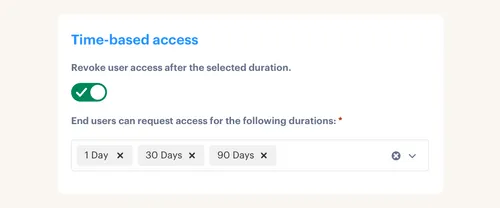
If access is tied to an incident, a production change, or a short admin job, the default should be temporary: 1 hour, 6 hours, or 24 hours. If nobody can explain why elevated access needs to live beyond 24 hours, don't make it permanent just because it's easier.
A fintech team using a just-in-time model cut privileged access by 85% and automatically revoked more than 1,300 requests after the approved window ended. That's where standing privilege and cleanup burden can both shrink at once.
Run reviews where the access history already lives
Reviews fail when reviewers have to reconstruct reality from multiple systems. They move fast when context is already attached to the operational record.
The reviewer should see enough to decide in seconds: user details, group membership, last login, and a recommendation when inactivity is obvious. Revocation should happen from the same flow. No cleanup ticket. No admin to-do list in somebody's notebook.
Review quarterly for high-risk apps and privileged roles. Every 6 months for stable business apps. Skip campaigns on apps you can't yet action automatically — fix the action path first. Reviews without enforcement are just paperwork.
How Multiplier Turns Jira Into the Operating Layer
Multiplier sits in Jira Service Management, connects to your identity provider, and keeps the request, approval, provisioning action, and evidence tied to the same Jira issue.
Standardized intake and approval inside Jira and Slack
Multiplier's Application Catalog gives employees a Jira-native self-service way to request sanctioned apps and roles, either in JSM or through the Slack app. Apps and roles sync from Okta, Entra, or Google Workspace, and each role maps to an identity provider group. Clean intake is what makes reliable automation possible later.
Multiplier's Approval Workflows route decisions to the right people — the requester's manager, an app owner, or a specific user. Approvers can act in Jira or Slack, and the request stays anchored to the Jira issue the whole way.
Execution and evidence on the same record
Once a request is approved, Multiplier's Automated Provisioning adds or removes the user from the mapped group through Okta, Entra, or Google Workspace. That cuts out the manual group assignment step that usually eats 5 to 30 minutes per request. Status gets written back to the Jira ticket — audit evidence is created as part of the work, not rebuilt after the fact.

For elevated access, Multiplier's Time-Based Access provisions the group membership, starts the timer, and removes access automatically at expiry. Multiplier's Access Reviews keep campaigns in Jira, show reviewers user context and last login details, and can enforce revocations through the identity provider for supported flows.
Teams can also use Post Functions for lifecycle tasks and Auto Reclaim to remove unused licenses based on identity-provider login activity. Get started with Multiplier to see how it works in practice.
Reducing Manual Efforts in Access Starts With One Workflow
This isn't about layering more software on top of a broken process. It's about removing the split between request, approval, provisioning, and evidence so the right action happens automatically.
That's why the leanest teams don't have the most admins. They have the fewest handoffs. Put governance in Jira. Let Slack speed decisions. Let the identity provider handle authoritative changes. The audit trail stops being a project and starts becoming exhaust from the workflow itself.
If your people are still acting as the glue between systems, the process isn't modern. It's manual with better branding.
Frequently Asked Questions
How do I automate access requests in Jira?
You can automate access requests in Jira using Multiplier's Application Catalog. Set it up in your Jira Service Management portal, and employees can browse sanctioned applications and select roles to request access. Once a request is approved, Multiplier automatically provisions access through your identity provider, eliminating manual steps and reducing errors.
What if I need to revoke access for inactive users?
Use Multiplier's Auto Reclaim feature. Set inactivity thresholds for your applications — if a user exceeds the threshold, Multiplier notifies them and, after a grace period, automatically revokes their access. This keeps licenses clean and ensures only active users retain access.
Can I set time limits for elevated access?
Yes. Multiplier's Time-Based Access lets users choose a duration when submitting a request (1, 6, or 24 hours). After approval, Multiplier provisions the access and removes it automatically when the time expires — no manual cleanup required.
When should I conduct access reviews?
Quarterly for high-risk applications and privileged roles. Multiplier's Access Reviews run campaigns directly in Jira, where reviewers see user details, group memberships, and last login dates. Decisions are documented and executed within the same system.
Why does my access request process feel slow?
Fragmented workflows across tools are usually the culprit. Multiplier consolidates requests, approvals, and provisioning within Jira, eliminating unnecessary handoffs and speeding up the process without compromising governance.


