


Your access process can pass 99 Jira tickets and still fail the audit if the approval, provisioning change, and revocation evidence live in different places. The mistake most IT teams make is treating compliance as a reporting problem, when it’s really an operating problem. Auditors don’t want a heroic spreadsheet built the week before review. They want proof that access was requested, approved, granted, and removed through a process you can defend.
Most IT teams don’t fail compliance because they don’t care. They fail because the work happens in one place, the approval happens in another, the access change happens in Okta or Entra, and the evidence gets rebuilt later when the auditor asks for it.
And I get why it happens. You grow fast. Someone needs Figma. Someone needs GitHub admin for 24 hours. Someone needs Salesforce access before a customer call. So the team does what works in the moment. Until the moment becomes the process.
Key Takeaways:
- Compliance breaks when access work is split across Jira, Slack, identity providers, and spreadsheets.
- Chat bots and SaaS management tools can speed up requests, but they usually don’t enforce time-bound access or audit evidence.
- If you can’t prove who approved access, what changed, and when it was removed, you don’t have a clean compliance process.
- The better model is simple: request in Jira, approve in Slack or Jira, provision through the identity provider, and write evidence back to the ticket.
- Time-bound access should be the default for elevated roles, not a special security project.
- Access reviews work better when the decision and the revocation happen in the same workflow.
Why Access Compliance Breaks Inside Split Workflows
Access compliance breaks when the request, approval, provisioning, revocation, and evidence trail live in different systems. Jira may hold the ticket, Slack may hold the approval, Okta or Entra may hold the actual entitlement, and a spreadsheet may hold the audit record. That creates gaps nobody sees until review time.

The access request is not the real control
A Jira ticket by itself feels like control. I’ve seen this happen a lot. Someone files the request, the IT team comments “approved,” and everyone feels like the process worked. But if the group assignment happens manually in the identity provider, the actual control is still living outside the ticket.
Picture a workplace technology manager at 4:45 PM on a Friday. A new sales leader needs admin access to a CRM workflow before Monday. The manager checks Slack for approval, opens Jira, then adds the user to the right Entra group. It works. The business moves. The problem shows up three months later when nobody can prove whether the access was still needed after that first project.
What are the compliance requirements really asking for in that moment? Not just a ticket. They’re asking for a chain of proof. Who requested access, who approved it, what changed, when it changed, and whether the access was removed when the reason expired. Without that chain, your process is basically a warehouse with labels on the boxes but no inventory system. Looks organized. Until someone asks for the exact item.
If you’re already living this split across Jira, Slack, and your identity provider, the first move is getting the workflow into one record. You can Learn more about Multiplier if you want to see how Jira-native access governance handles that without adding another portal.
Chat speed can hide governance problems
Chat is great for movement. Someone asks, someone reacts, someone approves. Done. I’m not anti-chat at all. For a lot of companies, Slack is where work actually happens, and pretending otherwise is silly.
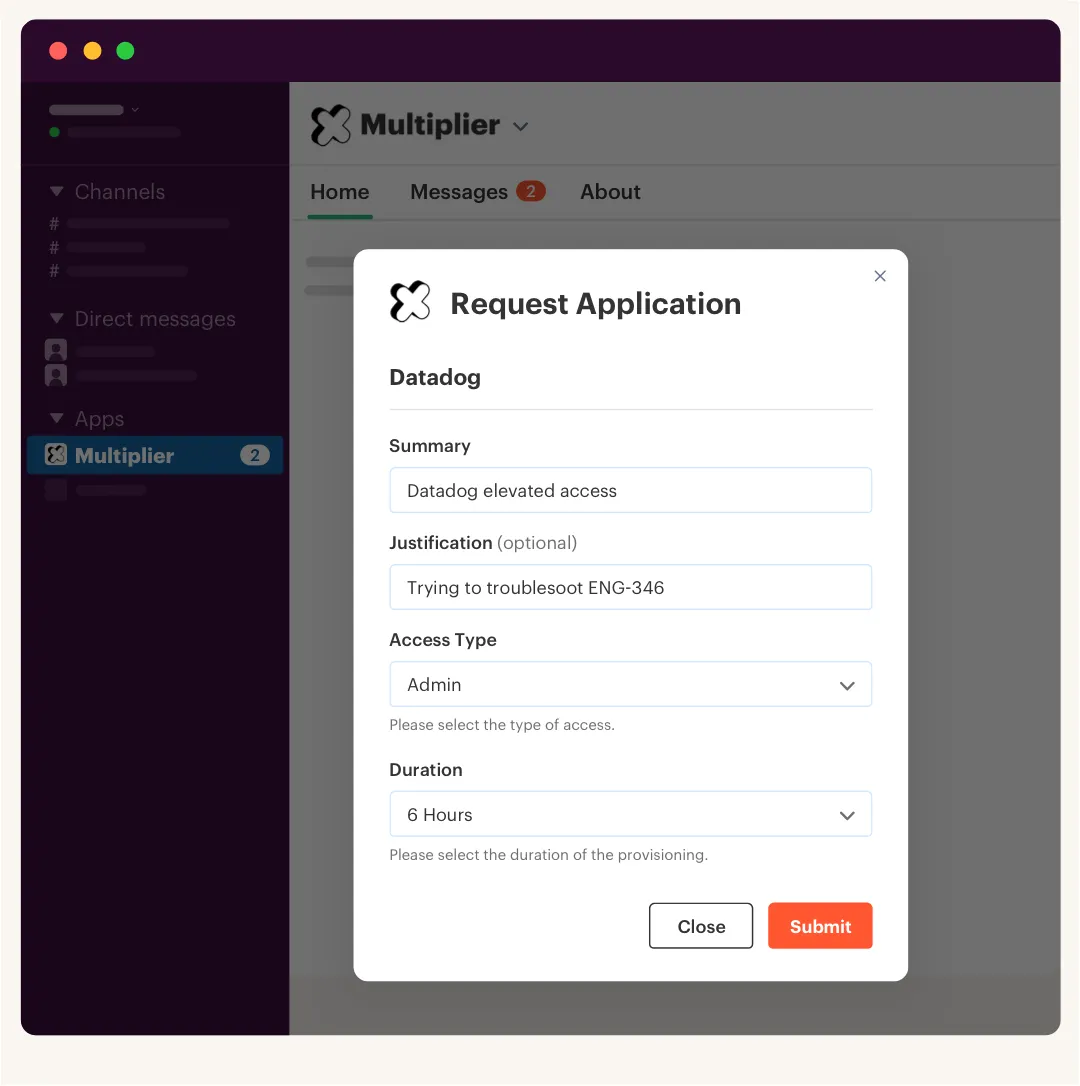
The mistake is treating a chat approval as governance. A thumbs-up in Slack doesn’t always tell you which app, which role, what duration, what risk level, or whether the approval triggered the right identity provider change. For low-risk access, maybe that’s fine. For admin roles, financial systems, production tools, or customer data, that gets risky fast.
The NIST access control guidance is pretty clear on the direction of travel: define access, enforce it, review it, and remove it when it’s no longer valid. Not in those exact startup-friendly words, obviously. But that’s the operating model. Access can’t just be fast. It has to be fast and provable.
A fintech team like Luno hit this problem during rapid growth. Access requests were coming through Slack, email, and Jira, and IT was still manually assigning Okta groups. They got the business what it needed, but every manual step added tracking work and human error. After automating the request and provisioning flow, they cut IT workload on access requests by 80%. That’s not a small cleanup. That’s the process finally matching the volume.
The real issue isn’t that teams use too many tools. The real issue is that none of those tools owns the full access lifecycle.
What Compliance Actually Requires From Access Workflows
Compliance-ready access workflows need four things: clear intake, accountable approval, authoritative provisioning, and reliable revocation evidence. If one piece is missing, the process becomes harder to defend. The goal is not more paperwork. The goal is making the normal workflow produce the proof automatically.
Start by finding the evidence gaps before the audit does
Run a simple test on your last 20 access requests. Pick a mix of routine apps, privileged access, and one or two messy exceptions. For each ticket, ask four questions: can you see who approved it, can you see the exact role granted, can you prove the change happened in the identity provider, and can you prove access ended when it should have?
If fewer than 18 out of 20 tickets answer all four, you don’t have an audit problem yet. You have an operating problem. The audit just makes it visible. I like this test because it doesn’t require a 6-month maturity assessment or a consultant with a 70-slide deck. You can do it in an hour, and it usually hurts a bit.
The results tend to fall into patterns:
- Approval exists, but provisioning proof is missing: Someone said yes, but nobody can prove the right group changed.
- Provisioning happened, but the approver is unclear: Access exists, but the decision trail is weak.
- Access was granted with no expiry: The original reason ended, but the entitlement stayed.
- Evidence lives outside Jira: Screenshots, exports, and spreadsheet notes become the audit trail.
A fair counterpoint: smaller teams can sometimes get away with manual evidence for a while. If you have 80 employees and five core SaaS apps, a spreadsheet might survive. Once you’re onboarding 20 people a month or processing hundreds of requests a quarter, the spreadsheet stops being a control and starts being another place where work gets lost. That’s the point where what are the compliance gaps becomes a weekly question, not a quarterly one.
Map every request to an identity provider group
The cleanest access workflows start with group mapping. Each requestable role should map to one or more identity provider groups in Okta, Entra ID, or Google Workspace. That sounds basic, but it changes the whole motion. Instead of IT interpreting a vague request, the system knows which group creates which entitlement.
Having burned through messy access processes before, I’d argue this is where most teams should spend the first serious effort. Not on building a prettier request form. Not on a better Slack command. Map the roles. Viewer, Editor, Admin, Finance Approver, Production Read Only. If the role can’t be mapped cleanly, that’s a signal the access model is too fuzzy.
A simple rule works well here: if a role gets requested more than five times per month, map it to an identity provider group and make it requestable. If it gets requested once a quarter, keep it manual but still require the approval and evidence trail. If it carries admin rights or sensitive data access, force duration and owner approval regardless of frequency.
This is where SaaS management tools often fall short. They can show who has access. Some can suggest unused licenses. Useful. But visibility is not the same as control. Compliance needs the action path too, meaning the request creates a record, the approval creates accountability, and the identity provider change executes from that record. Otherwise you’re still reconciling after the fact.
Use time limits for anything you’d hate to explain later
A lot of teams talk about least privilege like it’s a policy. It isn’t. Least privilege is an operating habit. The question is simple: does this person need this access now, and should it disappear when the job is done?
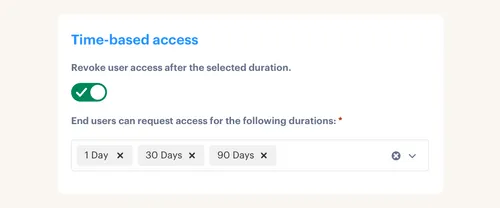
For elevated access, I’d start with three default windows: 1 hour, 6 hours, and 24 hours. One hour works for quick production checks. Six hours works for project work or incident response. Twenty-four hours works when someone needs a full business day but shouldn’t keep the role forever. Simple options beat open-ended forms because the requester doesn’t have to invent a policy every time.
The decision rule is blunt:
- If the access can change customer data, make it time-bound.
- If the access grants admin rights, make it time-bound.
- If the access is for a project or incident, make it time-bound.
- If the role is part of someone’s permanent job, review it on a fixed schedule instead.
A case can be made for permanent access in some roles. Finance admins, security leads, and core IT admins may need standing access because delays would create bigger risk. That’s valid. The sharper point is that standing access should be chosen, documented, and reviewed, not accidentally created because nobody wanted to follow up later.
Keep approvals close to the work, not buried in another portal
Approvals slow down when they move away from the person doing the work. If your employees use Jira for IT requests and Slack for decisions, sending them into a separate IGA portal creates friction. Some people will comply. Others will route around it.
What works better is boring, in a good way. The request starts in the service desk. The approver gets the decision where they already respond. The identity provider change happens after approval. The ticket records the outcome. No drama. No archaeology later.
The AICPA SOC 2 criteria are built around trust in systems and controls. Access controls are a big part of that trust story, especially for companies handling customer data. When approval evidence gets detached from the actual access change, the control is harder to explain. Auditors don’t love detective novels.
One practical threshold: if an approval takes more than 24 business hours for a routine app, the workflow is probably too far away from where people work. If an approval takes less than 10 minutes but leaves no reliable evidence, it’s probably too informal. The goal is the middle. Fast decision, clean record.
If you want to see what that looks like with Jira and Slack as the front door, See how Multiplier works in a real access workflow.
Treat access reviews as cleanup plus enforcement
Quarterly access reviews often become theater. Export the users. Send the spreadsheet. Ask app owners to mark keep or remove. Chase them. Chase them again. Then IT manually removes access and hopes the spreadsheet matches reality.
I’m being a little harsh, but not by much. The reason reviews fail is not that app owners are lazy. It’s that the review asks them to make decisions without enough context, then asks someone else to do the revocation later. Two handoffs. Two chances to miss something.
A better access review gives the reviewer the data they need:
- User and department: So the reviewer knows whether access matches the role.
- Group membership: So the entitlement is clear.
- Last login: So inactive access is obvious.
- Risk or recommendation: So the reviewer doesn’t start from a blank page.
- One-click revoke path: So the decision becomes action, not another ticket pile.
A good rule: if a reviewer marks “revoke,” the system should remove the identity provider group membership without a second manual queue. If your review only produces a spreadsheet, it’s not enforcement. It’s a suggestion. That’s why what are the compliance requirements should always include the revocation path, not just the certification record.
Use license waste as an access risk signal
Unused licenses aren’t just a finance problem. They’re often a sign of standing access nobody has cleaned up. If someone hasn’t logged into an app in 30, 60, or 90 days, the question isn’t only “can we save money?” It’s also “why does this person still have access?”
The threshold depends on the app. For collaboration tools, 30 days of inactivity may be enough to trigger a warning. For quarterly finance tools, 90 days might be more reasonable. For privileged engineering systems, I’d rather see shorter windows and stronger justification. The pattern matters more than the exact number.
A simple policy model:
- Warn inactive users before revocation so you don’t break real work.
- Exclude specific groups when needed like executives or critical support roles.
- Revoke automatically after the grace period if there’s no login.
- Write the removal back to a ticket so finance, IT, and audit can all trust the record.
The surprising connection is that license optimization and access compliance are basically cousins. Finance wants unused seats gone. Security wants unnecessary access gone. IT wants fewer manual cleanup tasks. Same workflow, different executive sponsor. When you combine usage data with automated revocation, you get a cleaner SaaS bill and a cleaner access posture.
How Multiplier Automates Access Governance in Jira
Multiplier automates access governance by keeping requests, approvals, provisioning, reviews, and evidence inside Jira Service Management. It provisions through identity provider groups in Okta, Entra ID, and Google Workspace, then records the change on the Jira issue. That turns routine access work into audit-ready evidence.
Jira-native requests with identity provider provisioning
Multiplier starts with a Jira-native application catalog, so employees request approved apps and roles from the same place they already use for IT support. Each catalog role maps to one or more identity provider groups. When the Jira issue reaches the approved status, Multiplier calls the identity provider API to add the user to the mapped group.

That matters because it removes the swivel chair step. No copying details from Jira into Okta. No guessing which group matches the role. No screenshot hunting later. For SSO apps, group-based provisioning can flow through the identity provider to the application, while the Jira ticket keeps the approval and execution record together.
Multiplier also supports approvals through Jira Service Management and Slack, with approvers assigned by app owner, manager, or a specific user. The important bit is that Slack doesn’t become a separate governance system. It’s an approval surface tied back to the Jira issue. A team like Synthesia processed 3,800+ access requests in a year and automated 75% of them with a small IT Ops team. That’s the kind of ratio you need when headcount grows faster than IT hiring.
Time-bound access and reviews that execute
Multiplier’s time-based access makes elevated access temporary by default. Requesters choose a duration like 1, 6, or 24 hours. After approval, Multiplier adds the user to the mapped identity provider group, starts the timer, and removes the group membership when the window expires. The grant and revocation are both recorded in Jira.
Access Reviews work the same way conceptually. Admins launch a Jira-native campaign, reviewers see user attributes, groups, last login, and recommendations, then mark keep or revoke. When the reviewer chooses revoke, Multiplier removes the relevant identity provider group membership and creates the Jira evidence for the change. That closes the gap between “we reviewed access” and “we actually removed access.”
Multiplier also has Auto Reclaim on its Advanced edition for license cleanup based on identity provider login telemetry. Admins define inactivity thresholds, grace periods, and exclusions. If the user stays inactive after warning, access is revoked and a Jira ticket documents the removal. That ties back to the earlier problem: compliance evidence shouldn’t be rebuilt later. It should fall out of the workflow while the work is happening.
If your team is trying to answer what are the compliance gaps across Jira, Slack, and your identity provider, the fix is usually not another dashboard. It’s a tighter workflow. Get started with Multiplier if you want the request, approval, provisioning, revocation, and evidence trail living in one Jira-native process.
Make Compliance Evidence Part of the Workflow
Compliance gets easier when evidence is created at the same time as the access change. Not after. Not during audit prep. Right when someone requests access, someone approves it, the identity provider grants it, and the system removes it later.
That’s the real shift. Stop asking “where do we store audit evidence?” and start asking “why doesn’t the workflow produce it?” Once you see it that way, the tool choice gets clearer. Chat alone won’t do it. SaaS inventory alone won’t do it. A separate portal may add control, but if the work already lives in Jira, you’re making people leave the system that holds the operational truth.
The better answer is boring and repeatable. Govern access where the work already happens, provision through the identity provider, set time limits when access is risky, and make every decision traceable. That’s how compliance stops being a quarterly scramble and becomes part of the job.
Frequently Asked Questions
How do I ensure time-bound access for elevated roles?
To ensure time-bound access for elevated roles, you can use Multiplier's time-based access feature. When submitting a request, specify a duration such as 1, 6, or 24 hours. After approval, Multiplier will automatically provision access and set a timer to revoke it once the duration expires. This helps minimize risks associated with unnecessary prolonged access and ensures compliance with least privilege principles.
What if I need to track access changes for audits?
To track access changes for audits, use Multiplier's integration with Jira. Every access request, approval, and provisioning action is logged in the Jira ticket associated with the request. This creates a clear audit trail that includes who requested access, who approved it, and when the access was granted or revoked. This method ensures that you have reliable evidence ready for audits without needing to recreate records later.
Can I automate access reviews with Multiplier?
Yes, you can automate access reviews using Multiplier's Access Review feature. Create a review campaign within Jira, select the applications to review, and assign reviewers. They will receive a dashboard showing user details, group memberships, and last login dates. Once they mark access as 'Keep' or 'Revoke', Multiplier will automatically update the identity provider groups and document the changes in Jira, streamlining the review process.
When should I use the application catalog for access requests?
You should use the application catalog for access requests when you want to simplify the intake process. Multiplier's application catalog allows employees to browse approved applications and roles directly within Jira or Slack. This ensures that requests are consistent and include the necessary context, reducing the chances of errors and speeding up the approval process. It's especially useful for managing high volumes of access requests efficiently.
Why does my team need to map roles to identity provider groups?
Mapping roles to identity provider groups matters because it creates a clear connection between what users request and what access they receive. This ensures that when a request is made, Multiplier can automatically provision the correct access without manual intervention. It also helps maintain compliance by ensuring that access is granted based on predefined roles, reducing the risk of overprovisioning and facilitating easier audits.


