


Quarterly access reviews don't prevent standing privilege if revocation still lives in a spreadsheet. Regular access reviews prevent real risk only when the review decision turns into an actual access change, not another comment in Jira that someone needs to clean up later.
I've seen this pattern a bunch. IT runs the campaign, managers click through the list, security gets the CSV, everyone feels pretty good for 12 minutes. Then three months later, the same users still have the same access because the revoke step sat in someone's queue beside 47 other tickets.
Key Takeaways:
- Regular access reviews prevent standing privilege when the review includes usage context and enforced revocation.
- Spreadsheet reviews fail because they separate the decision from the access change.
- The real bottleneck isn't certification. It's cleanup.
- If a reviewer can't see last login, role, manager, and group membership, they're guessing.
- If revocation takes longer than 48 hours after a review decision, the access review is mostly evidence, not control.
- The better model is simple: review in the system of record, revoke through the identity provider, and keep evidence tied to the ticket.
Why Access Reviews Fail When Revocation Lives Elsewhere
Access reviews fail when the review system can't enforce the decision. The team may collect approvals, mark users for removal, and export evidence, but the risk stays open until someone removes the actual entitlement. That gap is where standing privilege survives.

The Review Is Not the Control
A review is only a control if it changes access. I know that sounds obvious, but it's where a lot of teams get trapped. They treat the campaign as the event, when the event should be the cleanup. Someone says "revoke," the spreadsheet turns green, the audit folder gets updated, and the access sits there because nobody changed the group in Okta, Entra, or Google Workspace.
The painful part is that the team did the hard work. They found the stale access. They got the app owner to make a call. They created evidence. Then the whole thing lost force because the last mile was manual. If your access review process ends with a to-do list, regular access reviews prevent less than you think.
It's like doing month-end close, finding the bad entries, and deciding the journal entry can wait until someone has time. Finance would never treat that as done. Access should work the same way — a finding isn't closed until the system changes.
Spreadsheets Create a Fake Sense of Progress
Spreadsheets are useful at small scale. Fair enough. If you have 12 apps, 40 employees, and one IT person who knows every system by memory, you can make a spreadsheet work for a while. The mistake is letting that same process survive when you hit 200 employees, 80 apps, and multiple reviewers who don't know the real history behind each entitlement.
By that point, the spreadsheet becomes a report about work, not the place where work happens. A reviewer marks "remove." IT creates a separate ticket. Someone searches for the right group. Another person asks if the user still needs access for a project. Then the audit owner asks for proof that the change happened. Not fun. Not fast.
If you're trying to map that current mess against a Jira-native review and revocation path, see how Multiplier works in the context of the exact handoff most teams are trying to remove.
The Hidden Cost Is Cleanup Debt
The hidden cost of weak access reviews is cleanup debt. Every delayed revoke becomes one more open loop. Every exception becomes one more thing someone needs to remember. Every quarter, the team starts the next review before the last review's removals are fully closed.
A security lead at a fintech doesn't wake up worried about the spreadsheet. They worry about the production group that still has five people in it from a migration that ended six months ago. They worry about the contractor who moved projects and kept access. They worry about the app owner rubber-stamping because the review screen gave them no real usage context. That's the part that wears people down.
At Stavvy, long-lived privileged access became the problem after funding and acquisitions changed the access picture fast. They moved toward time-bound access and cut privileged access by 85%, with 1,300+ access requests automatically revoked after approved windows. The lesson isn't "buy a tool." The lesson is that revocation has to be built into the access model, or the review just keeps rediscovering the same problem.
How Regular Access Reviews Prevent Standing Privilege
Regular access reviews prevent standing privilege when they diagnose stale access, force clear reviewer decisions, and execute removals through the identity provider. The process needs a short path from "this user no longer needs access" to "the group membership has been removed." Anything longer creates risk.
Start With the Signals That Show Access Is Stale
90 days of no login is a strong signal. Not perfect, but strong. If someone hasn't used an app in 90 days, and they're not in an exception group like executives, finance close, or legal hold, the access should be challenged. The reviewer shouldn't need to hunt across four systems to see that.
Start every review by sorting users into three buckets: active and expected (keep them), inactive or role-mismatched (challenge them), and privileged or sensitive (review them even if they logged in yesterday). That last bucket matters because privileged access isn't only about usage. A user can use admin access often and still not need it permanently.
Run the first pass with these questions:
- Has the user logged in within the last 30, 60, or 90 days?
- Does their role still match the access level?
- Is the app tied to their current department or project?
- Is the entitlement privileged, expensive, or sensitive?
- Can the reviewer name the business reason for keeping it?
If the answer to that last question is vague, revoke or time-bound it. Not always instantly. Some apps need a grace period, and some users need follow-up because login data can miss edge cases. That's the honest limitation. Still, vague business justification is where access sprawl grows.
Make Reviewers Decide With Context, Not Memory
Reviewers rubber-stamp when the review screen gives them no context. I don't blame them. If you send an app owner a list of 300 names with no title, department, manager, group, or last login, you're basically asking them to remember an org chart from six months ago. They'll click keep because keep feels safer than breaking someone's work.
The better review experience puts enough context in front of the reviewer to make the decision obvious: job title, department, manager, group membership, last login, access role, and a recommendation. A reviewer doesn't need a novel. They need the few fields that answer one question: does this person still need this access for their job?
My rule is pretty direct. If a reviewer needs to open more than two other systems to make a decision, the review design is broken. Not the reviewer. The system. Regular access reviews prevent more risk when the reviewer can see the access story in one place and act without doing detective work.
Tie Each Review Decision to a Real Access Change
A review decision should trigger the access change, or at minimum create a tracked removal task with ownership and due date. The threshold I'd use is 48 hours. If a revoke decision hasn't been executed within 48 hours, escalate it. If that happens in more than 10% of removals, the process is failing after the review, not during it.
Before the campaign starts, define the removal path for every in-scope app. For SSO apps, map the role to the identity provider group that controls access. For manual apps, assign an owner and set the expected completion window. For privileged access, default to a shorter window and require a reason to keep permanent access. Simple. But most teams skip this because they want to launch the review first and clean up the mechanics later.
That order is backwards. Decide how revocation will happen before you ask reviewers to revoke anything. Otherwise you're running a survey, not a control. We learned this the hard way in other operational workflows too. If the output of a process creates more work than it resolves, people eventually stop trusting the process.
Review High-Risk Access More Often Than Low-Risk Access
Not all access deserves the same review cycle. Quarterly reviews are fine for many standard apps. Admin roles, production systems, finance systems, customer data, and broad export permissions should be reviewed monthly or moved to time-bound access. If a mistake would create material risk, don't wait 90 days to notice it.
A useful rule: review based on blast radius, not app popularity. Slack access and production database access shouldn't sit in the same review cadence just because both are apps. One is collaboration, one can expose customer data or break systems. Different risk, different rhythm.
Some teams prefer a single quarterly review because it's easier to schedule. I get it. One calendar event, one audit package, one push. The downside is that low-risk apps waste reviewer attention while high-risk access waits too long. A tiered cadence takes more setup at the start, but it stops the review from becoming one giant checkbox exercise.
Use Time-Bound Access to Shrink the Review Backlog
Time-bound access changes the whole review conversation. Instead of asking "should this person still have admin access forever?" you ask "how long do they need it for this task?" That's a much easier question. It's also closer to how work actually happens.
If an engineer needs elevated access for an incident, make it 1 hour, 6 hours, or 24 hours. If finance needs a reporting tool during close, make the window match the close process. If a contractor needs a system for a project, tie access to the project window. The reviewer still approves the access, but the system removes it when the job is done.
That's where regular reviews and just-in-time access work together. Time-bound access prevents a chunk of standing privilege before it ever hits the quarterly review. The review then focuses on the harder cases: permanent roles, exceptions, and access that doesn't map cleanly to temporary work. If you want to see how that review-to-revoke loop can sit inside Jira and Slack instead of living across side channels, see how Multiplier works.
Measure the Gap Between Decision and Revocation
The most useful access review metric isn't campaign completion. It's decision-to-revocation time. If reviewers finish 100% of the campaign, but revoked users keep access for 11 more days, the control is slow. The completion rate looks good. The risk picture doesn't.
Track four numbers after every campaign: how many users were reviewed, how many were marked for revocation, how many removals completed automatically, and how long it took to close the remaining removals. That gives you a real view of whether regular access reviews prevent access drift or just document it.
At Synthesia, the access request problem looked operational at first. Slack channels, Notion boards, missed notifications, manual provisioning. During 4x growth, that became a governance issue too because speed and control started depending on heroic follow-up. After moving access requests into Jira Service Management with automated workflows, 75% of access requests became fully automated, and a 4-person IT Ops team supported 420+ employees. Less hero work, more enforced process.
How Multiplier Enforces Access Decisions in Jira
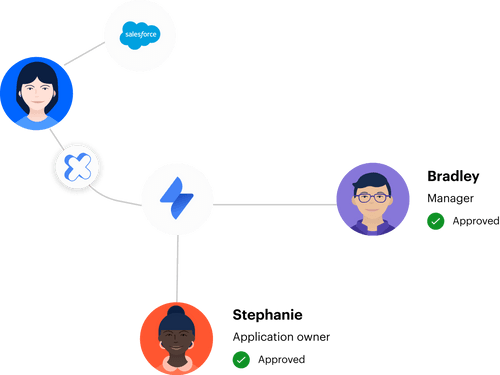
Multiplier enforces access decisions by keeping review, approval, provisioning, and revocation tied to Jira Service Management. The key mechanism is identity provider group control. When access is approved, changed, or revoked, the action runs through Okta, Entra ID, or Google Workspace and the Jira issue keeps the record.
Access Reviews With Usage Context in JSM
Multiplier's Access Reviews let admins run certification campaigns inside Jira Service Management. Reviewers see user attributes, group memberships, last login, and recommendations, then mark access as keep or revoke. That matters because regular access reviews prevent more risk when the reviewer can see why access might be stale.
The revoke decision isn't meant to sit as a spreadsheet note. For SSO apps controlled through identity provider groups, Multiplier removes users from the relevant groups and creates Jira evidence around the change. That closes the gap from earlier: reviewer decision, access change, audit record. Same motion.
Provisioning and Revocation Through Identity Provider Groups
Multiplier provisions access through identity provider group mappings. Each catalog role maps to one or more groups in Okta, Entra ID, or Google Workspace. When a Jira issue reaches the approved status, Multiplier calls the identity provider and adds the user to the mapped group. When access expires or gets revoked through a supported workflow, it removes the group membership.

That boundary matters. Multiplier doesn't directly provision inside every individual SaaS app. It uses the identity provider as the authoritative control plane. For teams already running SSO apps through groups, that's usually the right model because it keeps the access change fast, reversible, and auditable from the same Jira record.
Time-Based Access That Removes the Cleanup Step
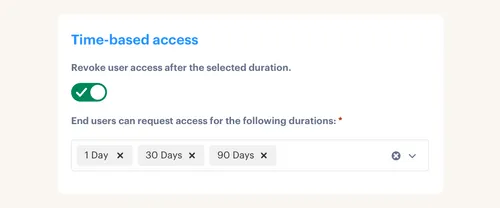
Multiplier's Time-Based Access lets requesters choose a duration like 1, 6, or 24 hours. After approval, access is granted through the mapped identity provider group, and the timer starts. When the window expires, Multiplier removes the group membership and records the change in Jira.
That's the practical version of least privilege. No one has to remember to clean it up. No one has to run a report three months later and wonder why the entitlement is still active. For teams trying to reduce standing privilege without making employees wait forever, this is the operating model worth copying. If your current review process keeps producing cleanup debt, get started with Multiplier and look at the access paths where automatic revocation would remove the most risk first.
Make Revocation the Default Outcome
Regular access reviews prevent real problems when they stop being a quarterly evidence project and become an enforcement loop. Reviewers need context, revocations need owners, and high-risk access needs shorter windows than standard app access. Otherwise the process looks mature from the outside and stays broken underneath.
The best place to start is small. Pick 10 high-risk apps, map the groups that control access, define the stale-access signals, and measure decision-to-revocation time. Once that number drops, the review stops feeling like audit theater and starts acting like a real control.
Frequently Asked Questions
How do I set up access reviews with Multiplier?
To set up access reviews with Multiplier, follow these steps: 1) In Jira, navigate to the Access Reviews section and click on 'New Review.' 2) Fill out the required information, including the name of the campaign and the applications you want to include (only those marked as Approved will be eligible). 3) Assign reviewers for each app and set the start and end dates for the campaign. Once everything is set, click 'Create Access Review' to launch the campaign. This process helps ensure that your access reviews are streamlined and effective.
What if I need to revoke access quickly after a review?
If you need to revoke access quickly after a review, ensure that your process is tied to Multiplier's automated provisioning. After a reviewer marks access for revocation, Multiplier will automatically remove the user from the relevant identity provider group, such as Okta or Google Workspace, and create a Jira ticket documenting the change. To maintain efficiency, aim to execute revocations within 48 hours to minimize standing privilege risks.
Can I automate access requests in Slack?
Yes, you can automate access requests in Slack using Multiplier. Simply install the Multiplier Slack app, and employees can trigger access requests by typing '/request' in any channel. They will see the same app catalog available in Jira Service Management, allowing them to select the application and role they need. This integration speeds up the request process and keeps everything logged in Jira for audit purposes.
When should I use time-based access?
You should use time-based access when granting temporary elevated permissions is necessary, such as for specific tasks or projects. With Multiplier, requesters can choose durations like 1, 6, or 24 hours during the access request process. This approach ensures that access is automatically revoked after the specified time, reducing the risk of standing privileges and simplifying access management.
Why does my access review process feel slow?
Your access review process may feel slow if it relies on manual steps or lacks integration. To speed it up, use Multiplier's Access Reviews feature within Jira. This feature allows reviewers to see user attributes, last login dates, and recommendations all in one place, enabling quicker decisions. Additionally, ensure that revocations are automated through your identity provider to close the loop efficiently.


