


72% of access delays have nothing to do with policy. They come from the handoff between Jira, Slack, your identity provider, and whatever spreadsheet someone built to hold the whole thing together.
If you spent time this week chasing an approver, double-checking the right Okta group, or rebuilding audit evidence from ticket comments, you felt the real problem already. And it isn't lack of governance. It's fragmented governance.
Key Takeaways:
- Identity governance breaks when the request lives in one system and the change happens in another.
- Automating user provisioning and access changes works best when your identity provider is the source of truth.
- If access is provisioned through IDP groups, revocation gets faster, cleaner, and more auditable.
- Jira-native governance cuts the swivel-chair work that slows IT and weakens least privilege.
- The best operating model is simple: request in Jira, approve in Jira or Slack, provision through the identity provider, record evidence in the same ticket.
- Time-bound access and in-Jira reviews matter because they remove standing privilege instead of just documenting it.
- Lean IT teams can automate 75%+ of access requests when intake, approval, and provisioning are wired together correctly.
Why separate governance portals create slow access and messy audits
Identity governance gets slow when the system of request and the system of action are split apart. A separate portal sounds controlled on paper, but in practice it creates more hops, more waiting, and more places for evidence to disappear. That's why automating user provisioning and access changes often stalls before it really starts.

The real bottleneck is the ITSM and IGA split
Most teams assume the hard part is deciding who should get access. That's not actually the part that breaks first. The thing that breaks is the operating model.
A requester opens Jira Service Management. The approver gets pinged in email or Slack. An IT admin jumps into Okta or Entra. Then someone drops a comment back into Jira and maybe grabs a screenshot because audit season always comes back around. One request like that feels manageable. A few hundred of them a month is where it gets ugly.
I've seen this movie a lot. The ticket exists, but the truth of the ticket lives somewhere else. So approvals get missed. Provisioning gets delayed. Revocation gets forgotten. And the audit trail becomes a scavenger hunt.
Manual provisioning creates hidden standing access
The obvious cost is time. The less obvious cost is access that never gets removed.

A lot of teams think manual work just means slower fulfillment. Fair point. But that's only half the damage. When admins are overloaded, they start making practical shortcuts. Broader group membership. Longer access windows. Fewer expiries. More “we'll clean that up later.” Later rarely comes.
That matters because least privilege isn't a policy document. It's an operating behavior. If your process makes removal harder than granting, you're going to accumulate access whether you mean to or not.
Day to day, this looks worse than people admit
Picture a Tuesday morning at a fast-growing company. Twenty new joiners started Monday. By 9:30 a.m., Jira tickets are open, Slack messages are flying, app owners are unclear, and the IT queue is full of requests missing one key detail. An admin spends 8 to 12 minutes per request just figuring out what should happen, then another few minutes making the change in the identity provider and documenting it after the fact. By lunch, the backlog is already winning.
A mid-market team in the Multiplier customer base hit this exact wall during rapid growth. Another team processed 3,800+ access requests in a year and automated 75% of them only after they stopped treating access as a pile of disconnected tasks. That emotional drag is real too. People stop trusting the process. IT gets seen as the blocker. Nobody likes working like that.
If you want to stop the backlog, you have to change the architecture of the workflow, not just yell at the queue. Learn more about Multiplier
What automating user provisioning and access changes actually requires
Automating user provisioning and access changes starts with one decision: where is the source of truth? If approvals happen in one place but entitlements are managed somewhere else without a clean link, automation stays partial and brittle. The better model is authoritative provisioning through the identity provider, tied back to the request record in Jira.
The source-of-truth rule: provision through the IDP or don't call it automated
This is the first rule I'd use. I call it the Authoritative Path Rule. If access can be granted without flowing through your identity provider, you don't really have automated governance. You have a faster manual mess.
Why? Because the identity provider is where group membership, lifecycle logic, and reversibility actually live. When automating user provisioning and access decisions through IDP groups, the request becomes deterministic. Approved role equals mapped group. Mapped group equals entitlement. Revocation follows the same path backwards.
That changes everything. Fewer one-off admin decisions. Fewer mystery permissions. Cleaner rollback. Cleaner audits too.
Tickets should carry context, not just approval status
Approval alone isn't enough. The ticket needs to contain the data that makes execution reliable.
That means role, application, duration if access is temporary, approver identity, and the downstream action taken. Without that, automating user provisioning turns into a guessing game where humans still fill in the gaps. And humans are where inconsistency creeps in.
A separate portal often makes this worse, not better. You've got one record for intake, another for provisioning, and then some side note in Slack explaining why an exception was made. Sure, control exists somewhere. But operational clarity doesn't.
The 3-link chain that determines whether automation holds
There are really only three links that matter. Request. Decision. Execution.
If one of those links breaks, the process falls back to manual cleanup. That's why I like a simple conditional rule here: if the request record doesn't trigger the change, and the change doesn't write back to the same record, expect audit pain later.
You can use this as a quick self-assessment:
- Can a user request access from the same place they request other IT help?
- Does the right approver get routed automatically based on the app or manager relationship?
- Does approval trigger a real identity provider action, not a human reminder?
- Does the result get recorded on the same ticket?
- Can revocation happen automatically when time expires or a review decision says revoke?
If you answer “no” to two or more, automating user provisioning and access changes is probably more manual than your dashboard suggests.
The good news is the fix isn't mysterious. It's a different workflow design.
A better operating model for automating user provisioning and revocation
The better model is boring in the best way. Request in Jira. Approve in Jira or Slack. Provision through the identity provider. Write the evidence back to the Jira issue. That loop is what makes automating user provisioning and revocation reliable instead of aspirational.
Start with a catalog and role mapping, not free-form requests
A lot of access processes fail at intake. People ask for “Figma access” or “GitLab admin” with no context, no role definition, and no duration. Then IT has to interpret what they meant. That interpretation step is where time gets burned and mistakes get made.
The fix is tighter than most teams think. Use a catalog model. Approved apps only. Defined roles only. Each role mapped to one or more identity provider groups. If the role isn't mapped, it isn't automatable yet. That's the Mapping Threshold. No group mapping, no zero-touch provisioning.
This sounds rigid. It is. And that's why it works. Critics will say free-form requests give people flexibility, and they're not entirely wrong. But flexibility at intake usually becomes ambiguity at execution.
Make time-bound access the default for elevated roles
Standing admin access is often just operational laziness dressed up as convenience. I don't mean that as an insult. I mean the process usually makes temporary access harder than permanent access.
Flip that. If a role is elevated, production-facing, or tied to sensitive data, make duration selection part of the request itself. One hour. Six hours. Twenty-four hours. Something explicit. Then tie expiry to group removal through the identity provider.
A fintech team using this model cut privileged access by 85%. That's not just a cleaner spreadsheet. That's a different risk profile. And it only works when automating user provisioning and revocation are part of the same path.
Run access reviews where the work already lives
Quarterly certifications often become theater. Export data. Email spreadsheets. Chase reviewers. Re-enter decisions. Hope the revocations happen. Then package the evidence for the auditor like you're building a crime board on a wall.
There’s a better way. Run the review in Jira, where the original request and approval trail already exist. Give reviewers enough context to make a real call: user, app, group, role, last login, department. Then execute revocations from the review decision itself when the entitlement is backed by the IDP group.
That connection is more important than the review itself. Review without enforcement is just paperwork. Review with automated removal is governance.
Lean teams win by shrinking handoffs, not hiring around them
One of the more interesting patterns in this market is that the best IT teams don't always have the biggest staff. They just have fewer dead handoffs.
A four-person IT Ops team at a high-growth AI company supported 420+ employees and automated 75% of access requests after moving away from Slack channels and Notion boards. Another team cut IT workload on access requests by 80% after replacing manual approval chasing and group assignment. Honestly, that's the part a lot of buyers underestimate. The value isn't just faster clicks. It's fewer judgment calls on routine work.
If your current model needs more people every time headcount grows, it isn't a governance model. It's a staffing workaround. See how Multiplier works
How Multiplier automates the access workflow inside Jira
Multiplier embeds the workflow inside Jira Service Management, then executes the actual user changes through your identity provider. That matters because automating user provisioning and revocation only holds up when the request, the approval, the action, and the evidence stay connected. Multiplier does that without forcing users into a separate governance portal.
Jira-native requests and approvals remove the portal problem
Multiplier gives teams a Jira-native Application Catalog so employees can request sanctioned apps and roles from JSM, or through Slack, instead of bouncing between tools. Apps and groups sync from Okta, Entra ID, and Google Workspace, and only approved apps appear in the catalog. That keeps intake cleaner from the start.
Approval Workflows then route the request to the right person, whether that's the manager, app owner, or a specified user. Approvers can act in Jira or Slack, and the request stays tied to the Jira issue the whole time. That's a big deal. No side-channel approval thread you need to reconstruct later.
Provisioning through IDP groups makes changes authoritative
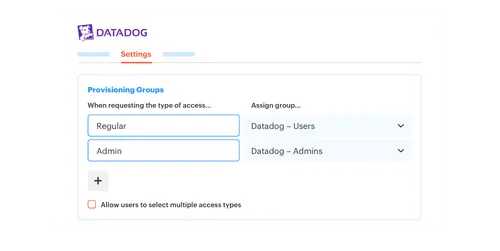
This is the core move. Multiplier handles Automated Provisioning via Identity Provider Groups, which means approved roles map to IDP groups and the workflow can add or remove the user from those groups when the Jira issue hits the right status. That makes automating user provisioning faster, but more importantly, it makes it authoritative and auditable.

The distinction matters. Multiplier provisions through identity provider groups. It does not directly provision inside individual SaaS apps outside that model. In my view, that's the right constraint. It keeps the source of truth where it belongs and makes reversals cleaner when someone changes teams, leaves, or loses temporary access.
Time-Based Access builds on the same foundation. If a request is time-bound and access is granted through the mapped group, Multiplier can remove that membership automatically at expiry and record the change in Jira. That's how least privilege stops being theoretical.
Reviews, lifecycle work, and license cleanup happen in the same operating system
Multiplier also carries the model into Access Reviews, so teams can run certification campaigns in Jira instead of spreadsheets. Reviewers see user details, groups, last login data, and can mark Keep or Revoke. When a revocation is tied to the relevant IDP group, the removal can execute and the ticket trail stays intact.
For broader identity lifecycle changes, Post Functions let teams trigger no-code actions from Jira workflow transitions, like creating users in Entra, adding department-specific groups, or disabling accounts on offboarding. And Auto Reclaim can identify inactive users from identity provider login telemetry, warn them, and revoke licenses if they stay inactive. That last one is only on the Advanced edition, so worth knowing up front.
The common thread is simple. Multiplier keeps governance where the work already happens, then uses the identity provider to make the change real. If you want to see what that looks like in your own Jira environment, Get started with Multiplier
Why the best governance model is the one your team will actually use
Separate portals promise control, but they usually add friction right where you can least afford it. The better path is simpler: keep requests and approvals in Jira and Slack, push provisioning and revocation through the identity provider, and let the audit trail build itself in the same record.
That's the real unlock with automating user provisioning and access changes. Faster access. Fewer standing privileges. Cleaner audits. Less admin drag. And no extra portal for people to ignore.
Frequently Asked Questions
How do I set up time-based access for users?
To set up time-based access in Multiplier, you can follow these steps: 1) When a user submits a request through the Jira Service Management (JSM) portal, ensure they select the duration for access (like 1, 6, or 24 hours). 2) After approval, Multiplier will automatically provision the access and set a timer to revoke it once the duration expires. 3) This process helps enforce least privilege by ensuring that elevated access is temporary and automatically removed, reducing the risk of standing privileges.
What if I need to revoke access for multiple users?
If you need to revoke access for multiple users, you can use Multiplier's Access Reviews feature. Here’s how: 1) Create an access review campaign in JSM, selecting the applications and users in scope. 2) Assign reviewers who can mark users to 'Keep' or 'Revoke' based on their access needs. 3) Once decisions are made, Multiplier will automatically remove users from the relevant identity provider groups, ensuring that the audit trail remains intact within Jira.
Can I automate user onboarding with Multiplier?
Yes, you can automate user onboarding using Multiplier. Start by: 1) Setting up an Application Catalog in your JSM portal where new hires can request access to approved applications. 2) Use Post Functions to automate the creation of user accounts and assign them to the appropriate groups based on their roles. 3) This way, onboarding becomes streamlined, and you reduce manual input, allowing your IT team to focus on more critical tasks.
When should I use the Slack App for access requests?
You should use the Slack App for access requests when you want to streamline communication and reduce context switching. Here’s how: 1) Employees can trigger access requests directly in Slack using the /request command, making it easier for them to ask for what they need without switching to another tool. 2) The requests automatically create Jira tickets, ensuring all approvals and actions are tracked in one place. 3) This integration keeps the workflow efficient and helps maintain a complete audit trail.
Why does my team need automated provisioning?
Automated provisioning is crucial because it reduces manual errors and speeds up access requests. With Multiplier, once an access request is approved, it automatically provisions access through your identity provider (like Okta or Azure AD). This means: 1) Users get timely access without delays caused by manual processes. 2) The audit trail is maintained within Jira, ensuring compliance and accountability. 3) This approach minimizes the risk of standing privileges and helps enforce least privilege effectively.


