


Jira admins usually know within 10 minutes if an IAM tool is going to create more work or remove it. The mistake most buying guides make is treating Jira access management like a generic identity governance project, when the real fight is approvals, provisioning, and audit evidence getting split across too many systems.
If you're running Jira Service Management, you've probably felt this this week. A request came in through JSM, approval happened in Slack or email, provisioning happened in Okta or Entra, and the proof for auditors ended up nowhere useful. That's why this list focuses on the best identity access management options for Jira admins, not generic IAM buyers.
Some of these platforms are strong if you're already committed to a single ecosystem. Some are better as a conversational layer. A few are trying to cover SaaS operations and governance in one place. But Jira admins usually need something narrower and more operational: fast request handling, clear approval routing, automated provisioning, time-bound access management, and audit evidence that doesn't need to be rebuilt at quarter end.
Quick Reference Comparison Table
[Table: Vendor] — See "Table Embed Codes" in Oleno to copy the HTML for this table.
Key Takeaways:
- Okta Identity Governance makes the most sense when Okta already runs identity, MFA, and directory controls across the business.
- Microsoft Entra ID Governance is strong for hybrid Microsoft shops, but it can feel heavy for mixed-tool Jira access management.
- ConductorOne stands out for modern governance programs that care about least privilege and automation, though pricing visibility is thin.
- Moveworks improves request intake and employee experience, but most Jira admins will still need a deeper governance layer behind it.
- Zluri is useful for SaaS visibility and license cleanup, yet deeper identity governance for Jira workflows often needs a more focused operating model.
What Jira Admins Actually Need From Identity Access Management
Jira admins need identity governance for Jira that keeps work, approvals, and evidence close together. The biggest operational win is not broader policy coverage on paper. It's fewer handoffs across Jira, Slack, the identity provider, and audit spreadsheets.
Back in a lot of ops environments, the tool shortlist gets built by security architecture and the cleanup gets inherited by IT operations. That's the split. Security buys for control depth. Jira admins live with the request volume, the weird edge cases, and the angry "why don't I have access yet?" messages at 8:12 AM.
The difference between enterprise IAM breadth and Jira-native execution
Enterprise IAM breadth matters. Jira-native execution matters more if your team is drowning in service requests.
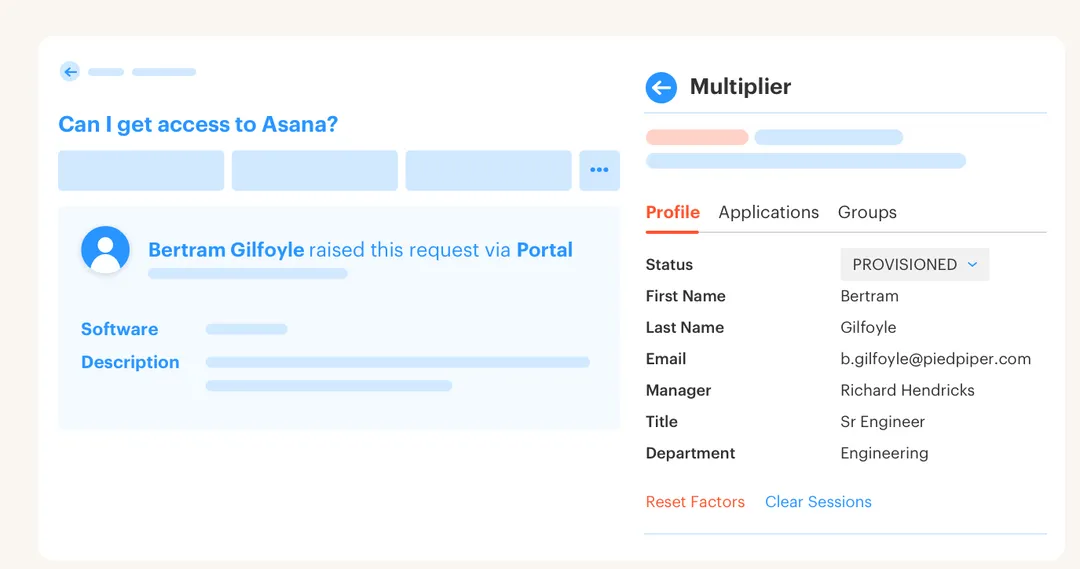
A platform can look fantastic in an analyst grid and still be the wrong fit for day-to-day Jira access management. If the request starts in JSM, the approval gets kicked to email, the admin has to jump into another portal, and the reviewer later has to reconstruct what happened, you've built a relay race instead of a workflow.
Think of it like airport baggage handling. The suitcase isn't lost because the airport lacks planes. It's lost because the handoff chain is messy. Identity governance breaks the same way. Too many handoffs, too many places where context disappears.
The 3-Hop Rule is useful here. If a standard access request requires more than three system hops after submission, Jira admins should assume delays, audit gaps, or both. JSM ticket, approval surface, provisioning system. That's enough. Add spreadsheets or side-channel screenshots and the process starts to leak.
Evaluation criteria for the best identity access management tools
Jira admins should evaluate IAM tools on workflow fit first, governance depth second, and ecosystem alignment third. That's a different order than many enterprise buying teams use, and honestly, it's usually the right one for ITSM-heavy teams.

A service desk lead opens JSM on Monday morning. There are 37 pending access requests, 9 need manager approval, 4 involve temporary privileged access, and 6 are already late. The dashboard doesn't care how elegant a vendor's abstract governance model is. It cares whether approvals are routed, provisioning is automatic, and audit evidence lands where the work happened.
The FRAME test helps here: Flow, Routing, Automation, Monitoring, Evidence.
- Flow: Does the request start where users already work?
- Routing: Can approvals follow manager, app owner, or staged logic?
- Automation: Does provisioning trigger from group mappings or workflows?
- Monitoring: Can admins see stuck requests before they become escalations?
- Evidence: Does the system preserve a usable audit trail without manual reconstruction?
If a tool scores weakly on two or more of those five points, it's probably a poor fit for Jira-native identity governance, even if it looks strong in broader IAM categories. So the real question is: why do general IAM evaluations keep missing this?
Why General IAM Buyers and Jira Admins Evaluate Tools Differently
General IAM buyers optimize for platform breadth, while Jira admins optimize for operational drag. That difference changes the whole shortlist, especially when access reviews in Jira Service Management and daily request handling sit on the same team.

This is where a lot of evaluations go sideways. A security architect may care most about entitlement models, non-human identity governance, and cross-tenant policy control. Fair enough. Those are real concerns. But a Jira admin feels the cost through ticket queues, provisioning lag, broken ownership, and audit prep.
Where access requests break down for Jira-based IT teams
Access requests usually break down at the handoff layer, not at the policy layer. The policy may be fine. The execution is what fails.
Picture a common Tuesday. A new engineer needs access to five tools before lunch. They submit through JSM. Their manager approves in Slack. An IT admin checks the identity provider. One app owner never responds. Another asks for more context in a direct message. By the time provisioning happens, nobody can explain the full chain cleanly.
That hidden work adds up fast. In separated workflows, one visible request can create two to three times more off-ticket work in chasing, validating, documenting, and revoking later. You don't need a perfect benchmark to know that's expensive. You can feel it in the backlog.
Some teams will argue a dedicated governance portal is cleaner because it centralizes policy. That's a fair point. For large, highly standardized environments, it can be. But when employees already live in Jira and Slack, forcing work into another portal often shifts complexity instead of reducing it.
What to look for in approvals, provisioning, and audit evidence
The right access request automation should keep approvals visible, provisioning consistent, and evidence attached to the original work item. If one of those breaks, the whole experience gets slow and fragile.
Ask five diagnostic questions:
- Does approval logic support manager, app owner, and multi-stage routing?
- Can provisioning happen through identity provider groups rather than manual admin steps?
- Is temporary access enforced with expiry, not calendar reminders?
- Can access reviews run with enough context for reviewers to make real decisions?
- Is audit proof generated as part of the workflow rather than after it?
If three or more answers are "not really," you're looking at a system that will create operational drag for Jira access management.
Audits are where this gets exposed. Everything looks manageable until quarter end. Then screenshots start flying around like confetti. Not fun. So with that filter in mind, here’s how the leading vendors actually stack up.
Okta Identity Governance
Okta Identity Governance is a strong choice for organizations already anchored in the Okta ecosystem. Its value comes from alignment with Okta Workforce Identity, request workflows, certifications, and broad integration support. For Jira admins, the real question is whether that ecosystem strength maps cleanly into daily JSM execution.
Okta strengths for Okta-centric organizations
Okta Identity Governance fits best when Okta is already the operational center of identity. Okta has continued expanding governance capabilities, including certification and governance updates tied to its identity platform (Okta Identity Governance Release Notes).
For teams already standardized on Okta SSO, MFA, and directory controls, that native alignment matters. You get less translation work between systems. Broad integration support is also part of the appeal, with Okta emphasizing wide connector coverage and governance expansion across identities (Okta Platform Innovation Update).
That makes Okta attractive for buyers who want governance layered onto an existing Okta stack rather than introduced as a separate strategic program.
Okta limitations for Jira-first workflows
A Jira-first team may find Okta's center of gravity sits outside JSM. That's not a flaw in the product. It's a fit issue.
When governance lives primarily in the identity layer, Jira admins can end up toggling between service tickets and an external governance experience. Okta also describes different governance models across converged versus separate approaches, which matters if your workflow still spans multiple systems (Okta Governance Model Overview).
The practical rule is simple. If your employees start access work in Jira and your auditors expect ticket-linked evidence, a tool that treats Jira as a side channel will create friction. If Okta is already your source of truth and JSM is mostly intake, the fit improves.
Okta pricing and deployment fit
Okta Identity Governance has more public pricing visibility than several competitors, with Starter pricing publicly listed around $6 per user per month billed annually, while upper tiers require further evaluation. That at least gives buyers a threshold to work from.
The deployment fit is strongest for mid-market to enterprise teams already bought into Okta. If you're trying to solve identity governance for Jira as an operational problem first, not an identity stack expansion, it's smarter to test that fit early with a workflow pilot rather than a feature checklist.
How Multiplier is Different: Multiplier is built to keep access work inside Jira Service Management, with approvals, provisioning actions, and audit history tied to the ticket. For Jira admins, that changes the operating model from "jump to the governance portal" to "finish the work where the service request already lives."
Microsoft Entra ID Governance
Microsoft Entra ID Governance is a strong option for Microsoft-heavy enterprises that want lifecycle workflows, access reviews, and privileged access aligned to the wider Microsoft stack. The tradeoff is complexity, especially for mixed-tool teams running Jira access management outside a Microsoft-first operating model.
Microsoft Entra strengths for Microsoft-heavy environments
Microsoft Entra ID Governance is strongest when the surrounding environment is already Microsoft-heavy. Microsoft documents access reviews, entitlement management, and lifecycle workflows as core parts of the Entra governance model (Microsoft Entra Identity Governance Overview).
That native depth is a real advantage in hybrid AD, Azure, and Microsoft 365 estates. Recent Microsoft updates have also continued expanding governance-related capabilities across the Entra stack (Microsoft Entra March 2025 Update).
For large enterprises already paying the Microsoft tax, and I mean that in the practical sense of living inside the ecosystem every day, Entra can feel like the natural next step.
Microsoft Entra limitations for mixed-tool environments
Mixed-tool environments are where Entra can feel heavier than expected. The platform is broad, but breadth isn't the same as low-friction execution for Jira admins.
A JSM team managing broad SaaS access across non-Microsoft apps may find the experience less intuitive than the marketing story suggests. Independent commentary on recent Entra governance changes still points to admin complexity and the need for deeper Microsoft familiarity to get full value (MajorKey analysis of Entra governance updates).
That's the earned pivot here. Yes, Entra is comprehensive. Yes, that matters. But if your day-to-day work happens in Jira and Slack, comprehensiveness can arrive bundled with operational sprawl.
Microsoft Entra pricing and operational fit
Microsoft governance-related licensing is often cited around $6 per user per month, but the real cost depends on what Microsoft licensing you already hold and which features are bundled versus added on (Microsoft Entra Identity Governance Overview). In other words, headline pricing can understate evaluation complexity.
If you're a large Microsoft-first organization, that complexity may be worth it. If you're a Jira admin trying to reduce handoffs this quarter, not build a bigger identity architecture project this year, the fit can be harder to justify.
How Multiplier is Different: Multiplier centers Jira Service Management as the operating layer for requests, approvals, and provisioning workflows. That means the employee request path, approver experience, and evidence trail stay closer to the service desk instead of being absorbed into a broader admin environment.
ConductorOne
ConductorOne is a modern governance platform built for organizations that care about least privilege, fast time-to-value, and automation. Its appeal is clear for security-led teams. For Jira admins, the tradeoff is that the product is governance-first, not Jira-native first.
ConductorOne strengths for modern governance programs
ConductorOne has built a strong narrative around rapid deployment and enterprise traction, including reported growth claims and expansion in the enterprise market (ConductorOne press release). Product updates also keep reinforcing automation, review workflows, and lifecycle capabilities (ConductorOne release notes).
This is where ConductorOne gets interesting. It speaks directly to modern least-privilege programs. JIT access, AI-assisted governance, and support for human and non-human identities all line up with where serious governance teams are heading.
If your buying center is security-led and cloud-first, ConductorOne will likely make the shortlist quickly.
ConductorOne limitations and pricing visibility
ConductorOne does not publish a public starter price, which creates friction for earlier-stage buyers who want to self-qualify before a sales process. Company profiles and market summaries also frame it as an enterprise-oriented platform, which reinforces that sales-led motion (CB Insights company profile).
There is a second issue. Jira admins may want finer operational fit than the initial platform story gives them. If your team needs request intake, approval routing, provisioning, and ticket history to stay deeply connected in JSM, you'll want to validate that workflow early, not assume the governance layer will naturally adapt.
So who should pick ConductorOne? Cloud-first teams modernizing governance with a strong security program. Who should be cautious? Jira admins looking for Jira-native identity governance rather than a broader standalone IGA experience.
How Multiplier is Different: Multiplier is narrower by design for Jira-centric teams. It combines request intake, approval routing, provisioning through identity provider groups, and ticket-level traceability inside Jira workflows, which changes the daily admin experience more than a feature-comparison grid usually shows.
Moveworks
Moveworks is strongest as a conversational support layer, not as a full identity governance system. That distinction matters because many Jira admins are really evaluating two different problems at once: employee request experience and governance execution.
Moveworks strengths as a conversational support layer
Moveworks has real strength in conversational employee support across Slack, Teams, and web workflows. Recent product announcements continue leaning into AI-driven task execution and approved paths to employee-facing automation (Moveworks Dynamic AI Platform release, Moveworks Quick GPT release).
For large enterprises chasing better employee experience, that's compelling. Request intake gets easier. Deflection improves. Chat becomes the front door.
And honestly, that's valuable. Employees don't love portals. They ask for access where they already work.
Why Moveworks is adjacent rather than a full Jira IAM replacement
Moveworks is adjacent because conversational intake is not the same thing as identity governance depth. That's the core buying mistake to avoid.
You can absolutely use a conversational layer to front-end access requests. But if you still need access reviews, time-bound enforcement, audit evidence, and policy-driven revocation, you'll need another system behind it. If X is chat-first intake, then Y must still be governance execution.
That's the Operator Test. Ask one question: if the chatbot disappeared tomorrow, would approvals, provisioning, revocation, and audit readiness still function cleanly? If the answer is no, you aren't evaluating a governance platform. You're evaluating a front door.
How Multiplier is Different: Multiplier uses Slack-based requests and approvals, but keeps the system of record in Jira Service Management. That gives teams the convenience of chat without losing the ticket-linked governance trail needed for audits and operational follow-through.
Zluri
Zluri is strong for SaaS visibility, shadow IT discovery, and license optimization. It becomes less clear as a primary fit when the requirement is deeper Jira-native governance control rather than broad SaaS operations.
Zluri strengths for SaaS visibility and license optimization
Zluri's appeal starts with SaaS discovery and usage visibility. Reviews and market summaries consistently emphasize application discovery, spend insights, and automation around SaaS operations (Info-Tech review).
That matters more than some IAM buyers admit. A lot of access waste isn't policy failure. It's app sprawl. Zluri also gets attention for pricing and positioning as a SaaS management and access platform, even if exact public starter pricing remains unclear (CloudEagle Zluri pricing guide).
For IT and finance teams trying to clean up licenses and understand what apps employees are actually using, Zluri can be very practical.
Zluri limitations for deeper governance control
Deeper governance is where the category line matters. Zluri is useful. But useful for SaaS management is not identical to strong identity governance for Jira.
If your main issue is discovery, spend, and self-service access across a messy SaaS estate, Zluri may fit. If your main issue is tighter policy enforcement, stronger review workflows, temporary access control, and audit evidence tied to Jira tickets, you'll probably want something more operationally focused.
There's a case to be made for combining both types of tools. That's valid. But if you need one system to reduce Jira admin workload on access management, discovery alone won't close the gap.
How Multiplier is Different: Multiplier is optimized around Jira Service Management execution, with Jira-native access reviews, app catalog workflows, and automated group-based provisioning tied to ticket history. That operating model is built for service desk flow, not broad SaaS estate discovery.
How Multiplier Fits Jira-Centric Access Management
Jira-centric access management works best when requests, approvals, provisioning, reviews, and evidence all live close to the ticket. That's where Multiplier's model is different. It embeds governance inside Jira Service Management and Slack, then drives provisioning through the identity provider instead of asking teams to adopt a separate portal.
What Multiplier does differently inside Jira Service Management
A Jira-native operating model changes the bottleneck. Instead of splitting work between JSM, chat, admin portals, and spreadsheet evidence, Multiplier keeps the workflow attached to the issue that started it.

That matters in very practical ways. The Jira-native access request catalog lets employees self-serve access in minutes. Requests can route to managers or app owners with multi-stage rules, and lower-risk scenarios can be auto-approved. After approval, provisioning runs through identity provider group assignment. If the access should expire, time-bound policies enforce that and revoke automatically.
This isn't just a nicer UX detail. It's an execution model. Access reviews and certifications run as Jira campaigns, with reviewer context and recommendations attached. Results can be exported for auditors or pushed to Vanta. Identity lifecycle orchestration can also trigger from Jira events, so onboarding and offboarding changes stay tied to the issue record. If you want a closer look at how access requests can stay in the ticket flow, See how Multiplier works.
The conditional rule is simple. If your team already runs operational work through Jira Service Management, moving governance into that system reduces handoff cost. If your team barely uses Jira for access work, the advantage is smaller.
Which teams should consider Multiplier first
Multiplier fits mid-market and high-growth IT, security, and workplace tech teams that already run on Jira Service Management and use Okta, Entra ID, or Google Workspace as the identity backbone. That's the sweet spot.
The strongest fit usually looks like this: JSM is already the place employees request help, Slack is where approvals happen fast, the identity provider is where provisioning should be enforced, and the audit team wants a clean evidence trail without quarterly archaeology. That's why teams like Synthesia have publicly shared that they automated a large share of access requests while running lean IT operations, and why other fast-growing teams adopt this model to cut manual work.
Not every team needs this. A giant Microsoft-first enterprise may still prefer Entra's broader native depth. An Okta-centered team may prefer to extend deeper into Okta. A SaaS ops team focused on discovery may lean toward Zluri. But if you're a Jira admin trying to remove operational drag from access workflows, Multiplier is aimed directly at that pain.
Comprehensive Identity Access Management Comparison Grid
This side-by-side view is the fastest way to compare the best identity access management options for Jira-heavy teams. It won’t answer every edge case. It will show where each product naturally fits, where Jira alignment starts to thin out, and which tools are built more for ecosystem depth than service-desk execution.
[Table: Vendor] — See "Table Embed Codes" in Oleno to copy the HTML for this table.
Jira admins don't need more surface area. They need less swivel-chair work.
That's the cleanest way to read this market. Okta and Entra are strong when your identity stack is already built around them. ConductorOne is compelling for modern governance teams that want broader least-privilege programs. Moveworks improves the front-end experience. Zluri helps with SaaS visibility and license hygiene. But best identity access management buying for Jira teams is a different motion because the win condition is operational execution inside the service desk.
If your priority is keeping requests, approvals, provisioning, reviews, and audit evidence tied to Jira Service Management, Multiplier is one of the first tools to evaluate. That’s really the heart of this best identity access management comparison for Jira admins. Choose the tool that matches where work actually happens. For Jira admins, that's usually the whole story.
Frequently Asked Questions
How do I set up automated provisioning with Multiplier?
To set up automated provisioning with Multiplier, first ensure you have connected your identity provider, like Okta or Azure AD. Then, configure your access request workflows in Jira Service Management (JSM) to include the necessary approval steps. Once a request is approved, Multiplier will automatically call your identity provider to add or remove users from the appropriate groups. This streamlines the process and eliminates manual steps, making sure access is granted quickly and accurately.
What if I need to revoke access after a temporary period?
If you need to revoke access after a temporary period, you can use Multiplier's Time-Based Access feature. When submitting a request, users can select how long they need access (e.g., 1, 6, or 24 hours). Once approved, Multiplier automatically provisions access and sets a timer to revoke it when the time expires. This helps maintain least privilege and reduces the risk of unnecessary standing access.
Can I track access requests in Jira with Multiplier?
Yes, with Multiplier, all access requests are tracked directly in Jira. When an employee submits a request through JSM or Slack, a Jira ticket is automatically created. This ticket captures all the details, including approval status and provisioning actions. This integration ensures that you have a complete audit trail linked to the original request, making it easier to manage and review access over time.
When should I conduct access reviews using Multiplier?
You should conduct access reviews regularly, ideally on a quarterly basis or in alignment with your organization's compliance requirements. Using Multiplier's Access Review feature, you can create campaigns that allow designated reviewers to assess user access based on specific criteria. This process replaces manual spreadsheet reviews and ensures that decisions are documented within Jira, making it easier to maintain compliance and track any necessary revocations.
Why does my team need a Jira-native IAM solution like Multiplier?
A Jira-native IAM solution like Multiplier is essential because it keeps all access management activities within the tools your team already uses. This reduces context switching and operational drag, allowing for faster request handling and clearer audit trails. By integrating approvals, provisioning, and access reviews directly into Jira Service Management, Multiplier simplifies the workflow and enhances efficiency for Jira admins.
Multiplier connects to your existing JSM setup in minutes. Try it free on the Atlassian Marketplace.


