


42 screenshots, 3 Slack approvals, 2 spreadsheets, and 1 Jira ticket later, a lot of teams still call that an audit trail. If you were building a comprehensive audit for access requests this quarter, you probably felt the same pain: the evidence exists somewhere, but not in one place, and definitely not in a way an auditor wants to see.
Most teams think building a comprehensive audit is a reporting problem. I don't think it is. It's a workflow problem first, and that's why the reporting always feels broken after the fact.
Key Takeaways:
- Building a comprehensive audit starts with fixing where requests, approvals, provisioning, and revocations happen
- If evidence lives across Jira, Slack, email, and spreadsheets, your audit will always be slow to assemble
- The fastest way to improve audit quality is to make Jira the system of record and push changes through your identity provider
- Time-bound access cuts a major source of audit risk: standing privilege that no one remembers to remove
- Access reviews work better when revocations execute from the review itself, not from a follow-up spreadsheet
- A strong audit process should let you answer 5 questions fast: who requested, who approved, what changed, when it changed, and when it was removed
- Tools like Learn more about Multiplier make that operating model much easier to run inside Jira
Why Building a Comprehensive Audit Usually Breaks
Building a comprehensive audit usually breaks because the evidence trail gets split across too many tools. The request starts in one place, the approval happens somewhere else, the access change gets made in the identity provider, and the proof gets recreated later. By the time an auditor asks for it, your team is stitching together history instead of showing a clean record.

The audit problem is usually a workflow problem
A lot of teams assume they need a better export, a better spreadsheet, or a better way to store screenshots. Fair point, because that's where the pain shows up. But that's not really where the failure starts.
The failure starts upstream. A manager approves in Slack. IT gets pinged in a channel. Someone manually updates Okta or Entra. Then another person drops a note into Jira. Maybe. If you're lucky. What you end up with isn't a record. It's a reconstruction.
I like to call this the Four-Hop Audit Trap. Request, approval, action, evidence. If those four hops happen in four different places, the audit quality drops fast. If you need more than 10 minutes to prove one normal access change, you're already in the trap.
What this looks like on a random Tuesday
An IT service manager opens Jira at 9:12 a.m. There are 17 access requests in the queue, 6 came through Slack, 4 need manager approval, and 3 are missing enough detail to act on. By lunch, two people have sent screenshots, one manager approved with a thumbs up emoji, and someone on the team is manually checking which Okta group maps to which app role.
That sounds small. It isn't.
A mid-market fintech team in the knowledge base was dealing with hundreds of routine requests like this, coming in through Slack, email, and Jira. IT had to chase approvals and manually assign Okta groups. The result was more work, more room for human error, and slower audit prep later. That's not a people problem. That's a system design problem.
And yeah, it gets exhausting. Not dramatic exhausting. Just the slow grind kind, where every quarter-end review turns into a scavenger hunt.
Why separate governance portals make this worse, not better
There's a case to be made for dedicated IGA tools. They can go very deep on policy. They can satisfy enterprise checklists. And for some very large environments, that's a real requirement.
But for a lot of Jira-centered teams, the separate portal becomes the new bottleneck. Now the request lives in Jira, the governance logic lives elsewhere, approvals bounce between systems, and audit evidence still needs to be reconciled. You bought control, but also bought distance from the place the work actually happens.
That's why I think identity governance belongs in Jira, not another portal. Not because every other model is wrong in every case. But because if your team already runs work through JSM and Slack, splitting governance away from that workflow usually makes building a comprehensive audit harder, not easier. And if that's true, the fix isn't better reporting. It's a different operating model.
The Real Requirement Behind a Comprehensive Audit
A comprehensive audit is a complete, defensible record of who asked for access, who approved it, what changed, when it changed, and whether the access was later reviewed or removed. If you can't answer those five questions in one pass, the audit isn't comprehensive yet. It's partial evidence with extra hope layered on top.
Use the 5-Answer Test before you call anything audit-ready
This is the framework I'd use first. The 5-Answer Test.
- Who requested the access?
- Who approved or denied it?
- What exact entitlement or role changed?
- When was the change executed?
- When was it revoked, reviewed, or expired?
If your current process can't answer all five from the same system of record, you don't have an audit trail. You have pieces of one.
This matters more than teams realize. Auditors don't just want proof a decision happened. They want the chain. That's a different standard. A Slack message plus a screenshot plus a manually updated spreadsheet might prove effort. It doesn't prove clean governance.
Building a comprehensive audit means designing for evidence at the moment of work
Most teams build for speed first, then try to layer compliance on top later. I get it. When people need access, the instinct is to unblock them fast. Especially in high-growth environments where 100 new hires can hit the system in a quarter.
But speed without evidence creates debt. Quiet debt. Then quarter close comes. Or the SOC 2 prep starts. Or an access review kicks off. Now someone has to go back and figure out what happened, whether access was appropriate, and whether it ever got removed. That's where the real cost shows up.
The better model is simple: make evidence the byproduct of the workflow. If the request creates the ticket, the approval updates the ticket, the provisioning writes back to the ticket, and the revocation is logged to the same record, you're building a comprehensive audit as work happens. That's the shift.
The old way does have one advantage
Manual processes do give teams flexibility. That's the honest concession. If you have weird edge cases, messy app ownership, or apps that aren't fully tied into your identity provider, humans can patch around gaps faster than a rigid system can.
That's valid.
But once routine access requests cross roughly 50 a month, that flexibility starts turning into drag. People forget steps. Evidence gets missed. Expiries don't happen. My rule of thumb is pretty blunt here: if more than 20% of your access changes require post-hoc evidence gathering, your audit model is already failing. At that point, the flexibility isn't helping. It's hiding the cost.
So what does a better model actually look like when you're building a comprehensive audit for real, not just talking about it?
How to Build a Comprehensive Audit Without Spreadsheet Cleanup
You build a comprehensive audit by collapsing request, approval, execution, and evidence into one operating flow. That's the whole game. Put the workflow where your team already works, run provisioning through the identity provider, and make expiry and reviews part of the same record instead of a separate cleanup exercise.
Start with one record, not one more dashboard
The first move is choosing the system of record. For Jira-centered teams, that should be Jira. Not Jira plus a side spreadsheet. Not Jira plus a folder of screenshots. Jira.
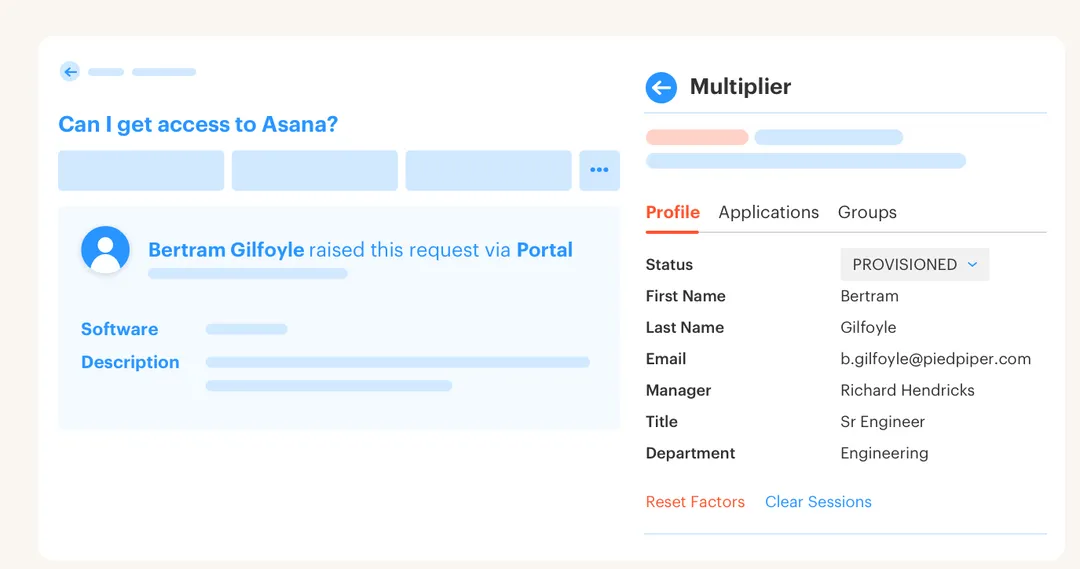
That sounds obvious, but it's not how a lot of teams run. They treat the Jira ticket like intake, then the real work happens somewhere else. That's backwards. If Jira is where the request is born, it should also be where the approval state, provisioning result, and audit evidence end up.
This is the Single-Thread Rule. One request, one issue, one evidence chain. If an approver acts in Slack, that action should still anchor back to the Jira issue. If provisioning happens through Okta, Entra, or Google Workspace, the result should still write back to that same issue. One thread. That's how building a comprehensive audit becomes practical instead of painful.
Diagnose your current maturity before you automate everything
Before you redesign the whole thing, you need to know what stage you're in. Not everyone should start in the same place.

Ask yourself these four questions:
- Do access requests already enter through one standard path?
- Are approvers clearly defined for most applications?
- Are app roles mapped to identity provider groups?
- Can you prove revocation or expiry without manual follow-up?
If you answered yes to 0 or 1, you're in the fragmented stage. Centralize intake first.
If you answered yes to 2 or 3, you're in the governed stage. Now you can automate approvals and provisioning.
If you answered yes to all 4, you're in the enforceable stage. That's where building a comprehensive audit gets much easier, because the evidence is already tied to execution.
Honestly, teams skip this diagnosis all the time. They jump straight to automation and then wonder why weird exceptions blow up the rollout.
Use the 70/20/10 rule for access automation
I prefer a simple split here. Automate the 70, govern the 20, inspect the 10.

The 70 is routine app access. Standard roles. Known owners. Group-based provisioning. This should move fast.
The 20 is elevated access that still fits a policy path. Maybe admin rights for a short duration. Maybe higher-risk tools. This needs approvals and stronger controls, but it should still be structured.
The 10 is edge cases. Manual apps. Unique requests. Odd exceptions. Keep humans in the loop and keep the record tight.
Why this split? Because trying to automate 100% on day one is how projects stall. A better starting point is to centralize requests in a Jira-native application catalog, route approvals to the right manager or app owner, and let approved requests trigger identity-provider group changes automatically where mappings exist. For apps that aren't ready for full automation, you can still capture approvals and maintain an audit trail in the same flow.
That's the practical advantage of Multiplier. You don't need perfect coverage on day one to start standardizing intake, tightening approvals, and writing execution results back to the ticket.
Make temporary access the default for privileged roles
Standing privilege is where audits go to die slowly. Not because the grant was always wrong at the start. Usually it wasn't. It was valid once. Then nobody cleaned it up.
So set a policy threshold. If access is privileged, production-related, or sensitive, make it time-bound by default. One hour, six hours, 24 hours. Pick the duration tiers ahead of time. Don't invent them during an incident.
This is one of those places where the competing priority is real. Permanent access is easier for users. No question. It removes friction. But it also raises risk and makes building a comprehensive audit much harder because now you need to prove periodic reassessment instead of enforced expiry.
A just-in-time model works because the end state is enforced. With Multiplier, time-based access can provision through mapped identity provider groups after approval, then remove that access automatically when the approved duration expires. The request, decision, grant, and revocation all stay logged to the Jira issue. That's what good evidence looks like. Not a reminder. Not a cleanup task. An actual enforced end state.
Run reviews from live usage context, not stale spreadsheets
Quarterly access reviews fall apart when reviewers get a CSV dump with no context. People rubber-stamp because they don't know what they're looking at. Or they over-revoke because the list is messy. Both are bad.
A better review has context attached inside the review workflow: user details, group memberships, job title, department, last login dates, and recommendations where available. And the action should matter. If a reviewer hits revoke, that revocation should execute and log back to the record.
I call this the Review-to-Revocation Loop. If review decisions don't trigger real changes, the campaign is only half-governance. If they do trigger changes, you're building a comprehensive audit while also reducing standing access. Big difference.
Some teams prefer annual reviews for lower effort, and I get the logic. But if you have high-risk apps, quarterly is the threshold I'd use. If an app contains sensitive data or admin power, waiting 12 months to recheck access is just too loose.
Measure three audit metrics, not fifteen
You don't need a giant dashboard to know if this is improving. Track three things.
- Median time from request to approved access
- Percentage of requests with complete five-point evidence
- Percentage of privileged access that expires automatically
That's enough to manage by. If median request time is dropping, evidence completeness is improving, and auto-expiry coverage is rising, you're building a comprehensive audit the right way.
More metrics can come later. These three tell the story.
And once you know the model, the next question is obvious. How do you actually run this without bolting another tool onto an already messy stack?
What It Looks Like When Governance Runs Inside Jira
Governance runs better inside Jira when the ticket becomes the operating record, not just the intake form. Requests start there, approvals stay tied there, identity provider changes write back there, and audit evidence accumulates automatically instead of being rebuilt later. That's the practical version of building a comprehensive audit.
Multiplier turns the Jira issue into the audit spine
This is where Multiplier makes a lot of sense for Jira-heavy teams. Multiplier lives inside Jira Service Management, so the request flow doesn't need a separate governance portal just to become auditable.
The Application Catalog gives employees a Jira-native self-service place to request sanctioned apps and roles. That matters because good audits start with structured intake. If people can request "whatever they need" in random channels, the evidence gets messy right at the start. Multiplier syncs apps and groups from Okta, Entra, and Google Workspace, and approved apps appear in the catalog with role mappings attached. That creates cleaner inputs.
Then the approval side stays close to the work. Multiplier's Approval Workflows route requests to managers, app owners, or specific users in Jira and Slack. The Slack App lets approvers act in chat, but the action still ties back to the Jira issue, which is exactly what you want when you're building a comprehensive audit without side-channel evidence.
Provisioning and expiry stop being separate cleanup jobs
This is the part teams usually underestimate. The real lift isn't only in collecting approvals. It's in proving the access change actually happened, and then proving it ended when it should have.
Multiplier handles that through Automated Provisioning via identity provider groups. Once a request is approved and the Jira issue hits the right status, Multiplier calls the identity provider to add the user to mapped groups, and it writes success or failure back to the ticket. That's a much cleaner chain than manual copy and paste.
For higher-risk access, Time-Based Access is where the model gets stronger. Requesters can choose a duration like 1, 6, or 24 hours. After approval, access is provisioned and then removed automatically at expiry through the identity provider group mapping. The grant and the removal are both logged to the Jira issue. That's a direct answer to one of the hardest parts of building a comprehensive audit: proving not only who got access, but when it stopped.
Reviews and cleanup stay inside the same governance loop
Multiplier also closes the loop on certifications and SaaS cleanup. Access Reviews run in Jira, with campaigns, reviewer assignments, user context, and revoke actions all tied to the workflow. If you're already trying to replace spreadsheet-driven reviews, this is a much stronger operating model because reviewer decisions and enforcement live close together.
Then there's Auto Reclaim, which is available on the Advanced edition. It uses identity provider login telemetry, inactivity thresholds, grace periods, and exclusions to reclaim unused licenses automatically. That's useful for cost control, sure. But it also strengthens the audit story because inactive entitlements don't just linger forever waiting for the next review.
If your team wants to keep governance in the service desk instead of splitting it across Jira, Slack, spreadsheets, and a separate portal, Get started with Multiplier. That's where the operating model starts to get a lot simpler.
Building a Comprehensive Audit Gets Easier When Evidence Is a Byproduct
Building a comprehensive audit gets easier the moment you stop treating audit evidence as a separate project. The strongest teams don't prepare for audits by gathering screenshots. They run access workflows in a way that produces evidence automatically.
That's the shift. Put governance where the work already happens. Keep the request, approval, provisioning result, review, and revocation tied to one record. Use the identity provider as the execution layer. Make temporary access normal for risky roles. And stop asking people to remember clean-up steps that a system can enforce.
Manual processes will always have a place around the edges. That's true. But if your normal path still depends on human memory, your audit trail will stay patchy.
The better model is boring in the best way. One request. One record. One chain of proof. That's how building a comprehensive audit stops being a quarter-end scramble and starts becoming normal operations.
Frequently Asked Questions
How do I streamline access requests in Jira?
You can streamline access requests by using Multiplier's Application Catalog within Jira Service Management. Start by ensuring your employees can easily browse sanctioned applications and select roles directly from the catalog. This replaces ad hoc requests from multiple channels. When they submit a request, a Jira ticket is automatically created, which keeps everything organized in one place. Additionally, set up Approval Workflows to route requests to the right approvers without leaving Jira, ensuring faster decisions and better tracking of requests.
What if my team needs to manage temporary access?
If your team needs to manage temporary access, utilize Multiplier's Time-Based Access feature. When submitting a request, users can choose a duration for their access, such as 1, 6, or 24 hours. After approval, Multiplier automatically provisions the access and sets a timer to revoke it when the duration expires. This approach minimizes standing privileges and ensures that access is only available when truly needed, reducing audit risks associated with long-lived access.
Can I automate access reviews with Multiplier?
Yes, you can automate access reviews using Multiplier's Access Review feature. Create a campaign within Jira to review user access for approved applications. Assign reviewers and launch the campaign, allowing them to see user details and last login dates directly in Jira. Reviewers can mark access to keep or revoke, and Multiplier will automatically remove users from relevant groups based on their decisions. This keeps the review process efficient and ensures that all actions are documented within the same system.
When should I implement time-bound access policies?
Implement time-bound access policies when dealing with elevated or sensitive roles. These policies help enforce least privilege by making access temporary by default. You can configure access durations during the request process, ensuring that users only have access for as long as necessary. This reduces the risk of standing privileges and simplifies audit trails, as Multiplier automatically logs all access grants and revocations to the Jira ticket, making it easier to provide evidence during audits.
Why does my audit process feel disjointed?
Your audit process may feel disjointed due to fragmented workflows across different tools. To improve this, consider consolidating your identity governance within Jira using Multiplier. By keeping requests, approvals, provisioning, and evidence all tied to a single Jira ticket, you eliminate the need for manual reconstruction of audit trails. This integrated approach ensures that all actions are recorded in one place, making it easier to provide a comprehensive audit trail when needed.


