


Contract Renewal Playbook: Why Access Governance Breaks Before the Software Even Matters
Most teams don’t need another policy doc. They need a contract renewal playbook for access governance that actually reflects how work gets done. Because this stuff rarely breaks on policy first. It breaks in the handoffs. Jira here. Slack there. Identity provider in another tab. Audit evidence in some spreadsheet nobody trusts. That’s where delays pile up, standing access lingers, and audits get ugly fast.
Key Takeaways:
- Identity governance breaks when requests, approvals, provisioning, and evidence live in separate systems
- The real bottleneck isn’t policy, it’s the split between ITSM and IGA
- Strong least privilege needs automatic expiry, not manual cleanup
- A better model keeps governance inside Jira and pushes changes through your identity provider
- Slack-based approvals matter because people actually respond there
- Access reviews are easier when the evidence and revocation live in the same workflow
- The right setup cuts manual work, reduces standing access, and makes audits far less painful
Why Access Governance Breaks When It Lives Outside Jira
Access governance usually falls apart long before the toolset gets a fair shot. Why? Because the workflow is scattered. And once the workflow is scattered, every request starts depending on memory, follow-up, and cleanup. That is not a system. That is survival mode.

The real problem isn’t approvals
Most teams think slow access is an approval problem. Usually it’s not. It’s a coordination problem.
A request lands in Jira. The approver gets pinged in Slack or email. Someone in IT has to remember which group maps to which role. Then they hop into Okta, Entra ID, or Google Workspace to make the change. Then someone updates the ticket. Maybe they attach evidence. Maybe they don’t. If the access is supposed to expire later, now somebody has to remember that too.
That’s not governance. That’s duct tape with a nice logo on top.
And this gets worse in a very predictable way as headcount climbs. At 100 employees, people can brute-force a messy workflow. At 400 or 800, it starts leaking everywhere. Queues grow. Access gets over-granted because speed wins. Review cycles get softer. Evidence gets rebuilt later because nobody captured it cleanly the first time.
Separate portals create a hidden tax
A separate IGA portal looks tidy on a slide. In real life, it adds tax to every request.
Now the employee has to know where to go. The app owner has to check another system. IT has to reconcile what happened across Jira, the identity provider, and the governance layer. So even when the controls technically exist, the day-to-day workflow is broken. And broken workflows always create risk.
VideoAmp ran into a version of this when they were scaling. They had tried Okta’s self-service request feature, but the separate portal became the issue. Less friendly. Less customizable. Less Jira-based auditability. That matters a lot more than vendors like to admit. Adoption falls off fast when people have to leave the system they already use.
Honestly, this is where a lot of governance projects lose credibility. Quietly. Not in the big security review. In the daily experience.
Audits expose what operations tries to hide
Messy operations can stay hidden for a while. Audits have a way of dragging all of it into the light.
If approvals happened in email, provisioning happened in the IDP, and evidence lives in screenshots or comments added after the fact, you do not have a clean control. You have a story you are trying to reconstruct.
And if you own this process, you feel it. You’re chasing approvers. Checking if revocation actually happened. Trying to prove a policy got enforced after the fact. It’s exhausting. Worse, it makes smart teams look sloppy.
Why a Good Contract Renewal Playbook Starts by Fixing the Workflow
A real contract renewal playbook is not just about negotiating software spend. It’s about understanding how access work actually runs, where the drag lives, and what evidence you can trust. If the workflow is broken, your renewal conversation is already off track.
This is the part teams miss. They evaluate vendors on features, not operating model. But the operating model is the thing that determines whether the tool will get used, whether approvals will move, and whether audit evidence will exist when you need it.
If you’re thinking about renewals, expansions, or replacing a clunky governance stack, start here: map the workflow first. Not the brochure.
Discover how leading teams automate access workflows inside Jira
The ITSM and IGA Split Is the Bottleneck Most Teams Miss
The ITSM and IGA split sounds manageable in theory. In practice, it separates service work from governance control and leaves a human in the middle to stitch everything together. That human becomes the workaround. And that’s where scale starts to hurt.
Service desks know the request, not the enforcement
Jira Service Management is great at intake, workflow, and accountability. It already has the request, the requester, the timestamps, the assignee, and the approval flow. That’s where the work starts. In a lot of companies, it’s also where employees already expect to go.
But on its own, JSM doesn’t enforce identity changes. It doesn’t remove group memberships when time expires. It doesn’t run governance campaigns and execute revocations through the identity provider by itself. So teams add manual steps. Or another tool. Or both.
That’s the split.
And once the split exists, all the junk follows. Copy and paste. Side conversations. Extra portals. Manual evidence collection. A lot of “we’ll clean that up later.” You know how that ends.
Governance suites know the policy, not the daily reality
Dedicated IGA products are built for control. Fair enough. But a lot of them are built outside the place where the real work already happens.
That creates friction immediately. Longer implementation cycles. More training. More context switching. More reconciliation. Security may love the policy model, but the people doing the work now have another system to babysit.
There’s a place for heavyweight governance in very large environments. Sure. But for plenty of mid-market and high-growth teams running on Atlassian, that model creates more overhead than value. Especially when Jira is already the system of work. That’s also why any practical contract renewal playbook has to look at adoption and workflow fit, not just feature lists.
The real issue isn’t whether policy exists. It’s whether policy actually gets executed in the same workflow as the request.
Least privilege fails when it depends on memory
Least privilege sounds great in a policy deck. In real life, it fails when cleanup depends on somebody remembering to do it later.
That’s why standing access sticks around. Elevated roles get granted during an urgent moment, then nobody circles back. The approver assumes IT will remove it. IT assumes the manager will ask. Time passes. Access stays.
Stavvy tackled this head on. They needed to cut long-lived privileged access as they scaled, and just-in-time access became the answer. Not surprising. Once access has a real expiry built into the workflow, least privilege stops being a slogan and starts acting like an operating model.
What a Better Access Governance Model Actually Looks Like
A better model keeps the request, approval, provisioning event, revocation, and evidence tied to the same record. That’s the shift. Not more policy. Not another queue. One system of work, with the identity provider doing the authoritative access change underneath it. This is the kind of design choice that should show up in any serious contract renewal playbook.
Start with one system of work
The first move is simple. Put governance where the work already happens.
If employees already use Jira Service Management for requests, don’t push them into another portal for access. If approvers live in Slack, don’t bury decisions in inboxes. If your identity provider is the source of group membership, make it the place where access is actually granted and removed.
That means your system should look more like this:
- The employee requests access in Jira or Slack
- The right approver gets routed automatically
- Approval updates the Jira issue
- The identity provider applies the mapped group change
- The issue records what happened for audit and troubleshooting
Simple matters. A lot.
Make temporary access the default for elevated roles
This is where a lot of teams can get better fast. Admin roles. Production access. Sensitive apps. Finance systems. Security tools. These should not become permanent grants by accident.
Time-bound access changes the whole conversation. Instead of debating whether someone should get access, you grant what they need for 1 hour, 6 hours, 24 hours, or whatever window makes sense, then let the system remove it automatically. Risk goes down. The business keeps moving.
And honestly, it’s more practical than people think. Engineers don’t want to wait during an incident. Security teams don’t want standing privilege. You can satisfy both if the access window is built into the workflow.
Treat reviews like workflow, not theater
Quarterly reviews become theater when reviewers get a CSV, a vague app list, and no context. So they rubber stamp. Or they stall. Or they bounce questions back to IT and everything drags.
A real review should show who has access, what group they’re in, what their role is, when they last logged in, and whether there’s a reason to revoke. Then the revocation should happen from that same workflow. Otherwise it’s just a decision disconnected from execution. And that kind of disconnect is exactly what a contract renewal playbook should expose before you keep paying for the wrong stack.
Build for adoption, not theory
People use what’s easy. They avoid what adds friction.
That’s why chat-based approvals matter. That’s why a Jira-native request flow matters. That’s why a visual catalog matters. When the process is obvious, people follow it. When it feels like another compliance maze, they work around it.
Luno saw this as they grew and access requests were coming through Slack, email, and Jira. That kind of multi-channel intake creates noise fast. Once you centralize requests and automate the common steps, the queue gets lighter and the team gets time back. That’s not a small win. That’s the operation getting sane again.
Use the data that actually matters
Good governance isn’t just about who got access. It’s also about whether that access still makes sense.
Three signals matter a lot here:
- Last login
- Group or seat activity over time
- Whether the access still fits the user’s role or actual need
If you can see those signals in your review and reclamation process, you stop guessing. And when you stop guessing, revocation gets easier. The conversation changes from “maybe they still need it” to “they haven’t logged in for 90 days, why are we still paying for this and carrying the risk?”
How Multiplier Makes Jira-Native Governance Real
Multiplier makes Jira-native governance real by keeping access workflows inside Jira Service Management and Slack, while pushing the actual changes through your identity provider. That matters because the request, decision, enforcement, and evidence stay connected. You get faster access, cleaner least privilege, and a much better audit trail without sending people into another portal.
A catalog and approval flow people will actually use
Multiplier’s Application Catalog gives employees a Jira-native self-service place to request approved apps and roles, either in JSM or through the Slack app. Apps sync from Okta, Entra ID, and Google Workspace, and each role maps to the right identity provider group. So instead of vague tickets and endless back-and-forth, requests come in with the context IT actually needs.

Then the Approval Workflows route the decision to the right person. That could be the app owner, the requester’s manager from the IDP, or a specific user. Approvers can act in Jira or from Slack DMs with approve or deny buttons, and the issue moves through the workflow as the decision happens.
This is where teams feel value fast. Cycle time. Queue volume. Less chasing. Less ambiguity. Multiplier cuts that drag because the workflow lives in the systems people already use. And because the approval stays tied to the Jira issue, the evidence doesn’t disappear into side channels.
Start automating access approvals and provisioning with Multiplier
Provisioning, expiry, and reviews tied to the same record
After approval, Multiplier can provision access through identity provider group mappings. It doesn’t directly provision inside individual SaaS apps outside that model, and that distinction matters. The point is to make the IDP the authoritative execution layer, while Jira stays the system of record. When the Jira issue hits the right status, Multiplier calls the IDP APIs to add or remove the user from the mapped groups and writes the result back to the ticket.
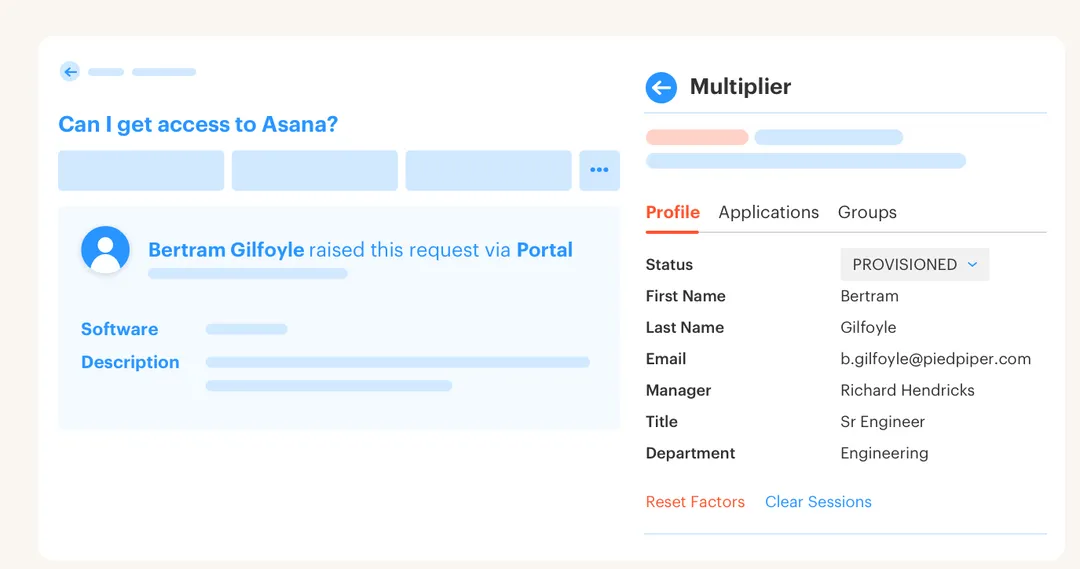
For elevated access, Time-Based Access makes the grant temporary by default. A requester can choose a duration, access gets provisioned after approval, and Multiplier removes the group membership when the timer expires. That closes one of the biggest least privilege gaps most teams have, which is access that gets granted correctly and then never removed.
Then on the review side, Access Reviews run as a Jira-native campaign workflow. Reviewers can see user attributes, group memberships, last login, and recommendations, then mark keep or revoke. Multiplier can remove the user from the relevant IDP groups and create Jira tickets documenting the change. So the review and the enforcement are no longer split apart.
Less waste, cleaner lifecycle work, and better audit evidence
Multiplier also helps on the cost side with Auto Reclaim, which identifies inactive users based on real login telemetry from the identity provider, sends a warning, and then revokes access if they still don’t log in during the grace period. That’s how you cut SaaS waste without relying on stale spreadsheets or annual panic. It’s available on the Advanced edition, and it’s especially useful when paired with access reviews and time-based access.

For broader identity lifecycle work, Post Functions let teams trigger actions from Jira workflow transitions without scripts. That can include creating a user in Entra, adding them to groups, assigning licenses, updating profiles for transfers, or disabling accounts during offboarding, depending on the workflow and supported IDP actions. Again, the important part is that the action and the approval trail stay linked to the Jira issue.
If your team is trying to automate a big chunk of routine access work, this is the type of operating model that gets you there. And if you’re building a contract renewal playbook, this matters even more. Because you’re not just reviewing features. You’re reviewing whether the platform reduces manual work, shrinks standing access, improves audit evidence, and actually gets adopted.
Why Jira-Native Governance Wins as You Scale
Jira-native governance wins because it matches how teams actually work, not how software diagrams pretend they work. Requests already happen in service workflows. Approvers already live in Slack. Identity changes should run through the IDP. Audit evidence should fall out of the process, not get recreated later. That’s the logic any smart contract renewal playbook should follow.
Most teams don’t need more moving parts. They need fewer. Fewer portals. Fewer manual steps. Fewer standing privileges. Fewer audit fire drills.
Ready to simplify access governance and clean up renewal decisions? Get started with Multiplier
That’s really the path forward. Put governance in Jira. Enforce it through your identity provider. Make least privilege the default instead of the aspiration.
And if you’re evaluating tools this quarter, don’t just ask which platform has the longest feature list. Ask which one gives you a contract renewal playbook you can actually run. One rooted in workflow, adoption, evidence, and real operational control. That’s the difference between buying software and actually fixing the problem.
Frequently Asked Questions
How do I set up time-based access for my team?
To set up time-based access with Multiplier, start by ensuring that your applications are configured to allow time-based requests. When an employee submits a request through the Application Catalog in Jira Service Management, they can select a duration for access (like 1, 6, or 24 hours). After the request is approved, Multiplier will automatically provision the access and set a timer to revoke it once the duration expires. This helps enforce least privilege by ensuring that elevated access is temporary and reduces the risk of standing privileges.
What if I need to revoke access for multiple users at once?
If you need to revoke access for multiple users, consider using Multiplier's Access Reviews feature. You can create a campaign that includes all relevant applications, assign reviewers, and launch the review process. Reviewers will see user attributes and can mark users for revocation based on inactivity or role changes. Once decisions are made, Multiplier will automatically remove users from the relevant identity provider groups and document the changes in Jira, streamlining the revocation process.
Can I integrate Slack approvals with Multiplier?
Yes, you can integrate Slack approvals with Multiplier. When employees submit access requests via the Multiplier Slack app, approvers receive direct messages with options to approve or deny the requests. This keeps the approval process within Slack, reducing context switching and speeding up decision-making. Once approved, the request transitions in Jira, and Multiplier provisions access automatically through your identity provider, ensuring everything is logged for audit purposes.
When should I use the Application Catalog?
You should use the Application Catalog when you want to streamline access requests for your team. It provides a centralized, Jira-native self-service experience where employees can browse approved applications, select roles, and submit requests easily. This not only ensures that requests include the necessary context but also routes approvals to the right people. By using the catalog, you can reduce manual overhead and improve visibility into access requests, making it easier for IT to manage and audit access.
Why does my team need automated provisioning?
Automated provisioning is crucial because it eliminates the manual steps involved in adding users to the right groups after access requests are approved. With Multiplier, once a request is approved, it automatically calls your identity provider to provision access, reducing the risk of errors and delays. This ensures that users get timely access while maintaining a clear audit trail in Jira. It also helps your team focus on higher-value tasks instead of getting bogged down in repetitive administrative work.


