


57% of employees say waiting too long for apps and access hurts their productivity, according to Okta’s Businesses at Work data and related identity workflow research. If you’re creating a self-service application request flow right now, the hard part isn’t building a form. It’s making sure the request, approval, provisioning, expiry, and audit trail all stay connected.
A lot of teams think creating a self-service application catalog is the same as solving access management. It’s not. A nice front end without governance behind it just gives you a faster way to create manual work.
Key Takeaways:
- Creating a self-service application experience only works if every app role maps to a real identity provider group
- If approvals still happen outside Jira or Slack, your process will stay slow even with a catalog
- A good self-service application flow should capture role, approver, duration, and evidence in one record
- If your team handles more than 50 access requests a week, manual provisioning usually becomes the real bottleneck
- Time-bound access should be the default for elevated roles, not a special exception
- Audit readiness gets easier when evidence is created during the workflow instead of rebuilt later
Why Creating a Self-Service Application Often Fails
Creating a self-service application request flow fails when teams only improve intake. The request gets cleaner, but the rest of the chain stays broken. Approval still sits in Slack threads, provisioning still happens by hand in the identity provider, and audit evidence still gets rebuilt later.

The catalog is usually not the real bottleneck
Most teams start with the storefront. Makes sense. The intake is messy, employees are pinging IT in Slack, someone sends an email, someone else opens a Jira ticket, and now you’ve got three sources of truth before lunch.
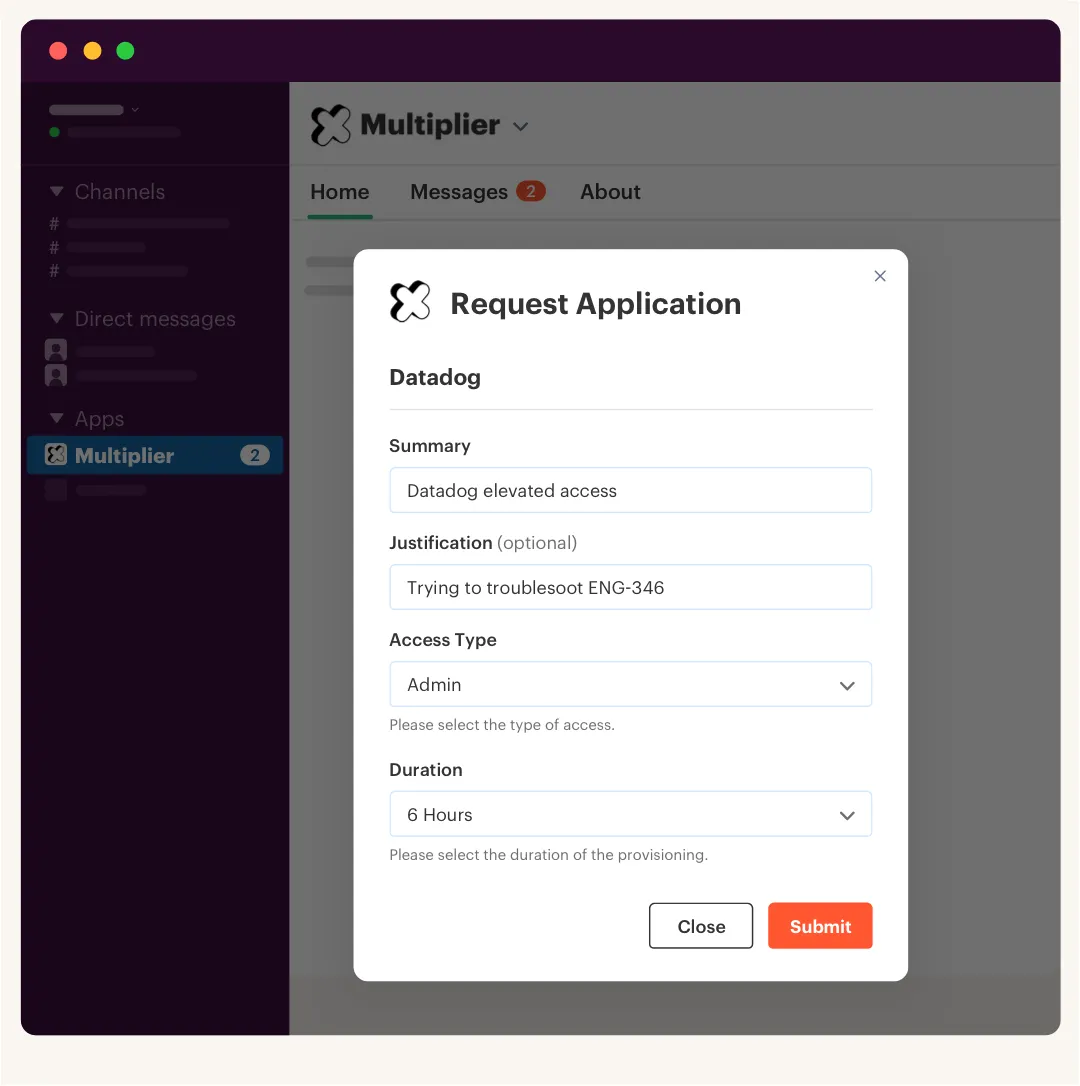
Picture a 400-person company onboarding 15 people on Monday. By Tuesday morning, the IT queue is full of requests for Slack, Zoom, Jira, GitHub, Figma, and two random apps nobody documented properly. The requests are missing role details. Ownership is fuzzy. One person in IT knows which Okta group actually maps to the right entitlement, and that person is in meetings. That’s not a request problem. That’s a workflow design problem.
I’ve seen this pattern a lot. Teams think the pain comes from not having a self-service application portal. In reality, the pain comes from what happens after the click.
Chat-first requests feel fast, but they weaken control
Slack feels fast because it hides the work. Someone drops a request in a channel, a manager replies with a thumbs up, IT picks it up later, and maybe someone remembers to add a note for audit. Fast in the moment. Expensive later.
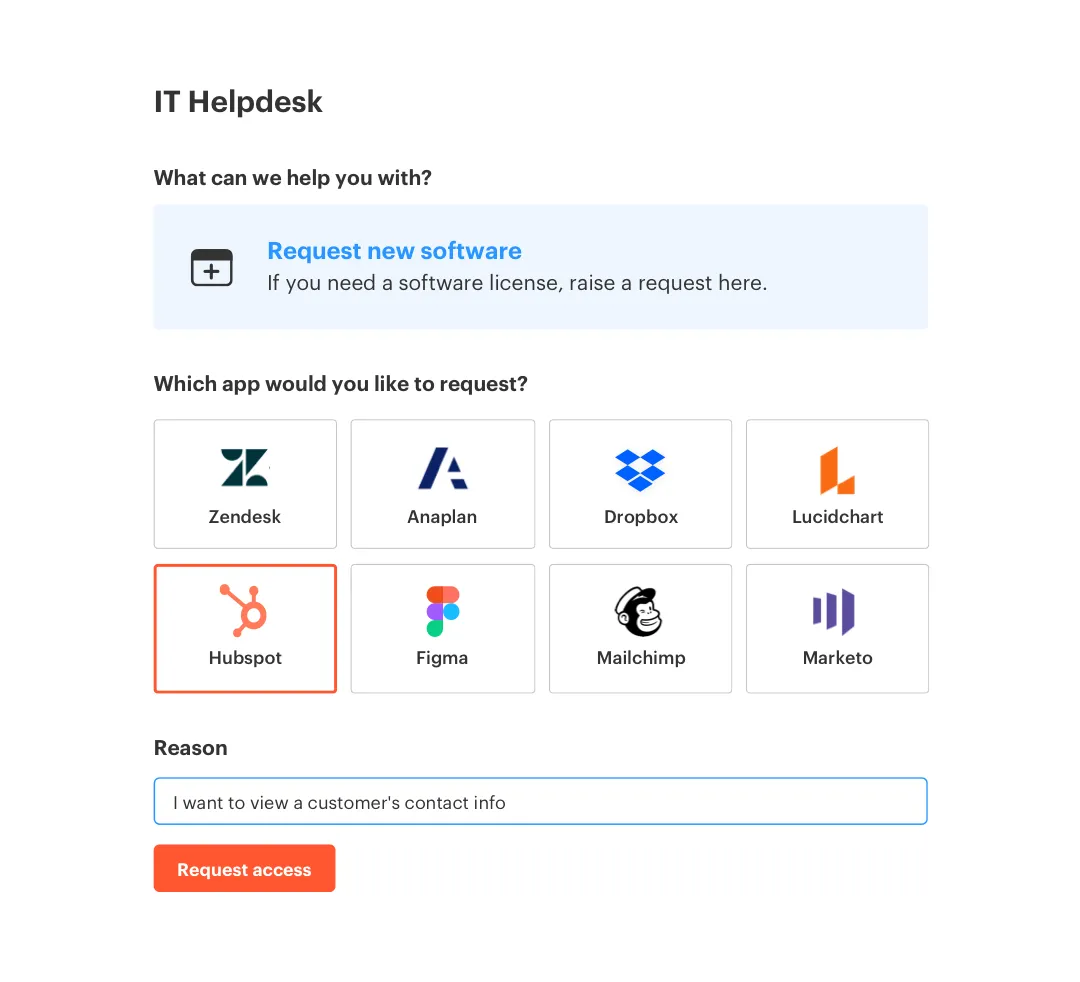
Chat bots and SaaS management tools alone don’t solve governance. That’s the contrarian take here, and I think it’s the right one. If the chat flow can’t enforce approvers, trigger authoritative provisioning through the identity provider, and write evidence back to the system of record, you’re just moving the mess into a friendlier interface.
A separate portal has a similar issue. Employees now have one more place to learn, one more login, one more workflow that drifts from the service desk. Creating a self-service application experience should reduce context switching, not add to it.
The hidden cost shows up during audits and access reviews
The direct cost is time. The hidden cost is cleanup. Every manual handoff creates little piles of risk that don’t look dramatic on a Tuesday, but they absolutely show up at quarter end and audit time.
A mid-market fintech team in the Multiplier customer base was dealing with hundreds of routine access requests across Slack, email, and Jira while manually assigning Okta groups. Their IT team was spending 5 to 30 minutes on standard requests. At scale, that’s not a minor admin task. That’s a recurring tax on your best people. And when you’re also chasing screenshots and approval proof, the tax compounds.
Creating a self-service application flow isn’t about making requests prettier. It’s about making the whole system trustworthy. So the next question is obvious: what actually breaks underneath all this?
The Real Problem Is the Split Between Request and Provisioning
The real problem isn’t that employees can’t request apps themselves. It’s that most companies split the request from the action. One system collects the ask, another person chases the approver, a third system provisions the access, and a spreadsheet becomes the audit trail.
If the role doesn’t map to an IDP group, your process is already weak
This is the first diagnostic I’d run. Pick 10 common app requests and ask one simple question: does each approved role map to a specific group in Okta, Entra, or Google Workspace? If the answer is no for more than 2 of the 10, you don’t have a real self-service application workflow yet. You have a request form plus human memory.
That sounds harsh. It’s also true.
Creating a self-service application only becomes useful when roles are deterministic. Viewer maps to one group. Admin maps to another. Temporary elevated access maps to a time-bound path. If people need to interpret the request every single time, turnaround slows down and mistakes creep in.
The service desk and governance stack should not be two worlds
A lot of teams accept the split because they assume that’s just how identity governance works. Jira for tickets. Email or Slack for approvals. Okta for provisioning. CSV exports for audits. Then they act surprised when cycle times drag.
The ITSM and IGA split is the operational bottleneck. That’s the whole story in one line. When work starts in Jira but governance lives somewhere else, every request crosses tool boundaries like a relay race with four different batons. Something gets dropped.
There’s a case to be made for dedicated IGA suites in very complex enterprises. Fair enough. Deep policy control matters in some environments. But for a lot of mid-market and high-growth companies already running on Jira Service Management, that extra portal creates more drag than value unless it’s tightly embedded into the daily workflow.
The old architecture rewards standing access
Manual access systems train teams into bad habits. If approvals are slow and provisioning is annoying, people start granting broader standing access just to avoid future delays. You see it with engineering admins, finance tools, production systems, everywhere.
A startup cybersecurity team using Multiplier cut privileged access by 85% after shifting to a more time-bound model. That result matters because it points to the real connection: slow workflows create overprovisioning. Security problems are often workflow problems wearing a different outfit.
So if the old setup keeps producing standing access, messy evidence, and admin churn, what does that cost in actual operational terms?
The Cost of a Weak Self-Service Access Model Adds Up Fast
A weak self-service application model costs time, security posture, and audit credibility all at once. The waste is rarely in one giant failure. It’s in hundreds of small manual steps that repeat every week.
Start with a simple workload math check
If your team processes 50 access requests a week, and each one takes 10 minutes of manual work between approval chasing, group assignment, confirmation, and ticket updates, that’s 500 minutes a week. Roughly 8.3 hours. Over a quarter, you’re past 100 hours. That’s before retries, exceptions, or audits.
And 10 minutes is conservative. In one customer scenario from the source material, standard requests were taking 5 to 30 minutes each. That means a team handling 200 requests a month might be burning anywhere from 17 to 100 hours monthly on work that should be largely automatic.
That’s why I think teams underestimate this category. The requests look tiny one by one. They aren’t tiny in aggregate.
Manual evidence creation is where audits get ugly
Audit pain doesn’t come from one missing screenshot. It comes from rebuilding a story after the fact. Who requested access? Who approved it? What role was granted? When was it removed? Was the change made through the identity provider or directly in the app? If you can’t answer those questions from one system of record, someone ends up playing detective.
Vanta and other compliance platforms are useful, but they can’t invent clean evidence if the underlying workflow is fragmented. That’s the surprising connection a lot of teams miss. Audit stress is usually an operations design problem first, not a reporting problem.
Think of your process like airport baggage routing. The bag tag matters, sure. But if the handoffs between scanners, conveyors, and gates are disconnected, the tag won’t save you. Same here. A request form without linked approvals and linked provisioning is just a bag tag on a broken conveyor.
Employees feel the friction immediately
A system can be technically compliant and still feel broken to employees. New hires don’t care which tool owns governance. They care whether they can do their job on day one.
At one fast-growing advertising company, scaling from 100 to 500 employees created repetitive onboarding access requests every week. Tuesdays were packed with tickets missing the details IT needed to act. Once they moved to a self-service catalog model inside Jira Service Management, they processed 500 plus app requests in six months and saved more than 70 hours of IT productivity. That’s not just an ops win. That’s a better new hire experience.
And honestly, that emotional part matters. It’s exhausting when your team spends the morning chasing approvals and the afternoon proving they chased them.
What a Good Self-Service Application Workflow Actually Looks Like
A good self-service application workflow is not just a portal. It’s a request path with strong defaults. The employee chooses an approved app and role, the right approver is pulled in automatically, the change happens through the identity provider, and the full trail sits on the ticket.
First, diagnose what kind of system you actually have
Before changing anything, ask these five questions:
- Can employees request access from one approved catalog instead of Slack, email, and side forms?
- Does each role map to a real identity provider group?
- Are approvals tied to a workflow status with named approvers?
- Can elevated access expire automatically?
- Can you pull audit evidence from the ticket without rebuilding it manually?
If you answer no to 2 or more, don’t start with UI polish. Start with the operating model.
This is where a lot of teams go wrong. They optimize the front door when the plumbing behind the wall is leaking.
Then design around authoritative provisioning
Provision through your identity provider. That’s the core design rule. If access changes happen through Okta, Entra, or Google Workspace group membership, you get a cleaner source of truth, faster reversibility, and better evidence.
Okta’s workforce identity guidance has pushed this idea for years: centralize control in the identity layer where possible. I agree with that. Where I’d push further is this: the identity layer should be triggered from the workflow your team already uses, not from a disconnected governance portal that creates new adoption friction.
A clean pattern looks like this:
- Publish only sanctioned apps and roles
- Map each role to one or more IDP groups
- Route each request to the right approver
- Trigger provisioning only when the issue reaches the approved state
- Write success or failure back to the same record
If you can’t describe your flow that clearly, it’s probably too manual.
Make time-bound access the default for high-risk roles
This is the second major design rule. If an app role is privileged, sensitive, or rarely needed, add a duration at request time. Don’t make people remember to remove it later.
A good threshold here is simple. If an entitlement would raise concern during an audit, or if misuse could affect customer data, production systems, or finance controls, default it to temporary access. Common durations like 1 hour, 6 hours, or 24 hours are usually enough for operational work. Longer than 7 days for elevated access should trigger a second look.
Some teams will say that’s too rigid during incidents. Fair point. During real production pressure, you need speed. That’s exactly why the duration needs to be built into the workflow up front instead of handled manually later.
Build reviews and reclamation into the model, not as cleanup
Creating a self-service application process without reviews is like opening a tab and never checking the bill. Access accumulates. Licenses accumulate. Risk accumulates.
Quarterly access reviews should focus first on apps with either high privilege or low login activity. If you have more than 200 users in scope, don’t review every app with the same intensity. Rank them. Start with admin tools, finance systems, engineering production access, and expensive SaaS licenses. Then widen out.
Inactive licenses need a separate rule. If an app hasn’t been used in 30 to 90 days, depending on its purpose, trigger a warning and reclaim path. That’s not just cost control. It’s also a quiet form of least privilege enforcement.
A high-growth AI company in the source material processed more than 3,800 access requests in a year and automated 75% of them. Their four-person IT team supported more than 420 employees. That didn’t happen because they had a prettier request form. It happened because the flow was structured end to end.
How Multiplier Makes This Work Inside Jira and Slack
Multiplier turns creating a self-service application workflow into an operational system inside Jira Service Management and Slack. The key difference is that requests, approvals, provisioning, and evidence stay connected to the same Jira issue instead of getting scattered across tools.
A Jira-native catalog fixes intake without adding another portal
Multiplier’s Application Catalog gives employees a self-service app store inside JSM, and it can also be accessed through the Slack app. Approved applications appear as tiles, roles are selectable, and each role maps to an identity provider group. That matters because it removes guessing from the process.
If your team isn’t ready for full automation yet, that’s fine. You can still start catalog-first and centralize requests in Jira so every access change has a record. I like that because it acknowledges reality. Not every team can jump from spreadsheets to full orchestration in one shot.
Provisioning through the identity provider keeps changes authoritative
This is the piece I’d focus on most. Multiplier provisions through identity provider groups, not by asking IT to copy and paste changes manually after approval. Once a Jira issue reaches the configured approved state, Multiplier can call Okta, Entra, or Google Workspace to add or remove the user from the mapped group and write the result back to the ticket.

That design solves two problems at once. It speeds up fulfillment, and it makes the audit trail cleaner because the ticket and the change stay linked. For elevated roles, Time-Based Access can provision the access, start the timer, and remove the group membership at expiry. Fewer standing privileges. Less cleanup. Better evidence.
Reviews, Slack approvals, and reclaim close the loop
Multiplier also keeps the surrounding governance work in the same system. Approval Workflows route requests to managers, app owners, or specific users in Jira and Slack. Access Reviews run as Jira-native campaigns with reviewer context like groups, job titles, and last login data. Auto Reclaim can identify inactive users from identity provider login telemetry, warn them, and revoke access if they remain inactive after the grace period.
That closes the loop in a way most self-service application projects never do. Intake, fulfillment, review, and removal are all tied together.
If you want to see what that looks like in your Jira environment, Get started with Multiplier.
The Best Self-Service Application Is the One You Can Actually Govern
Creating a self-service application flow is worth doing. But only if you finish the job. The real goal isn’t prettier requests. It’s faster access, less standing privilege, and evidence that creates itself while the work happens.
If you keep governance inside Jira and route provisioning through your identity provider, the whole system gets simpler. Employees get what they need faster. IT spends less time on repetitive work. Audits stop feeling like archaeology. That’s the bar.
Frequently Asked Questions
How do I set up a self-service application catalog with Multiplier?
To set up a self-service application catalog using Multiplier, follow these steps: 1) Install the Multiplier app in your Jira Service Management (JSM) instance. 2) Configure the Application Catalog by syncing it with your identity provider (like Okta or Google Workspace) to display approved applications. 3) Ensure that each application role maps to the correct identity provider group for clean provisioning. This setup allows employees to browse and request access to applications directly from the JSM portal or Slack, fixing intake.
What if I need to manage temporary access for elevated roles?
To manage temporary access for elevated roles using Multiplier, enable Time-Based Access during the request process. When employees submit a request, they can select a duration (like 1, 6, or 24 hours). After approval, Multiplier provisions access and automatically sets a timer to revoke it once the duration expires. This approach minimizes standing privileges and helps maintain a secure environment by ensuring access is only granted when necessary.
Can I automate access reviews with Multiplier?
Yes, you can automate access reviews using Multiplier's Access Reviews feature. To do this, create a review campaign in Jira, select the applications you want to include, and assign reviewers. Reviewers will receive notifications and can easily mark users to keep or revoke access based on their activity. Multiplier automatically processes these decisions, updating the relevant identity provider groups and generating Jira tickets for documentation, making the review process efficient and organized.
When should I consider using Auto Reclaim?
Consider using Auto Reclaim when you want to optimize your SaaS spend and manage licenses effectively. This feature is particularly useful if you have many applications and users, as it automatically identifies inactive users based on their login activity. You can set inactivity thresholds and grace periods, allowing Multiplier to send warnings before revoking access. This helps ensure that you only pay for licenses that are actively used, reducing unnecessary costs.
Why does my self-service application catalog need governance?
Your self-service application catalog needs governance to maintain security and compliance. Without proper governance, requests may not be linked to the correct approvals or provisioning actions, leading to potential security risks. Multiplier ensures that every request, approval, and access change is documented in Jira, creating a reliable audit trail. This governance structure helps prevent overprovisioning and ensures that access is granted based on established policies, which is important for passing audits and maintaining a secure environment.


