


Creating effective approval flows doesn't start with adding another approver. It starts with the ugly ratio most IT teams already know: 100 small access requests can create 100 tiny audit problems if the approval, grant, and evidence live in different places.
Most approval flow advice is way too clean. It assumes people follow the process because the process exists. In real life, people ask in Slack, managers reply with a thumbs up, IT adds the user to an Okta group, and three months later someone is rebuilding evidence for an audit from screenshots and memory.
And honestly, that's where the whole thing breaks. Not because your team is lazy. Because the workflow was never designed to prove the work happened.
Key Takeaways:
- Creating effective approval flows means tying the request, approval, provisioning, and evidence to the same record.
- If an approval needs more than two people, it probably needs a risk rule, not another human checkpoint.
- Low-risk access should be automated after approval, while privileged access should expire by default.
- Slack approvals are fine, but only if the final decision is written back to Jira or your system of record.
- Access reviews need usage context, or reviewers will rubber-stamp access because they don't have enough information.
- The best approval flow is boring: clear intake, clear owner, clear expiry, clear evidence.
Why Approval Flows Break When Work Leaves Jira
Approval flows break when the decision happens in one place, the access change happens somewhere else, and the audit evidence gets rebuilt later. Jira can track the request, but it can't prove control if the approval lives in Slack and the actual group change happens manually in an identity provider. That gap is where delays, risk, and audit pain start.

The Hidden Cost Is Not the Approval
The approval itself is usually not the slow part. A manager can say yes in 30 seconds. The cost comes from everything wrapped around the decision: finding the approver, checking whether the role is appropriate, granting access, closing the ticket, and proving later that the right person approved the right thing.
I've seen this pattern in other workflows too. Back when I was building content systems, the writing wasn't always the bottleneck. The bottleneck was context. Who owned the brief? Who approved the angle? Who had the final say? Access approvals work the same way. If the context is scattered, the actual decision becomes weirdly expensive.
At 4:47pm, an IT service desk manager is looking at a Jira queue with 37 open access tickets. One request came through Slack, another has a manager approval buried in email, and a third needs an Okta group assignment but doesn't say which role. The team can clear the queue, sure. But now every cleared ticket leaves behind a tiny evidence problem.
If you're trying to see what a cleaner access approval path looks like inside Jira, learn more about Multiplier.
Chat Approvals Feel Fast Until You Need Proof
Chat-first access feels great at first. Someone asks for Figma Admin access, the app owner clicks approve, and everyone moves on. Fast. Nice. The problem is that chat by itself is not governance, because the approval needs to connect to the request, the entitlement, the revocation, and the evidence trail.
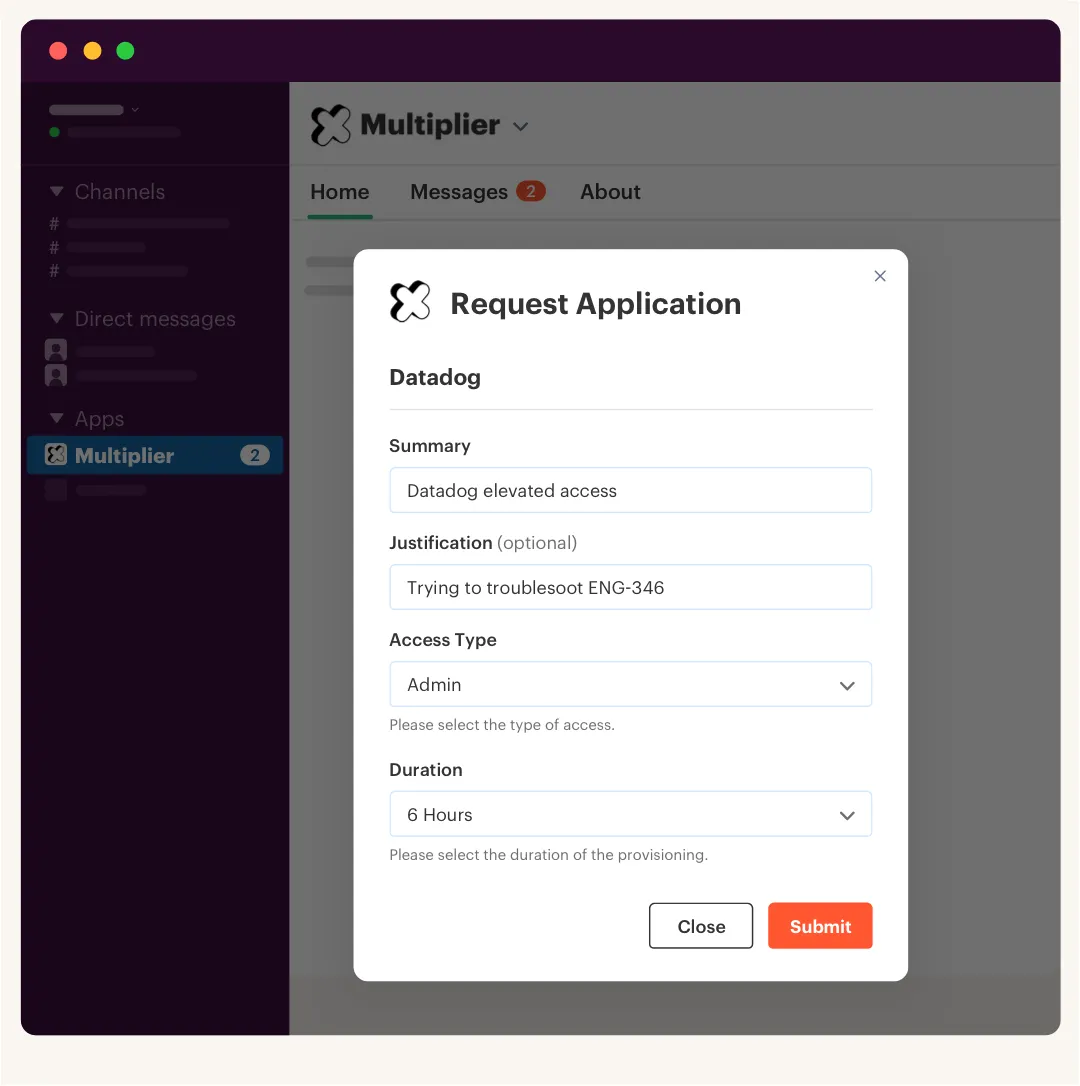
There's a fair argument for chat. People live there all day. For low-risk requests, forcing everyone into a separate portal is a quick way to get ignored. But if the Slack message is not tied to a Jira issue and the identity provider action, you're running a drive-through window with no receipt printer. It feels efficient until finance or security asks what was served, who approved it, and whether the order was ever closed.
NIST's access control guidance, including account management in SP 800-53, is pretty clear on the need to manage accounts, authorizations, and reviews. A fast approval that can't be proven later is only half a control.
More Approvers Usually Means Weaker Ownership
A lot of teams respond to access risk by adding more approvers. Manager plus app owner plus security plus IT. Seems safer. In practice, it often creates a crowd where nobody feels fully accountable.
The threshold is pretty blunt: if more than two people need to approve a request, stop adding humans and define the risk rule instead. For example, Viewer access to a low-risk SaaS app can go to the manager only. Admin access to a finance tool needs the app owner and maybe security. Production access should be time-bound, with expiry set before the grant happens.
A fintech team like Luno ran into the classic version of this during fast growth. Hundreds of routine access requests were arriving through Slack, email, and Jira, and IT was chasing approvals while manually assigning Okta groups. They cut IT workload on access requests by 80% after moving to a more automated Jira and identity provider workflow. The point isn't that every company needs the same setup. The point is that approval flow design is really ownership design.
And if ownership is fuzzy, creating effective approval flows becomes impossible.
How to Design Approval Flows That Actually Hold Up
Creating effective approval flows means designing for four outcomes at once: fast intake, correct decisioning, automated access change, and clean evidence. If one of those is missing, the flow will look fine in a diagram but fail during daily work. Build the approval path around risk, not around org chart politics.
Diagnose the Approval Mess Before You Redesign It
Before you change the workflow, you need to know where it's actually broken. Start with five recent access requests and trace them from request to grant to closure. Not 50. Five is enough to show the pattern, because the same weird gaps usually repeat.
Ask these questions while looking at the actual tickets, Slack messages, and identity provider logs. Did the requester choose a specific role, or did they just say "I need access"? Did the approval happen inside the ticket, or somewhere else? Did IT manually grant access after approval? Was an expiry required? Could you show an auditor, in under 5 minutes, who approved the request and what changed?
If you answer no to two or more of those questions, don't start by buying another tool or adding another approval layer. Start by fixing the flow. The messy middle is where most teams lose control: the intake form is too vague, the approver mapping is tribal knowledge, and the final access change happens as a manual side quest.
A quick diagnostic:
- Trace 5 requests end to end: Pick a mix of low-risk, privileged, and cross-functional requests.
- Mark every system touched: Jira, Slack, email, Okta, Entra, Google Workspace, spreadsheets.
- Count manual handoffs: Anything requiring copy/paste or a human group assignment counts.
- Check audit reconstruction time: If proof takes more than 5 minutes per request, the flow is not audit-ready.
- Identify repeatable approvals: Any request approved the same way 10 times should probably be automated after approval.
Separate Low-Risk Access From Privileged Access
Not every app request deserves the same approval flow. Treating a Zoom Viewer request and production database access the same way creates backlog for no reason. Worse, people start bypassing the process because the process feels ridiculous.
If the access is low-risk, commonly requested, and reversible through an identity provider group, route it through a single approver and automate the grant after approval. If the access is privileged, sensitive, or tied to production systems, require a stronger approval path and make the grant temporary by default. If the access can't be revoked automatically, flag it as manual and review it more often.
Critics of automation have a point. Some approvals need judgment. Some requests have weird context. Some apps have bad identity provider coverage. That's exactly why the flow should split by risk. Automation takes the boring, repeatable work away so humans can focus on requests that actually need thinking.
A practical risk split:
- Low-risk access: Manager approval, automatic provisioning, no expiry unless license cost is high.
- Sensitive business apps: App owner approval, role-specific grant, quarterly review.
- Privileged access: App owner or security approval, 1 to 24 hour duration, automatic revocation.
- Manual or non-SSO apps: Ticketed approval, documented grant, shorter review cycle.
- Unknown app request: IT triage first, then catalog decision before access is granted.
Put Evidence Creation Inside the Flow
Audit evidence should not be a separate project. Once evidence becomes a quarterly cleanup job, the team is already behind. Someone is exporting CSVs, collecting screenshots, pasting comments into tickets, and hoping the story lines up.
Better approval flows create evidence as a byproduct. The request captures who asked for what. The approval records who approved and when. The identity provider change records what actually happened. The ticket ties the whole thing together. Not glamorous. But it works.
Think of it like package tracking. Nobody wants a warehouse worker writing a spreadsheet at the end of the month saying, "Pretty sure these packages shipped." You want every scan attached to the package as it moves. Request submitted. Approved. Granted. Delivered. Revoked. Access should work the same way.
The 5-minute audit test: pick any access request from the past 90 days. If your team can show request, approval, grant, and current access state in 5 minutes or less, your flow is healthy. If it takes 30 minutes and three systems, the workflow is producing cleanup, not evidence.
A strong flow records:
- Requester and business reason: Why the person needs access.
- Application and role: Exactly what entitlement was requested.
- Approver decision: Who approved or denied, with timestamp.
- Provisioning action: What changed in the identity provider.
- Expiry or review date: When access ends or gets reviewed.
- Revocation proof: Evidence that removed access actually got removed.
Creating effective approval flows gets a lot easier when the evidence is attached to the work itself, not recreated after the fact.
Use Review Context So People Don't Rubber-Stamp
Access reviews fail when reviewers lack context. If you send an app owner a spreadsheet with 600 names, 40 groups, and no usage data, you're not running a review. You're asking someone to guess under pressure.
Reviewers need enough information to make a sane decision: job title, department, group membership, last login, app role, maybe a recommendation if the user has been inactive for 90 days. Without that, "Keep" becomes the safe default because revoking the wrong person feels worse than leaving access alone.
A reviewer should be able to decide on 80% of users without leaving the review screen. The remaining 20% can require follow-up. If reviewers need to open the identity provider, Slack the manager, search old tickets, and ask IT what a group means, the review campaign is already broken.
Synthesia grew from 100 to more than 400 employees with a four-person IT Ops team. They processed 3,800+ access requests in a year, with 75% fully automated. That kind of volume forces clarity. You can't scale approvals and reviews on memory, Notion boards, and missed Slack notifications.
If you want to see how Jira-native approval flows connect approvals, provisioning, and review evidence, see how Multiplier works.
Build the Flow Around the Identity Provider
The identity provider should be the enforcement point. Jira can manage the work. Slack can speed the decision. But Okta, Entra, or Google Workspace is where the actual entitlement changes need to happen.
A lot of teams miss this. They build great request forms and approval chains, then leave provisioning as a manual step. That creates a split where the workflow says "Approved," but access still depends on someone remembering to add the user to the right group. Small mistake. Big downstream cost.
Map each requestable role to an identity provider group. When the request is approved, the group assignment happens automatically. When access expires or gets revoked in a review, the group membership is removed. Jira remains the record of the work, while the identity provider remains the source of enforcement.
Atlassian has been writing more about companies using Jira Service Management beyond classic IT tickets, including employee lifecycle work in JSM. That trend matters because access approval flows are no longer isolated IT tasks. They're part of onboarding, transfers, offboarding, compliance, security, and finance. Once you see the connection, manual group changes look like a tax on every employee move.
If a request can be fulfilled through an identity provider group, don't leave it as a manual ticket. Approve it once. Execute it through the identity provider. Write the result back to the record.
How Multiplier Makes Approval Flows Auditable
Multiplier makes approval flows auditable by keeping the access request, approval, provisioning action, review decision, and evidence inside Jira Service Management. It uses identity provider group assignments for provisioning and revocation, while Slack can handle fast approvals without becoming the system of record. Audit readiness comes from linked actions, not screenshots.
Jira-Native Reviews With Real Usage Context
Access reviews are where weak approval flows get exposed. If people were over-approved, never revoked, or granted access manually without a clean record, the review campaign turns into a scavenger hunt. Nobody wants that, especially not right before an audit.
Multiplier's Access Reviews run inside JSM and show reviewers what they need: user attributes, groups, last login, and recommendations like revoking users inactive for 90+ days. Reviewers mark Keep or Revoke, and revocation removes the user from the relevant identity provider group. The decision and the enforcement are connected.
Non-SSO apps still have limits, and automatic revocation depends on group-based access. Fair limitation. But for apps governed through Okta, Entra, or Google Workspace groups, the review can move from "please certify this spreadsheet" to "make a decision, enforce it, and keep the proof."
Approval Workflows That Trigger Real Provisioning
Approval workflows only matter if the approval leads to the right access change. A manager clicking approve is not the finish line. The finish line is the user getting the right role, for the right amount of time, with the record updated.

Multiplier handles this through Approval Workflows and Automated Provisioning via identity provider groups. Admins map Jira statuses to approval gates, assign approvers by app owner, manager, or a specific user, and route notifications through JSM or Slack. After approval, the mapped identity provider group assignment happens automatically, and the Jira issue gets updated with the result.
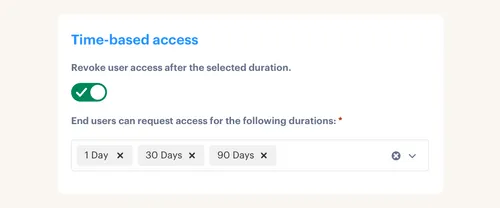
For privileged access, Time-Based Access adds the missing control that most approval flows skip. The requester chooses a duration, like 1, 6, or 24 hours. After approval, access is granted through the mapped group, and when the time window expires, the group membership is removed and the change is recorded in Jira. That's how you avoid the classic problem where temporary access quietly becomes permanent.
If you're trying to get approvals, provisioning, expiry, and review evidence into one Jira-native flow, get started with Multiplier.
Build Approval Flows That Create Proof Automatically
Creating effective approval flows is not about making every request slower and more controlled. It's about making the right path easier than the workaround. Low-risk access should move quickly. Privileged access should expire. Reviews should show usage context. Evidence should be created while the work happens.
The mistake is treating approvals as the control. They're not. The full control is the chain: request, decision, provisioning, expiry or review, revocation, evidence. Once that chain lives in Jira and connects to the identity provider, the process is a lot less fragile.
And that's the real win. Not prettier tickets. Fewer loose ends.
Frequently Asked Questions
How do I automate access requests in Multiplier?
To automate access requests with Multiplier, first ensure your applications are set up in the Application Catalog within Jira Service Management (JSM). Employees can then browse approved applications and roles directly in JSM or via Slack. After selecting an app and role, they submit their request, which automatically creates a Jira ticket. Multiplier manages the approval workflow and provisioning based on the roles assigned to the applications, reducing manual errors and ensuring all requests are logged for audit purposes.
What if I need to revoke access quickly?
Use Multiplier's Access Reviews feature. It lets you create campaigns for reviewing user access efficiently. Reviewers can see user context, such as last login and job title, to make informed decisions. When access needs to be revoked, Multiplier automatically removes users from the relevant identity provider groups and documents the change in Jira.
Can I set time limits on access requests?
Yes. Multiplier's Time-Based Access feature lets requesters choose a duration for access, such as 1, 6, or 24 hours. Once approved, Multiplier provisions the access and automatically revokes it when the time limit expires. This is useful for managing privileged access and ensuring users only have access for as long as necessary.
When should I use manual provisioning?
Use manual provisioning for non-SSO or unmapped applications that can't be automatically managed through identity provider groups. You can still capture approvals and maintain an audit trail within Multiplier, and document manual grants in Jira to keep access changes traceable.
Why does my approval flow need to connect to Jira?
Connecting your approval flow to Jira ensures that all actions — requests, approvals, and provisioning — are documented in a single system. Multiplier lets you manage approvals and provisioning directly within Jira, so you can track the entire lifecycle of an access request, improve accountability, and reduce the risk of errors.


