


Privilege creep is one of those problems that sneaks up on you. One approved request at a time, users accumulate access they no longer need, and before long you've got a sprawling mess of standing privileges that nobody can fully account for.
The scary part? Most teams don't realize how bad it is until an auditor asks them to prove who has access to what. Then comes the spreadsheet scramble.
Key Takeaways:
- Privilege creep happens gradually through legitimate requests that never get cleaned up
- Standing access is the core risk driver, time-bound, just-in-time access is the structural fix
- Manual access reviews are too slow and too infrequent to catch creep before it compounds
- Automated revocation tied to approval workflows is the only way to enforce least privilege at scale
- Audit evidence shouldn't be rebuilt after the fact, it should be produced as a byproduct of normal workflows
- Governance belongs in Jira, not in a separate portal that nobody actually uses
Your Access Policies Are Fine. Your Enforcement Isn't.
Here's what I see constantly. Organizations have solid least-privilege policies on paper. Role definitions exist. Approval processes exist. Someone, at some point, wrote down the rules. But the actual enforcement? That's where things fall apart.

The problem isn't the policy. It's that policy and execution live in completely different systems. A new hire joins, gets provisioned for a project, and that access becomes permanent by default because nobody set an expiry. A contractor finishes their engagement, but the offboarding ticket gets closed without anyone checking whether their Okta groups were cleaned up. An engineer gets temporary admin access for an incident, and three months later they still have it because the follow-up never happened.
This isn't negligence. It's the natural outcome of a fragmented process where approvals happen in email, provisioning happens in the identity provider, and cleanup requires someone to manually connect the dots between all three.
The Standing Privilege Problem Is Structural
Privilege creep prevention gets framed as a discipline problem. Train your IT team better. Do reviews more often. Build better checklists. But that framing misses the actual issue.

Standing access is the default state of every system. When you grant someone access and don't attach an expiry, that access persists indefinitely. Removing it requires a separate, deliberate action, and that action depends on someone remembering to take it. At 50 employees, you can manage this manually. At 200, it starts slipping. At 500, you've got a privilege creep problem whether you know it or not.
The Principle of Least Privilege has been a foundational security concept for decades, but most organizations enforce it at provisioning time and then abandon enforcement entirely. The gap between "access granted" and "access removed" is where privilege creep lives.
Why Access Reviews Don't Solve It
Quarterly access reviews feel like the answer. And they're better than nothing. But they have a fundamental timing problem.
If you're doing reviews every 90 days, a user can accumulate inappropriate access for up to three months before anyone catches it. And that's assuming the review is thorough, which is a big assumption when reviewers are staring at a spreadsheet of 400 users and rubber-stamping "Keep" because they don't have enough context to do otherwise.
The other issue is that reviews are reactive. They catch creep that has already happened. They don't prevent it. If your goal is to reduce standing privilege exposure, you need something that acts at provisioning time, not 90 days later.
The Cost of Getting This Wrong
Let me put some numbers on this, because it's easy to treat privilege creep as a theoretical risk until it isn't.
Verizon's Data Breach Investigations Report consistently finds that compromised credentials and excessive privileges are among the top factors in data breaches. When an attacker gets hold of credentials, the blast radius is determined almost entirely by how much standing access that account had. Over-provisioned accounts are the difference between a contained incident and a catastrophic one.
The Audit Cost Nobody Talks About
Beyond the security risk, there's a compliance cost that hits teams every quarter. When auditors ask for evidence of access controls, most IT teams have to reconstruct it. Pull Okta exports. Cross-reference Jira tickets. Find the Slack thread where the approval happened. Screenshot everything and paste it into a document.
This takes days. Sometimes weeks. And it's pure overhead, work that produces no value except satisfying the auditor's requirement. One fintech company I know of spent three weeks before their SOC 2 audit just pulling together access evidence that should have been automatically generated as a byproduct of their normal workflows.
That's the hidden cost of governance that lives outside your ticketing system.
The License Waste Nobody Accounts For
There's also a direct financial cost that's easier to quantify. Every SaaS seat assigned to a user who no longer needs it is money being burned. At scale, this adds up fast. A 500-person company with 40 SaaS tools and even a 10% inactive user rate across those tools is wasting meaningful budget every month. Most finance teams have no visibility into this because nobody is connecting login activity to license assignments systematically.
What Effective Privilege Creep Prevention Actually Looks Like
The teams that handle this well aren't doing more manual work. They've changed the architecture so that least privilege is enforced by default, not by exception.
The core shift is moving from permanent access as the default to time-bound access as the default. When every access grant has an expiry built in, you don't need to remember to clean it up, the system does it automatically. That's a fundamentally different model than granting access and hoping someone revokes it later.
Make Time-Bound Access the Starting Point
When a developer needs admin access to a production database for an incident, they shouldn't be getting permanent access with a note to revoke it later. They should be getting 4-hour access that auto-revokes when the window closes. When a contractor needs access to a project repo, they shouldn't be getting indefinite access, they should be getting access through the end of their contract.
This sounds like more friction, but it doesn't have to be. If the request process is easy, browse a catalog, pick a duration, get approved in Slack, the time-bound model is just as fast as the permanent model. The difference is what happens after. With permanent access, cleanup is a manual action that depends on someone's memory. With time-bound access, cleanup is automatic.
The diagnostic test here is simple: look at your last 20 access requests. How many had an expiry attached? If the answer is zero or close to it, you're running on standing privilege by default.
Connect Approvals to Provisioning and Revocation
A lot of organizations have approval workflows that are disconnected from actual provisioning. Someone approves a request in a ticket, and then IT manually goes into Okta to add the user to the right group. The approval and the action are separate steps, which means there's a gap where things can go wrong or simply not happen.
The better model is one where approval triggers provisioning automatically, through the identity provider, with a record attached to the originating ticket. When the access window expires, revocation happens automatically through the same mechanism. The Jira ticket has the full history: who requested, who approved, when access was granted, when it was removed.
This isn't just operationally cleaner. It means your audit trail is produced as a byproduct of normal work, not reconstructed before an audit.
Run Access Reviews With Actual Context
When you do run periodic reviews, the quality of the review depends entirely on the quality of the information the reviewer has. A spreadsheet with a list of names and group memberships tells you almost nothing. A reviewer dashboard that shows last login date, current group memberships, job title, department, and a system recommendation based on inactivity, that's something a reviewer can actually act on.
The other thing that matters is what happens when someone clicks "Revoke." If the reviewer has to submit a separate request and wait for IT to manually remove the access, the review is effectively advisory. If revocation executes automatically and generates a ticket documenting the change, the review has teeth.
Good access reviews aren't just about surfacing who has what. They're about making it easy to act on that information and automatically enforcing the decisions that get made.
Build Governance Into Your Existing Workflows
The reason separate IGA portals fail in practice is adoption. If employees have to go to a different system to request access, they'll find workarounds. If approvers have to log into a portal they rarely use, approvals get delayed or happen out-of-band. If IT has to reconcile two systems to produce audit evidence, they'll do it manually and hate every minute of it.
The teams that get this right put governance where the work already happens. If your organization runs on Jira and Slack, that's where access requests, approvals, and evidence should live. Not in a separate portal that adds another login to everyone's workflow.
How Multiplier Enforces Least Privilege Without Adding Overhead
Multiplier runs inside Jira Service Management. Access requests, approvals, provisioning, and revocation all stay tied to the same ticket.
Time-Based Access With Automatic Revocation
Multiplier's Time-Based Access feature makes time-bound provisioning the default rather than the exception. When employees submit a request through the JSM portal or via Slack, they can select a duration alongside the application and role. After approval, Multiplier provisions access through the identity provider immediately and starts a timer. When the window closes, it removes the user from the mapped group and logs the revocation back to the Jira ticket.
Access Reviews That Actually Execute
Multiplier's Access Reviews run within JSM. Admins create campaigns, assign reviewers, and launch. Reviewers land on a JSM Help Center dashboard that shows user access details, including group memberships, job titles, departments, last login dates, and recommendations. When they click "Revoke," Multiplier removes the user from the relevant identity provider groups, creates a Jira ticket documenting the change, and updates campaign progress. Results can be exported to CSV or pushed to systems like Vanta for compliance reporting.
The audit trail isn't something you reconstruct. It's just there, because every action is linked to the workflow and the change it triggered.
Automated Provisioning That Closes the Gap Between Approval and Action
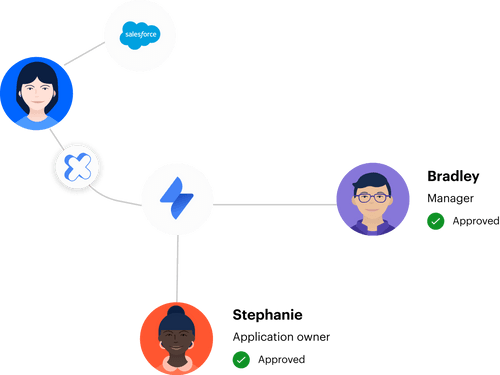
Approval workflows in Multiplier route decisions to the right people, app owners, managers, or specific users, through JSM notifications and Slack DMs. When someone approves, Multiplier transitions the ticket and calls the identity provider to add the user to the mapped group, assign or remove access, and write the outcome back to the issue. The whole loop, request, approval, provisioning, and revocation, stays tied to a single Jira record.

Where to Go From Here
Privilege creep isn't a people problem. It's a systems problem. When standing access is the default, when approvals and provisioning are disconnected, and when audit evidence has to be rebuilt from scratch, creep is the inevitable outcome.
The fix is changing the defaults. Time-bound access instead of permanent access. Automated revocation instead of manual cleanup. Governance that lives in Jira, where the work already happens, instead of in a separate portal that adds friction without adding control. When you get those defaults right, least privilege stops being a policy you aspire to and starts being the way your system actually operates.
Frequently Asked Questions
How do I set up time-bound access in Multiplier?
When an employee submits a request through the JSM portal or Slack, they select a duration (1, 6, or 24 hours). After approval, Multiplier provisions access and starts a timer. When it expires, access is removed automatically without any manual follow-up.
What if I need to revoke access immediately?
Find the Jira ticket tied to the access request and use the Revoke option. Multiplier removes the user from the mapped identity provider groups and creates a ticket documenting the change, so your audit trail stays intact.
Can I automate access reviews with Multiplier?
Yes. Admins create review campaigns in JSM, select the apps to include, and assign reviewers. Reviewers get notified and can mark access as Keep or Revoke from the dashboard. Multiplier executes revocations and logs the changes automatically.
When should I use the Application Catalog in Multiplier?
Whenever employees need to request access. They browse a visual catalog, pick a role and duration, and submit through JSM or Slack. Requests route to the right approvers without IT having to manage intake manually.
Why does my team need automated provisioning?
Manual provisioning creates gaps. When IT has to add users to groups by hand, steps get missed and access lingers. With automated provisioning, approval triggers the change in the identity provider immediately, with a Jira record attached. No follow-up required.


