


Your access requests are drowning your IT team. Every onboarding surge floods the queue. Approvals scatter across Slack, email, and random DMs. Someone forgets to provision the right groups. The new hire waits three days for Figma access. By the time you fix it, another batch of tickets piles up.
Most teams assume this is just the cost of growth. More employees equals more requests equals more IT headcount. But the real problem isn't volume. It's that your access workflow lives in five different places, none of them talking to each other. Requests start in Jira, approvals happen in Slack, provisioning is manual in Okta, and audit evidence gets recreated in a spreadsheet every quarter. You're not short on tools. You're short on a system that connects them.
Key Takeaways:
- Access request chaos stems from fragmented workflows across ITSM, chat, identity providers, and manual approvals
- Streamlining means unifying requests, approvals, and provisioning in one system with automatic audit trails
- Jira-native access governance eliminates context switching and turns routine requests into automated workflows
- Time-bound access and automatic revocation enforce least privilege without manual cleanup
- Teams running lean IT operations automate 75%+ of access requests and support 400+ employees with four-person teams
Why Access Request Workflows Break at Scale
Access requests feel simple when you're 50 people. Someone pings IT in Slack. IT adds them to a group. Done. But at 200 people, that workflow collapses. At 500, it's a full-time job just tracking who approved what.

The Fragmentation Tax
Here's what actually happens. A product manager files a JSM ticket requesting Figma access. The ticket sits in queue until someone notices. IT tags the manager for approval. The manager misses the Jira notification because they live in Slack. Two days pass. IT follows up in email. Manager approves via reply. IT screenshots the email, pastes it into the ticket, then manually logs into Okta to add the user to the Figma SSO group. No one sets an expiry. Three months later the person still has access, the license is still billed, and the audit trail is a collage of screenshots and comments.
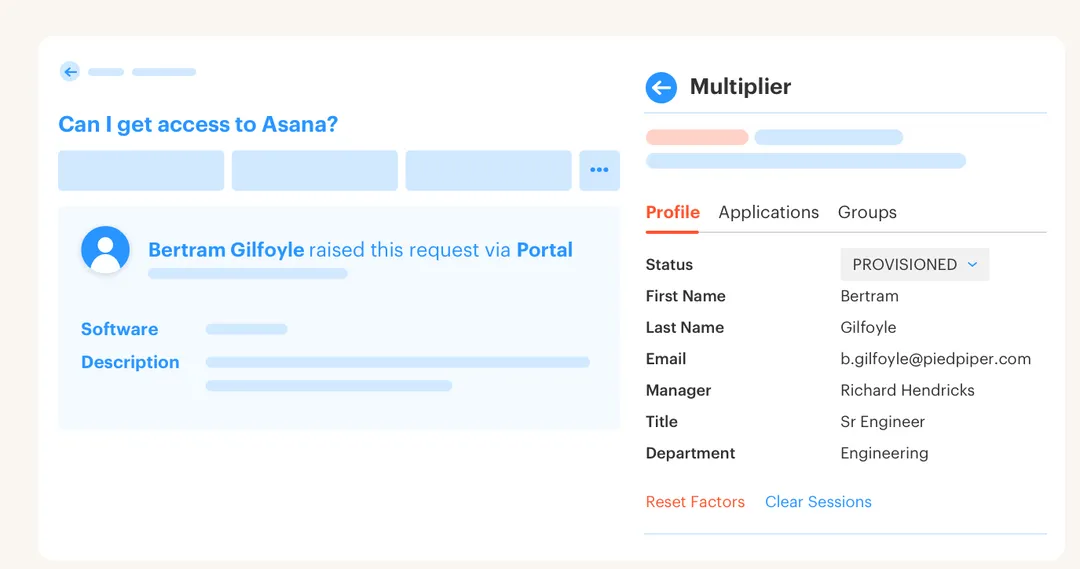
Multiply that by 400 requests a month and you see the problem. It's not that any single step is hard. It's that every request requires six context switches, three manual actions, and zero enforced policy. Learn more about Multiplier to see how automation eliminates these bottlenecks.
When Approvals Live Everywhere Except Where They Should
The approval step is where most workflows stall. You configured JSM to route to managers. But managers don't check Jira daily. They check Slack. So they miss the notification. IT pings them directly. Manager says "approved" in a thread. IT copies that into the ticket as evidence. Now you've got two systems of record and neither one is authoritative.

Some teams tried solving this with email approvals. That works until the approval email goes to spam or the manager is on vacation. Some tried Slack bots that create tickets. That works until the bot can't handle role selection or time-bound access. The fundamental issue remains. Approvals scattered across channels create delays, weak evidence, and zero consistency.
The Provisioning Bottleneck No One Talks About
Even when approvals are fast, provisioning is still manual. IT gets the green light, opens Okta, searches for the user, finds the right group, adds them, and updates the ticket. That's 3-5 minutes per request if everything goes smoothly. But it rarely does. The group name changed. The user isn't synced yet. The app owner never documented which group maps to which role. IT guesses, provisions the wrong level, and has to redo it later.
Teams at 1000+ employees told us they were spending 20+ hours a week just on group assignments. Not strategy. Not automation. Just clicking through identity provider UIs to add users to groups that could have been mapped once and provisioned automatically.
What Streamlining Actually Means in Practice
Streamlining isn't about working faster. It's about eliminating the manual steps that shouldn't exist in the first place. The goal is simple. Request, approve, provision, and audit should happen in one connected flow with zero human intervention for routine access.
Unified Request Intake That Employees Actually Use
The first step is giving employees one place to request access. Not Slack. Not email. Not a Google Form. One self-service catalog embedded in JSM where they can see approved apps, select roles, and submit. The catalog syncs from your identity provider automatically, so IT doesn't maintain parallel lists. Each app shows up as a tile with a logo. Employees pick the app, pick the role, and submit. A Jira ticket gets created instantly with all the context IT needs.
This matters because intake quality determines everything downstream. When employees fill out a form that says "what app do you need?" they write "Salesforce" and IT has to follow up to ask which profile. When they pick from a catalog that shows "Salesforce: Sales User" and "Salesforce: Admin," the ticket includes the right details from the start. No back and forth. No delays.
Approval Routing That Doesn't Require Chasing People
Once the request is in, approvals need to happen where approvers live. For most teams, that's Slack. The approval workflow should detect who needs to approve based on the app, app owner, requester's manager from the identity provider, or a hardcoded user, then send them a Slack DM with Approve and Deny buttons. One click. Decision recorded in Jira automatically. No email threads. No missed notifications.
The key is tying the approval back to the Jira issue. When the approver clicks Approve in Slack, the ticket transitions to the next status and triggers provisioning. The approval is logged on the record that initiated it. Auditors see the request, the approver, the timestamp, and the action taken, all in one place.
Provisioning Through the Identity Provider, Not Manual Clicks
After approval, provisioning should be instant and automatic. The system calls your identity provider API, adds the user to the mapped group, and updates the Jira ticket with success or failure. For SSO apps, group membership pushes entitlements through SAML or SCIM to the application. For non-SSO apps, IT still provisions manually, but the ticket captures the approval and tracks the change.
This eliminates the swivel chair problem. IT isn't logging into Okta 50 times a day. They're reviewing exceptions and handling edge cases. The routine stuff, the 80% of requests that follow a standard pattern, runs on autopilot. See how Multiplier works to understand the technical flow.
Time-Bound Access That Revokes Itself
The next layer is making access temporary by default. When someone requests elevated permissions, they should specify a duration. 1 hour. 6 hours. 24 hours. After approval, the system provisions access and starts a timer. When the window expires, the system removes the user from the group automatically and logs the revocation to the ticket. No manual cleanup. No standing privileges.
This is where streamlining turns into least privilege enforcement. You're not just moving faster. You're reducing exposure windows, cutting license waste, and creating an audit trail that proves access was revoked when it should have been.
How Multiplier Automates the Entire Access Request Flow
Multiplier is a Jira Service Management app that embeds access governance directly into where IT and employees already work. Instead of juggling a separate IGA portal, spreadsheets, and manual provisioning, Multiplier unifies requests, approvals, and provisioning inside JSM and Slack.
Application Catalog Embedded in JSM
Multiplier syncs apps and groups from Okta, Azure AD, and Google Workspace. Only apps marked "Approved" appear in the catalog. Each role maps to an identity provider group. Employees submit requests via the JSM portal or Slack. A Jira issue is created automatically with the right context captured up front, so IT has what it needs to route and process the request cleanly.
Approval Workflows That Route to Slack
Multiplier detects who needs to approve based on app owner, requester's manager, or a hardcoded user. Approvers receive JSM notifications and Slack DMs with one-click Approve or Deny buttons. Upon approval, Multiplier transitions the ticket and triggers provisioning automatically. The approval is logged on the Jira issue. No email threads. No screenshots. Just a single source of truth.
Automated Provisioning via Identity Provider Groups
After approval, Multiplier calls your identity provider API to add the user to mapped groups. For SSO apps, group-based provisioning pushes entitlements through SAML or SCIM. Multiplier updates the Jira ticket with success or failure comments for audit and troubleshooting. IT isn't clicking through Okta 50 times a day. Routine requests move faster, with execution tied back to the original Jira issue.

Time-Based Access with Automatic Revocation
Multiplier enforces least privilege by making elevated access temporary by default. Requesters choose a duration during submission. After approval, Multiplier provisions access and starts a timer. On expiry, it removes the user from the group and logs the revocation to the Jira issue. No manual cleanup. No standing privileges. Security teams get confidence that exposure windows are minimized. Operations teams get fast access without creating backlog.
The Path Forward: Start with Intake, Scale with Automation
You don't need to rip out your entire stack. Start by centralizing intake. Get requests into one place with enough context that IT can act without follow-up. Then add approval routing so decisions happen where approvers live. Then automate provisioning for your most common apps. Each step compounds. Faster approvals mean less backlog. Automatic provisioning means IT scales without headcount. Time-bound access means fewer standing privileges and cleaner audits.
The teams running lean IT operations, supporting 400+ employees with four-person teams, didn't get there by working harder. They got there by eliminating the manual steps that shouldn't exist. Streamlining access requests isn't about speed. It's about building a system where the right outcome is the easy outcome.
Frequently Asked Questions
How do I set up time-based access for my team?
To set up time-based access using Multiplier, follow these steps: 1) When submitting an access request, the requester should specify the desired duration (e.g., 1 hour, 6 hours, or 24 hours). 2) Once the request is approved, Multiplier will provision access and automatically start a timer. 3) After the specified time expires, Multiplier will remove the user from the group automatically, ensuring no manual cleanup is needed. This approach helps enforce least privilege and minimizes unnecessary access.
What if my approvers miss notifications?
If approvers are missing notifications, consider using Multiplier's approval workflows that route requests directly to Slack. This way, approvers receive direct messages with one-click Approve/Deny buttons. To set this up, ensure that the Multiplier Slack app is installed and configured. This reduces the chances of missed notifications and keeps the approval process streamlined, as all actions are logged back to the Jira issue for audit purposes.
Can I automate provisioning for non-SSO applications?
While Multiplier automates provisioning for SSO applications through identity provider groups, non-SSO applications still require manual provisioning. However, you can still capture approvals and maintain an audit trail for these requests. To streamline the process, ensure that your team is aware of the manual steps required for non-SSO apps, and consider adding them to the application catalog for easier access requests.
How do I ensure compliance during access reviews?
To ensure compliance during access reviews, utilize Multiplier's Access Review feature. Start by creating a campaign that includes only approved applications. Assign reviewers such as app owners or managers to oversee the review process. Reviewers can easily mark users to keep or revoke access based on their activity. This process integrates directly with Jira, ensuring that all decisions and changes are documented and easily auditable.
When should I consider implementing automated access management?
Consider implementing automated access management with Multiplier when your organization experiences rapid growth or when access requests become overwhelming for your IT team. If you're handling hundreds of requests manually, automating the process can significantly reduce the workload. By integrating Multiplier with Jira Service Management, you can streamline requests, approvals, and provisioning, ensuring that your team operates efficiently and maintains compliance.


