


If you're enforcing least privilege to pass an audit, you've already made it too narrow. Access control breaks way before the auditor shows up, usually when someone asks for admin access in Slack at 4:47 pm and everyone just wants the ticket gone.
I've seen this pattern a lot. Teams buy a chat bot, or bolt approval buttons onto Jira, or run a quarterly access review in a spreadsheet and call it governance. Fair enough. It feels like progress. But if the access still doesn't expire, and provisioning still happens manually in Okta or Entra, you haven't reduced risk. You've just made the request look cleaner.
The goal isn't to make access requests nicer. The goal is enforcing least privilege to make temporary access the default, make approvals traceable, and make revocation happen without someone remembering to do it later.
Key Takeaways:
- Least privilege fails when access approvals, provisioning, and evidence live in different tools.
- Chat approvals are useful, but they don't enforce expiry or prove what changed.
- If elevated access lasts longer than 24 hours without a reason, treat it as standing privilege.
- The identity provider should be the place where access changes actually happen.
- Jira should hold the full record: request, approval, grant, expiry, revocation, and review.
- Access reviews work better when revocations execute from the same workflow.
- Enforcing least privilege to reduce risk requires operating rules, not just policy language.
Why Least Privilege Breaks When Access Lives Everywhere
Least privilege breaks when the request happens in one place, the approval in another, and the access change somewhere else. Each handoff creates a gap. At 50 requests a month, the gaps feel annoying. At 500, they become the system.

The split between tickets and identity creates the real mess
Most access problems don't start with bad intent. They start with speed. Someone needs GitHub admin for an incident, finance needs a SaaS role before close, a new hire needs 12 apps before standup, and IT is trying to keep the business moving without becoming the department of "please wait."
Picture an IT admin at 4:37 pm. A Slack DM comes in asking for temporary access. The Jira ticket has half the context. The manager approved in a thread. The admin opens Okta, adds the person to the group, then leaves a ticket comment saying "done." No expiry. No clean proof of who approved what. And now someone has to remember to remove it later, which is a terrible control because humans are terrible calendar reminders when the queue is on fire.
Access governance should work more like a visitor badge at a secure office. You don't give someone a permanent badge because they have a 2-hour meeting. You issue access for the visit, log who approved it, and the badge stops working when the window ends. That mental model is obvious in the physical world. Weirdly, it gets ignored in SaaS.
If you're already running Jira Service Management and identity through Okta, Entra, or Google Workspace, the question isn't whether you need more tools. The question is whether the tools you already trust are connected in the right order. If you want the faster path, Learn more about Multiplier and look at what happens when access work stays inside Jira instead of getting split across side channels.
Chat bots can speed up approvals without enforcing control
Chat approvals solve one slice of the problem. They make it easier for managers to say yes. They do not, by themselves, make sure the grant was correct, time-bound, logged, and revoked.
That matters. The NIST control for least privilege is not asking whether someone clicked an approval button in Slack. It's asking whether access is limited to what users need, and whether the organization can enforce that limit. A chat bot can collect the yes. Governance has to connect that yes to the identity provider and the audit trail.
A fast approval with manual provisioning is still manual provisioning. The admin still has to pick the right group, make the change, and document the evidence. If they pick the wrong group once every 100 requests, that sounds small until you're processing thousands of access changes a year.
Synthesia hit this problem during 4x headcount growth. Access requests lived in Slack channels and Notion boards. Notifications got missed, IT chased people, and provisioning stayed manual. After moving the process into Jira Service Management with automated access workflows, a 4-person IT Ops team supported 420+ employees and processed 3,800+ access requests in a year, with 75% fully automated. That's the difference between faster conversations and actual governance.
The old model doesn't fail because people are careless. It fails because the workflow asks people to be perfect hundreds of times in a row.
How to Make Least Privilege Operational Every Week
Least privilege becomes real when every access path has an owner, an approval rule, a provisioning action, and an expiry rule. If one of those four pieces is missing, the process relies on memory. Memory is not governance.
Diagnose whether you have an access problem or an expiry problem
About 80% of teams I talk to think they have an access request problem first. Slow approvals. Too many tickets. People asking in Slack. All true. But the more useful question is whether access ever ends without a human chasing it.
I'd start with five questions. Not a giant audit. Just enough to know where you sit. If more than two answers are "no," enforcing least privilege to reduce standing access is going to be hard with your current process.
Ask yourself:
- Can a requester choose 1 hour, 6 hours, or 24 hours of access at the point of request?
- Does the approved access grant happen through the identity provider, not by hand inside each SaaS app?
- Does the system remove access automatically when the window expires?
- Can you open the ticket and see the request, approver, group change, and revocation?
- Can reviewers revoke access from the review workflow without creating a separate cleanup task?
The threshold I like is simple. If elevated access lasts more than 24 hours, someone should explain why. Not in a policy doc no one reads. In the request itself. Some access needs to last longer, and that's fine. Finance systems, customer support tools, and core job apps aren't all the same. The mistake is treating temporary admin access and permanent role access like they belong in the same queue with the same approval shape.
Put the identity provider in charge of the actual change
The identity provider should be the system that makes access real. Jira can hold the request. Slack can collect the approval. But Okta, Entra, or Google Workspace should add and remove the user from the group because that's where the entitlement chain becomes authoritative.
That sounds obvious, but a lot of teams drift away from it. They start with clean SSO groups, then exceptions pile up. One app owner grants access directly. Another team keeps a spreadsheet for contractors. Someone creates a special admin role during an incident and forgets to map it back. Six months later, the access review becomes archaeology. You're brushing dirt off old ticket comments trying to figure out why someone has a role.
Use a rule here. If an app supports SSO group-based access, route the grant through the identity provider group. If it doesn't, still create the Jira record and approval trail, but don't pretend auto-revocation exists where the technical control can't remove the access. That distinction matters. It keeps your governance honest.
Luno is a good example of why the identity provider connection matters. During rapid growth to nearly 1,200 employees, their team had hundreds of routine access requests coming through Slack, email, and Jira. IT had to chase approvals and manually assign Okta groups. After moving requests into Jira Service Management with Okta-backed provisioning, they reduced IT workload on access requests by 80%. The request didn't just get prettier. The execution changed.
Make duration a required field for risky access
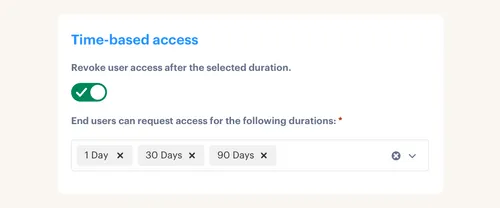
Temporary access should be decided before approval, not after. If someone asks for elevated access, the requester should choose the duration up front. The approver should see that duration. The ticket should record it. Then the system should remove access when time runs out.
The decision rule is pretty straightforward:
- Low-risk app access can be ongoing if it maps to someone's role.
- Privileged access should default to 1, 6, or 24 hours.
- Any access longer than 7 days should trigger a stronger approval or a review date.
- Any admin role without an expiry should be treated as an exception, not the norm.
Now, there's a fair argument against making everything temporary. It can annoy people. Engineers in a production incident don't want to stop and explain why they need access again. Finance doesn't want a quarter-end close blocked because a timer expired at the wrong moment. Completely valid.
The answer isn't to abandon time-bound access. The answer is to apply it where the risk justifies the friction. Production admin, security tooling, sensitive data, billing systems, privileged repo access. Start there. Don't start by putting a 1-hour timer on every normal business app, because you'll burn trust before the control proves its value.
Treat access reviews as cleanup plus signal
Access reviews are usually treated like a compliance chore. Pull a spreadsheet. Send it to managers. Wait. Nudge. Wait again. Collect "keep" or "remove" answers, then ask IT to do the actual cleanup. Not surprising people rubber-stamp it.
A better review process gives reviewers context and makes revocation executable. Show the user, department, group, role, last login, and recommendation in one place. If someone hasn't logged into an app in 90 days, that should show up next to the decision. If the reviewer chooses revoke, the access change should happen through the identity provider and the evidence should be attached to the ticket or campaign record.
The diagnostic here is simple. Open your last review and pick 10 revocations. Can you prove each one actually happened within 5 business days? If not, your access review is a survey, not a control.
The Verizon Data Breach Investigations Report keeps showing how often credentials and privilege paths matter in breaches. You don't need to turn every access review into a security investigation, but you do need to close the loop. Review without enforced revocation is just paperwork with better formatting.
If you're trying to connect request intake, approvals, provisioning, and reviews without sending everyone to another portal, see how Multiplier works inside Jira and Slack.
Measure standing privilege, not just ticket speed
Ticket speed is seductive. Everyone loves a shorter SLA. But if the team gets access in 10 minutes and keeps it for 10 months, the metric is lying to you. Fast access and least privilege only work together when speed comes with expiry.
Track four numbers:
- Percentage of access requests provisioned through identity provider groups
- Percentage of privileged requests with a defined duration
- Number of expired grants removed automatically
- Number of access review revocations completed without manual follow-up
I'd be more impressed by 60% of privileged access expiring automatically than by a 20% faster approval SLA. One reduces risk. The other may just make the risky thing happen faster.
A lot of leaders won't love this at first. They want the clean dashboard that says requests are down, approvals are fast, and IT is doing great. Fair enough. But enforcing least privilege to actually reduce risk means measuring what stays behind after the request is done. The leftovers are where the risk lives.
Build one workflow for request, grant, expiry, and evidence
The cleanest access workflow has one record from start to finish. Request comes in. Approver decides. Identity provider changes the group. Access expires. Revocation gets logged. Later, the review references the same history.
You can sketch the operating model in about 15 minutes:
- Define which apps are approved for self-service requests.
- Map each app role to an identity provider group.
- Assign approvers by app owner, manager, or named user.
- Require duration for risky roles.
- Write provisioning and revocation events back to the ticket.
- Use access reviews to catch stale standing access.
The hard part isn't drawing the flow. The hard part is refusing to let exceptions become the real system. Every company has exceptions. Contractor edge cases. Non-SSO apps. Weird legacy tools. Fine. Track them as exceptions and keep the main path clean.
That's the part most teams miss. Least privilege doesn't become easier because the policy gets stricter. It becomes easier because the default workflow makes the right thing less annoying than the workaround.
How Multiplier Enforces Temporary Access in Jira
Multiplier makes least privilege operational by connecting Jira Service Management, Slack approvals, and identity provider group changes in one workflow. Requests start where employees already ask for access. Provisioning and revocation happen through Okta, Entra, or Google Workspace. Evidence stays tied to the Jira issue.
Jira-native requests with identity-backed provisioning
Multiplier starts with an Application Catalog inside Jira Service Management, so employees can browse approved apps, pick a role like Viewer or Admin, and submit the request through JSM or Slack. Behind the scenes, each role maps to one or more identity provider groups. When the Jira issue reaches the approved status, Multiplier calls the identity provider API to add the user to the mapped group.

That matters because the access change stays authoritative. Multiplier isn't asking IT to copy a name from Jira into Okta and then paste a screenshot back into the ticket. The Jira issue becomes the record of what was requested and approved, while the identity provider remains the place where access is granted or removed. Clean separation. Much better control.
Multiplier's approval workflows route decisions to managers, app owners, or specific users in Jira and Slack. Approvers can act from the tools they already use, and the ticket keeps the decision trail. For teams coming from Slack requests, spreadsheets, and manual group assignment, Multiplier cuts out the weird middle layer where evidence gets lost.
The callback to the earlier problem is pretty direct. If every manual request used to take 5 to 30 minutes, and each one required checking approval, adding the group, and logging proof, the cost compounds fast. Multiplier removes the manual group-change step for mapped apps and records success or failure back to Jira.
Time-bound access and reviews close the loop
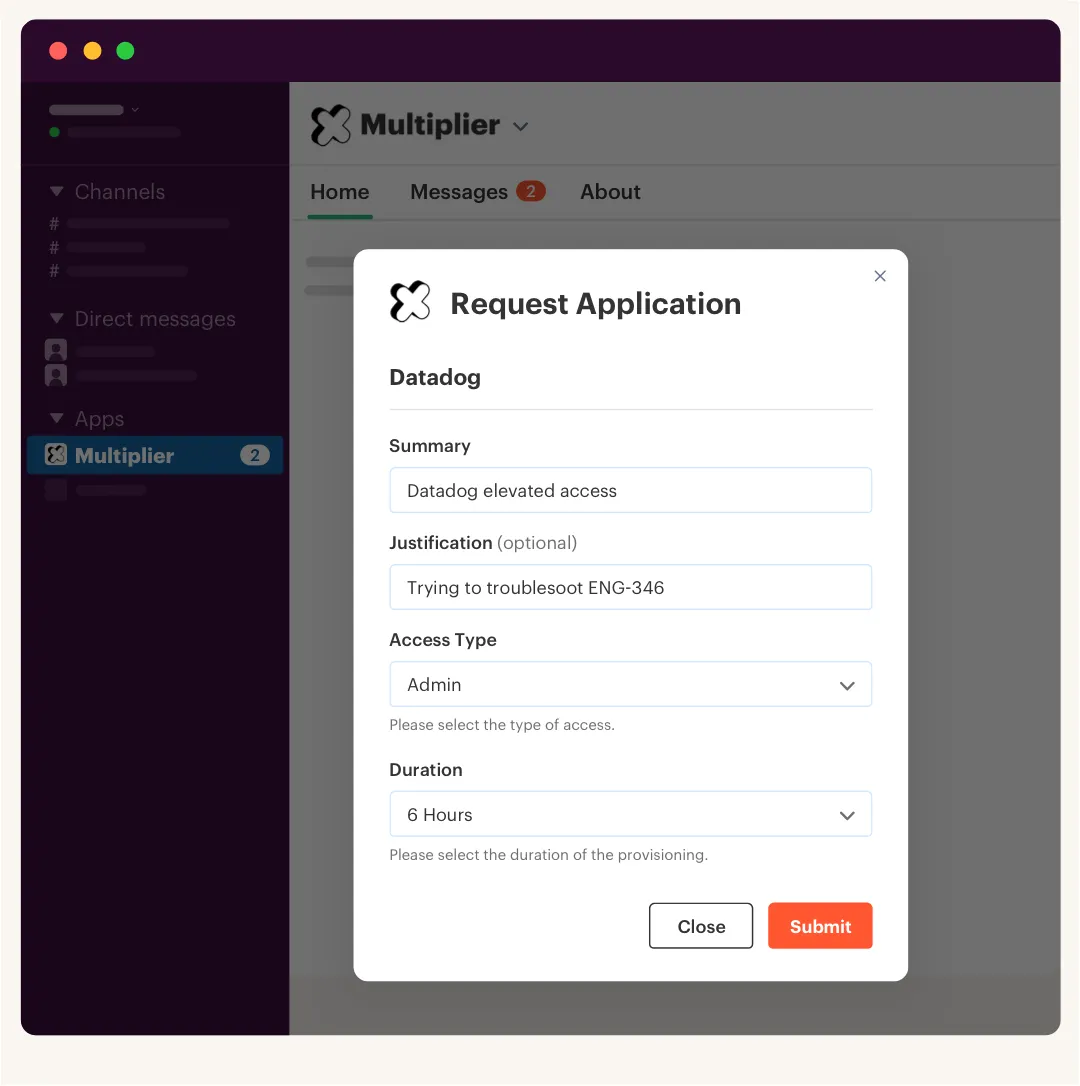
Multiplier's Time-Based Access is the piece that makes enforcing least privilege to reduce standing access feel practical. Requesters choose a duration, like 1, 6, or 24 hours. After approval, Multiplier provisions access through the mapped identity provider group and starts the timer. When the window expires, Multiplier removes the user from the group and records the change in Jira.
That's the control most chat-only workflows don't have. Approval is only half the story. Expiry is the part that reduces the pile of forgotten admin roles, old project access, and "just for this week" grants that somehow survive two reorganizations.
Multiplier also runs access reviews inside Jira Service Management. Reviewers can see user attributes, groups, last login data, and recommendations, then choose Keep or Revoke. For supported identity provider group access, revocations execute automatically and tickets document the change. Auto Reclaim can also identify inactive users based on identity provider login data, apply inactivity thresholds and grace periods, then revoke access and generate a Jira ticket when the user remains inactive.
If your access process already lives in Jira but enforcement still lives in someone's memory, get started with Multiplier and focus first on the apps where time-bound access and group-based provisioning can remove the most risk.
Make Least Privilege a Workflow, Not a Wish
Least privilege doesn't fail because teams don't care. It fails because the workflow makes the secure path too manual, too fragmented, and too easy to bypass. Once requests, approvals, provisioning, expiry, and evidence live in one operating path, the whole thing gets much easier.
Start with the risky access. Map it to identity provider groups. Require duration. Log the approval and revocation in Jira. Then use access reviews to clean up what's left. That's how enforcing least privilege to reduce risk becomes something the team can actually run every week, not a slide in a compliance deck.
Frequently Asked Questions
How do I set up time-based access in Multiplier?
To set up time-based access with Multiplier, follow these steps: 1) When submitting an access request via the Jira Service Management portal or Slack, select the desired duration for access (e.g., 1, 6, or 24 hours). 2) After the request is approved, Multiplier will automatically provision access and start the timer. 3) Once the time expires, Multiplier will remove the user from the group without needing any manual follow-up. This helps ensure that access is temporary and reduces the risk of standing privileges.
What if I need to revoke access after a review?
If you need to revoke access after an access review, you can do so directly within the Jira Service Management interface. Here's how: 1) Open the access review campaign and locate the user whose access you want to revoke. 2) Select 'Revoke' and provide a reason if required. 3) Multiplier will automatically remove the user from the relevant identity provider group and create a Jira ticket documenting the change. This ensures that the revocation is logged and traceable.
Can I automate access requests for non-SSO apps?
Yes, you can automate access requests for non-SSO applications using Multiplier. Here's how: 1) Add the non-SSO app to your Application Catalog in Jira Service Management. 2) When users request access, they can still submit the request through the catalog, which captures the approval trail. 3) However, keep in mind that provisioning for these apps will remain manual, so IT will need to handle the actual access grant. This way, you maintain an audit trail even for manual processes.
When should I conduct access reviews?
You should conduct access reviews regularly, typically on a quarterly basis, to ensure compliance and security. Here's a simple approach: 1) Schedule your access review campaigns in advance using Multiplier's Access Review feature. 2) Include all applications marked as 'Approved' in the review scope. 3) Assign reviewers who can make informed decisions about user access. This structured process allows you to identify and revoke unnecessary access efficiently, keeping your security posture strong.
Why does access management fail in fragmented systems?
Access management often fails in fragmented systems because requests, approvals, and provisioning happen in different tools, leading to gaps and errors. When using Multiplier, you can avoid this by: 1) Keeping all access requests and approvals within Jira Service Management to maintain a single source of truth. 2) Automating provisioning through your identity provider to ensure timely and accurate access changes. 3) Logging all actions in one place, which simplifies audits and reduces the risk of unauthorized access.


