


85% less privileged access is possible. The mistake is thinking you achieve least privilege in a policy doc, when you actually achieve least privilege in the workflow.
If you touched Jira, Slack, Okta, and a spreadsheet this week just to get one person the right access, you felt the problem already. You don't have an identity policy issue. You have an operating model issue.
Key Takeaways:
- Least privilege breaks when approvals, provisioning, and evidence live in different systems.
- If access is manual, it usually becomes broad, sticky, and hard to revoke.
- A useful rule: if an elevated permission has no expiry, treat it as standing access.
- Identity governance works better in Jira when Jira is already where requests and work happen.
- Automation-first least privilege beats policy-heavy least privilege, especially in fast-growing teams.
- The fastest path to cleaner audits is making evidence a byproduct of the request itself.
Why most least privilege programs fail in practice
Least privilege fails in practice because the control lives on paper, while the work lives across five tools. That gap is where standing access, delayed approvals, and weak audit trails show up.

A pretty common setup looks like this. Someone needs access to GitHub, Figma, AWS, or a sensitive Jira project. They ask in Slack. Their manager replies with a thumbs up. IT opens Jira. Someone checks Okta for the right group. Someone else assigns it. Then, because audit season is always lurking, a screenshot gets pasted somewhere so there’s proof later.
That flow feels manageable when you're small. It isn't. It just hides the cost for a while. Once headcount grows, the same process starts producing weird behavior. Access gets granted broadly so nobody blocks work. Admin roles stick around because nobody wants to be the person who breaks production at 6 p.m. Reviews move to spreadsheets because the ticket doesn't contain the full story. Then everyone says they care about least privilege. But the system is set up for convenience-first access with manual cleanup after the fact.
Back in earlier growth-stage teams I’ve seen this pattern a bunch. It always starts with good intentions. Nobody says, "let’s create standing privilege and a messy audit." It happens because the old workflow makes the wrong behavior easier than the right one.
A fintech team dealing with post-growth sprawl ran into exactly this problem. Long-lived privileged access stayed in place because the revocation step depended on people remembering. Once they shifted to a just-in-time model, privileged access dropped by 85%. That's not a policy win. That's an operations win.
And there’s the emotional part of it. Your team gets tired of chasing approvers, tired of being the human API between Jira and the identity provider, tired of rebuilding evidence after the fact. After enough of that, broad access starts to feel like the cheaper option. It isn't.
If you want to achieve least privilege in a real environment, you have to fix the path access takes.
Want to see what that looks like in a Jira-native model? Learn more about Multiplier
The real bottleneck is the ITSM and IGA split
The real bottleneck is not lack of policy. It's the split between the service desk where work starts and the governance stack where control is supposed to happen.
A separate portal adds drag you never get back
Most teams assume a dedicated IGA portal is the mature answer. I get why. On the surface, it sounds more controlled. More official. More governance-ish. Fair point. In some large enterprises with a lot of edge-case policy logic, a separate system can make sense.
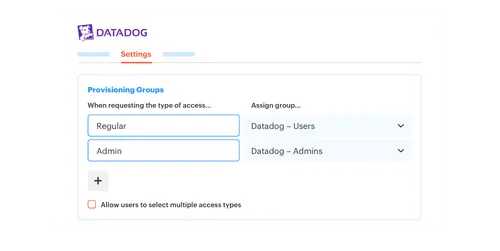
But for a lot of mid-market and high-growth companies already running on Jira Service Management, that extra portal becomes a second front to manage. Employees request in one place. Approvers respond in another. IT provisions in the identity provider. Evidence lands wherever someone had time to save it. You didn't centralize governance. You fragmented it.

A good mental model here is what I call the Three-Hop Failure. If an access request requires three or more human hops after approval, least privilege gets weaker, not stronger. Why? Because every extra hop increases delay, ambiguity, and the odds that someone grants permanent access just to keep work moving.
That sounds abstract until you watch it happen on a Tuesday morning. A new hire starts. They have the basics, but now they need Loom, Figma, one analytics tool, and access to a product repo. The requests come through Slack, email, and Jira. Approvals sit in different threads. IT keeps bouncing between JSM and the identity provider. By lunch, nobody is thinking about role precision. They're thinking about getting the person unstuck.
Manual evidence creation ruins audits before the audit starts
audit pain usually starts months before the auditor shows up. It starts when evidence is optional.

That’s why spreadsheets keep creeping back in. The ticket captured the request, but not the approval clearly enough. The identity provider shows the group change, but not the business reason. Slack has the approver comment, but not the final state. So a person has to reconstruct the story later. That reconstruction step is where teams lose time, miss context, and make weak claims they can't prove cleanly.
The hidden connection here is between audit quality and provisioning design. Most teams treat them as separate workstreams. They aren't. If the same workflow that approves access also drives the group change and logs the outcome in the ticket, audit evidence gets created as a side effect. If not, audit prep becomes a second job.
The NIST least privilege guidance is clear on the principle. The messy part is enforcement. Principles don't revoke access. Workflows do.
Policy-heavy governance has a ceiling
Policy-heavy least privilege sounds strong until it meets a fast-moving company. Then the gaps show up fast.
You can write all the access standards you want. You can define role sensitivity. You can tell teams elevated permissions must be reviewed quarterly. All valid. But if revocation is manual, approvals are scattered, and provisioning depends on whoever is on call, enforcement becomes inconsistent by default.
I’d argue that’s why a lot of least privilege programs stall. They focus on the policy surface area first, when the operational enforcement layer is actually what determines outcomes. The rule I use is simple: if you can't enforce expiry automatically, don't assume temporary access is temporary.
This is the point where the better question shows up. Not "what policy should we add?" but "what workflow makes least privilege the easy thing to do?"
How to achieve least privilege in Jira without slowing everyone down
You achieve least privilege in Jira by reducing standing access, automating the risky handoffs, and making evidence show up in the same system where the request started. That's the shift.
First, diagnose what kind of least privilege problem you actually have
Three questions tell you where you are.
- Are access requests still coming through more than one channel?
- Does approved access require a human to add users to groups manually?
- Can you prove who approved, what changed, and when it was revoked from one record?
If you answered no to the third question, you don't really have operational least privilege yet. You have partial traceability. Different thing.
I think this diagnostic matters because teams often jump straight to tooling debates. Okta versus this. IGA suite versus that. But the maturity gap is usually simpler than that. It's one of three buckets:
- Bucket 1: Intake chaos. Requests come from Slack, email, forms, and side conversations.
- Bucket 2: Approval drag. The right people exist, but requests stall because routing is unclear.
- Bucket 3: Enforcement gap. Approval happened, but provisioning, expiry, or review still depends on manual work.
Different bucket, different next move. If you're in Bucket 1, centralize requests first. If you're in Bucket 2, fix approver routing. If you're in Bucket 3, automate provisioning and revocation through the identity provider. That's the order. Not because it's elegant. Because it's what actually sticks.
Build around identity provider groups, not one-off exceptions
Least privilege gets easier when roles map cleanly to identity provider groups. It gets harder when every request turns into a custom decision.
This is where a lot of teams go wrong. They keep treating access as a special-case workflow, one request at a time. The better model is what I call Group-Mapped Least Privilege. Each sanctioned role maps to one or more identity provider groups. Approval decides whether the person should get that role. The system applies the group membership. Removal follows the same path in reverse.
Why does this matter? Because group-based provisioning gives you authority and reversibility. The identity provider remains the source of truth. Jira remains the operating layer. Audit evidence stays tied to the issue. You don't need people manually stitching those things together.
A high-growth AI company hit this wall after 4x headcount growth. Requests were tracked through Slack and Notion, notifications were missed, and manual provisioning couldn't keep up. Once they moved to a model with an app catalog, approval routing, and provisioning through Okta, 75% of access requests became fully automated. A four-person IT Ops team supported more than 420 employees. That kind of scale doesn't come from asking people to work harder. It comes from removing handoffs.
One concession here. Not every app will fit neatly into automated group-based provisioning on day one. Some non-SSO apps will still need manual handling. That's fine. The point isn't perfection. The point is to push the highest-volume, lowest-ambiguity access paths into an authoritative flow first.
Make temporary access the default for elevated roles
If you want to achieve least privilege in sensitive systems, elevated access should expire unless someone deliberately extends it. Not the other way around.
That changes the risk profile immediately. Production access. Admin roles. Database permissions. Finance systems. These are the places where a default duration does more good than another approval layer.
The framework I like here is Default-Ephemeral Access. Routine low-risk access can be persistent when justified. Elevated or sensitive access should be time-bound by default. My practical threshold is this: if the permission can materially change data, users, or system configuration, set a duration. One hour, six hours, twenty-four hours. Pick the smallest window that matches the job.
This sounds strict. It actually reduces friction when it's done right. A person requests what they need, gets approved, works, and the access drops off automatically when the window ends. No cleanup ticket. No sticky admin group six weeks later. No "we'll remove it after the incident" that nobody gets to.
A fintech team scaling under customer and compliance pressure used this model to shrink privileged access sharply. More than 1,300 approved access requests were automatically revoked after their windows ended. That's what enforcement looks like when the expiry is built into the workflow.
And honestly, this is where least privilege stops being a philosophy and starts becoming real. Real means the system removes access even when nobody remembers.
Run reviews where the work already lives
Quarterly access reviews fail when reviewers have to reconstruct context from scratch. They get better when the reviewer can see the user, the app, the usage signal, and the decision path in one place.
That’s why Jira-native reviews make so much sense for teams already running service work there. You're not asking people to log into some separate governance universe just to click Keep or Revoke. You're putting the review in the same operational lane where requests and changes already happen.
The rule I'd use is simple. If a review campaign can't trigger real revocation, it's only half a review. That's the Enforcement Rule. Review without action becomes checkbox theater pretty fast.
Usage context matters here too. A last login signal changes the quality of the decision. If someone hasn't touched an app in 90 days, that should inform the reviewer. Same for job title, department, and current group membership. When those signals show up with the review, revocation becomes easier to justify and faster to execute.
For teams also trying to control license waste, this creates a surprising connection. Least privilege and SaaS spend are often managed separately, but they're tied together by the same underlying issue: unused access that never got removed. Clean up one well, and you usually improve the other.
Midway through this process, it often helps to see the operating model in action. See how Multiplier works
Put a hard number on acceptable manual work
You need a threshold. Otherwise every exception becomes permanent.
My rule is 25%. If more than 25% of your access requests require manual provisioning, manual evidence gathering, or manual revocation, your least privilege model is too fragile for scale. Not broken beyond repair. But too fragile.
Why 25%? Because below that, humans are handling true exceptions. Above that, humans are the system. And humans, when overloaded, optimize for speed and convenience before control. Naturally. Every team does this.
A large fintech operation dealing with hundreds of routine requests found that manual assignment and audit logging were eating up the queue. After standardizing requests and provisioning through Jira Service Management and Okta, IT workload on access requests dropped by 80%. That's what happens when the manual layer becomes exception handling instead of daily plumbing.
So the new way is pretty clear:
- Centralize intake in Jira
- Route approval cleanly
- Provision through identity provider groups
- Default sensitive access to expiry
- Run reviews with usage context
- Treat evidence as a byproduct, not a project
That’s how you achieve least privilege in a way your team will actually maintain.
How Multiplier automates least privilege in Jira
Multiplier automates least privilege inside Jira Service Management by tying requests, approvals, provisioning, and evidence to the same Jira issue. That matters because the ticket stops being a note about the work and becomes the record of the work.
Multiplier turns approved access into authoritative change
The core thing Multiplier gets right is the handoff after approval. A lot of systems stop at routing and notifications. Multiplier keeps going.
With the Application Catalog, employees can request sanctioned apps and roles inside JSM, or through the Slack app, instead of sending access needs through random channels. Each role maps to identity provider groups. Then Automated Provisioning via Identity Provider Groups takes over after approval, adding or removing the user through Okta, Entra ID, or Google Workspace based on the workflow state. That cuts out the manual copy-paste step that usually creates delay and errors.
Approval Workflows keep the decision in Jira and Slack, with app owners, managers, or specific users acting as approvers. So when someone approves, the request doesn't just sit there waiting for an admin to notice. It moves.
This is the transformation callback that matters. If your current cost is 5 to 30 minutes per routine request, multiplied across hundreds of requests, then getting provisioning tied directly to the approved issue changes the economics fast.
Multiplier makes least privilege enforceable, not aspirational
This is where Multiplier really lines up with the least privilege goal.
Time-Based Access lets requesters choose a duration like 1, 6, or 24 hours, then automatically removes the mapped group membership when the window expires. That matters because temporary access only counts as temporary if the revocation is automatic. For review cycles, Access Reviews run in Jira with reviewer context like user details, group memberships, and last login data, and revocations can be executed back through the identity provider with evidence tied to Jira. If you're also trying to reduce inactive entitlements, Auto Reclaim can warn inactive users and revoke access after a grace period based on identity provider login telemetry. It is only available on the Advanced edition, so that’s worth knowing up front.
One honest limitation. Multiplier provisions through identity provider groups. It does not directly provision inside individual SaaS apps outside that model. For teams already centered on Okta, Entra, or Google Workspace, that's usually the right design anyway because it keeps the identity provider authoritative.
If your goal is to achieve least privilege in Jira without adding another portal, Multiplier fits the operating model really well. It keeps governance in Jira, approvals in Jira and Slack, provisioning through the identity provider, and evidence on the issue. That's why the audit trail is continuous instead of reconstructed later.
If you want to see that in your own environment, Get started with Multiplier
The teams that get least privilege right make it operational
Least privilege is not hard because the principle is confusing. It's hard because most teams are trying to enforce it with fragmented workflows.
The old model splits requests, approvals, provisioning, and evidence across too many places. The better model pulls them back into Jira, drives changes through the identity provider, and makes expiry and review part of normal operations. When that happens, you don't just improve control. You speed access up, cut manual work, and walk into audits with cleaner proof.
That’s the shift. Stop treating least privilege like a policy project. Start treating it like a workflow design problem.
Frequently Asked Questions
How do I set up automated provisioning with Multiplier?
To set up automated provisioning with Multiplier, follow these steps: 1) Ensure that your identity provider (like Okta or Google Workspace) is properly integrated with Multiplier. 2) Use the Application Catalog within Jira Service Management to allow employees to request access to sanctioned applications. 3) Once a request is approved, Multiplier will automatically manage group memberships, adding or removing users based on the workflow state. This eliminates manual steps and speeds up access provisioning.
What if I need to revoke access quickly?
If you need to revoke access quickly, you can use Multiplier's Time-Based Access feature. Set a duration for elevated permissions when granting access, ensuring that it automatically expires after the specified time. This way, access is removed without needing manual follow-up. Additionally, if you need to revoke access outside of the time-based setup, you can do so directly through the Jira ticket associated with the request, which will trigger the necessary changes in your identity provider.
Can I track access requests in real-time?
Yes, you can track access requests in real-time using Multiplier within Jira Service Management. Each access request creates a Jira ticket that logs all actions taken, including approvals and provisioning changes. You can monitor the status of each request and see who approved it, what changes were made, and when. This centralized tracking helps maintain an audit trail and ensures compliance during access reviews.
When should I use the Application Catalog?
You should use the Application Catalog when you want to streamline access requests for your team. It provides a single, user-friendly interface where employees can browse and request access to approved applications. This not only simplifies the request process but also ensures that all requests are logged in Jira, creating a clear audit trail. It's especially useful for organizations experiencing rapid growth, as it helps manage increasing access demands efficiently.
Why does my access review process feel disorganized?
Your access review process may feel disorganized if approvals and evidence gathering are spread across multiple platforms. To improve this, consider using Multiplier's Access Reviews feature, which integrates directly within Jira. This allows you to manage reviews in one place, where reviewers can see user details, last login dates, and group memberships, making it easier to decide whether to keep or revoke access. Centralizing this process helps eliminate confusion and speeds up review cycles.


