


85% cuts in privileged access don’t come from writing stricter policy docs. They come from fixing the workflow that hands access out in the first place.
If you’re trying to improve audit readiness for access management, there’s a decent chance your team felt this exact pain recently: the auditor asks for evidence, someone opens Jira, someone else opens Okta, then Slack, then a spreadsheet, then starts piecing the story together by hand. That’s not audit readiness. That’s audit reconstruction.
Key Takeaways:
- Audit readiness gets better when approvals, provisioning, and evidence live in the same workflow
- Manual least privilege usually fails at the revocation step, not the policy step
- If access expires automatically, your audit story gets cleaner fast
- A good rule: if evidence has to be rebuilt after the fact, the process is broken
- Teams can automate 75% or more of access requests when Jira, Slack, and the identity provider are tied together
- Quarterly access reviews work far better inside Jira than in spreadsheets
- To improve audit readiness for access management, start by removing tool splits, not by adding more policy
Why Most Audit Readiness Work Fails Before the Audit Starts
Improving audit readiness for access management usually fails long before the auditor shows up. It fails in the day-to-day work, when requests come in through one system, approvals happen in another, provisioning happens somewhere else, and evidence gets saved nowhere useful.

A lot of teams think the audit problem starts when compliance asks for proof. I don’t think that’s true. The audit problem starts the first time someone gets access through a side channel and nobody fixes the process after. One exception becomes ten. Then fifty. Then it’s normal.
Picture a mid-market IT team with 900 employees, JSM in place, Okta in place, Slack in place. Sounds organized. But an engineer still asks for elevated access in Slack, their manager replies with a thumbs up, IT adds the person to the right group in Okta, and the Jira issue gets updated later, maybe. Or not. Three months after that, the same engineer still has the access. Nobody planned for that. Everyone just got busy.
That’s the hidden cost. Not just the audit pain. The standing privilege, the extra license spend, the weak evidence trail, the time wasted proving what happened after the fact.
There’s a reason this keeps happening. The old model splits ITSM and identity governance into separate worlds. Jira is where work starts. The identity provider is where the change happens. Slack is where people actually respond. The spreadsheet is where the audit team ends up. You can feel how broken that is even before you measure it.
And once the company grows, the cracks widen. A fintech team like Luno hit this wall when rapid growth pushed hundreds of routine access requests through Slack, email, and Jira at the same time. IT had to chase approvals and manually assign Okta groups, which made logging everything for auditors slow and error-prone. They weren’t lazy. They were trapped in a process that made clean evidence hard by default.
If you want to Learn more about Multiplier, that’s really the core idea: fix the workflow where the evidence is born, not the reporting layer where you try to recover it later.
The Real Problem Isn’t Compliance. It’s Operational Fragmentation.
The real problem isn’t that teams don’t care about compliance. It’s that most access workflows were never built to improve audit readiness for access management in the first place. They were built to get people access quickly, then everyone hoped the evidence would somehow sort itself out.
That hope doesn’t scale.
A policy is not control unless the revocation happens
Most companies have a least privilege policy. Fewer have least privilege enforcement. That difference matters more than people think.
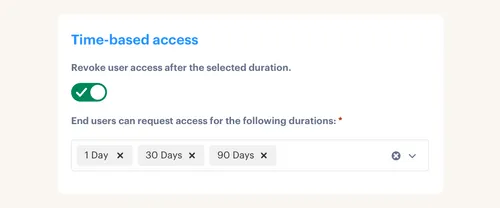
If elevated access can stay open past the intended window, your policy is just a nice sentence in a doc. The rule I use is simple: if temporary access lasts longer than 24 hours without automatic removal, you don’t have just-in-time access. You have delayed standing access. Harsh, maybe. Still true.
A fintech company like Stavvy saw this clearly. They had growth, acquisitions, sensitive data, and long-lived privileged access sitting around. Once they moved to time-bound access, they cut privileged access by 85% and automatically revoked more than 1,300 requests after approved windows ended. That’s what operational enforcement looks like. The policy became real because the expiry became automatic.
Evidence scattered across tools is evidence you don’t really own
You can’t improve audit readiness for access management if your proof lives in four places and none of them tell the full story. One system has the request. Another has the approval. Another has the provisioning action. Then someone pastes screenshots into a ticket and calls it complete.
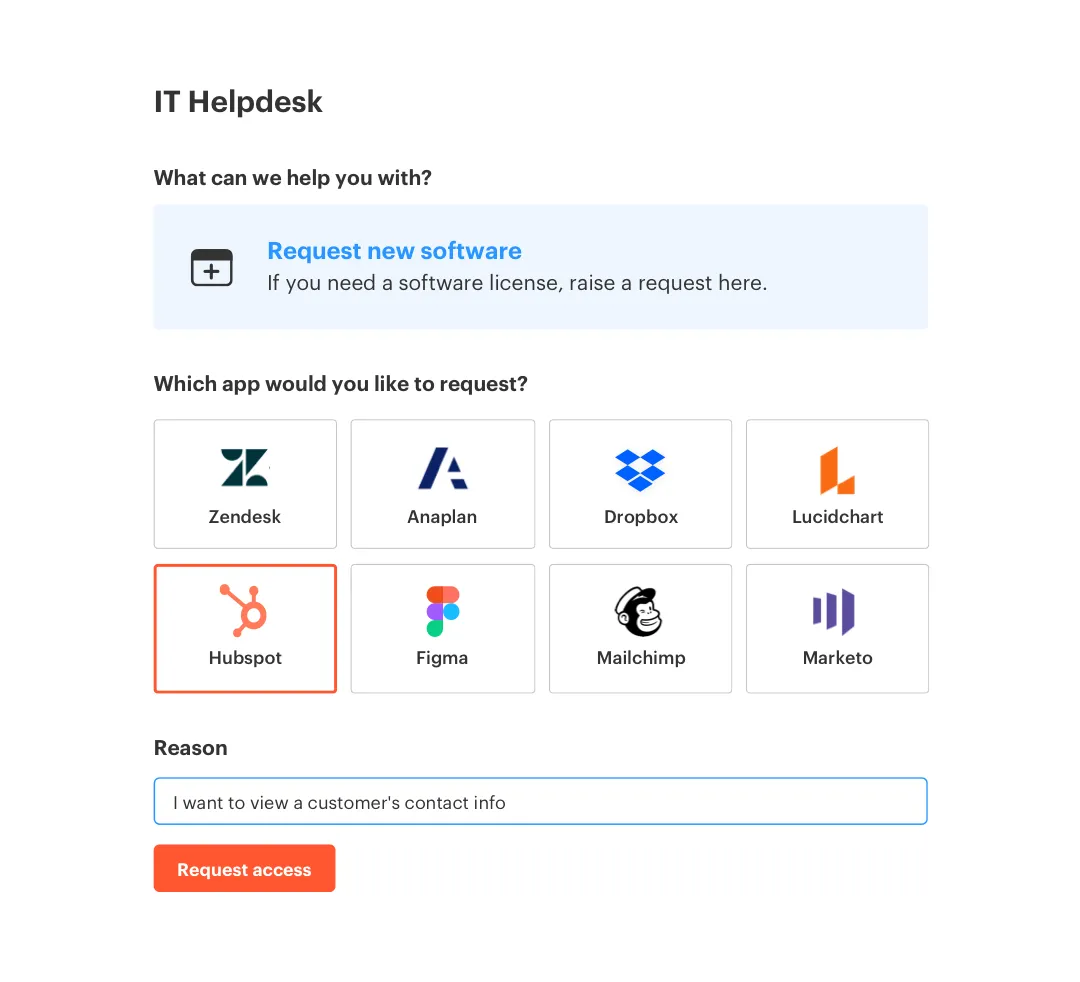
I get why teams do this. The status quo has merits. Jira is already there. Slack is where people answer fast. Okta or Entra is the source of truth for identities. Nobody wakes up and says, “Let’s create a fragmented mess.” It just happens. Tool by tool. Shortcut by shortcut.
But this is where the model breaks. If an auditor asks, “Who approved this, when was it granted, when did it expire, and where’s the evidence?” and you need a person to manually stitch that timeline together, the process is too fragile. That’s my Litmus Test for audit readiness. One ticket should tell the full story. If it can’t, you’re rebuilding history.
More portals rarely fix the bottleneck
A lot of teams respond to audit pain by adding another governance portal. On paper, that sounds reasonable. In practice, it often creates one more place people ignore.
A separate IGA layer can be useful in some environments, especially huge enterprises with specialized control needs. Fair point. But for mid-market and high-growth companies already running on Jira Service Management, the extra portal often adds training, context switching, and another sync problem. Meanwhile the actual work still starts in Jira and Slack. So the bottleneck stays alive.
That’s why the ITSM and IGA split is such a problem. You’re asking people to do governance in one place and work in another. Humans won’t keep that clean for long. Systems might.
So what’s the fix? You stop treating audit readiness like an after-the-fact reporting project and start treating it like workflow design.
How to Improve Audit Readiness for Access Management Without Slowing Everyone Down
You improve audit readiness for access management by making the ticket the system of coordination and the identity provider the system of execution. Approvals should happen where people already work, access should be time-bound by default, and evidence should be captured as a byproduct of the normal flow.
That sounds obvious. It isn’t how most teams operate.
Start with the 4-link evidence chain
Before you change tools or workflows, diagnose where your process breaks. I call this the 4-link evidence chain: request, approval, execution, revocation. If one link is missing, your audit trail is weak.
Ask these five questions:
- Can you point to a single record for every access request?
- Is the approver captured in that same record?
- Is the provisioning action tied back to that record automatically?
- If access is temporary, is expiry and removal recorded too?
- Can you export all of that without screenshots?
If you answer “no” to two or more, that’s your first threshold. Don’t add more policy yet. Fix the workflow. Honestly, this catches more issues than most formal readiness reviews because it focuses on what the team can actually prove, not what they intended.
Put temporary access on a clock by default
The fastest way to improve audit readiness for access management is to stop letting elevated access float around without an end date. You don’t need perfect governance everywhere on day one. You do need a hard rule for high-risk access.
My rule would be this: if the role touches production, customer data, finance systems, or admin rights, require a duration at request time. One hour, six hours, twenty-four hours. Pick the windows that match the risk. If a team can’t define an expiry for sensitive access, they probably shouldn’t auto-grant it.
This is where people push back. They’ll say extensions create friction during incidents. That’s a valid concern. But the better answer isn’t open-ended access. The better answer is reusable approval logic and easy extensions for previously approved access windows. Short friction beats long exposure.
Think of it like a visitor badge in an office. A badge that never expires stops being a visitor badge. It’s just permanent access with nicer branding. Same story here.
Route approvals where response time is highest
Approval speed matters because slow approvals create shadow processes. If managers take 18 hours to respond in email, people will find another way. They always do.
What I’ve seen work is simple: keep the approval anchored to the Jira issue, but deliver it in the tool people actually answer fast. Usually Slack. If the team already lives there, use it. If not, stay in JSM. The point is not the channel. The point is response behavior.
A good benchmark is this: if low-risk requests regularly wait more than 4 business hours for approval, your workflow is training employees to bypass it. That’s not just an efficiency problem. It becomes an audit problem because side-channel approvals leave weak evidence.
A high-growth company like VideoAmp felt this during onboarding. They grew from 100 to 500 employees, and repetitive access requests started flooding IT. Tuesdays became a mess. Not because the team didn’t know what to do, but because the requests lacked context and ownership was fuzzy. Once they centralized requests in a self-service catalog inside Jira Service Management, they processed 500+ app requests in six months and saved 70+ hours of IT productivity. Cleaner intake creates cleaner evidence. Every time.
Run reviews inside the system that already knows the context
Quarterly reviews are where a lot of teams pretend they’re audit-ready. Then the spreadsheet circus begins.
A better approach is to run reviews where user context, app scope, and revocation actions already exist. If the reviewer can see user attributes, group membership, last login, and a recommendation in one place, the decision quality goes up. If revocation then executes from that same workflow, the evidence gets stronger without extra admin work.
The conditional rule is pretty straightforward. If your reviewers need to cross-reference a spreadsheet with Jira tickets and your IDP console, the review is too manual to trust at scale. If they can review and revoke in one flow, you’ve got something far more defensible.
Not everyone agrees with this. Some security teams prefer exporting everything to a sheet because it feels flexible. And sure, for tiny app sets or one-off campaigns, that can work. But once you’re reviewing dozens of apps and hundreds of users, flexibility turns into drift. The sheet becomes the process. That’s when rubber-stamping creeps in.
Use license data as an audit signal, not just a finance signal
This one gets overlooked. Login activity isn’t only useful for SaaS cost control. It’s also a strong signal for access cleanup.
If someone hasn’t logged into an app for 30, 60, or 90 days, that should inform both reclamation and review decisions. Not automatically in every case. But it should move the conversation from “Do they still need it?” to “Why are we still carrying this access?”
That’s the surprising connection. License optimization and audit readiness are closer than most teams think. The same inactivity signal that saves money can also tighten least privilege.
A practical benchmark helps here. If more than 10% of your paid SaaS seats haven’t been used in 30+ days, you likely have an access governance problem, not just a procurement problem. Access gets granted too broadly, stays too long, and nobody closes the loop.
If you want to See how Multiplier works, look at it through that lens. Not as another admin tool. As a way to make the everyday workflow produce the compliance output you were going to need anyway.
How Multiplier Makes Audit Readiness Operational
Multiplier improves audit readiness for access management by keeping requests, approvals, provisioning, expiry, and review evidence tied to Jira Service Management instead of scattered across separate tools. That means the audit trail is built during the work, not recreated after.
Jira, Slack, and the identity provider stay in one loop
Multiplier’s Application Catalog gives employees a Jira-native place to request approved apps and roles, either in JSM or through the Slack app. That already cuts a lot of the mess because requests stop arriving through random channels. Then Approval Workflows route the decision to the manager, app owner, or a specific approver inside Jira and Slack, with the issue as the record.

Once approved, Multiplier uses Automated Provisioning via identity provider groups to make the change through Okta, Entra ID, or Google Workspace. That matters. The execution isn’t happening off to the side. It’s tied back to the Jira issue with status updates and comments for audit and troubleshooting. So the request, the decision, and the action are linked.
For teams trying to automate 75% or more of requests and run lean IT, that loop is the win. A company like Luno reported an 80% reduction in IT workload on access requests after moving routine approvals and provisioning into this kind of model.
Temporary access, reviews, and cleanup stop being manual chores
Multiplier’s Time-Based Access is probably the strongest lever here if your goal is tighter least privilege with cleaner evidence. Requesters choose a duration during submission. After approval, access is provisioned. When the window expires, Multiplier removes the mapped group membership through the identity provider and records the change in Jira. That’s a much stronger story for an auditor than, “We usually remember to take it away.”
Then you’ve got Access Reviews in JSM. Admins create campaigns, choose in-scope approved apps, assign reviewers, and let reviewers act from a dashboard that shows user details, groups, last login, and recommendations. When someone marks Revoke, Multiplier can remove the relevant identity provider group and document it with Jira tickets tied to the campaign. Cleaner review cycle. Better evidence trail.
And for teams getting hit by SaaS sprawl, Auto Reclaim adds another layer. It watches last-login data from the identity provider, applies inactivity thresholds and grace periods, warns users, and revokes access if they stay inactive. It’s only available on the Advanced edition, so it’s not universal. Still, it’s a good example of automation-first least privilege. The access that shouldn’t stay open doesn’t stay open.
If your team wants the governance layer to live inside the workflow you already trust, Get started with Multiplier.
A Cleaner Audit Starts With a Cleaner Workflow
Most teams don’t fail audits because they lack intent. They fail because their access process leaves too many loose ends.
If you want to improve audit readiness for access management, don’t start by asking how to package evidence better. Start by asking why the evidence is fragmented in the first place. When requests live in Jira, approvals happen where people respond, provisioning runs through the identity provider, and temporary access actually expires, the audit story gets a lot simpler. And a lot more believable.
That’s the real shift. Stop rebuilding proof after the fact. Build workflows that produce proof while the work happens.
Frequently Asked Questions
How do I set up time-based access for sensitive roles?
To set up time-based access in Multiplier, start by defining the roles that require temporary access. When users submit a request through the Application Catalog, they can select a duration for their access (like 1, 6, or 24 hours). Once the request is approved, Multiplier provisions the access and automatically sets a timer to revoke it when the time expires. This ensures that sensitive roles do not have prolonged access, minimizing security risks and maintaining compliance.
Can I automate access reviews in Jira?
Yes, you can automate access reviews using Multiplier's Access Review feature. First, create a review campaign in Jira Service Management, selecting the applications to include. Assign reviewers who will evaluate user access based on their roles and last login dates. Once the campaign is launched, reviewers can mark access as 'Keep' or 'Revoke' directly in Jira, and Multiplier will automatically handle the revocation and document the changes, making the process efficient and auditable.
What if my team struggles with slow approval times?
If your team faces slow approval times, consider using Multiplier's Approval Workflows. These workflows allow you to route approvals directly within Jira or Slack, ensuring that approvers receive notifications promptly. You can set default approvers for specific applications, which streamlines the process. Additionally, if approvals are consistently taking longer than four business hours, it might be helpful to analyze the workflow and make adjustments to improve response times.
When should I implement automated provisioning?
You should implement automated provisioning when your team is ready to streamline access management and reduce manual errors. Multiplier's Automated Provisioning feature allows you to automatically add or remove users from identity provider groups based on approved requests. This not only speeds up access for low-risk requests but also ensures that access is revoked automatically when it should end, helping maintain a secure environment and reducing the administrative burden on your IT team.
Why does evidence collection matter in access management?
Evidence collection is crucial in access management because it provides a clear audit trail for compliance and security. With Multiplier, all access requests, approvals, and provisioning actions are linked to Jira tickets, creating a unified record. This means that when auditors ask for proof of access, you can easily provide a complete history without having to piece together information from multiple systems. A strong evidence trail not only simplifies audits but also enhances your organization's overall security posture.


