


387 new employees in 8 months can break a clean access process fast. If you're trying to manage access during employee onboarding, transfers, and offboarding with Jira tickets, Slack messages, and identity provider changes happening in separate places, the problem isn't effort. It's the gap between the request and the actual access change.
Most IT teams don't fail because they don't care about least privilege. They fail because the process asks humans to remember too much. Approve the ticket. Add the Okta group. Comment back in Jira. Set a reminder to remove access later. Screenshot something for audit. Do that 200 times a month and something will get missed.
Key Takeaways:
- Access breaks when Jira, Slack, and your identity provider don't share the same workflow.
- The real goal isn't more policy. It's making least privilege the default path.
- If a request takes longer than 15 minutes to approve, look for ownership gaps before adding more process.
- Time-bound access should be mandatory for privileged roles, not a special exception.
- The cleanest audit trail is created while the work happens, not rebuilt later in spreadsheets.
Why Employee Access Breaks When Work Splits Across Tools
Employee access breaks when the request, approval, provisioning, and evidence live in different systems. Jira might capture the ticket, Slack might capture the decision, and Okta or Entra might hold the actual access. The handoff between those systems is where delays, standing privilege, and audit gaps show up.

The Real Bottleneck Isn't the Ticket Queue
A full ticket queue looks like the problem. It usually isn't. The real issue is that each ticket contains only part of the truth, so IT has to reconstruct the missing context before they can act. Who owns the app? Which role should this person get? Is the manager approval enough? Should it expire after a day, a week, or never?
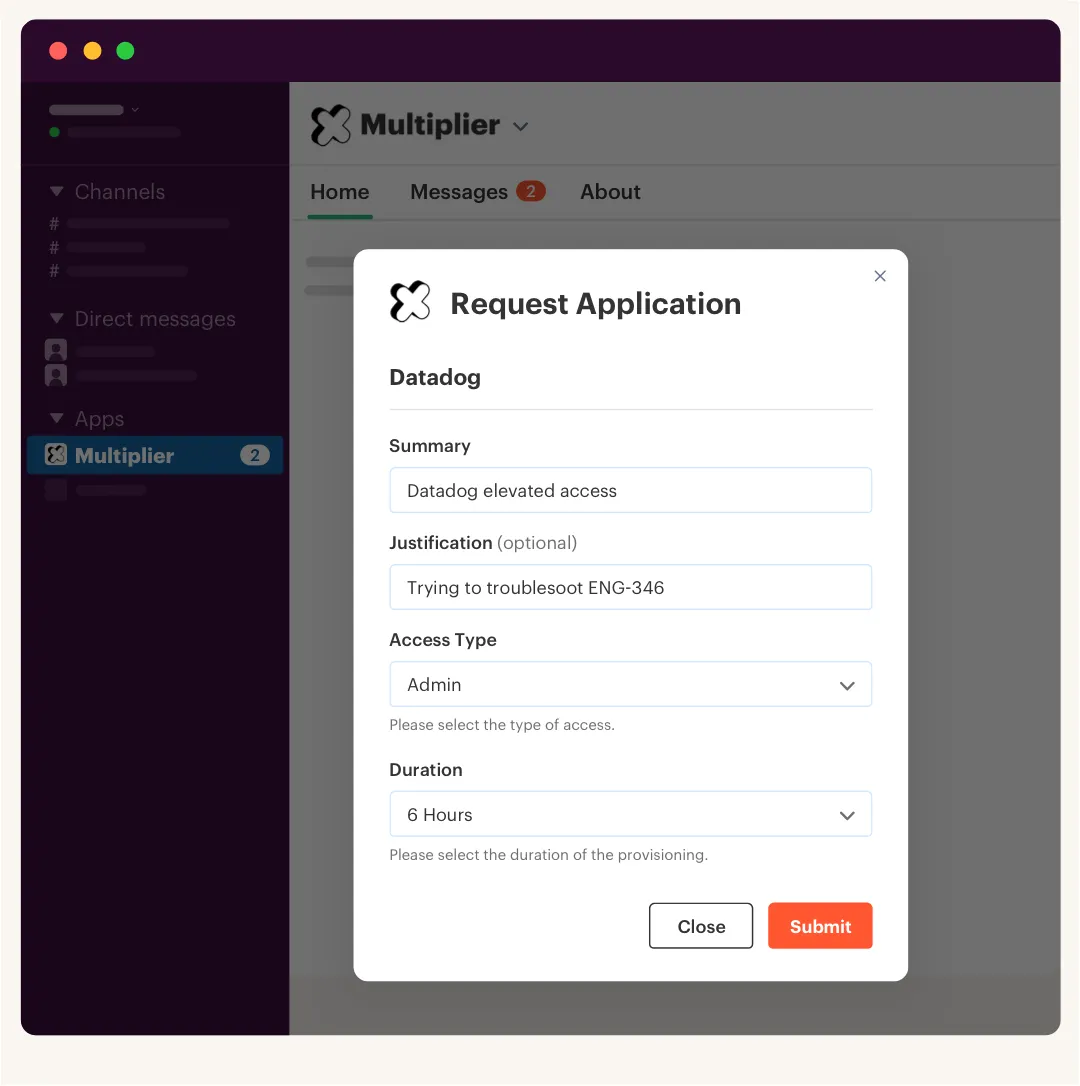
I've seen teams try to fix this by writing longer request forms. Fair instinct. More fields should mean more context. If the form doesn't map to the identity provider group though, the same manual work still happens after approval. Someone still has to open Okta, Entra, or Google Workspace and make the change by hand. That's where errors creep in.
Picture an IT admin at 8:47 AM on a Tuesday during onboarding week. The Jira queue shows 23 new tickets since last night, half of them saying "Need Salesforce access" with no role specified. The new revenue team started Monday, the manager is pinging in Slack, and the admin is toggling between Okta tabs trying to figure out whether this hire is a viewer, a standard user, or one of those weird regional admin roles someone created last quarter. Multiply that by 40 new hires and the queue becomes a guessing game with real downstream cost: blocked reps, annoyed managers, and an IT team that spends Tuesday morning playing detective instead of provisioning.
The threshold I'd use is simple: if more than 20% of access tickets require a follow-up question, your intake isn't structured enough to automate. Don't start by adding approvers. Fix the request shape first so every ticket contains the app, role, requester, approver, duration, and identity group mapping. Once that's there, the process can move fast without getting sloppy. If your Jira queue is already showing that pattern, the next useful move is seeing how a Jira-native access model handles the same flow. Learn more about Multiplier.
Policy-Heavy Least Privilege Usually Fails in Practice
Least privilege sounds clean in a policy document. In real life, it gets messy because every exception feels urgent. Engineers need production access during an incident. Finance needs a reporting tool before close. A new manager needs access to compensation data. Everyone has a good reason.
Security teams know the risk. The NIST access control guidance is clear that access should be limited, reviewed, and tied to real need. Operational enforcement is the part that breaks. If the only way to enforce least privilege is to ask IT to manually remove access later, you don't have least privilege. You have a calendar reminder with a failure rate.
There's a competing priority here, and it's real. Make access too hard and people route around the process. They ask a friend. They share data exports. They reuse admin accounts. Not because they're reckless, but because they have work to do. Security that blocks the business usually loses to workarounds.
The better rule: if access is high-risk, make it temporary by default. Not after a debate. Not after someone remembers. Default durations should be short enough that forgotten access can't sit around for months. For admin roles, start with 1, 6, or 24 hours. For normal business apps, use role-based access with periodic review. Different risk, different control.
Audit Evidence Should Be a Byproduct
Audits become painful when evidence is treated like a separate project. Someone exports tickets, checks Slack threads, pulls identity provider logs, and pastes screenshots into a spreadsheet. I don't know who decided screenshots were an operating model, but here we are.
The hidden cost is the rework. You already did the access work once. Then audit season asks you to prove it again. Who approved the request? Who made the change? Was access removed? Was the revocation completed, or just requested? If those answers aren't tied to the original Jira issue, audit evidence becomes archaeology. You're digging through layers of tools, trying to explain what happened months ago.
A practical test works well here: pick 10 access changes from last quarter and try to answer five questions in under 30 minutes. Who requested it? Who approved it? What group changed? When did it change? Was it later removed or reviewed? If you can't answer those without leaving Jira, your audit trail is fragmented.
That's the part most teams underestimate. The access problem doesn't end when the employee gets the tool. It ends when the system can prove the right person got the right access for the right amount of time.
How to Manage Access During Employee Changes Without Rebuilding the Process
To manage access during employee changes, start by making Jira the workflow record and your identity provider the execution layer. Jira should capture the request, approval, and evidence. The identity provider should make the access change. Slack can speed decisions, but it shouldn't become the system of record.
Diagnose Where Your Access Flow Actually Breaks
Before you change any tool, run a 50-ticket diagnostic. Pull the last 50 access tickets and sort each delay by cause: missing requester context, unclear app owner, slow approval, manual provisioning, or no cleanup path. Most teams jump straight to "we need automation," but automation just makes a bad process fail faster if the inputs are unclear.
What you're looking for is concentration. If 30 of the 50 tickets stalled because the approver was unclear, your first fix is ownership. If provisioning took 5 to 30 minutes per request because admins had to assign groups manually, your first fix is identity provider mapping. If old access never gets removed, your first fix is expiry and review. Sounds obvious, but teams skip this and buy workflow complexity instead.
Five questions to run before touching the workflow:
- Which app requests repeat every week?
- Which roles map cleanly to identity provider groups?
- Which approvals are actually needed, and which are habit?
- Which access types should expire automatically?
- Which audit questions are painful to answer later?
A company like Luno is a good example of the pattern. They grew to nearly 1,200 employees and saw access requests come through Slack, email, and Jira. IT had to chase approvals and manually assign Okta groups. Once they centralized requests and automated routine provisioning, they cut IT workload for access requests by 80%. The lesson isn't "automate everything." The lesson is to automate the repeatable work after you understand where the delay really lives.
Build the Catalog Around Roles, Not App Names
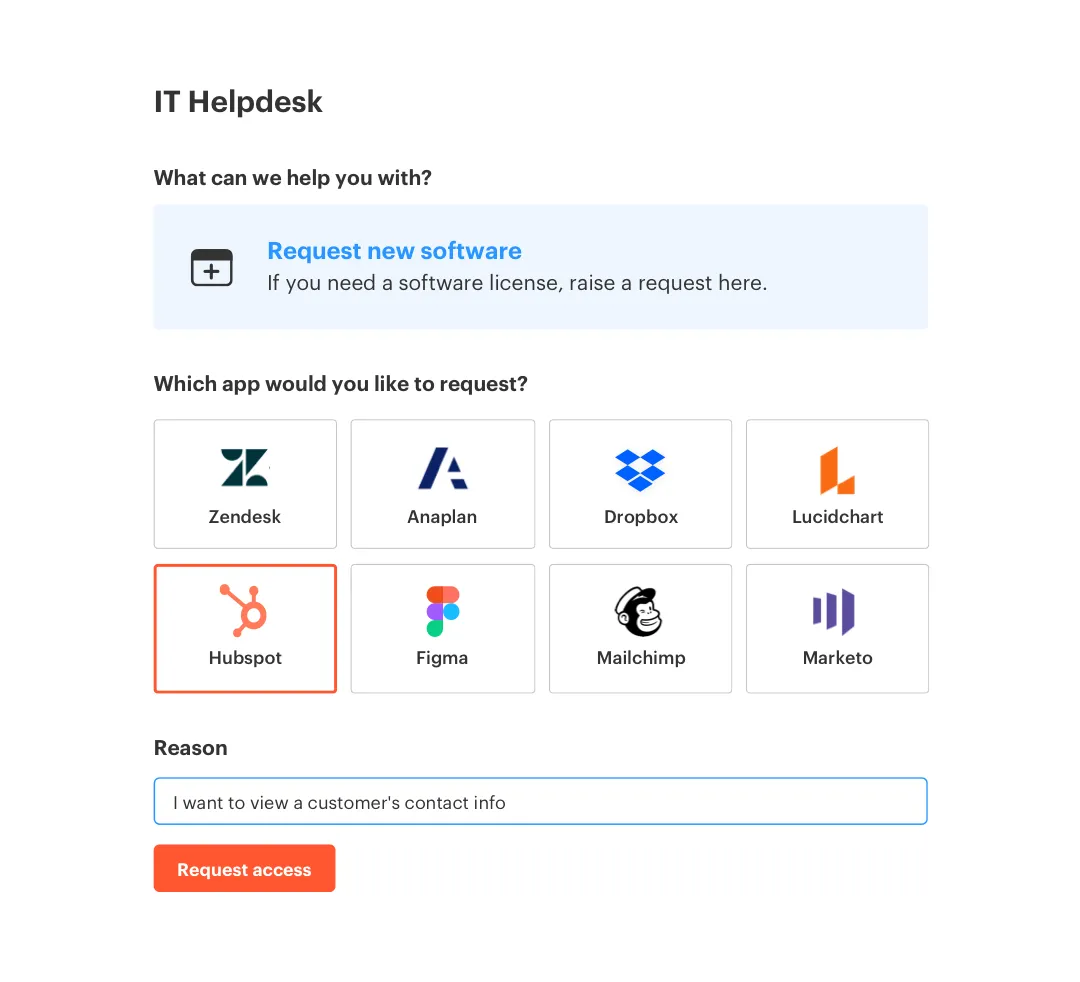
"Request Salesforce" is too vague. "Request Salesforce, Standard User, 30 days" is something IT can route, approve, and provision. That small shift matters because it turns a vague ticket into a deterministic workflow.
The role layer is where most access programs either get clean or stay messy. Employees think in app names. IT thinks in groups. Security thinks in risk. Finance thinks in licenses. The catalog has to connect all four without making the requester learn your identity architecture. Let the employee choose the thing they understand, then map that selection to the group and approval path behind the scenes.
A practical threshold: don't automate an app until at least 80% of its requests fit into known roles. If every request is custom, keep it manual until the pattern emerges. That's not a failure. It's restraint. Automating a messy entitlement model just creates faster cleanup later.
The before and after is easy to spot. Before: a requester writes "Need Figma" and IT asks three follow-up questions over two days, then manually adds the user to the right group, then forgets to comment back on the ticket. After: the requester picks Figma Editor from a catalog, chooses a duration if needed, and the ticket already knows who approves it and which group grants it. Less drama. Fewer Slack pings. Better evidence.
Route Approvals Based on Risk, Not Habit
Approval chains tend to grow because nobody wants to be the person who removed a gate. I get it. If something goes wrong, the safe move is to add another reviewer. Every extra approval adds latency though, and after a point, it doesn't add much control.
A better approval model starts with risk bands. Low-risk apps can be auto-approved or manager-approved. Business-critical systems should route to app owners. Privileged roles should require tighter approval and temporary access. If the request is for a standard role in a low-risk tool, don't make a director click a button just because the old spreadsheet did.
The rule I like: if an approval path takes longer than 15 minutes on average and rejects fewer than 5% of requests, that approval probably isn't doing real control work. A gate that never blocks anything is usually a delay wearing a security costume. Funny, but true.
There's a valid counterpoint. Some regulated teams genuinely need extra approvals because the business risk is higher, and reducing approvers there would be reckless. That's fair, and I wouldn't argue with a SOX-bound finance team about their dual-approval rule. The point isn't to remove approvals. It's to make each approval earn its place. To manage access during employee growth, approval design should match the risk of the role, not the anxiety of the last audit.
Provision Through the Identity Provider
The identity provider should be the place where access changes become real. Jira is great for intake, approvals, SLAs, and history. Slack is great for quick decisions. Neither should be the final authority on whether someone has access. That belongs in Okta, Entra ID, or Google Workspace.
Provision through identity provider groups and you get cleaner execution. The request maps to a group. Approval triggers group membership. SSO or SCIM pushes the entitlement to the app where supported. Removal works the same way in reverse. The causal chain is tight, which matters because access governance is really about reversibility. If you can grant access fast but can't remove it cleanly, you've only solved half the problem.
A simple rule before automating: if an app can be controlled through an identity provider group, automate the group change first. If it can't, keep the request and approval in Jira, but mark provisioning as manual so the evidence stays clean. Don't pretend manual apps are automated. That's how audit gaps happen.
The Verizon Data Breach Investigations Report keeps showing how much identity and human behavior matter in security outcomes. Access work feels like IT plumbing, but it directly shapes risk. A stale group membership is not just an admin cleanup item. It's a standing permission that may outlive the business need by months.
Make Temporary Access the Default for Elevated Roles
Temporary access is where least privilege becomes practical. Without expiry, every exception becomes permanent unless someone remembers to undo it. And people are busy. They forget. Or they leave the company. Or the ticket gets closed after provisioning and no one comes back to clean it up.
For elevated access, use time windows as the default. Start with short durations: 1 hour for incident response, 6 hours for project work, 24 hours for extended troubleshooting. If the same person needs more time, they can request an extension. That's much cleaner than granting admin access "for now" and hoping someone reviews it next quarter.
A fintech team like Stavvy made this shift after growth and acquisitions left long-lived privileged access in place. They needed access that fit their Atlassian workflow and met customer and compliance expectations. With time-bound access, they reduced privileged access by 85% and had more than 1,300 access requests automatically revoked after approved windows. That's the part I care about. Revocation actually happened.
One caveat matters. Temporary access only works automatically when the grant is controlled through identity provider group membership. If someone grants access directly inside a SaaS admin console and never ties it back to SSO or a group, expiry can't reliably remove it. Fix the control path first, then enforce the timer.
Review Access Based on Usage, Not Just a Calendar
Quarterly access reviews often become rubber-stamping because reviewers lack context. They get a spreadsheet with names and apps. Maybe a department. Maybe a title. Then they're asked to decide whether access is still needed. If they don't know, they keep it. Nobody wants to break someone's workflow.
Usage context changes the conversation. Last login, group membership, department, job title, and role all help reviewers make a real decision. If someone hasn't logged into an app in 90 days, that's a different review than someone who used it yesterday. If a person transferred from Finance to Sales and still has Finance systems, that's a signal.
The rule I'd use: any app with sensitive data or paid seats should have a review trigger based on usage or role change, not just quarter-end. Calendar reviews are useful, but they're blunt. Usage-based review catches waste and risk earlier.
Atlassian has been pushing more employee lifecycle work into Jira Service Management, including examples like Vuori's approach to lifecycle management in JSM. The larger pattern is clear in Atlassian's employee lifecycle writeup: companies want service management to own the employee workflow, not just the ticket. Access governance should follow the same direction. If your team wants to see what that looks like when Jira, Slack, and identity provider changes are connected, See how Multiplier works.
How Multiplier Automates Jira Access Governance
Multiplier automates Jira access governance by keeping requests, approvals, identity provider changes, and evidence tied to the same Jira issue. Employees use JSM or Slack to request access. Approvers decide in the same flow. The actual provisioning runs through Okta, Entra ID, or Google Workspace groups.
Jira-Native Requests With Identity Provider Execution
Multiplier sits between Jira Service Management and your identity provider. Employees request approved apps through an Application Catalog in JSM or Slack, choose the role they need, and submit the request. Behind the scenes, catalog roles map to identity provider groups, so the request isn't just a ticket. It's a structured access change waiting for the right approval.
That's the big shift. Instead of IT reading a ticket, finding the right group, making the change, and updating evidence manually, Multiplier provisions through the identity provider after the Jira workflow reaches the approved status. The ticket gets updated with the outcome, which gives IT a cleaner record when someone asks what changed and why.
The same model applies to approvals. Managers, app owners, or specific users can approve in JSM or Slack. For time-based access, the approved window starts after provisioning, then access is removed from the mapped identity provider group when the duration expires. The key limitation is worth saying out loud: automatic revocation depends on access being granted through identity provider group membership. If access was granted manually inside a SaaS app, it still needs a manual control path.
Reviews, Reclaims, and Lifecycle Changes Stay in Jira
Multiplier also handles access reviews in JSM, which is useful because review decisions and revocations belong near the original service workflow. Reviewers can see user attributes, groups, last login, and recommendations, then mark keep or revoke. When revocation is selected, the system removes the relevant identity provider group membership and creates Jira evidence around the change.

Auto Reclaim works differently, but the idea is similar. It uses last-login data from connected identity providers, applies inactivity thresholds and grace periods, then revokes access if the user stays inactive. It's available on the Advanced edition, and its accuracy depends on the identity provider having reliable login telemetry. No magic. Just a cleaner operating loop.
Post Functions cover lifecycle orchestration from Jira workflow transitions. During onboarding, a workflow transition can trigger identity provider actions like creating a user in Entra ID or adding the person to department groups. During offboarding, transitions can disable accounts or remove key group memberships. For teams already living in Jira, that's the point. The access work doesn't move to another portal.
If the earlier problem was 5 to 30 minutes per routine request, plus cleanup work later, the better outcome is a request that starts in Jira or Slack and executes through the identity provider with evidence attached to the Jira issue. That's how you manage access during employee growth without asking IT to become a human integration layer. When you're ready to connect the catalog, approvals, and identity provider flow inside Jira, Get started with Multiplier.
Start With the Workflow Your Team Already Uses
Access governance gets easier when the workflow matches how people already work. Jira captures the service record. Slack speeds the approval. The identity provider executes the change. When those three stay connected, least privilege stops being a policy people admire and starts becoming the normal path.
I wouldn't start with a giant governance redesign. Start with your 50 most recent access tickets. Find the repeated apps, unclear approvers, manual group changes, and stale access risk. Then automate the cleanest slice first. Because once the repeatable flow works, the rest gets a lot less wishy washy.
Frequently Asked Questions
How do I set up time-based access for new hires?
To set up time-based access for new hires using Multiplier, follow these steps: 1) In the JSM portal, create a request type for access that includes a field for duration (like 1, 6, or 24 hours). 2) When a new hire submits a request, they can select the duration for their access. 3) Once approved, Multiplier provisions the access and automatically sets a timer to revoke it when the time expires. This ensures that access is temporary by default, helping maintain least privilege and reducing the risk of long-lived access.
What if I need to revoke access for an employee who left?
If you need to revoke access for an employee who has left, you can do this easily with Multiplier. First, locate the Jira ticket associated with their access request. Then, you can either manually remove their group membership through your identity provider or, if the access was provisioned through Multiplier, simply mark the ticket for revocation. Multiplier will automatically handle the removal of their access from the relevant identity provider groups and document the change in the Jira ticket for audit purposes.
Can I customize the application catalog for specific teams?
Yes, you can customize the application catalog in Multiplier to suit specific teams. To do this, go to the JSM portal and access the Application Catalog settings. Here, you can add or remove applications based on team needs and set visibility controls. While filtering by department is not yet supported, you can manage which apps are visible by marking them as 'Approved' or 'Manual Provisioning Required'. This helps ensure that each team has access to the tools they need without overwhelming them with unnecessary options.
How do I automate access reviews with Multiplier?
To automate access reviews using Multiplier, start by creating a review campaign in the Access Reviews section of JSM. Select the applications you want to include (only those marked as 'Approved'), and assign reviewers for each app. Once the campaign is launched, reviewers will receive notifications and can easily mark access as 'Keep' or 'Revoke' directly within JSM. Multiplier will handle the revocation process automatically, ensuring that all changes are logged and documented for audit purposes, streamlining your access governance.


