


90-day growth spurts break access workflows fast. And if you're trying to streamline access requests and governance with a separate IGA portal bolted onto Jira, you're probably making the mess worse, not better.
Most teams think the bottleneck is approvals. I don't buy that. The real drag is the split between where work starts, where decisions happen, where provisioning happens, and where evidence gets rebuilt later for audit.
Key Takeaways:
- If access starts in Jira, governance should stay in Jira
- The real problem isn't ticket volume, it's tool fragmentation
- If you want to streamline access requests and approvals, reduce handoffs before you add policy
- Time-bound access works best when revocation is automatic, not calendar-driven
- Access reviews should run where your service workflows already live
- License waste drops when inactivity rules trigger action, not just reporting
- Separate portals create admin work twice: once for the request, once for the evidence
Why Separate Governance Tools Slow Access Down
Access requests slow down when intake, approval, provisioning, and evidence live in different places. Sounds manageable on a slide. In real life, it behaves more like a bad relay race: the baton gets dropped every time the workflow leaves the lane. One request becomes four systems, three follow-ups, and one future audit problem nobody volunteered for.

Picture a normal Tuesday at 8:14 AM. A new engineer needs GitHub, AWS, Jira, and one elevated role for a production issue. The request starts in Jira. Manager approval happens in Slack or email. Somebody in IT checks Okta or Entra, figures out which group maps to the right role, makes the change manually, then adds a note back to the ticket. Three hours later the engineer is still blocked, the IT admin is annoyed, and six months from now an auditor will ask for proof nobody can pull cleanly. That's four systems for one request. You feel that drag every week, even if nobody has named it yet.
The old argument for a separate IGA layer isn't dumb. If you're a massive enterprise with dense policy requirements, dedicated governance staff, and the patience for long rollouts, a separate suite can absolutely make sense. That's a fair exception. But that's not most mid-market and high-growth teams. Most need to streamline access requests and reviews without training employees on another portal and without creating a second job for the people already buried in Jira queues.
The hidden tax is context switching
Four screens is where the pain usually starts. I call this the 4-Screen Rule: if a standard request requires four screens or more to complete, automation usually pays back faster than another approval tweak.
Here's the practical version. If your team touches Jira, Slack or email, the IDP, and a spreadsheet or side note for evidence, you're already over the line. Then cycle time drifts from minutes into hours, and hours into days. Not because any single step is hard. Because handoffs kill momentum.
A fast-growing fintech team ran into exactly this. Hundreds of routine access requests were coming in through Slack, email, and Jira. IT then had to chase approvals and manually assign Okta groups. After centralizing requests and automating the flow, they cut IT workload on access requests by 80%. That's not a cosmetic win. That's the difference between a lean team coping and a lean team getting buried alive.
Reduce screens before you add policy. That's the move.
Audits get messy because evidence is an afterthought
Ever notice how audit pain seems to show up all at once? It doesn't. It starts quietly, months earlier, the first time someone approves access in Slack and the workflow never captures that decision cleanly.
According to NIST's access control guidance, access decisions, least privilege, and reviewability reinforce each other. That's the mechanism people miss. When the approval trail and the provisioning trail don't line up, the control may exist in theory, but the evidence doesn't exist in a form anyone trusts.
And that's why rebuilding evidence in spreadsheets is such a bad sign. You're not documenting a clean process. You're doing forensic reconstruction after the fact, like trying to recreate a deploy from chat logs instead of version control. It looks official. It feels responsible. It's still audit theater.
If you want to Learn more about Multiplier, run one simple test first: pull your last 20 requests and ask how many would survive an auditor's questions without screenshots, Slack archaeology, or somebody's memory filling in the gaps.
Standing access becomes the lazy fix
Fast workflows produce precise access. Slow workflows produce standing access. That's the trade most teams make, whether they admit it or not.
This is the part people rarely say out loud. When request flows are clunky, employees get broad access up front, revocation slips, and elevated groups become semi-permanent because removing them feels like one more task for next week. Then next week becomes next quarter. Then it becomes your risk posture.
According to Verizon's Data Breach Investigations Report, credential abuse and privilege misuse keep showing up in breach patterns year after year. Slow manual governance doesn't just waste time. It widens blast radius.
So no, the real issue isn't that employees ask for too much access. The real issue is that your workflow makes precise access too expensive to manage. Once you see that, the next question gets sharper: where exactly is the bottleneck hiding?
The real bottleneck is the ITSM and IGA split
The bottleneck isn't approvals by themselves. It's the split architecture. Jira handles intake. Slack or email handles decisions. The identity provider handles the actual change. Then some poor soul has to reconcile everything later. That's the root cause.
Most teams try to streamline access requests by improving one step. Faster approvals. Better forms. More detailed policy. Helpful, sure. But if the workflow is still split across tools, you're polishing a broken chain. What matters is end-to-end continuity.
There's a simple model for this. I call it the Same-Record Principle: the request, the approval, the change, and the evidence should all tie back to one record. If they don't, your process drifts. If they do, governance gets dramatically easier to run.
The request system should also be the governance system
A high-growth advertising company learned this the hard way during onboarding. They were scaling from 100 to 500 employees, and every Tuesday the IT queue filled with repeat app requests, vague descriptions, and ownership confusion.
Employees already know where to go for IT help. That's usually Jira Service Management. Force them into another portal for app access and adoption drops faster than people expect. Then come the side-channel requests. Slack pings. DMs. The classic "can you just do this one manually?"
Once that company launched a self-service app catalog inside Jira Service Management, they processed 500+ app requests in six months and saved 70+ hours of IT productivity. Same employees. Same apps. Very different system behavior.
Convenience beats policy more often than policy people want to admit. If governance lives outside the place employees already work, the workflow leaks.
Approval speed depends on proximity, not pressure
What gets approved faster: a request sitting in the flow of daily work, or one buried in a side portal approvers barely open? You already know the answer.
Most approval chains don't fail because approvers are careless. They fail because the request lands too far away from normal work. Email gets buried. Another portal gets ignored. A separate dashboard becomes tab number 19.
Slack-first work patterns made this even more obvious. People respond in chat because chat is where the day is happening. That's why approval proximity matters more than approval pressure. If the decision lands where people already work, it moves. If it lands in a side system, it stalls. Simple.
According to Atlassian's research on service management adoption, teams move faster when service workflows are embedded where people already collaborate. Cleaner response. Fewer dropped approvals. Better traceability. Same humans, less friction.
Pressure doesn't fix distance. Placement does.
Provisioning should follow authoritative group logic
Manual provisioning works right up until it doesn't. Then headcount doubles, contractors pile in, auditors want proof, and suddenly the whole thing feels held together with comments and hope.
Provisioning through the identity provider changes the shape of the process. It creates one authoritative path for group assignment, one place to reverse access, and one evidence chain back to the request. That's why I'd frame the real choice differently: not portal or no portal, but authoritative workflow or swivel-chair workflow.
There are exceptions here, and they matter. Some non-SSO apps still need manual handling, and some ugly edge cases won't fit neat group mappings on day one. Fair. But the rule should still be crisp: if an app can be governed through IDP groups, it should be. If it can't, track it in the same service workflow anyway so the approval and evidence stay attached to the same record.
One record. One system of work. One authoritative change path. That's the architecture that scales, which raises the practical question: what does good actually look like day to day when you want to streamline access requests and approvals?
What streamlined access requests actually look like
Streamlined access requests aren't just faster tickets. They're a different operating model. The goal isn't to move approvals around a little quicker. The goal is to make least privilege the easy path, not the heroic path.
When teams get this right, the pattern is pretty consistent. Intake gets centralized. Decision logic gets standardized. The identity change gets automated. Evidence stops being a separate project. Boring, in the best possible way.
Start with a maturity check before you automate
Before you automate anything, figure out which bucket you're in. I call this the Access Friction Spectrum, and it matters because the wrong first step can burn an entire quarter.
If you're under 50 access requests a month, manual work may still be annoying but survivable. Between 50 and 200, delays usually show up first in onboarding, offboarding, and role changes. Over 200 monthly requests, the process either gets standardized or it starts breaking in public.
Ask yourself four questions:
- Do requests come in through more than two channels?
- Does IT manually map roles to groups more than 10 times a week?
- Can you prove expiry and revocation without chasing screenshots?
- Do employees wait more than one business day for standard app access?
If you answered yes to two or more, you're past the point where cleanup alone will save you. You need workflow consolidation. That's usually the moment teams stop debating and actually streamline access requests and approvals instead of talking about it.
Build a request path with role clarity up front
Before: "Need access to Figma." After: "Need Figma Editor for 30 days." That's the whole game in one example.
A clean request path starts with a catalog, not a free-text ticket. Employees choose from sanctioned apps, select the right role, and submit with the right context already attached. That cuts the back-and-forth that bloats queues and burns reviewer attention.
This only works if role mapping is specific. If an app has three common levels of access, define the three. If it has one safe default and one elevated role, separate them. Here's the threshold I use: if a reviewer has to ask "what exactly are they asking for?" on more than 15% of requests, your request design is broken.
The vague version forces manual interpretation. The specific version becomes a real governance object. You can approve it, provision it, review it, and revoke it. Manual interpretation doesn't scale. It just hides the scaling problem for a while.
For a closer look at how this plays out in Jira, See how Multiplier works.
Route decisions to owners, not to whoever shouts loudest
Who should approve access: the person with accountability, or the person closest to the queue? Sounds obvious. Yet generic IT queues still get used as the decision layer all the time.
The better rule is conditional. If the access is low-risk and pre-approved, auto-approve it. If it's application-specific, route it to the app owner. If it's role-sensitive or elevated, route it to the manager or designated owner. If it's short-lived privileged access, pair approval with duration by default.
This is where policy-heavy setups often go sideways. They write elegant policy docs, then ask humans to remember the logic in the moment. That never scales well. Automation-first least privilege wins because it converts judgment into workflow logic. Not all judgment. Enough judgment.
A fintech company tackling privileged access used this model to cut privileged access by 85%, with 1,300+ access requests automatically revoked after approved windows. That's what happens when the workflow remembers what the humans shouldn't have to.
Make time-bound access your default for elevated roles
Permanent admin access is usually a workflow failure wearing a convenience mask.
If the role is elevated, set a duration at request time. One hour. Six hours. Twenty-four hours. Pick the window that fits the risk and use case. If the access doesn't need to exist forever, don't grant it forever.
The threshold I like is blunt on purpose: if an entitlement is admin, production, financial, or customer-data related, it should be time-bound unless someone can name a strong operational reason not to. And if it isn't provisioned through IDP group membership, don't pretend auto-revocation exists. It doesn't. Not really.
Some teams worry this creates friction during incidents. Fair concern. In a real incident, speed matters. But the better pattern is controlled extension, not permanent elevation. Yes, you may add one extra field to the request. You also remove weeks or months of unnecessary exposure after the task is done.
Run reviews where the evidence already lives
Reviews inside the workflow feel operational. Reviews outside the workflow feel like paperwork cosplay.
Access reviews break when they become a separate compliance project. The spreadsheet gets exported. Owners rubber-stamp rows. Revocations get tracked somewhere else. Then everyone acts surprised when exceptions pile up and nothing actually gets removed.
Reviews work better inside the same system as requests and approvals because the reviewer gets context: group membership, job title, department, last login, and a clear recommendation. Then the revoke action can flow through the same governance path instead of becoming another ticket nobody wants.
If you run quarterly reviews, use a simple cut line. Any app with more than 25 users or elevated access should be in scope. Any user inactive for 90+ days should trigger scrutiny. That won't catch every oddball case. It will catch enough to streamline access requests and reviews without turning the exercise into a quarterly spreadsheet ritual.
A review that doesn't execute revocation is just a meeting with receipts.
How Multiplier keeps the workflow inside Jira
Multiplier keeps access governance in Jira Service Management, which is where a lot of teams should've started in the first place. Instead of sending employees into a separate portal and then stitching the record back together later, it lets the request, approval path, provisioning action, and audit trail stay tied to Jira.
A catalog and approval path people will actually use
Multiplier's Application Catalog gives employees a Jira-native self-service place to request sanctioned apps and roles through JSM or Slack. Apps can sync from Okta, Entra, and Google Workspace, and only apps marked Approved appear in the catalog. That matters because random intake becomes controlled intake.

Then Multiplier's Approval Workflows route the decision to the right person inside Jira or Slack. Admins can map approval statuses, set default approvers, and override per app with the app owner, the requester's manager from the IDP, or a specific user. That cuts the "who owns this?" delay that slows standard access work.
This also means you can streamline access requests and approvals without creating a new place for employees to learn. Same service desk. Same ticket record. Less confusion.
Provisioning and revocation that follow the same record
Once a request is approved, Multiplier can use Automated Provisioning via Identity Provider Groups to make the change through Okta, Entra, or Google Workspace. That's a big deal because the identity provider stays authoritative. The role maps to one or more groups, the workflow hits Approved, and the system makes the group change while writing comments back to Jira for evidence and troubleshooting.
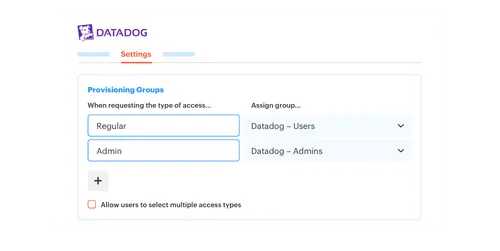
For elevated roles, Time-Based Access adds the missing enforcement layer. A requester can choose a duration like 1, 6, or 24 hours. After approval, access is granted through the mapped IDP group and removed automatically when the timer expires. That's how least privilege becomes operational instead of theoretical.
Multiplier won't magically auto-remove purely manual or non-SSO grants. Worth being clear about that. But for group-based access, it closes the loop cleanly.
Reviews, lifecycle work, and license cleanup without spreadsheet rebuilds
Multiplier also handles Access Reviews inside JSM. Admins create campaigns, choose in-scope Approved apps, assign reviewers, and let reviewers act from a Jira-native dashboard with user attributes, groups, last login, and recommendations. Keep or revoke. Then the revocation can be executed and documented in the same flow.

For broader identity lifecycle work, Post Functions let teams trigger no-code actions from Jira workflow transitions. That can cover steps like creating a user in Entra during onboarding, updating attributes in a transfer, or disabling accounts in offboarding. Different use case than ad hoc app requests. Same core benefit. The identity work stays tied to the issue.
And if SaaS waste is showing up in your budget, Auto Reclaim uses IDP login telemetry to identify inactive users, warn them, and revoke access after a grace period if they stay inactive. That feature is limited to the Advanced edition, and it depends on accurate last-login data from the IDP. Still, for the right environment, it's a clean way to cut license waste without monthly spreadsheet hunts.
If you want to Get started with Multiplier, the pitch is pretty simple: you don't need another portal to get stronger governance. You need the workflow you already trust to actually finish the job.
Why Jira-native governance is the cleaner path
If you're trying to streamline access requests and governance, don't start by adding another layer of software between Jira and the actual work. Start by removing the split that created the mess in the first place.
Identity governance belongs in Jira for a very practical reason. That's where the request already starts, where teams already collaborate, and where the record already matters. Once approvals, provisioning, time limits, reviews, and evidence all tie back to that same record, the process gets faster and the control gets stronger.
That's the part most people miss. Better governance doesn't come from wrapping more policy around a fragmented workflow. It comes from making the right workflow easier to run every single day. Cleaner architecture, cleaner evidence, faster access. That's the whole thing.
Frequently Asked Questions
How do I set up automated access provisioning?
To set up automated access provisioning with Multiplier, follow these steps: 1) Ensure your identity provider (like Okta or Azure AD) is connected to Multiplier. 2) Use the Application Catalog in Jira Service Management to display sanctioned apps for your team. 3) When a request is approved, Multiplier will automatically provision access based on the mapped identity provider groups, eliminating manual steps. This streamlines the process and ensures that access is granted quickly and accurately.
What if I need to revoke access for inactive users?
You can manage inactive users using Multiplier's Auto Reclaim feature. Here's how: 1) Set inactivity thresholds for your applications, such as 30 days without login. 2) Multiplier will automatically notify users who exceed this threshold, giving them a chance to log in. 3) If they remain inactive after the grace period, Multiplier will revoke their access and generate a Jira ticket documenting the change. This helps optimize your SaaS spend and maintain security.
Can I create custom access request workflows?
Yes, you can create custom access request workflows using Multiplier. Start by: 1) Defining the roles and access levels for each application in the Application Catalog. 2) Setting up Approval Workflows to route requests to the appropriate approvers based on the app or role. 3) Using Jira automation to enforce specific rules for approvals, ensuring that the right people are involved in the decision-making process. This customization helps streamline access management tailored to your team's needs.
When should I run access reviews?
You should run access reviews regularly, ideally every quarter, to maintain security and compliance. To do this with Multiplier: 1) Create an Access Review campaign in Jira, selecting apps that are marked as Approved. 2) Assign reviewers who can make informed decisions based on user attributes and last login data. 3) Monitor the progress through the Jira dashboard, ensuring timely revocations for inactive users. This process keeps your access management efficient and audit-ready.
Why does my team need time-based access?
Time-based access is essential for minimizing security risks associated with elevated roles. By using Multiplier's Time-Based Access feature, you can: 1) Set a specific duration for elevated access requests, such as 1, 6, or 24 hours. 2) Automatically revoke access once the time expires, reducing the chances of unauthorized use. 3) This approach helps enforce least privilege principles and ensures that users only have access when they truly need it.


