


Mobile access requests don't fail because your IDP integration is weak. They fail because the approval, provisioning, expiry, and audit trail all live in different places, and your mobile workforce feels that mess first.
If you've got employees requesting access from phones, approving in Slack, filing Jira tickets, and waiting on IT to update Okta or Entra, your idp integrations for mobile are only solving half the problem. The identity provider knows who the user is. Great. But it doesn't always know why the access was requested, who approved it, how long it should last, or whether the audit evidence is clean enough to survive review.
And that's where teams get stuck. They think they need tighter IDP plumbing. Most of the time, they need a better access workflow around the IDP.
Key Takeaways:
- IDP integrations for mobile access only work when request, approval, provisioning, expiry, and evidence stay connected.
- Mobile-first access breaks fastest when approvals happen in chat but provisioning happens later in a separate admin console.
- Time-bound access is the cleanest way to enforce least privilege without slowing down employees.
- If a request needs more than 2 manual handoffs, it probably shouldn't be automated yet.
- Jira can become the access governance layer if the identity provider remains the system that actually grants access.
- The goal isn't more portals. It's fewer places where access decisions can get lost.
Why Mobile IDP Integrations Still Break Access Governance
Mobile IDP integrations break access governance when they authenticate users but don't control the full access workflow. The problem usually shows up after approval, when IT still has to assign groups, track expiry, and gather evidence by hand. Authentication worked. Governance didn't.

Authentication Is Not the Same as Access Control
A lot of teams treat IDP integration like the finish line. Connect Okta, connect Entra, connect Google Workspace, done. I get why people think this way, because identity providers are the source of truth for users and groups, and in most companies that feels like the official control point.
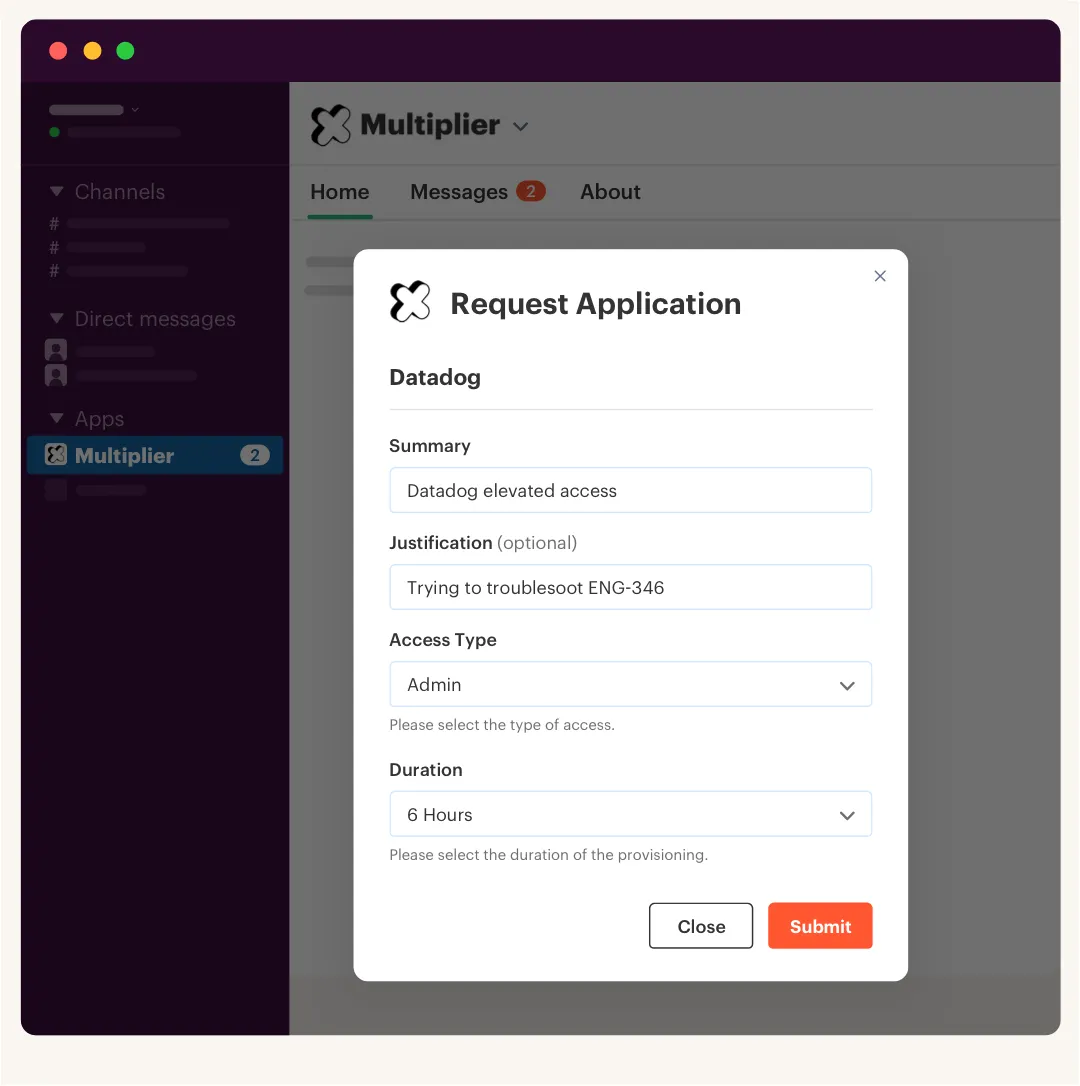
The real access request doesn't start in the IDP. It starts with someone needing Figma, GitLab, Salesforce, Snowflake, or admin access while they're away from their desk. Maybe they're on a phone. Maybe they're responding to an incident. Maybe they're onboarding into a new role and just need the right tools to do the job. The IDP can grant the access, but it doesn't naturally carry the business context unless your workflow gives it that context.
A simple check catches this fast. Pull 10 access requests from last month. For each one, ask: who requested it, who approved it, what group changed, when should it expire, and where would an auditor see that proof? If you can't answer all 5 from one record, your idp integrations for mobile are really just login plumbing.
That hurts a bit. But it's useful.
Mobile Work Makes the Gaps Obvious
It's 9:40 PM on a Tuesday. A security engineer is on her phone in an Uber, trying to get temporary database access during a Sev-2 incident. She drops a request in #sec-oncall on Slack. Her manager hits the thumbs-up from his couch six minutes later. IT sees the message at 11:14 PM, opens Okta, adds her to a privileged group, and types "will remove in AM" in a personal note. Tomorrow becomes Friday. Friday becomes next week. The group membership outlives the incident by 23 days.
Nobody was careless. The process was just built for a slower world.
Mobile access is like airport boarding. The passenger can have a valid passport, a boarding pass, and a seat assignment, but if the gate agent is checking 3 different systems while the jetbridge attendant waits for a paper manifest, the line still backs up. Your IDP proves identity, Jira tracks the request, Slack captures the decision, and the failure point is the handoff between them, not the systems themselves.
For mobile IDP integrations, the rule is pretty simple: if the approval happens on mobile, the provisioning path needs to move without someone opening an admin console. Otherwise you've just made the request easier while leaving the hard part untouched. That creates a weird outcome where employees feel like access is modern, and IT still feels like it's doing manual cleanup at 11 PM.
A team evaluating Jira-native access workflows should look at how the request record drives the IDP change, not just whether the IDP connection exists. If that Jira-to-IDP path is where you're stuck, Learn more about Multiplier in the context of request-driven provisioning rather than another standalone access portal.
The Hidden Cost Is Standing Privilege
Standing privilege is what happens when temporary access becomes permanent because revocation depends on memory. It rarely starts as a big security decision. It starts as a small operational shortcut, repeated 50 or 500 times.
At Stavvy, the issue was long-lived privileged access after funding growth and acquisitions. Their team moved to time-bound access and reduced privileged access by 85%, with more than 1,300 access requests automatically revoked after approved windows. The interesting part isn't the number. It's the mechanism. Access was granted when needed, then removed when the approved window ended, without an IT engineer remembering to do it.
That pattern matters for mobile teams because mobile requests are often urgent. Urgency creates exceptions. Exceptions create standing access. Standing access becomes a compliance problem later, usually when nobody remembers why the permission exists.
If access is temporary by default, the whole conversation changes. You stop asking, "Can we trust this person forever?" You start asking, "Do they need this for 1 hour, 6 hours, or 24 hours?" That's a much better question, and it's the one your next auditor actually wants you to answer.
How to Make IDP Integrations Work for Mobile Access
IDP integrations for mobile access work when the service workflow owns the request logic and the identity provider owns the actual entitlement change. Jira should capture intent, approval, policy, and evidence. The IDP should execute group membership changes. Mixing those roles creates the mess.
Diagnose the Workflow Before Automating Anything
Before you automate a single thing, run this diagnostic on your last 25 access tickets. Sort them into 3 buckets: fully repeatable, approval-dependent, and messy. Fully repeatable means the app, role, approver, and IDP group are obvious. Approval-dependent means the path is clear, but a human needs to say yes. Messy means the request lacks context, ownership is unclear, or the app isn't connected to SSO.
The rule: automate bucket 1 first, structure bucket 2 next, and leave bucket 3 manual until the policy is clearer. Trying to automate messy requests too early just creates faster confusion. I've seen teams do this and then blame the tool, when the actual problem was that nobody knew who owned the app or what "admin access" really meant.
A good first-pass audit should answer:
- Which apps get requested at least 10 times per month?
- Which roles map cleanly to identity provider groups?
- Which requests need manager approval versus app owner approval?
- Which entitlements should expire automatically?
- Which apps can't be automated because provisioning is manual or non-SSO?
If you can't map a role to a group, don't automate it yet. Map it first, and the IDP turns into the execution layer instead of a manual admin screen. Skip that step, and you'll automate confusion at speed.
Route Approvals Where People Already Respond
The best approval workflow is the one people actually use. For a lot of IT and security teams, that means Slack and Jira, not a separate governance portal that employees forget exists after onboarding. A dedicated IGA portal does make sense for organizations with a 10+ person identity team, an 18-month rollout window, and the political muscle to force adoption across business units. Most mid-market teams have none of those. Pretending otherwise is how shelfware happens.
Mobile access makes this painfully obvious. If your approver is on a phone between meetings, a clean Slack approval with the right context beats a portal login every time. The catch is that Slack can't become the system of record by itself. A thumbs-up in chat is not enough if the Jira ticket, IDP group change, and audit trail don't all connect back to the same request.
Use a simple threshold. If an access request is low-risk and the role is mapped to a known group, route approval to the manager or app owner and provision after approval. If the request is high-risk, like production admin or sensitive data access, require explicit approval and time-bound duration. If ownership is unclear, don't route it through a generic IT queue. Fix ownership first.
At Synthesia, access requests were running through Slack channels and Notion boards while the company grew from 100 to over 400 employees. The team eventually processed 3,800+ access requests in a year with 75% fully automated. A 4-person IT Ops team supporting 420+ employees is the kind of ratio that only works when approvals don't depend on chasing people down in DMs.
Mobile approvals are not the enemy. Unanchored approvals are.
Make Group Mapping the Operational Backbone
Group mapping is where access governance gets real. A request can look clean in Jira and get approved in Slack, but the actual entitlement only changes when the user gets added to the right group in Okta, Entra, or Google Workspace. That's why idp integrations for mobile access need deterministic group mappings, not vague instructions in a ticket comment.
The working model is straightforward. Each app role maps to one or more identity provider groups. Viewer maps to one group. Editor maps to another. Admin maps to a higher-risk group with a stricter approval path. Once the request hits approved status, the workflow changes the group membership and logs the result against the original ticket.
The conditional rule is simple: if the same app role is requested more than 5 times per month and the group mapping has been stable for 60 days, automate it. If the mapping changes every week, pause and clean up the identity model first. Automation makes stable processes faster. It makes unstable processes more visible, which can feel like failure if you weren't expecting it.
Luno is a good example of the workload hiding inside group changes. Their IT team had hundreds of routine access requests coming through Slack, email, and Jira, and agents were manually assigning Okta groups after approvals. After moving to a self-service app store with automated provisioning, they cut IT workload on access requests by 80%. Requests that used to take 5 to 30 minutes each stopped eating the queue.
That's the part people underestimate. The value isn't faster access. It's fewer tiny interruptions that break the whole day.
Put Expiry Into the Request, Not the Cleanup List
Time-bound access should be part of the original request, not something IT remembers later. If someone needs elevated mobile access for an incident, a vendor task, or a short project, the duration should be chosen upfront and enforced automatically through the IDP group membership.
This is where least privilege becomes operational instead of philosophical. A policy document can say access should be temporary. Fine. Unless the workflow removes the group membership when the window ends, the policy depends on someone doing cleanup work after the urgent moment has passed. And people forget. Not because they don't care, but because the queue moves on.
Use duration defaults based on risk. For production admin, start with 1 hour. For sensitive data access, 6 or 24 hours might make sense. For project-based access, use a defined date or review cycle. If someone needs an extension and the original approval already covers the work, let the extension path be clear rather than forcing them to open a messy duplicate request.
A practical rule works well here:
- 1 hour for break-glass or incident access.
- 6 hours for operational tasks that need focus time.
- 24 hours for short project work.
- 7 days or more only when an app owner can justify it.
- Permanent access only for role-based baseline tools.
Without expiry, mobile access becomes a privilege leak. With expiry, it becomes just-in-time access your auditors can understand.
Treat Audit Evidence as a Byproduct
Audit evidence shouldn't be a separate project at the end of the quarter. If the request, approval, provisioning action, expiry, and revocation all attach to the same Jira issue, the evidence is created while the work happens. That sounds obvious, but a lot of teams still rebuild the story later from screenshots and spreadsheets the week before a SOC 2 review.
The test is simple. For any access request, can you show who approved it, what changed in the IDP, when access started, when it ended, and why it was needed, in under 60 seconds? If the answer requires searching Slack, exporting IDP logs, and matching timestamps in a spreadsheet, the workflow is broken. Maybe not visibly broken day to day. Broken when pressure hits.
Access reviews become cleaner too. Instead of asking reviewers to rubber-stamp a spreadsheet with stale data, give them usage context, group membership, job title, department, and last login signals. Then make the revoke action actually remove the IDP group. Review without enforcement is just theater.
For mobile IDP integrations, audit quality is a design choice. If the mobile request creates a Jira issue, the approval stays attached, and the IDP action writes back to the same record, you don't have to reconstruct the story later. It already exists.
How Multiplier Runs Access Through Jira
Multiplier runs access governance through Jira by connecting requests, approvals, provisioning, time-bound access, and evidence to the same Jira record. The identity provider still makes the actual access change. Jira becomes the workflow layer. That keeps governance close to the work.
Request Intake and IDP Provisioning Stay Connected
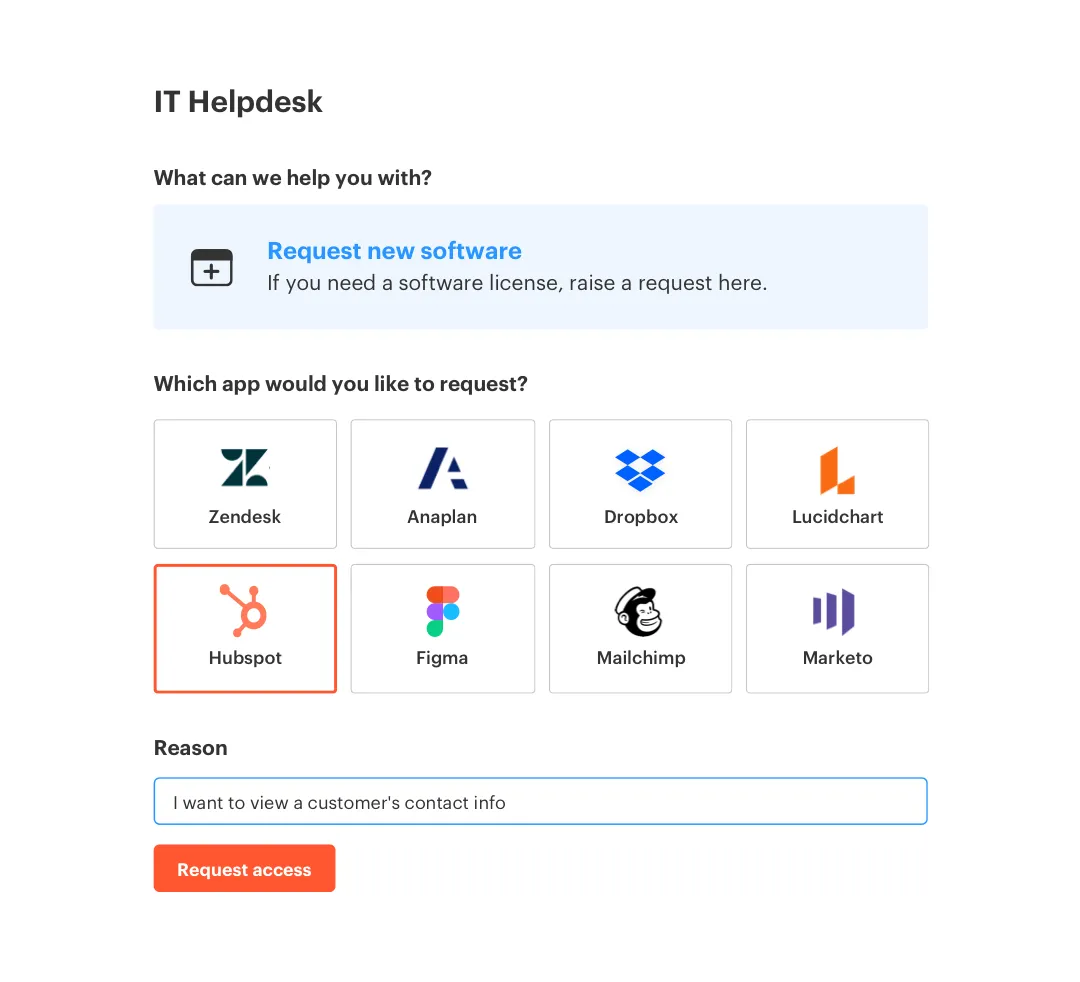
Multiplier uses a Jira-native application catalog so employees can request approved apps from JSM or Slack. Behind the scenes, catalog roles map to identity provider groups in Okta, Entra, or Google Workspace. When the request reaches the configured approved status, Multiplier calls the IDP API to add the user to the mapped group and writes the result back to the Jira issue.

That matters because it removes the gap between approval and action. In the old flow, someone approves in chat, then IT still needs to open the IDP and make the change. With Multiplier, the approval path and provisioning path stay tied together. No separate portal, no side spreadsheet, and no guessing which group the user needs.
There are limits, and they're worth saying out loud. Multiplier provisions through identity provider groups. It doesn't directly provision inside every individual SaaS app outside that model. Automatic revocation also depends on access being granted through IDP group membership. That's actually a useful constraint, because it forces the access model to stay clean instead of hiding exceptions everywhere.
For idp integrations for mobile, that Jira-to-IDP connection is the core move. The phone request can start in Slack, the record lives in Jira, the entitlement changes in the identity provider, and the evidence stays attached to the work.
Time-Bound Access Makes Least Privilege Real
Multiplier supports time-based access where requesters choose a duration like 1, 6, or 24 hours during submission. After approval, access is provisioned through the mapped IDP group, then removed automatically when the timer expires. The grant and revocation are both recorded back on the Jira issue.
This is the part that changes behavior. Employees can still get access fast, which matters during incidents or time-sensitive work. Security gets a smaller exposure window. IT doesn't need to remember cleanup. Auditors get a record that shows access wasn't just approved, but actually removed.
Multiplier also supports access reviews in JSM, where reviewers can see user attributes, groups, last login, and recommendations before marking Keep or Revoke. Revocations remove users from relevant IDP groups and create Jira tickets documenting the change. Auto Reclaim can also use last-login data from the identity provider to warn inactive users and revoke access after a grace period, when the policy applies.
If the pattern from earlier was 5 to 30 minutes per routine access request, the better version is pretty clear. Let the catalog capture context, let approval happen in Jira or Slack, let the IDP make the change, and let expiry remove the access. To see that request-to-revocation loop mapped against your own Jira and identity setup, Get started with Multiplier.
Make Least Privilege the Easy Path
IDP integrations for mobile access shouldn't just prove who someone is. They should make the right access path easier than the shortcut. That's the whole point.
If your team already works in Jira, approves in Slack, and manages identity through Okta, Entra, or Google Workspace, adding another portal can create more work than control. The cleaner move is to connect the workflow you already use to the identity provider that actually grants access.
Start with the repeatable requests. Map roles to groups. Add approval logic. Put expiry into the request. Then use the Jira record as the audit trail. Once that loop works, least privilege stops being a policy everyone agrees with and becomes the default path people actually follow.
Frequently Asked Questions
How do I set up time-based access for my team?
To set up time-based access with Multiplier, start by ensuring your applications are configured to allow time-bound requests. When an employee submits a request through the Jira Service Management (JSM) portal or Slack, they can choose a duration like 1, 6, or 24 hours. After the request is approved, Multiplier will automatically provision access and set a timer to revoke it once the duration expires. This enforces least privilege: access gets granted when needed and removed when the window closes.
What if my team needs access to non-SSO applications?
If your team requires access to non-SSO applications, you can still use Multiplier to manage the approval process. While provisioning for these applications remains manual, you can add them to the Application Catalog in JSM. This allows employees to request access, and approvals will be captured for audit purposes. Make sure to document the manual provisioning steps in the Jira ticket to maintain a clear audit trail.
Can I automate approvals for low-risk access requests?
Yes, you can automate approvals for low-risk access requests using Multiplier. Set up your approval workflows in JSM to designate default approvers for specific applications or roles. When a request is submitted, Multiplier will route it to the appropriate approver automatically. Upon approval, the ticket transitions to provisioning, streamlining the process and reducing delays. This is particularly useful for routine requests that don’t require extensive oversight.
When should I conduct access reviews?
You should conduct access reviews regularly to ensure compliance and security. With Multiplier, you can create access review campaigns in JSM to streamline this process. Set a schedule for reviews—quarterly is common—but adjust based on your organization's needs. Use the campaign to review users' access to applications, assess their activity, and determine whether to keep or revoke access. This keeps the environment clean — only the access people actually need, nothing more.
Why does my team need a unified access management system?
A unified access management system like Multiplier cuts complexity and saves IT time. Pull requests, approvals, and provisioning into one platform and you stop chasing information across tools. Employees get access faster, audit trails stay clean, and IT does less manual cleanup. When everything links back to Jira, governance stops being a side project.


