


At 200 access requests a month, integrating Okta or Azure into Jira stops being an integration project and starts being an operating model problem. You can connect the systems and still have broken access governance if approvals, provisioning, expiry, and audit evidence live in different places.
I've seen this pattern a lot. The identity provider gets treated like the source of truth, Jira gets treated like the ticket log, Slack is where decisions actually happen, and spreadsheets become the place everyone goes when the auditor asks a basic question.
Then IT wonders why access still feels slow.
Key Takeaways:
- Integrating Okta or Azure only works if Jira, approvals, and identity changes share one record.
- Chat bots can speed up requests, but they usually fail on governance, expiry, and audit evidence.
- Provisioning should happen through identity provider groups, not manual SaaS app changes.
- Access reviews need usage context, not just a quarterly spreadsheet of names.
- If an access request takes more than 10 minutes of IT effort, it's a workflow design problem.
- The cleanest setup is Jira for intake and evidence, Okta or Azure for enforcement, and Slack for quick approvals.
Why Okta or Azure Integrations Break Access Governance
Okta or Azure integrations break access governance when the identity provider executes changes, but Jira doesn't own the full request record. The problem isn't the API connection. The problem is that approvals, group changes, expiry, and review evidence drift into separate systems.

Chat Approvals Feel Fast Until Audit Time
A Slack approval feels like progress. Someone asks for Figma Admin, the manager drops a thumbs up, IT adds the user to an Okta group, and the employee gets moving. Pretty good, right? Until three months later, someone asks who approved the access, why Admin was granted, whether it expired, and whether the user still needs it.
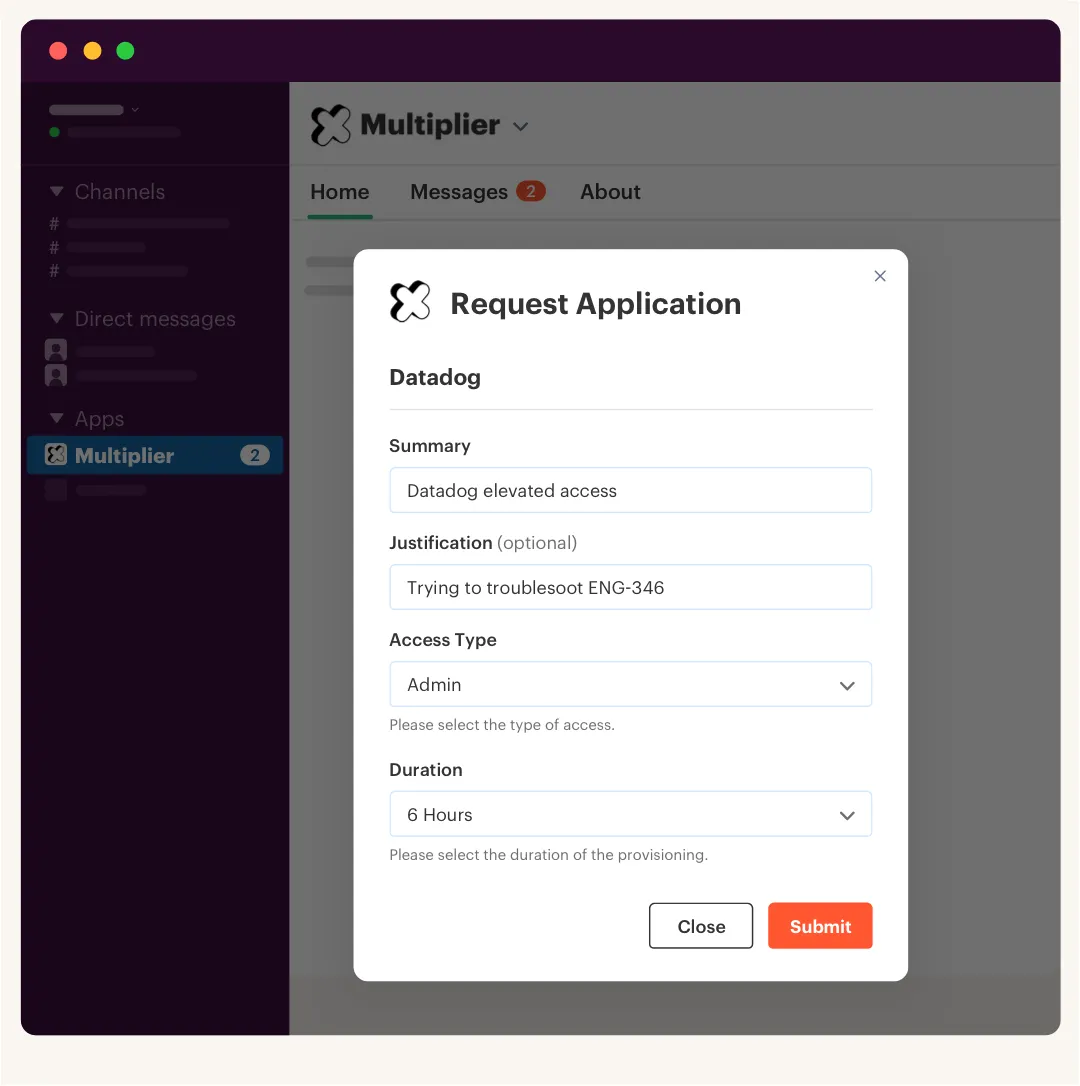
Now the team is hunting. Jira has the ticket, Slack has the decision, Okta has the group change, and a spreadsheet has the quarterly review notes. Imagine running a warehouse where the shipping label is taped to the truck, the inventory count lives in the manager's head, and the delivery proof is on a sticky note in the breakroom. The package gets out the door. Nobody can reconstruct the chain six weeks later when a customer disputes the order.
A real day looks like this. At 9:12 AM, a new RevOps hire named Priya pings #it-help in Slack asking for Salesforce Admin because her Outreach sync is broken and onboarding is blocked. By 9:30, her manager replies "approved" in the thread, IT opens Okta, adds her to the SF-Admin group, and pastes "done" on Jira ticket IT-4471. By Friday, there are 14 similar requests scattered across three Slack channels, and nobody remembers which ones should have been time-bound. If that sounds familiar, the request process isn't just busy. It's leaking evidence.
The teams that fix this don't start with another portal. They start by making the ticket the operating record, then letting Okta or Azure enforce the access change. If your team is already feeling that split between Jira, Slack, and the identity provider, the Jira-native pattern is worth seeing in practice: Learn more about Multiplier.
The Real Issue Is Standing Privilege
The access request isn't the expensive part. The expensive part is access that never gets removed. That's where integrating Okta or Azure becomes a governance problem instead of an IT admin task, because every permanent group assignment becomes a future review item.
I get why teams do it. Permanent access is easier in the moment. Nobody wants to slow down a production incident because an engineer needs temporary access to a system at 11 PM. That's a fair read. If every urgent request becomes a permanent grant, though, your access model starts to rot. Not because people are careless. Because the workflow never forced expiry at the time of approval.
A simple threshold works well here: if the access is privileged, production-related, finance-related, or customer-data-related, it should have a default expiry. Start with 1 hour, 6 hours, or 24 hours. If someone needs longer, they can ask for longer. The default should assume temporary access, because humans are bad at remembering cleanup work.
Okta and Azure are good enforcement layers. Jira is good at work tracking. The mistake is assuming either one alone can govern the full lifecycle. The better question: what system can prove who asked, who approved, what changed, when it changed, and when it ended?
How to Make Identity Provider Provisioning Auditable
Identity provider provisioning becomes auditable when every access change starts from a Jira request and ends with an Okta or Azure group change tied back to that request. The method is simple: use Jira for intent and evidence, then use the identity provider for enforcement.
Diagnose Whether Your Current Flow Is Actually Governed
Count the number of places someone must check to answer one access question. If the answer is more than two, your flow is probably not governed. It might be automated. It might even be fast. It's not clean enough for access reviews, incident response, or audit prep.
Run through these five questions before adding more tooling:
- Can you see the original requester, approver, role, and business reason in one Jira issue?
- Can you prove the exact Okta or Azure group that changed after approval?
- Can you tell whether the access was temporary or permanent without asking IT?
- Can reviewers see last login or usage context before keeping access?
- Can revocation happen from the review decision, without a second manual task?
Two or more "no" answers? Don't start by buying a bigger governance suite. Start by fixing the record chain. Honestly, this is where a lot of access programs go sideways. They try to build policy on top of broken evidence, then wonder why every audit turns into a rebuild exercise.
The rule I like is pretty simple: one request, one approval path, one enforcement layer, one audit trail. Jira can own the request. Slack can carry the decision. Okta or Azure can enforce group membership. The systems have to write back to the same record, though, or you're just making the mess move faster.
Map Roles to Groups Before You Automate Requests
What looks like a request catalog problem is actually a permission model problem in disguise. A catalog without group mapping is just a nicer form. The work only becomes repeatable when each app role maps to a specific identity provider group, because that's what turns approval into a deterministic change. No guessing. No "which group was that again?" messages in Slack.
Don't let someone request "Salesforce access" as a generic ask. Break it into roles like Viewer, Standard User, Billing Admin, or System Admin. Map each role to the right Okta or Azure group. If a role can't be mapped clearly, that's a signal. Either the app ownership is unclear, the permission model is messy, or the access level is too broad.
A good starting threshold: automate only roles where the group mapping is 95% obvious. Keep weird exceptions manual until you clean them up. Some teams try to automate every request on day one, and I think that's backwards. You want the boring, repeatable requests automated first, because those are the ones eating queue time and creating the least risk when mapped correctly.
The before and after is obvious. Before, IT reads the ticket, checks a spreadsheet, finds the right group, opens Okta or Azure, adds the user, then comments back. After, the approved role already knows which group to assign. The identity provider becomes the switch, Jira becomes the logbook, and the approval tells the system when to flip the switch.
Put Expiry Into the Request, Not the Follow-Up
Expiry has to be chosen before access is granted. If the cleanup task gets created after the fact, it will get missed. Not every time. Enough times to create standing privilege, license waste, and awkward review conversations later.
A conditional rule helps here. If the request is for elevated access, default to a time-bound grant. If it's for standard access tied to someone's job role, make it persistent but review it quarterly. If it's for a contractor, vendor, or temporary project, set the expiry to the contract or project end date. Simple. Not perfect, but much better than pretending IT will remember every cleanup.
The stronger version of this rule is to attach duration options directly to the request form. One hour. Six hours. Twenty-four hours. Maybe seven days for project work. The exact windows matter less than the habit. You're teaching the company that access has a shelf life.
Some security teams will argue every request should be manually reviewed because risk is too high. That's valid for production admin, finance systems, or sensitive data — and I'd lose that argument if I tried to push full automation on a SOX-scoped finance app. The sharper point is that manual review and time-bound automation aren't opposites. High-risk access can require approval and still auto-revoke through Okta or Azure when the time window ends.
Run Access Reviews Where the Evidence Already Lives
Reviewers rubber-stamp because they don't have enough context to do anything else. Show them names and app names, and you'll get "keep" clicked 200 times in a row. Give them department, title, group, last login, and the original request history, and the review changes from compliance theater into an actual decision.
The review question should not be "does this person have access?" That's too shallow. The question should be "based on role, usage, and business need, should this access continue?" Those are very different questions. One creates a spreadsheet exercise. The other creates governance.
A fintech team like Luno ran into the classic version of this problem during rapid growth. They had hundreds of routine access requests coming through Slack, email, and Jira, then IT had to chase approvals and manually assign Okta groups. After moving the access workflow into Jira Service Management with automated provisioning, they cut IT workload on access requests by 80%. That number matters because the real win wasn't just speed. It was fewer manual touches, cleaner records, and less room for human error.
If reviewers can revoke directly from the review decision, the whole process gets stronger. A "Revoke" decision should trigger removal from the mapped Okta or Azure group and create evidence that it happened. Otherwise, the review produces a second task list. Task lists are where revocations go to die.
Use Chat for Decisions, Not as the System of Record
Slack is great for getting a fast yes or no. It's not where governance should live. A chat approval has value when it updates the Jira issue, triggers the right workflow transition, and ties back to the access change in Okta or Azure. Without that, it's just a faster version of email.
The test is simple. If Slack disappeared tomorrow, would your access evidence still be complete? If the answer is no, Slack is carrying too much governance weight. Use it for speed, not memory.
There's a reason this matters more now. Atlassian has been pushing Jira Service Management deeper into employee service workflows, including onboarding and lifecycle use cases, as seen in their coverage of employee lifecycle management with Jira Service Management. That shift makes sense. Employees already know where to ask for things. IT already knows how to work tickets. The missing piece is identity enforcement.
Okta and Azure should be the authoritative place where access changes happen. Jira should be the authoritative place where the work is recorded. Slack can sit in the middle for human speed. That triangle works. The triangle breaks when chat becomes the evidence layer.
Separate Automation Candidates From Control Points
Not every access request should be automated the same way. The mature setup separates low-risk requests from high-risk requests, then applies different rules to each. That's how you move fast without pretending every app has the same risk.
A simple matrix works:
- Low-risk, high-volume apps: auto-approve or route to a manager, then provision through groups.
- Medium-risk apps: require app owner approval, then provision through Okta or Azure.
- High-risk apps: require explicit approval and time-bound access.
- Inactive users: reclaim access after a threshold, such as 30 or 90 days, depending on the app.
- Unknown or unmapped apps: keep manual until ownership and group mapping are clear.
The 30-day inactivity threshold is a good starting point for expensive SaaS tools. I wouldn't apply it blindly to everything. Some apps are used monthly or quarterly. Finance systems are a good example. If usage is naturally infrequent, use a longer window or add exclusions for roles that need standing access.
Microsoft's own guidance for managing groups in Microsoft Entra and Okta's guidance on using groups to manage access both reinforce the same operating idea: group membership is the cleaner control surface. The trick is making sure the group change is tied to a governed request. Otherwise you've got enforcement without context.
How Multiplier Connects Jira to Your Identity Provider
Multiplier connects Jira Service Management to identity providers by turning access requests, approvals, provisioning, and reviews into Jira-native workflows. Jira holds the record, Slack carries approvals when needed, and Okta, Entra ID, or Google Workspace enforce the actual group changes.
Jira-Native Requests With Identity Provider Enforcement
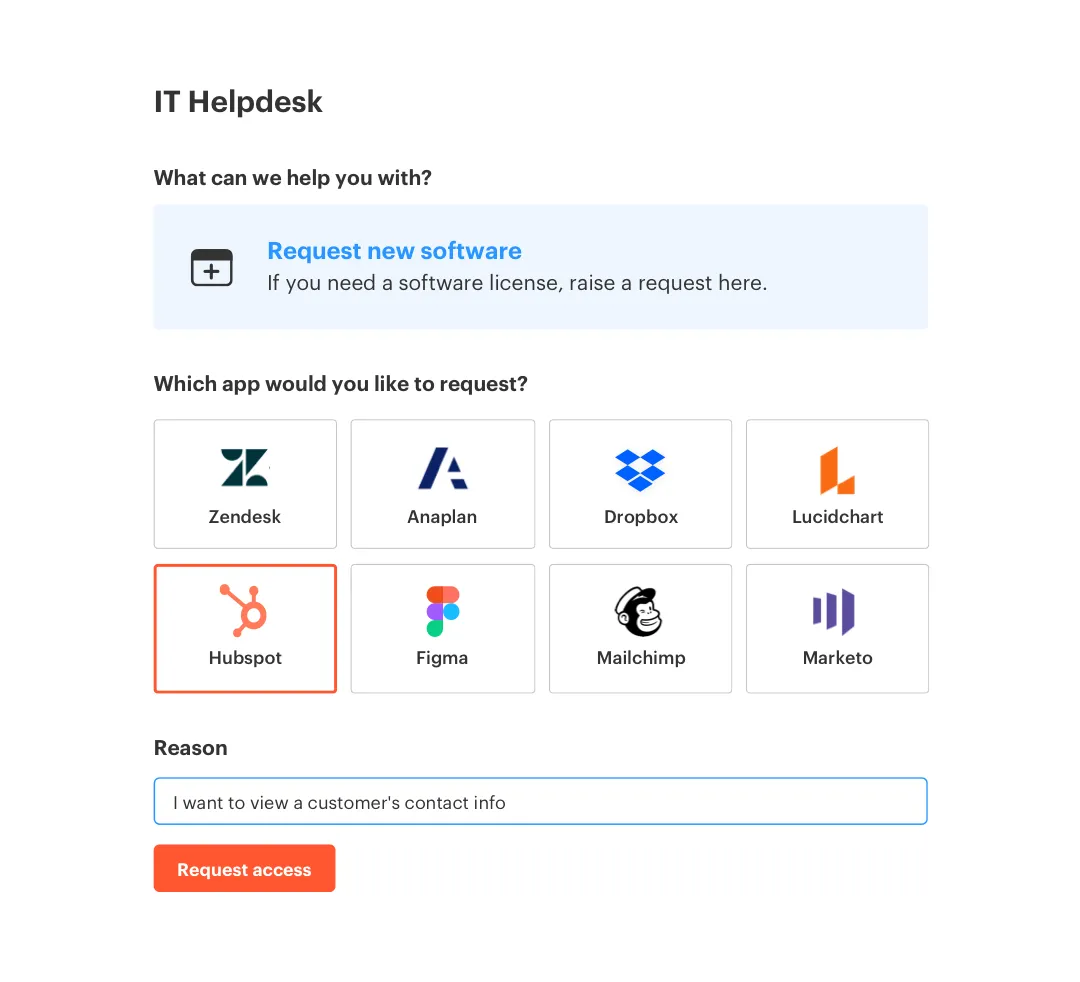
Multiplier starts with a Jira-native application catalog where employees request approved apps and roles from Jira Service Management or Slack. Each role maps to one or more identity provider groups, so approval can trigger the correct Okta, Entra ID, or Google Workspace change without an admin doing copy-paste work.

That matters because integrating Okta or Azure shouldn't mean teaching employees another portal. They should ask where they already ask. IT should see the request where they already work. The identity provider should execute the change. Clean handoffs. Fewer weird side channels.
The practical difference shows up in the boring requests. A user asks for a standard role. The app owner or manager approves. The mapped group gets assigned through the identity provider. The Jira issue records the request, decision, and provisioning result. That's the part most chat bots and SaaS management tools miss. They can make intake feel faster, but they don't always close the loop between approval, enforcement, and evidence.
Multiplier also supports time-based access for temporary grants. A requester can choose a duration, such as 1, 6, or 24 hours, and the product removes the user from the mapped group when the window ends. Automatic revocation depends on access being provisioned through identity provider group membership, which is an important limitation. If access was granted manually outside SSO, no tool can magically remove what it doesn't control.
Access Reviews That End With Real Revocation
Multiplier's access reviews run inside Jira Service Management, with reviewer context like user attributes, groups, last login, and recommendations. Reviewers can keep or revoke access, and revocations remove users from the relevant identity provider groups while creating Jira evidence.
That closes the loop from the earlier problem. The review decision isn't a note in a spreadsheet. It becomes an enforced change. The evidence stays tied to the campaign and the Jira record, which makes audit prep a lot less painful.
The same pattern applies to license cleanup. Auto Reclaim uses last-login data from connected identity providers to identify inactive users, notify them, and revoke access after the configured grace period if they remain inactive. Worth being precise: Auto Reclaim is available on the Advanced edition, and it depends on accurate login telemetry from the identity provider. If an app doesn't provide useful telemetry, the reclaim workflow won't be as strong.
For teams already living in Jira and Slack, Get started with Multiplier is the natural next step after you've mapped which requests should be automated, which ones need approval, and which ones should expire by default.
Build Access Governance Around the System of Record
Access governance gets easier when Jira owns the work record and Okta or Azure owns enforcement. That's the operating model. Not another portal for employees, not another spreadsheet for audit prep, and not a chat bot pretending approval history is the same thing as governance.
The move is pretty straightforward. Start with your highest-volume access requests. Map roles to identity provider groups. Add approval rules. Put expiry on risky access. Run reviews with usage context. Then make revocation part of the workflow, not a follow-up task.
When you're integrating Okta or Azure, the goal isn't just a cleaner connection. The goal is a system where every request can answer the same questions: who asked, who approved, what changed, when it changed, and whether the access still makes sense. Get that right, and access stops being a queue. It becomes a control system.
Frequently Asked Questions
How do I set up time-based access for my team?
To set up time-based access using Multiplier, you can follow these steps: 1) When creating an access request in the Jira portal, ensure the requester selects a duration for access, like 1, 6, or 24 hours. 2) Once the request is approved, Multiplier will automatically provision the access and set a timer to revoke it after the chosen duration expires. 3) Make sure to communicate the importance of time-bound access to your team, as it helps minimize standing privileges and reduces the risk of unauthorized access.
What if I need to revoke access after a review?
If you need to revoke access after an access review, you can do so directly within the Jira issue. 1) Reviewers can mark access as 'Revoke' during the access review process. 2) Multiplier will automatically remove the user from the relevant identity provider group and document the change in Jira, ensuring evidence of the revocation is maintained. 3) The Jira record stays tied to the review campaign, so audit prep doesn't require hunting through separate systems.
Can I automate access requests for specific roles?
Yes, you can automate access requests for specific roles using Multiplier. 1) First, ensure that each role is mapped to the appropriate identity provider group in your application catalog. 2) When employees submit requests through the Jira Service Management portal or Slack, approvals route automatically to the designated approvers based on the role selected. 3) This cuts manual effort and speeds up provisioning — context switching drops and every approval stays linked back to the original request.
When should I conduct access reviews?
Access reviews should typically be conducted quarterly or whenever there are significant changes in team roles or project scopes. 1) Use Multiplier's Access Review feature to create campaigns that include all relevant applications marked as 'Approved.' 2) Assign reviewers who can evaluate access based on user roles, last login dates, and other context. 3) This helps ensure that access stays appropriate and compliant with your organization's security policies.
Why does my access request process feel slow?
If your access request process feels slow, it's usually because systems are fragmented. 1) Ensure that all requests, approvals, and provisioning actions are centralized in Jira using Multiplier. 2) Centralizing removes the context switching and keeps all evidence tied to the original request. 3) By streamlining your process and using automated provisioning through identity provider groups, you can significantly reduce delays and improve overall efficiency.


