


You can implement ITSM-native identity governance faster than you think. Keep the work inside your service desk. Put requests, approvals, provisioning, expiries, and evidence on the same record. When you do that, least privilege turns into a habit, not a hope. And you feel it in the first week, fewer handoffs, fewer misses, cleaner audits. If you need a formal frame, Microsoft explains the governance building blocks well in the Entra governance deployment intro. But let’s keep this practical.
I learned this the hard way. Context scattered across tickets, email, Slack, and the IDP always looks fine in a meeting. Then month end hits, and the gaps show up. When we pulled the work and the proof into Jira, approvals landed faster, reviewers stopped rubber stamping, and IT didn’t need to babysit every change. ITSM-native identity governance is the simple shift that pays every day.
Key Takeaways:
- Put request, approval, IDP change, expiry, and evidence on one Jira issue
- Start with risk tiers and auto-approve rules for low-risk apps, then tighten
- Model roles as IDP groups so “group in, access on” and “group out, access gone”
- Turn on time-bound access by default to shrink standing privilege and license waste
- Measure time-to-access, percent auto-approved, auto-revocations, and seats reclaimed
Stop Splitting Access: ITSM-Native Identity Governance Or You Pay The Tax
ITSM-native identity governance removes the hidden tax created by separate portals. When requests, approvals, IDP changes, and evidence live on the same issue, you cut delays, reduce mistakes, and stop rebuilding proofs. The practical gain is speed with control, not speed or control.

What goes wrong when governance lives outside ITSM
Split systems create predictable failure points. The ticket lives in JSM, the approval hides in email, the change happens in the IDP, and the evidence ends up as screenshots. People chase context, miss expiries, and carry broad access longer than needed. That is the quiet cost, time and risk.
I have watched teams try to cover the gap with one-off scripts and side spreadsheets. It works for a month. Then the person who wrote it takes a vacation and the process stalls. Put the whole flow where the work already happens and the audit trail writes itself.
When the process and the proof share a record, the right outcome becomes the default. Approvals do not get lost, provisioning is consistent, and reviewers can see usage and group context without leaving the issue.
Are you trading speed for standing access?
Under pressure, teams grant long-lived access to avoid backlogs. It feels harmless. It is not. Standing privilege grows, licenses pile up, and no one knows what to revoke later. You are buying speed with risk and waste.
Short windows fix that without slowing people down. Set time-bound access as policy for sensitive apps, keep low-risk items on auto-approve, and reserve human review for the edge cases. You get speed without permanent exposure.
I am not asking you to trust theory. I am asking you to shift the default. Automatic expiry beats memory every time.
Why itsm-native identity governance belongs in your flow
You already run intake, SLAs, and fulfillment in ITSM. Extend that to identity. Keep approvals in Slack and JSM, provision through the IDP, and attach every change to the originating ticket. That single path removes swivel-chair work and cuts mistakes you do not even see today.
If you want a formal definition of identity governance for grounding, Evolveum’s overview is solid and readable in five minutes, see What is Identity Governance. Then bring it into your actual workflow instead of another portal.
Why ITSM-Native Identity Governance Beats Split Workflows
Consolidating identity operations in ITSM removes the real bottleneck. The problem is not speed, it is separation. When process and proof live apart, approvals vanish, expiries get missed, and audits collapse into scavenger hunts. Put everything on one issue and the friction drops.

The real bottleneck is the ITSM and IGA split
The symptom is slow access. The root cause is that approvals, changes, and evidence are fragmented across tools. People hunt for context, then stop looking. Entitlements stick, and no one remembers to remove them.
Move the process into Jira and the bottleneck dissolves. Requests flow to the right approver, the IDP makes the change, and the record captures it all. You cut risk while you reduce cycle time. That is the win.
I have seen teams try to bandage the split with heavy weekly review meetings. It burns hours, and still misses edge cases. Unify first, then review.
What changes when approvals, provisioning, and evidence share one record
Approvers decide where they already work. Provisioning fires through group assignment in the IDP. The ticket documents success or failure with details you can act on. Time-bound access is policy, not memory, so expiry is automatic.
Audits shift from screenshots to exports. Review cycles shorten because context rides with each item, last login, group membership, and a clear recommendation. The system generates the proof while the work happens.
It is a small structural change with outsized impact. That is why it sticks.
What metrics should you move first?
Pick numbers that no one argues. They show up in dashboards and tell a simple story.
- Time-to-access, median and p90
- Percent auto-approved for low-risk items
- Auto-revocations completed after expiry
- Licenses reclaimed from inactivity
Baseline these before you start. Then watch request cycle time fall, rubber-stamp reviews decline, and standing access shrink. If you want a broader market lens, Oracle’s summary on IGA drivers is useful context in the [Identity Governance Administration 2022].
The Measurable Cost Of Manual Requests And Missed Expiries
Manual coordination burns hours and expands risk. Each approval chase takes minutes you never log. Each manual provisioning step adds more. Miss an expiry and you pay twice, exposure and spend. At scale, that is days per month lost to work the system could do for you.
The coordination tax you can actually count
Put numbers on it. Ten to twenty minutes to chase an approval. Another five to thirty to provision by hand depending on the app. Three to five minutes to write evidence that may not match later.
Multiply by hundreds of tickets. You lose days to side channels each month while your attack surface grows. The federal ILM Playbook calls this out plainly, identity lifecycle without automation leads to drift and audit gaps.
I have been in those late meetings doing the math with a CFO. It is not a fun conversation when the waste is visible.
Real outcomes when you remove manual provisioning
Teams that automate approvals and group assignment see the backlog fade. One program processed 3,800 plus requests in a year with roughly 75 percent automation and a four person IT team supporting more than 420 employees. Another reported an 80 percent reduction in routine IT workload once low-risk apps stopped touching human hands.
You may not match those exact numbers on day one. The direction is consistent when the IDP does the heavy lifting and the ticket carries the proof.
Start with one or two high volume apps. Prove it there. Then expand.
Time-bound access proves least privilege, not just intent
Temporary access with automatic removal prevents entitlement creep. In one rollout, 1,300 plus time-bound grants were auto revoked after the approved window. That is evidence, not opinion.
During an incident or an audit, you can answer who had access, why, and when it ended from a single system of record. No scavenger hunt. No risk from stale privileges.
This is where many teams go wrong. They rely on memory.
What It Feels Like Before And After Time-Bound Access
Life before time-bound access is noise. New hires land, the Tuesday queue explodes, and IT is stuck doing manual group changes. Life after is quiet. The catalog, approvals, and provisioning live in JSM with the IDP behind it, so tickets move without handoffs and expiries happen on schedule.
That Tuesday morning backlog you dread
You know the pattern. Monday onboarding finishes. By Tuesday morning, the queue is wall to wall requests. Approvals lack context. Owners are unclear. Provisioning is a copy paste grind. Frustrating rework follows.
When the request, approval, and change share a record, those tickets close fast. Low-risk apps stop touching humans. High-risk items still get proper review. And the queue finally breathes.
I have watched teams feel that change within a week. Not months. Days.
Why approvers disengage, and how to fix it
Approvers ignore vague emails and confusing paths. Keep decisions in Slack and JSM, show the right fields on the ticket, and move the issue automatically when they click Approve. Decision friction drops. Response time improves. People stop bypassing the process because it no longer slows them down.
That is the difference between a process people respect and a process people route around. Small details, big payoff.
If you want foundations for why governance needs to live near the work, Evolveum’s primer on Identity Governance covers the control model. Then you can apply it inside your service desk.
Audits without screenshots
Audits get hard when evidence is scattered. Tickets, emails, and scripts do not line up. Put the request, approval, change, and expiry on the same issue. Then export the report.
No scramble. Fewer exceptions. Security leaders get proof, not promises. Auditors get clean answers, not a scavenger hunt.
I have done the screenshot dance. You do not need to.
How To Implement ITSM-Native Identity Governance Step By Step
You implement ITSM-native identity governance by mapping your current flow, designing a simple policy model, and turning time-bound access on by default. Start with one high volume app. Keep the rules simple. Prove the cycle time drop and expand.
Map the current request-to-provision path and find the friction
Document how requests move today. Where they start, who approves, how provisioning happens, and where evidence sits. Do not guess. Pull five to ten real tickets and trace them end to end.

You will spot the delays fast. Manual lookups for the right group. Approvals drifting into inboxes. Evidence living in screenshots. Expiries missing entirely. That is your backlog in plain view.
I like to convert that into a baseline. Time-to-access, percent touching humans, and an example stack trace for proof.
Now capture the flow in a simple diagram before you change anything. Wrong map, wrong plan.
After you have that picture, list your top three friction points:
- Missing or slow approvals
- Manual provisioning steps
- No expiry or license return process
Design your policy model: risk tiers, auto-approve rules, and approval chains
Define what is low risk and can auto-approve using attributes like department or role. For higher-risk scenarios, set single or multi-stage approvals using app owners or managers. Keep it simple. You are reducing human routing, not building a policy maze.

Then attach SLAs to time-to-access. If low-risk items cross your threshold, loosen the rule. If high-risk items move too slowly, tighten the reviewer list or add Slack prompts.
I prefer a single page policy for rollout. If a rule does not map to a real reason, remove it. Clarity lowers mistakes.
Tie your roles to groups early, even if you have not automated yet. That clean model pays later.
Implement just-in-time and time-bound requests in ITSM with SLAs and a scheduler
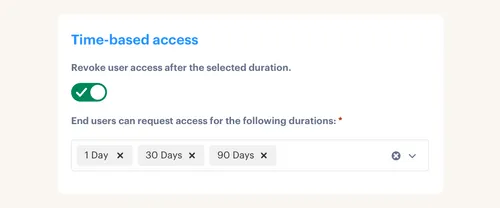
Expose a visual app catalog in your JSM portal or Slack. Capture role and requested duration. Route to approvers based on your model. On approval, add the user to the mapped group, start the timer, and remove access when it expires. Track your SLA for time-to-access and adjust rules weekly in the first month.
Here is a simple rollout plan:
- Start with one high volume app and one sensitive app
- Map roles to IDP groups and set owners
- Turn on auto-approve for the low-risk paths
- Enable time-bound access for the sensitive app
- Review metrics weekly and tune
Then expand:
- Add two more apps per sprint
- Introduce access reviews for the top five apps
- Add license reclamation where it matters
For additional structure, the Entra guide on governance models is a good reference, see the Entra governance deployment intro.
How Multiplier Automates ITSM-Native Identity Governance
Multiplier embeds access requests, approvals, provisioning, and reviews in Jira Service Management, then executes changes in the identity provider. The record lives on the issue, so the system captures evidence as the work happens. You get speed with control, not speed or control.
Automated provisioning through IDP groups, not brittle scripts
Each application role in the catalog maps to one or more IDP groups. When a ticket hits your configured approval state, Multiplier adds or removes the user from those groups. The change logs to the issue with success or error details you can act on.
For SSO backed apps, access lands in minutes. For non-SSO, you still capture approvals and evidence in the ticket, and an agent handles the manual step. No invisible work. No missing proof.
This is the direct attack on the manual provisioning cost you measured earlier.
Time-based access with automatic removal and license return signals
Just-in-time and time-bound access are built in. Requesters pick a duration, approvers review once, and Multiplier removes access at expiry. If the same need comes up before expiry, previously approved requests can extend without a second approval.
On spend, Auto Reclaim policies use last login data from your IDP to locate idle seats and remove them. The system notifies the user, then revokes if they do not log in within the grace window, and creates a Jira ticket for the audit trail. Details are in the docs, see Auto Reclaim: Automatic SaaS License Reclamation for the policy flow.
You reduce standing access and license waste at the same time.
Approvals where people work, plus access reviews in JSM
Approvals happen in Slack and JSM, so decisions land fast and are recorded. Access reviews run as Jira campaigns, with context like last login and group membership on the review issue. Reviewers can keep or revoke with a reason, and Multiplier removes groups automatically on revocation.
Results export cleanly for audits or flow into tools like Vanta. That is how you turn rubber-stamp reviews into actual governance without adding headcount.
Close the loop, then measure:
- Time-to-access drops as Slack approvals replace email chasing
- Percent auto-approved rises as low-risk paths stop touching humans
- Auto-revocations show least privilege working, not just promised
Ready to put this into practice with your stack? Get started with Multiplier
Conclusion
You do not need another portal to operationalize least privilege. You need to co-locate the process and the proof. Keep the request, approval, IDP change, and expiry on one record in Jira. Turn on time-bound access by default. Map roles to IDP groups and keep approvals where people work.
Start with one high volume app and one sensitive app. Baseline your metrics, then show the cycle time drop and the shrink in standing access. The system does the repetitive parts. Your team focuses on the exceptions. And audit prep turns into a report, not a war room.
Frequently Asked Questions
How do I set up time-bound access with Multiplier?
To set up time-bound access using Multiplier, follow these steps: 1) In your Jira Service Management (JSM) portal, create a request type for access requests. 2) When users submit a request, they can select a duration for access (like 1 hour or 24 hours). 3) Once approved, Multiplier will automatically provision access and set a timer to revoke it after the specified duration. This ensures that users only have access when they need it, reducing the risk of standing privileges. With this feature, you can streamline access management and enhance security by automatically removing access when it's no longer required.
Can I automate access reviews with Multiplier?
Yes, you can automate access reviews using Multiplier. To do this, create an access review campaign in your JSM. Start by selecting the applications you want to include in the review and designate the reviewers for each app. Once the campaign is launched, reviewers will receive notifications to assess user access based on their last login and other relevant data. Multiplier tracks the progress and allows you to export results for audit purposes. This automation simplifies the review process and ensures compliance without the hassle of manual tracking.
What if I need to revoke access for multiple users?
If you need to revoke access for multiple users, you can do so through the access review feature in Multiplier. When you create an access review campaign, you can include all relevant users and applications. Reviewers can mark users for revocation based on their access activity. Once a user is marked for revocation, Multiplier will automatically remove them from the relevant identity provider groups, ensuring that their access is promptly revoked. This process not only saves time but also maintains a clear audit trail of actions taken.
How do I integrate Multiplier with my identity provider?
Integrating Multiplier with your identity provider is straightforward. First, register Multiplier as an application in your identity provider (like Okta or Azure AD) and grant the necessary API permissions. Next, go to the Multiplier configuration in your JSM and select your identity provider. Follow the prompts to connect and sync applications and groups. Once integrated, Multiplier will handle provisioning automatically based on the group assignments you set up, streamlining your access management process.
When should I use auto-approval rules in Multiplier?
You should consider using auto-approval rules in Multiplier for low-risk applications or requests that are common and straightforward. By setting up these rules, you can streamline the approval process, allowing requests to be automatically approved based on criteria like department or role. This not only speeds up access for users but also reduces the workload on IT teams, allowing them to focus on more complex requests. Just ensure that your auto-approval criteria align with your organization's security policies to maintain control.


