


Mitigating security risks with access governance doesn't start with a new portal, it starts with the 200 tiny access decisions your team makes every week. You felt it this week when someone asked for admin access in Slack, the approval happened somewhere else, and nobody was 100% sure if it got removed later.
That's the whole problem. Not the policy doc. Not the committee. The risk is in the gap between the ticket, the approval, the identity provider, and the audit trail. And if those four things don't stay connected, your team ends up doing governance theatre.
Key Takeaways:
- Mitigating security risks with access requests starts by keeping approvals, provisioning, and evidence tied to one record.
- Separate IGA portals often add friction because the real access work already happens in Jira, Slack, and the identity provider.
- Identity provider groups should be the control point for most access changes because they're fast, reversible, and auditable.
- Time-bound access should be the default for admin roles, production systems, sensitive data, and expensive tools.
- Access reviews only work when revocation happens close to the review decision, not three weeks later in a spreadsheet.
- If your audit evidence has to be rebuilt manually, your access process is already leaking context.
If you're already trying to pull access work back into Jira instead of adding another queue, Learn more about Multiplier.
Why Access Risk Grows Inside Jira Workflows
Access risk grows when the request, approval, provisioning action, and audit evidence live in different places. Jira has the ticket, Slack has the conversation, Okta or Entra has the actual permission, and spreadsheets hold the audit story. That split creates slow access, standing privilege, and messy proof.

The Hidden Risk Isn't the Request, It's the Handoff
A request itself is rarely the dangerous part. Someone needs Figma, GitHub, Salesforce, production access, or a finance system. Pretty normal. The risk shows up when the request moves between tools and the context gets thinner every time. By the time IT actually provisions access, they may have a ticket with a vague description, a Slack approval, and a group assignment done by memory.
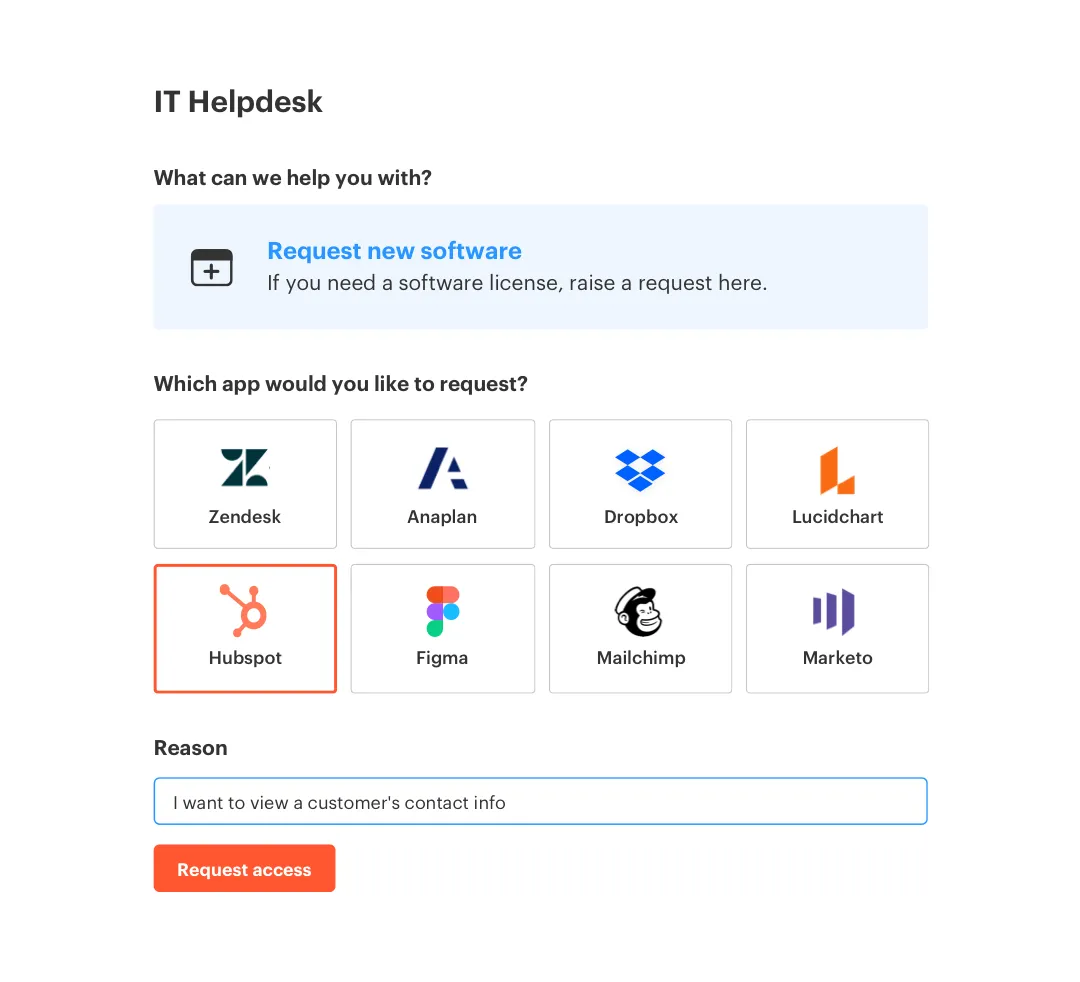
At 9:17 on a Tuesday, an employee pings IT in Slack asking for elevated access because a customer issue is stuck. A manager replies "approved" in the thread, someone adds the user to the right identity provider group, and the Jira ticket gets updated later when there's time. Three weeks later, an auditor asks who approved it, why it was granted, and whether it was removed. Now the team is searching Slack, Jira comments, and identity logs like they're reconstructing a crime scene. Not ideal.
I've seen this pattern a lot. Everyone involved is trying to be helpful. Nobody wakes up thinking, "Let's create an audit problem today." But when the workflow depends on people remembering to copy proof between tools, the process is already broken. It's like packing a suitcase across four rooms. You might get everything in there, but you'll probably forget the charger.
Separate Governance Portals Make the Split Worse
The usual answer is to buy a separate identity governance portal. I get why. It feels like the serious answer, especially when compliance pressure is rising and the security team wants more control. Frameworks like NIST SP 800-53 AC-6 make least privilege very clear, and nobody wants to explain why terminated users or temporary admins still have access. Fair.
The problem is that a portal outside Jira often creates another place for work to stall. Employees still open Jira tickets because that's where IT work lives. Managers still approve in Slack because that's where they live. IT still changes groups in the identity provider because that's where access is enforced. Then the governance portal becomes one more system to reconcile. More control on paper. More copying in practice.
A fintech team that grew close to 1,200 employees ran into exactly this kind of mess. Routine requests were coming through Slack, email, and Jira, and IT had to chase approvals before manually assigning Okta groups. Each request wasn't huge, maybe 5 to 30 minutes. But hundreds of them add up fast. The queue becomes a tax on every new hire, every transfer, and every project deadline.
The fix starts by deciding which access changes deserve friction and which ones should move cleanly through the identity provider without losing the audit trail.
How to Reduce Security Risk Through Identity-Backed Access
Good access governance reduces risk by making the identity provider the execution layer and Jira the evidence layer. Requests and approvals should stay close to the service desk, while group changes happen through Okta, Entra ID, or Google Workspace. That gives you speed without losing control.
Diagnose Which Access Requests Are Actually Risky
Before you redesign anything, split your access requests into risk buckets. Not every request deserves the same workflow. A read-only request for a design tool shouldn't go through the same approval chain as production database access. When everything gets treated as high risk, people route around the process. When everything gets treated as low risk, security loses trust in the process.
Run a simple audit on the last 50 access requests. I like 50 because it's enough to show patterns, but not so many that the exercise becomes a month-long project. For each request, ask what would happen if the wrong person got access for 30 days. If the answer is "almost nothing," it's probably low risk. If the answer involves customer data, financial reporting, production systems, or admin controls, it needs more structure. Pretty basic. Also weirdly clarifying.
Use these questions to sort the work:
- Does the access expose customer data, financial data, source code, or production systems?
- Would the user need this access permanently, or only for a task?
- Can the access be granted and removed through an identity provider group?
- Is the approval owner obvious before the request gets submitted?
- Would an auditor accept the ticket as proof without screenshots or side notes?
If fewer than 70% of your requests have clear approvers and clear groups, don't start with fancy policy logic. Start with cleanup. Map apps to owners, roles to groups, and request types to risk levels. Reducing access risk is mostly boring mapping work before it becomes automation work.
Make Identity Provider Groups the Control Point
The identity provider should be the source of truth for most access changes. That's the cleanest way to make access fast, reversible, and auditable. If Jira says approved but Okta or Entra tells a different story, the identity provider wins anyway. So anchor the workflow there from the start.
The mechanism is pretty straightforward. Each app role gets mapped to one or more identity provider groups. A "Viewer" role maps to a low-risk group. An "Admin" role maps to a higher-risk group. A request moves through approval, and the actual grant happens by adding the user to the mapped group. When access needs to end, removal from that group becomes the clean revocation point. No guessing inside five different SaaS apps.
Here's the rule I'd use. If an app supports SSO and group-based provisioning, route the access change through the identity provider group. If it doesn't, still keep the request and approval in Jira, but mark the provisioning step as manual and require the person doing it to comment on the ticket. If neither the approval nor the grant can be tied back to the ticket, the app shouldn't be treated as governed yet.
That last part matters. A lot. According to Verizon's 2024 Data Breach Investigations Report, credential abuse remains a major pattern in breaches. So keeping access risk low isn't just about who gets approved. It's about whether you can prove the right person got the right access, through the right path, and had it removed when it no longer made sense.
Use Time Limits Before You Add More Approvers
More approvers feel safe. Sometimes they are. But after two approval layers, you usually get more delay than risk reduction unless the access is extremely sensitive. The stronger move is often time-bound access. Give someone the access they need, for the window they need it, then remove it automatically.
I'd make temporary access the default for four categories: admin roles, production systems, sensitive datasets, and tools with export permissions. A 1-hour window works for emergency fixes. A 6-hour window works for project work or incident response. A 24-hour window works when someone needs a full day to complete a task. Anything longer should force a real conversation about whether the person actually needs standing access.
This is where least privilege gets practical. The policy version says people should only have what they need. The operational version says the request form forces a duration, the approval reflects that duration, and the identity provider removes the group membership when the timer ends. Much better.
A company with 160 employees once cut privileged access by 85% using a just-in-time model. That number stood out to me because it shows the hidden waste in standing privilege. Most admin access isn't needed all the time. It just never gets cleaned up because cleanup is nobody's favorite Friday afternoon activity. Time limits make cleanup the default.
Keep Approval Rules Simple Enough to Follow
Approval workflows fail when they try to encode every edge case on day one. I know the temptation. Security wants policy depth. IT wants fewer interruptions. App owners want control. Managers want visibility. Pretty soon, a simple access request has six branches and nobody knows why it landed with the CFO.
Start with three approval patterns. Low-risk access can be auto-approved if the requester's department and role match the app policy. Medium-risk access should go to the manager or app owner. High-risk access should go to the app owner and a security approver, but only for apps that truly justify it. If more than 20% of requests need exception handling, the workflow is too clever. Pull it back.
The approval owner should be known before the request is submitted. If IT has to ask, "Who owns this app?" every time, that's not an approval workflow. That's tribal knowledge with a ticket number. I'd rather have a slightly imperfect owner map that gets updated weekly than a perfect spreadsheet nobody trusts.
One thing works well here. Review the request queue every month and look for the five apps creating the most back-and-forth. For each one, fix one field, one approver, or one role mapping. Don't boil the ocean. A company that grew from 100 to 500 employees saw Tuesday access queues become a repeating pain because new hires needed extra apps and ownership wasn't always clear. The fix wasn't "more governance." It was clearer intake and cleaner routing.
If you want to see the difference between access requests that bounce around and access requests that move through Jira, Slack, and your identity provider cleanly, See how Multiplier works.
Treat Access Reviews Like Enforcement, Not Paperwork
Access reviews are supposed to reduce risk. Too often they become quarterly paperwork. A reviewer clicks "keep" because the spreadsheet is ugly, the context is thin, and revoking access means creating another ticket for someone else. That's how rubber-stamping happens. Not because people don't care. Because the system makes the right action annoying.
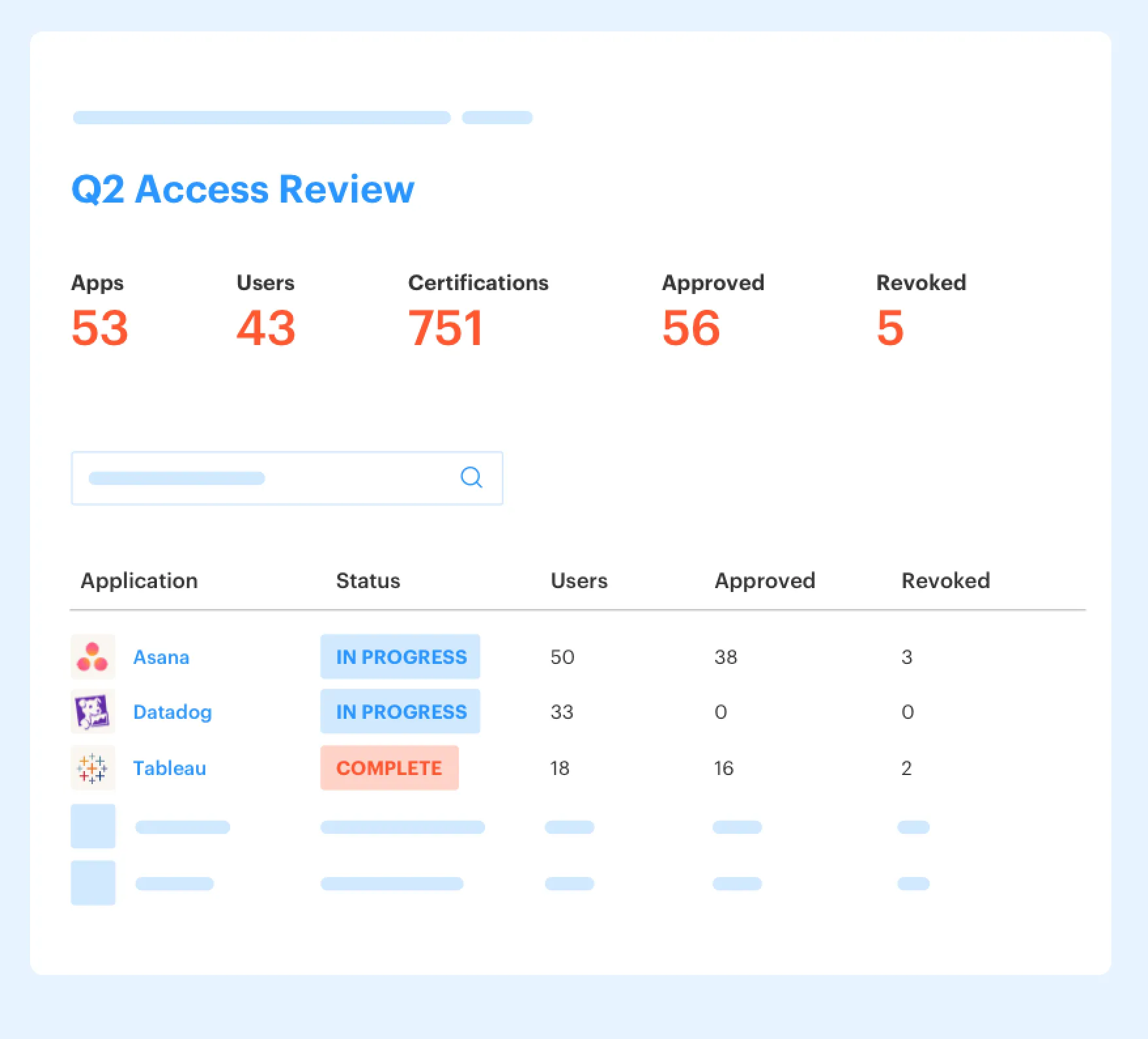
A useful review shows the reviewer enough context to make a decision. User name, department, manager, group membership, last login, role, and risk level should be visible together. If someone hasn't logged into a tool in 90 days, that should be obvious. If someone changed departments last month and still has access to the old team's system, that should be obvious too. The review should answer the question, "Would I grant this access again today?"
Use a 7-day rule. If a review decision says revoke, the access should be removed within 7 days, ideally much faster. If revocation takes longer than that, you're not running an access review. You're collecting opinions. The decision and the enforcement need to live close together, or the review loses teeth.
For mitigating security risks with access reviews, track three numbers:
- Percentage of access marked "revoke"
- Percentage of revocations completed within 7 days
- Percentage of review decisions tied to a ticket or identity log
If the third number is under 95%, your audit evidence is going to be painful. And frankly, that's where teams get burned. The review happened, but the proof is scattered. The auditor doesn't care that everyone meant well.
Build Audit Evidence as a Byproduct
Audit readiness should come out of the workflow, not a separate scramble after the workflow. If your team has to rebuild evidence in spreadsheets, take screenshots, and stitch together Slack approvals, the process is costing more than it looks. It's not just annoying. It also makes the evidence weaker because every manual step creates room for missed context.
The clean version has one record per access event. The request starts there. The approval lands there. The identity provider action writes back there. The revocation or expiry lands there too. When the auditor asks what happened, you don't tell a story across six tabs. You open the record. Done.
I'd use a simple evidence test. Pick 10 access changes from the last month. For each one, try to answer four questions in under 2 minutes: who requested access, who approved it, what changed in the identity provider, and whether the access still exists. If you can't answer at least 9 out of 10 from the ticket and identity logs, the audit trail is too fragile.
The funny thing is that good audit evidence also makes IT faster. People think compliance slows teams down, and fair enough, it often does when it's bolted on later. But when evidence is produced during the normal request flow, the team spends less time hunting for proof and more time doing actual work. That's the whole point.
How Multiplier Makes Access Governance Jira Native
Multiplier makes access governance Jira native by keeping requests, approvals, provisioning actions, reviews, and evidence tied to Jira Service Management. It provisions through identity provider groups, supports Slack approvals, and writes audit history back to the issue. That makes risk reduction part of daily IT work.
Jira Becomes the System of Record for Access
The reason Multiplier works in this model is simple: the access request starts where IT already works. Employees use the Application Catalog in JSM or Slack to request approved apps and roles. The role maps to identity provider groups in Okta, Entra ID, or Google Workspace. Approvers act in Jira or Slack, and the ticket stays connected to the decision.

Once approved, automated provisioning adds the user to the mapped identity provider group. That's the important part. The change happens through the identity provider, not a side process that someone has to remember later. Success or failure comments write back to the Jira issue, which means the request, approval, and execution stay together. With Multiplier, reducing access risk doesn't require forcing employees into a separate IGA portal.
A practical setup usually looks like this:
- Application Catalog: Employees request sanctioned apps and roles through JSM or Slack.
- Approval Workflows: Managers, app owners, or specific users approve based on the app policy.
- Automated Provisioning: Approved requests trigger identity provider group changes.
- Slack App: Approvers can act from chat while Jira remains the record.
- Time-Based Access: Temporary access expires and is removed through the identity provider.
That flow tackles the earlier handoff problem directly. No separate portal for one part of the work. No Slack approval floating away from the ticket. No manual group assignment with weak proof. The Jira issue becomes the suitcase, and everything goes into it.
Time-Bound Access and Reviews Close the Loop
Multiplier also handles the part most teams struggle to maintain manually: cleanup. Time-Based Access lets requesters choose a duration, like 1, 6, or 24 hours. After approval, access is provisioned through the mapped identity provider group, then removed when the window expires. That only works for access granted through identity provider group membership, which is exactly why the group mapping matters so much.
Access Reviews bring the same idea to periodic certifications. Reviewers see user attributes, groups, last login data, and recommendations inside JSM. They can mark access as keep or revoke, and revocations remove users from the relevant identity provider groups. Evidence stays connected to the campaign and the related Jira records, with CSV exports and Vanta-ready evidence available for audit work.
With Multiplier, the 5 to 30 minutes IT used to spend chasing approvals, assigning groups, and documenting proof can become a cleaner request path. Not magic. Just fewer handoffs. And for teams trying to grow without turning IT into a ticket factory, that's the real win. Ready to make access governance live where the work already happens? Get started with Multiplier.
What Changes When Access Work Has One Record
Access governance gets much easier when one record connects the request, approval, identity provider change, and audit evidence. The team stops rebuilding context every quarter and starts enforcing least privilege during normal work. Access moves faster because the controls are clearer.
I'd argue this is the real shift. Not "buy more governance software." Not "write more policy." The shift is making the right access path the easiest path. Employees request from the approved catalog. Approvers act where they already work. Provisioning runs through the identity provider. Evidence lands in Jira as the work happens.
That's how you reduce security risk without slowing the company down. You don't need a more dramatic process. You need fewer gaps between the tools already carrying the work.
Frequently Asked Questions
How do I set up time-based access in Multiplier?
To set up time-based access in Multiplier, follow these steps: 1) When submitting an access request through the Application Catalog in Jira Service Management or via Slack, select the desired application and role. 2) Choose a duration for the access, such as 1, 6, or 24 hours. 3) Once approved, Multiplier will automatically provision the access and set a timer to remove it when the duration expires. This helps enforce least privilege by ensuring users only have access for the time they need.
What if I need to extend time-based access?
If you need to extend time-based access in Multiplier, you can do so easily. First, check if the previous request was already approved. If it was, you can submit a new request for an extension. Multiplier can automatically apply the extension without requiring re-approval, as long as the policies permit it. This reduces friction during incidents and ensures users have the access they need without unnecessary delays.
How do I conduct access reviews with Multiplier?
To conduct access reviews using Multiplier, start by creating an access review campaign in Jira Service Management. 1) Go to the Access Reviews section and click 'New Review.' 2) Select the applications you want to include, ensuring they are marked as 'Approved.' 3) Assign reviewers for each app and launch the campaign. Reviewers will receive notifications and can mark access as 'Keep' or 'Revoke,' with Multiplier automatically handling the revocations and updating the Jira tickets for audit purposes.
Can I automate access requests in Slack?
Yes, you can automate access requests in Slack using Multiplier. Simply install the Multiplier Slack app, and employees can trigger access requests by typing `/request` in any channel or using the app's UI. They will see the same application catalog available in Jira Service Management, allowing them to select the app and role they need. Once submitted, a Jira ticket is created automatically, and approvers receive notifications in Slack to approve or deny the request.
Why should I use the Application Catalog for access requests?
Using the Application Catalog in Multiplier streamlines access requests significantly. It provides a single, Jira-native self-service experience where employees can browse approved applications and roles, ensuring that requests include the necessary context from the start. This helps route approvals to the correct owners or managers, reduces manual errors, and maintains an audit trail. Plus, it integrates seamlessly with your identity provider, making provisioning faster and more reliable.


