


Your ex-employee still having access to 14 SaaS apps isn't an identity problem, it's an operating problem. Orphaned accounts and credential risk show up when Jira tickets, Slack approvals, and identity provider changes all live in different places. The weird part is nobody feels the break on day one, because the account looks harmless until an audit, incident, or license review forces someone to ask why it still exists.
Most IT teams think the problem is offboarding. I’d argue the bigger problem is that access gets created in one place, approved in another, changed in a third, and reviewed later in a spreadsheet. So when a person leaves, changes roles, or stops using an app, the credential trail is already broken.
Key Takeaways:
- Orphaned accounts and credential risk grow when access changes aren’t tied to one system of record.
- The real control point is the identity provider, because group membership should drive access changes.
- If an access request can’t show requester, approver, entitlement, expiry, and revocation status in one record, audit evidence will be rebuilt later.
- Access reviews work better when reviewer decisions trigger actual removals, not follow-up tickets.
- Time-bound access reduces standing privilege because access expires by design.
- Jira is often the right place for governance because IT work already starts there.
Why Orphaned Accounts Become Credential Risk
Orphaned accounts become credential risk when ownership, approval, and revocation live in different systems. The account may look harmless, but the credential still exists, the license may still be active, and nobody has a clean record showing why access should remain. That gap gets expensive during audits and risky during incidents.

The Real Issue Isn’t the Account, It’s the Broken Chain
A user account becomes dangerous when nobody can explain its current state. Who approved it? What role was granted? Was it tied to a manager request, a project need, or a temporary exception? If the answer is spread across Jira comments, Slack threads, Okta groups, and a spreadsheet, you don’t have governance. You have archaeology.
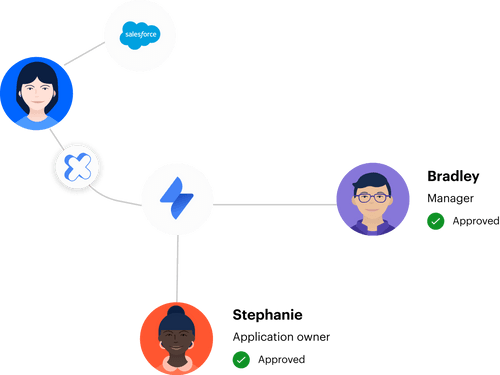
Picture an IT admin at 4:42 PM on a Thursday trying to close an offboarding ticket. The user is gone. The manager says they “probably” don’t need access anymore. The app owner is in another timezone. Okta shows the person in three groups, but only one maps clearly to a business reason. So the admin removes what looks obvious and leaves the rest for later. Later becomes never.
That’s the part people underestimate. The account didn’t get orphaned because IT was careless. It got orphaned because the workflow asked humans to preserve context across too many tools. Honestly, I think a lot of security debt is just missing context with a scarier name.
If Jira is already where your team proves the work happened, the next question is whether access should be governed there too: Learn more about Multiplier.
Credentials Outlive Intent Faster Than Teams Expect
Credential risk moves faster than policy documents. A contractor gets 24-hour admin access for an incident, then the manual cleanup task slips. A sales hire transfers into partnerships, but keeps access to the old territory tools. A finance app gets replaced, but the old account stays active because nobody wants to break a workflow they can’t fully see.
Verizon’s 2024 Data Breach Investigations Report continues to show credentials as a major part of breaches, which tracks with what most IT people already feel in their gut. Attackers don’t need every account. They need one credential with enough access, enough time, and enough ambiguity around ownership.
The painful part is how normal it all looks. No alarms. No big meeting. Just a bunch of “temporary” access grants, old groups, and app licenses that were never tied back to a clean decision. That’s why orphaned accounts and credential risk should be treated as a workflow problem first.
How to Cut Orphaned Account Risk at the Source
You cut orphaned account risk by making access changes flow through one governed path: request, approval, provisioning, expiry, review, and revocation. The identity provider should execute the change, but the work record should explain why it happened. Without both, you’ll keep cleaning up credentials after the damage is already baked in.
Start With a Simple Access State Check
Run a basic check before buying anything or redesigning your whole process. Pick 20 users who changed roles, left the company, joined as contractors, or requested elevated access in the last 90 days. For each user, try to answer five questions without asking another human for context: what access did they get, who approved it, what system granted it, when should it end, and where is the evidence?
If you can answer all five questions for at least 18 of the 20 users, your process is probably healthier than average. If you land between 12 and 17, you have a visibility problem. Under 12, you don’t really have access governance. You have a request queue with some governance language around it.
The threshold matters because orphaned accounts and credential exposure rarely show up as one obvious failure. They show up as missing fields. Empty approver data. Groups with no owner. Old tickets that say “done” but don’t show the exact change. Small stuff. Until an auditor or incident responder asks for proof.
A quick red flag list works well here:
- No linked approver: Access was granted, but approval lives outside the ticket.
- No entitlement mapping: The ticket says “give access” but not which role or group.
- No expiry field: Temporary access depends on someone remembering to remove it.
- No revocation event: The review says “remove” but doesn’t prove removal happened.
- No app owner: Nobody is accountable for saying whether access still makes sense.
Treat the Identity Provider as the Enforcement Layer
Access should be provisioned through your identity provider wherever possible. Not because Okta, Entra ID, or Google Workspace magically solves governance. They don’t. The reason is simpler: group membership gives you a clean enforcement point that can be changed, reversed, logged, and reviewed.
I’ve seen teams try to solve orphaned accounts and credential problems with better ticket forms. Fair enough, better forms do reduce confusion. The limitation is that a form doesn’t remove access. If the approval ends in a human manually copying a name into an admin console, you still have a gap between decision and enforcement.
Use a conditional rule. If an app supports SSO and group-based access, route provisioning through the identity provider group. If an app doesn’t support that, still capture the request and approval in the same ticket, but mark the grant as manual and include a required revocation owner. If neither is possible, that app should be flagged as high-friction during access reviews because cleanup depends on memory.
The mechanism is boring, which is why it works. The request creates the record. Approval changes the status. The status change triggers the identity provider group update. The ticket records the result. Now the credential has a story from request to grant, and that story survives employee changes, manager changes, and audit season.
Put Expiry on Risky Access by Default
Temporary access shouldn’t require a heroic admin to remember cleanup later. If the access is elevated, sensitive, contractor-based, or tied to an incident, the default duration should be short. I’d start with 1 hour for production break-glass access, 24 hours for incident support, and 7 days for project-based access unless the app owner gives a reason for longer.
The conventional approach says, “Grant access now, clean it up in the next review.” That sounds reasonable when request volume is low. At 50 requests a month, maybe you can keep up. At 500, you’ve created a backlog disguised as trust. And by the time the quarterly access review arrives, the reviewer is staring at old access with weak context.
The stronger move is to separate standing access from task-based access. Standing access is for roles where the user needs the tool every week. Task-based access gets an expiry. If someone needs repeated temporary access, don’t automatically make it permanent. Look at the pattern first. Three temporary requests in 30 days should trigger an owner review, not a blank check.
That might feel annoying for engineers or operators who need fast access during real work. Valid concern. Bad just-in-time access can slow people down if approvals are buried in a portal nobody checks. The fix isn’t to avoid expiry. The fix is to make approval fast enough that temporary access doesn’t feel like punishment.
Make Access Reviews Enforce Decisions, Not Just Collect Opinions
Access reviews fail when they stop at “Keep” or “Remove” decisions. A reviewer marks someone for removal, exports a CSV, sends IT a follow-up list, and then everyone hopes the actual revocation happens. That’s where orphaned accounts and credential risk sneaks back in. The review created intent, but not enforcement.
A better access review has three parts. It gives reviewers enough context to decide. It captures the decision in a system of record. Then it turns the revoke decision into the actual identity provider change. Miss the third part and you’ve just created audit paperwork, not governance.
Use a simple review scoring rule. If the user hasn’t logged in for 90 days, the default recommendation should be revoke. If the user changed departments in the last 60 days, the reviewer should validate whether the access still matches the current role. If the app has sensitive data, require a named app owner or manager to make the decision, not a general IT queue.
The NIST SP 800-53 access control guidance is pretty clear about least privilege and account management as ongoing controls, not one-time setup tasks. The operational lesson is even simpler. Reviews need to remove access while the decision is fresh. Otherwise you’re asking future IT to clean up past intent.
The access review pattern we just covered only works when the decision and the change stay connected, which is why the workflow design matters more than the review calendar: See how Multiplier works.
Measure the Cleanup Lag, Not Just Ticket Volume
Ticket volume tells you how busy IT is. Cleanup lag tells you how much risk is accumulating. Measure the time between the moment access should end and the moment it actually gets removed. For offboarding, the target should be same day. For temporary access, removal should happen at expiry. For review-based revocation, I’d target under 72 hours.
A lot of teams celebrate faster access requests while credential cleanup gets worse. I get why. Fast access is visible to employees. Cleanup is invisible until something breaks. But that’s exactly the trap. If you speed up granting without speeding up revocation, you increase the number of credentials that can become orphaned later.
Use three numbers every month:
- Grant cycle time: Request submitted to access granted.
- Cleanup lag: Access no longer needed to access removed.
- Evidence completeness: Percentage of grants with requester, approver, entitlement, and revocation status in one record.
The third number is underrated. IBM’s Cost of a Data Breach Report keeps pointing back to the cost of delayed detection and response. Clean evidence won’t prevent every incident, but it reduces the time wasted figuring out what happened, who approved what, and where access still exists.
Centralize the Front Door Without Hiding the Back End
Employees don’t care which identity group maps to which app role. They want Figma, GitHub, Salesforce, NetSuite, or whatever else lets them do their job. IT cares deeply, because the front-end request has to translate into the right back-end entitlement. That translation is where a lot of access programs get messy.
The clean pattern is an app catalog with sanctioned options. Employees choose the app and role. Behind the scenes, each role maps to the correct identity provider group. If the access is risky, the request routes to the manager or app owner. If the role is low-risk, approval can be lighter. Either way, the ticket should show the app, role, approver, group, and result.
One customer pattern stands out here. Synthesia grew from 100 to over 400 employees and processed 3,800+ access requests in a year, with 75% fully automated. A 4-person IT Ops team supporting 420+ employees only works when request intake, approval, and provisioning stop living in separate places. Otherwise, the math breaks.
Another example is Videoamp, where onboarding growth pushed repetitive app requests into the IT queue every Tuesday. The fix wasn’t a heavier governance portal. It was a self-service app catalog embedded in Jira Service Management, connected to Okta and Google Workspace, with 20 sanctioned apps and 500+ requests processed in 6 months. That’s the pattern: make the governed path easier than the side-channel path.
How Multiplier Governs Access Through Jira
Multiplier governs access by keeping requests, approvals, provisioning, reviews, and evidence inside Jira Service Management and Slack. Changes are executed through identity provider groups, so access decisions become enforceable system changes instead of loose instructions.
Jira-Native Requests With Identity Provider Provisioning
Multiplier’s Application Catalog gives employees a Jira-native place to request approved apps and roles, either from the JSM portal or Slack. Each catalog role maps to one or more identity provider groups in Okta, Entra ID, or Google Workspace. When the Jira issue reaches the approved status, Multiplier calls the identity provider APIs to add the user to the mapped group and records the result back on the ticket.

That’s the important bit. Provisioning happens through the identity provider, not through a random side process. For SSO apps where group membership drives access, the request, approval, group change, and audit trail all stay tied to the same Jira issue. Multiplier doesn’t directly provision inside every individual SaaS app, so the cleanest fit is group-backed access through your identity provider.
Time-Bound Access, Reviews, and Slack Approvals
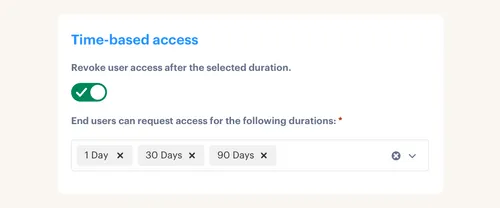
Multiplier also supports time-based access, where requesters choose a duration like 1, 6, or 24 hours. After approval, access is granted through the mapped identity provider group, then removed when the timer expires. That helps reduce standing access without relying on manual follow-up.
Access Reviews run inside JSM as campaigns with reviewer dashboards, user attributes, groups, last login data, and keep or revoke decisions. Revocations remove users from relevant identity provider groups and create Jira evidence around the change. Approvers can also act from Slack DMs for supported approval flows, which matters because the approval path has to match how people actually work. If the goal is to make Jira the governance record instead of another spreadsheet rebuild, Get started with Multiplier.
Make Credential Cleanup Part of the Workflow
Orphaned accounts and credential risk don’t go away because a policy says access should be reviewed. They go away when requests start in one governed path, approvals happen with context, provisioning runs through the identity provider, and revocation gets logged as part of the same workflow.
That’s the real shift. Stop treating credential cleanup as a quarterly project. Make cleanup part of the original access design, especially for role changes, contractors, sensitive apps, and temporary access. When access has a clean beginning, it’s much easier to give it a clean ending.
Frequently Asked Questions
How do I set up time-based access with Multiplier?
When submitting a request through the JSM portal or Slack, pick a duration — 1 hour, 6 hours, or 24 hours. Once approved, Multiplier provisions access and sets a timer. When the timer expires, access is revoked automatically. No manual cleanup required.
What if I need to revoke access quickly after a review?
If you need to revoke access quickly after a review, you can use Multiplier’s Access Review feature. Here’s how: 1) Launch an access review campaign in JSM, selecting the relevant applications and reviewers. 2) Reviewers will assess access and can mark users for revocation directly in the dashboard. 3) Once a decision is made, Multiplier will automatically remove the users from the relevant identity provider groups, ensuring that the revocation is logged in Jira for audit purposes. This streamlines the process and minimizes delays.
Can I customize the approval workflow in Multiplier?
Yes. Admins can map workflow statuses to "Waiting for Approval" and "Approved" in JSM, and set default approvers globally or per app — either the app owner or the user's manager. Approvals come through email or Slack, which means fewer lost requests and faster turnaround.
How do I track access requests and approvals in Multiplier?
Every access request creates a Jira ticket with the full trail: request, approval, provisioning result. Multiplier adds comments on success or failure, so admins always have a complete audit record in one place without chasing down context across tools.
When should I consider implementing Auto Reclaim?
You should consider implementing Auto Reclaim if you want to optimize your SaaS spend and manage licenses effectively. Here’s when to use it: 1) If you have a high number of inactive users or applications, Auto Reclaim can automatically identify and reclaim licenses based on login activity. 2) Set inactivity thresholds (e.g., 30 days) to trigger notifications and automatic revocation if users do not log in. 3) This feature is available exclusively on the Advanced edition of Multiplier, making it a valuable tool for organizations looking to streamline license management.


