


95% of the pain in access management is self-inflicted. Not because teams are lazy. Because they split one workflow across Jira, Slack, the identity provider, email, and a spreadsheet that somehow becomes the audit system.
If you were reducing manual tasks in IT this week, you probably felt it. A request came in through chat, approval got buried, someone had to remember the right Okta or Entra group, and now the ticket says “done” while the evidence lives in three different places.
Key Takeaways:
- Reducing manual tasks in IT usually fails when teams automate one step instead of the full access path
- The real bottleneck is the ITSM and IGA split, not a lack of policy
- If more than 25% of requests still need copy-paste group changes, your workflow isn’t actually automated
- Lean IT teams usually win with a Jira-native system, identity provider group mapping, and Slack approvals
- Time-bound access beats standing access when you want less risk without slowing people down
- Good audits are a byproduct of the workflow, not a quarterly reconstruction project
Why Reducing Manual Tasks in IT Usually Stalls Out
Reducing manual tasks in IT stalls out when teams automate the intake but leave approvals, provisioning, and evidence scattered across different tools. That creates a half-automated system that still depends on humans to glue everything together. And that glue work is where cycle time, mistakes, and audit mess pile up.

A lot of teams think the problem is volume. More employees. More apps. More tickets. Fair point. Growth absolutely creates pressure. But that's not the root issue.
The root issue is fragmentation.
Back when teams were 80 people, you could get away with this. Someone asks in Slack. IT pings a manager. An admin jumps into Okta. Maybe they leave a comment in Jira. Maybe they don't. At 80 people, it's annoying. At 400 people, it's broken. At 1,200 people, you're basically running access management by muscle memory.
You can see this in the customer stories. One fintech team had nearly 1,200 employees and access requests coming in through Slack, email, and Jira. IT had to chase approvals and manually assign Okta groups. Another team growing from 100 to 500 employees said Tuesdays became a flood of repetitive access requests because new hires needed apps, elevated permissions, and special cases all at once. Same pattern. Different company. Fragmented workflow, manual cleanup, constant interruption.
The hidden tax is context switching, not just labor
Most IT leaders underestimate how much time gets burned just moving between systems. Not even doing the hard part. Just switching tabs, checking who approved, confirming which group to use, then documenting what happened after the fact.
I call this the swivel-chair tax. If one request requires Jira for the ticket, Slack for the nudge, Okta for the action, and a sheet for evidence, you don't have one workflow. You have four partial workflows pretending to be one. If that sounds harsh, good. Because that's usually what's happening.
A simple threshold helps here. If a standard SaaS access request takes more than 5 minutes of human handling after approval, the workflow is still manual. If it takes 10 to 15 minutes, you've got an operational problem, not just an admin task.
Picture a Workplace Tech lead at 10:15 a.m. They open Jira and see 27 requests. Nine are waiting on approvals. Six were approved in Slack but not reflected clearly in the ticket. Four need temporary admin access for an incident. Three are for apps no one properly owns. Before lunch, they've done almost no strategic work, but they've touched five systems and still can't say with confidence what got granted, what expires, and what evidence exists. That's the kind of week that wears people down fast.
That's why reducing manual tasks in IT can't mean “add a bot” or “make a nicer form.” It has to mean collapsing the workflow into one operating system. Otherwise the busywork just changes shape. Want to see what the better shape looks like? Learn more about Multiplier
The Real Problem Is the ITSM and IGA Split
The real problem isn't that teams lack policy. It's that policy lives in one place while operational work lives somewhere else. ITSM handles intake well. Traditional IGA handles controls well. But the gap between them is where access slows down and least privilege quietly falls apart.
This is the part a lot of vendors skip over.
They'll say you need stronger governance. More review. More control. More policy. Sure. In theory. But policy-heavy approaches without operational enforcement don't hold up well in the real world. If your team still has to manually translate an approved request into the right group change, you're relying on discipline, memory, and goodwill. That's fragile.
And honestly, that's why so many least privilege programs stall. Not because the idea is wrong. Because the execution model is wrong.
Policy without execution creates standing access
Most teams don't end up with broad standing access because they love risk. They end up there because delayed access is expensive, manual expiry is unreliable, and people get tired of waiting. So they overgrant once and promise themselves they'll clean it up later.
Later rarely comes.
There's a good rule here. If temporary elevated access doesn't auto-revoke, it isn't just-in-time access. It's a calendar reminder pretending to be a control. That sounds blunt. But it's true.
A cybersecurity team at a fast-growing fintech used that exact logic. They wanted to cut long-lived privileged access because growth and customer expectations made the old model too risky. The answer wasn't just “review more often.” It was making elevated access temporary by design. That's a big difference.
Separate portals create adoption drag
There's also the portal problem. Teams already live in Jira and Slack. So when governance sits in a separate IGA tool, adoption drops. Requests start in one system, decisions happen in another, and evidence gets reconstructed later.
I've seen this movie before. A team tries the separate portal route because it sounds more enterprise. Six months later they're still nudging people in chat, screenshots are floating around, and IT is doing detective work before every audit. Critics of the Jira-native approach might argue a dedicated IGA suite offers deeper policy controls, and that's fair for very large, highly specialized environments. But if your day-to-day pain is slow approvals, manual provisioning, and messy evidence, depth in a separate tool doesn't solve the bottleneck. It can actually add one.
The best way to think about this is the Pipe Gap Model. Intake, decision, execution, evidence. Four stages. If even one stage happens outside the main system of work, manual tasks leak back in. If two or more stages happen outside it, the process won't scale cleanly.
That's why reducing manual tasks in IT isn't really a ticketing project or a governance project. It's a systems design problem. So what does a better system actually look like in practice?
How Lean IT Teams Actually Reduce Manual Tasks
Lean IT teams reduce manual tasks by standardizing the request path, pushing execution through the identity provider, and treating evidence as an output of the workflow. Not a separate project. That's the shift.
And no, this doesn't mean automating everything blindly. Some requests should still need a person. The trick is knowing where humans add value and where they just add delay.
Start with the 70-20-10 request split
Most access work doesn't deserve the same workflow. That's mistake number one. Teams run low-risk app access, sensitive admin roles, and weird edge cases through the same approval maze.
I prefer a simple framework here: the 70-20-10 split.
- 70% standard requests: low-risk, common app access, role-based, should be heavily automated
- 20% sensitive requests: elevated permissions or business-sensitive apps, should require explicit approval and fast provisioning
- 10% edge cases: unusual access, manual apps, exceptions, should stay visible and controlled
If you don't segment requests this way, your safest work gets slowed down by your riskiest work. And that means the queue grows for no good reason.
A good diagnostic test:
- Which requests happen every week?
- Which ones map cleanly to identity provider groups?
- Which ones create repeated follow-up questions?
- Which ones really need human judgment?
- Which ones should expire by default?
If your team can't answer those in 30 minutes, you're not ready for meaningful automation yet.
The before-and-after is pretty dramatic. Before, IT gets 100 requests, triages all 100 manually, chases approvers on half, and provisions most by hand. After, standard requests flow through a defined path, sensitive ones get the right approver fast, and only the true edge cases need extra handling. That's how you start reducing manual tasks in IT without creating new risk.
Build around group mapping, not app-by-app heroics
Provisioning gets easier when access roles map to identity provider groups. It gets messy when every app becomes its own little snowflake with tribal knowledge attached.
This sounds obvious. It's not. Plenty of teams still rely on “ask Sarah, she knows which group maps to Finance edit access.” That works until Sarah's in a meeting. Or on vacation. Or gone.
The practical rule is simple. If a role can't be mapped to a group, treat it as an exception and keep it visible. If it can be mapped, automate it. That one rule alone clears up a lot.
One AI company grew from 100 to 400+ employees in two years. Their IT requests were getting tracked in Slack and Notion, which turned every approval into a follow-up exercise. Once the workflow moved to an app catalog with automated approvals and provisioning, they processed 3,800+ access requests in a year and automated 75% of them with a four-person IT Ops team. That's not magic. That's structure.
A lot of people assume reducing manual tasks in IT means replacing thoughtful work with scripts. I don't buy that. What it really means is replacing repetitive judgment with pre-decided rules. Big difference.
Make temporary access the default for elevated roles
Elevated access should expire unless someone has a strong reason to make it permanent. Not the other way around. This is one of those ideas that feels strict until you run it for a month. Then it feels obvious.
The threshold I like is this: if an admin or production role is used for a task under 24 hours, default it to time-bound access. If the same person needs that role more than twice a week, review the job design before granting standing access. That isn't perfect for every org, but it's a much better starting point than open-ended privileges.
You also get a nice side effect here. Less cleanup. Because revocation isn't a separate to-do anymore.
Think about it like a hotel key card. You don't hand a guest permanent access to every room because reissuing keys is annoying. You issue access for the stay. Then it stops working. Access should work the same way for risky permissions. Short window. Clear purpose. Automatic end.
Some teams will say, “But during incidents, we need speed.” Totally fair. That's actually the case for doing this right. If time-based access is wired into the normal path, emergency grants can be fast without becoming permanent by accident.
Run reviews from live system data, not spreadsheet memory
Quarterly access reviews go sideways when reviewers get a CSV dump with no context and 300 names to rubber-stamp. People aren't lazy. They're overloaded. So they click through.
A better review has context. Last login. Role. Department. Group. Recommendation. And it should be tied to the same workflow system that handled the original grant.
This is where the 90-Day Drift Rule helps. If an app shows no meaningful login activity for 90+ days, it deserves either review or reclamation. Not because every inactive user is a risk, but because dormant access is where cost and exposure quietly pile up.
One thing that surprised me when I first saw well-run review programs: the speed doesn't come from pushing reviewers harder. It comes from removing ambiguity. Fewer judgment calls. Better signals. Cleaner actions. That's why the best review processes feel lighter, not heavier.
Midway through all this, you might be thinking: fine, good framework, but how do you actually run it without bolting on another tool your team has to learn? That's the right question. See how Multiplier works
Put one source of truth at the center
You need one record that captures request, approval, change, and evidence. One. Not a ticket plus a screenshot plus a side note in Slack plus a separate reviewer export.
When teams miss this, they create reconciliation work forever. Every audit. Every access dispute. Every offboarding mistake.
The Source-of-Truth Rule is simple:
- If approval isn't tied to the request record, evidence is weak
- If provisioning isn't tied to the request record, troubleshooting is slow
- If revocation isn't tied to the request record, least privilege drifts
- If reviews aren't tied to the request record, compliance becomes a reporting exercise
This is why governance inside the service desk makes so much sense for mid-market and high-growth teams. Work already happens there. Adoption is already there. The ticket is already there. So keep the governance there too.
And that's really the new way. Not more policy layers. Tighter operational design.
How Multiplier Automates Access Work Inside Jira
Multiplier reduces manual tasks in IT by keeping requests, approvals, provisioning, and evidence inside Jira Service Management instead of spreading them across separate tools. It works through your identity provider, supports Slack-based approvals, and turns the Jira issue into the system of record. That's what makes the workflow faster and easier to audit.
One request path, not five side channels
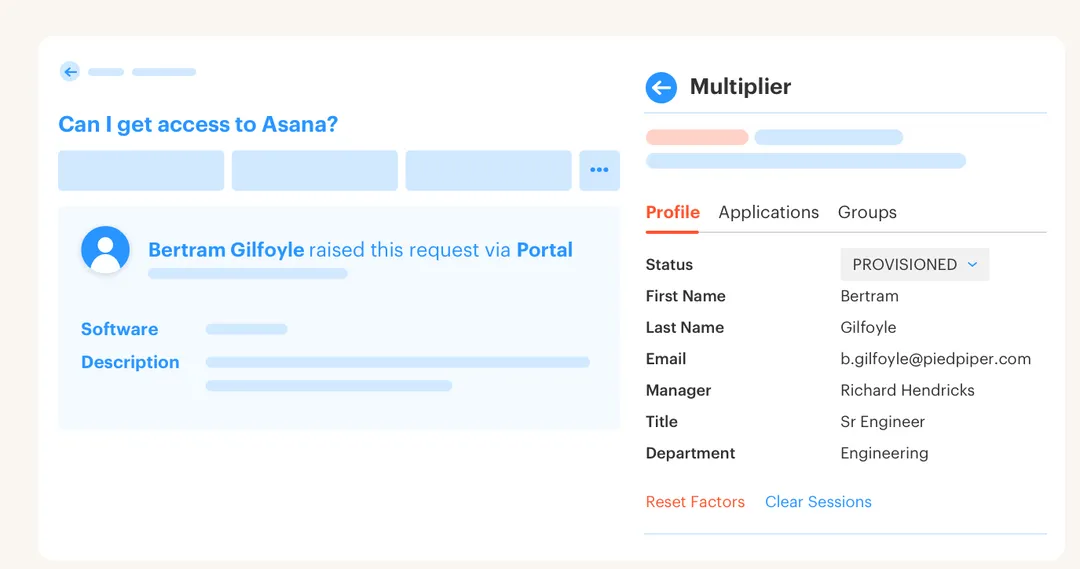
Multiplier's Application Catalog gives employees a Jira-native place to request sanctioned apps and roles, either in JSM or through the Slack app. Apps and groups sync from Okta, Entra ID, or Google Workspace, and each role maps to an identity provider group. That matters because it removes the “which group do I add?” guesswork that eats up so much admin time.
Approval Workflows then route the request to the right person, whether that's a manager, app owner, or specific user. Approvers can act in Jira or Slack, and the decision stays tied to the Jira issue. No separate approval trail to rebuild later. No buried email thread.
Together, those pieces give teams a single intake path for access requests, consistent approval routing, and a cleaner audit trail from the start. Instead of chasing requests across Slack, email, and forms, IT can centralize the process in Jira and use the same record to drive the next step.
Provisioning, expiry, and reviews happen off the same record
Once a request is approved, Multiplier can use Automated Provisioning via Identity Provider Groups to add or remove users from the mapped groups and write the results back to the Jira issue. That sharply reduces the manual copy-paste work that usually follows approval. It also keeps changes authoritative because provisioning runs through the identity provider, not through disconnected side processes.

For elevated roles, Time-Based Access makes the grant temporary by default. A requester can choose a duration like 1, 6, or 24 hours, and once that window ends, Multiplier removes the group membership automatically and records the change in Jira. If your least privilege model depends on humans remembering to clean up later, this is the part that changes the game.
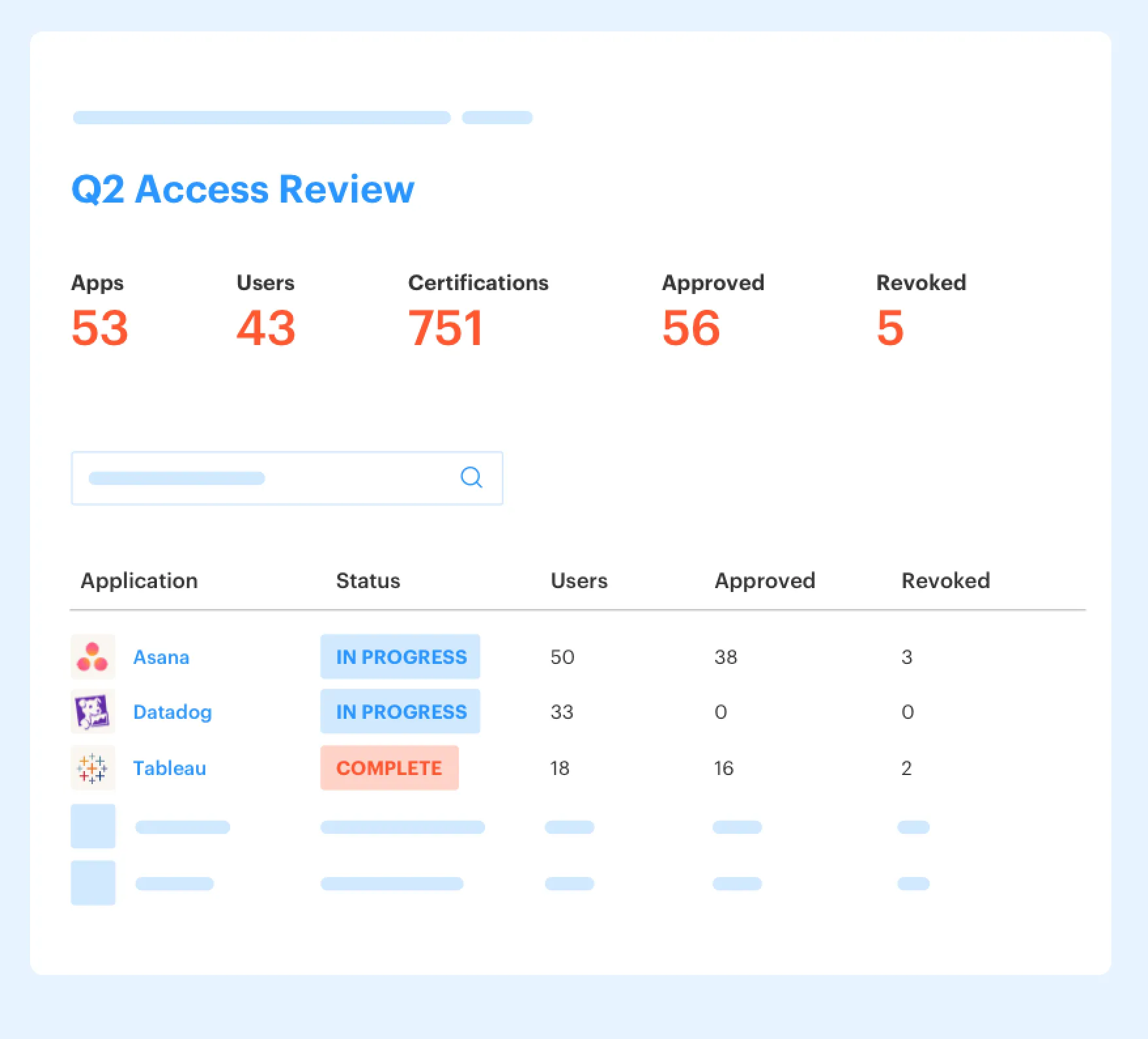
Multiplier also supports Access Reviews inside JSM, so teams can run certification campaigns with reviewer context like job title, department, group membership, and last login. Reviewers mark Keep or Revoke, and revocations can be enforced automatically through the identity provider with the evidence tied back to Jira. For SaaS cost control, Auto Reclaim can identify inactive users based on identity provider login data, warn them, and revoke access after the grace period. Worth noting, Auto Reclaim is available on the Advanced edition.
Why the Best Access Programs Feel Boring
The best access programs feel boring because the request path is clear, the approvals are predictable, and the evidence is already there when someone asks for it. That's the goal. Not more heroics. Less heroics.
Reducing manual tasks in IT is really about removing the little decisions and follow-ups that pile up all day. If your team is still chasing approvals, translating roles into group changes, and rebuilding audit evidence later, the process isn't mature yet. It's just busy.
The teams that get this right usually make three moves. They centralize requests in Jira. They execute changes through the identity provider. And they make temporary, reviewable access the default for anything sensitive.
Do that, and a lot of the noise disappears. Fast.
Frequently Asked Questions
How do I set up automated provisioning with Multiplier?
To set up automated provisioning with Multiplier, follow these steps: 1) Ensure your identity provider (like Okta or Azure AD) is integrated with Jira Service Management (JSM). 2) Use the Application Catalog to define which applications and roles will be available for requests. 3) Once a request is approved, Multiplier will automatically add or remove users from the specified groups in your identity provider. This integration reduces manual tasks and keeps your access management streamlined.
What if I need to revoke access for inactive users?
If you need to revoke access for inactive users, consider using Multiplier's Auto Reclaim feature. This feature automatically identifies users who haven't logged in for a specified period (like 30 days) and sends them a notification. If they remain inactive after the grace period, Multiplier will revoke their access and document the change in Jira. This helps optimize your SaaS spend and ensures that only active users have access to your applications.
Can I customize approval workflows in Multiplier?
Yes, you can customize approval workflows in Multiplier. Start by mapping out who should approve requests for different applications—this could be app owners, managers, or specific users. You can set default approvers globally or override them on a per-app basis. When a request is submitted, the approver will receive notifications in Jira or Slack, allowing them to approve or deny requests quickly. This keeps the process efficient and ensures that all approvals are documented in one place.
When should I use time-based access?
You should use time-based access for elevated roles that are needed temporarily. When submitting a request through Multiplier, requesters can choose a duration for access (like 1, 6, or 24 hours). This ensures that access is automatically revoked after the specified time, minimizing the risk of standing privileges. It's particularly useful for roles that are only required for specific tasks or during incidents, as it helps maintain a least privilege model while allowing flexibility.


