

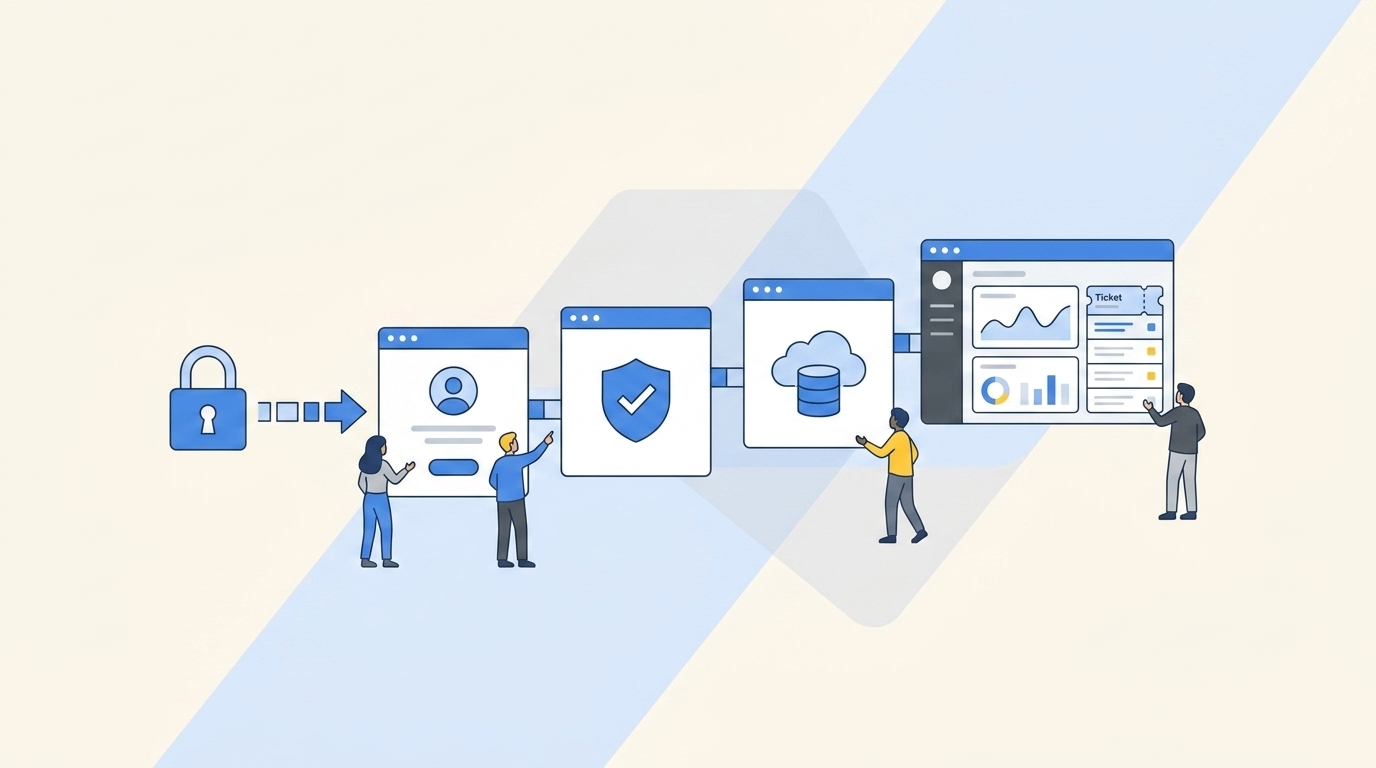
You can finish an SSO integration in 1 day and still leave IT chasing approvals the next morning. Most step-by-step SSO integration guides stop at SAML settings and call it done. That misses the part your IT team lives in every day: the handoff from request to approval to group change, and then the cleanup when access should end. That's where the backlog starts.
And that's where teams get tricked. They think the work is "integrate SSO with the apps." But the real work is making sure the request, approval, provisioning, expiry, and audit trail all stay connected.
Key Takeaways:
- SSO integration isn't finished when login works. It's finished when access changes are approved, provisioned, revoked, and logged in one place.
- If approvals happen in Slack but evidence lives in Jira, your process will break during reviews.
- A good access workflow starts with a sanctioned app catalog, not one-off tickets.
- Use identity provider groups as the control point, because they make provisioning and revocation repeatable.
- Time-bound access should be the default for elevated roles, especially admin access.
- Access reviews work better when the reviewer's decision triggers the revocation, not another task for IT.
- The fastest path is usually Jira + Slack + your identity provider, without forcing employees into another portal.
Why SSO Integration Breaks When Governance Leaves Jira
SSO integration breaks when teams treat authentication as the whole project. Login is only one layer. The bigger problem is the operational chain around access: who requested it, who approved it, what group changed, when access expires, and where evidence lives.

Login Works, But Access Still Spreads Everywhere
A lot of teams celebrate too early. They get SAML configured, users can sign in, and the app shows up in Okta or Entra. Great. But then someone asks for Admin access to Figma, GitLab, Snowflake, or a finance tool, and the process immediately leaves the clean SSO lane.
Picture a Workplace IT manager at 9:17 AM on a Tuesday. A new hire needs access, a PM needs elevated permissions for 24 hours, and Finance wants to know why a former contractor still has a paid license. The requests are in Jira, Slack, email, and maybe a shared spreadsheet. Two of them are missing the role. One has no app owner. One gets approved in Slack, then someone manually adds the user to an identity provider group and leaves a comment like "done."
That feels normal because it's how teams survive growth. A separate identity governance portal can make sense if you're a massive enterprise with a dedicated IAM team and months to implement. But for high-growth companies already running Jira Service Management, adding another portal often creates a second place to reconcile instead of a better way to work.
Policy Without Enforcement Is Just Documentation
The overlooked mistake is believing policy creates least privilege. It doesn't. Policy tells people what should happen, while automation makes sure it actually happens when tickets are flying around and everyone's busy.
This same pattern shows up in go-to-market teams too. The strategy doc is beautiful, the process makes sense, and then real life shows up. People skip steps, make exceptions, and do whatever gets the job done fastest. Access governance is the same. If the fastest path is asking in Slack and getting someone to manually add a group, that's what people will do.
A better test: pick 10 random access requests from last month and check whether each one has five things — request context, approver, group changed, timestamp, and revocation status if the access was temporary. If more than 2 of the 10 are missing any of those, your SSO integration with access governance is more fragile than it looks.
For teams that already see this Jira-to-Slack-to-IDP gap, the practical next move is seeing what that workflow looks like when the catalog and approvals stay tied to the ticket: Learn more about Multiplier.
The Hidden Cost Shows Up During Growth
Growth exposes every weak handoff. At 100 employees, IT can remember who owns which app. At 500 employees, the same system becomes a guessing game with more tickets, more exceptions, and more standing access than anyone wants to admit.
Videoamp hit a version of this when it grew from 100 to 500 employees. Tuesdays became the bad day because new hires started Monday, then the access queue filled up the next morning. The painful part wasn't just ticket volume. It was incomplete requests and unclear ownership, which meant IT had to chase context before they could even make a decision.
The lesson is direct. If your step-by-step SSO integration with Jira doesn't include intake, approvals, provisioning, and evidence, you haven't reduced the work. You've just moved it around.
How to Build SSO Integration With Jira That Actually Holds Up
A strong SSO integration with Jira starts by designing the access workflow before connecting every app. The sequence should be catalog, approval, group mapping, provisioning, expiry, and review. Skip that order, and you'll automate pieces of a process that's still broken.
Start With a Catalog Before You Touch Provisioning
The first decision is not technical. It's whether employees should ask for access through a controlled app catalog or through free-form tickets. If you allow both for too long, your data gets messy fast, because every requester describes apps, roles, and urgency differently.
A catalog forces structure. The employee chooses the approved app, then the role, then the duration if the app supports temporary access. That sounds basic, but it changes the quality of every downstream step. Instead of "need access to Salesforce," IT gets "Salesforce, Viewer, permanent" or "Salesforce, Admin, 6 hours." Different request. Different risk.
Use a simple threshold. If an app gets more than 5 access requests per month, put it in the catalog. Fewer than 5? Keep it manual until the pattern proves itself. This prevents the classic mistake of spending weeks cataloging every small tool while the biggest request drivers are still creating daily noise.
The before and after is stark. Before the catalog, IT reads the ticket, asks what role the person needs, checks who owns the app, waits, then provisions. After the catalog, the request already carries the app, role, approver, and routing logic. Not magic. Just better inputs.
Map Roles to Groups, Not People
A clean SSO provisioning model maps roles to identity provider groups. That's the part most teams underbuild. They connect apps to SSO, then keep assigning access person by person, which makes every future review harder.
The rule is simple. If a role can be requested more than once, it should map to a group. Viewer, Editor, Admin, Finance Approver, Support Lead, whatever your business calls it. The group becomes the repeatable control point, and the ticket becomes the record of why the user entered or left that group.
There's a catch. Not every app is ready for perfect group-based provisioning. Some non-SSO tools still need manual work, and pretending otherwise creates false confidence. Better to tag those apps as manual, still route the request through Jira, still capture approval, and only automate the apps where the identity provider can actually enforce the change.
For a step-by-step SSO integration with Okta, Entra ID, or Google Workspace, the working pattern looks like this:
- List the top requested apps by monthly ticket volume.
- Define 2 to 4 roles per app, not 12.
- Map each role to an identity provider group.
- Route each role to the right approver.
- Write the group change back to the Jira ticket.
That last step matters more than people think. Without the ticket update, the change happened, but the evidence is still scattered.
Put Approvals Where People Already Respond
Approval design is where a lot of SSO integration projects lose adoption. Employees request in Jira, managers live in Slack, app owners miss email, and IT ends up chasing everyone anyway. The "automated" process still becomes a human reminder system.
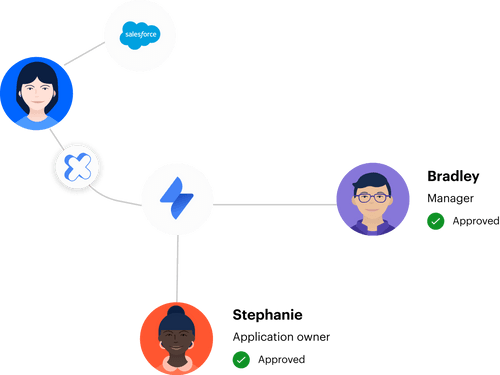
The better mechanism is to route the decision to the person who owns the risk, in the place they'll actually answer. Low-risk tools go to a manager. High-risk roles go to an app owner. Sensitive admin access might need a named security approver or a multi-stage Jira workflow. The point isn't to make every request heavy. The point is to make the approval match the blast radius.
Use a 3-bucket rule. Auto-approve low-risk apps where access doesn't expose customer data or admin actions. Manager-approve normal business apps where role fit matters. App-owner or security-approve anything with production, financial, HR, or admin exposure. If you can't place an app into one of those buckets in under 2 minutes, the app owner model probably isn't defined clearly enough yet.
Synthesia is a good example of why this matters. Their IT team was dealing with 4x headcount growth, Slack requests, and Notion tracking. Once they moved to a Jira-based catalog with Okta-backed automation, they processed 3,800+ access requests in a year, with 75% fully automated. Four people supporting 420+ employees. That's the kind of ratio you only get when approvals and provisioning stop being separate chores.
The middle of the project is where teams usually need to see the handoffs, because that's where the waste hides: See how Multiplier works.
Make Temporary Access the Default for Risky Roles
Permanent access is the path of least resistance when the system doesn't make expiry easy. Someone needs Admin for an incident, IT grants it, the incident ends, and nobody circles back because 11 other tickets landed.
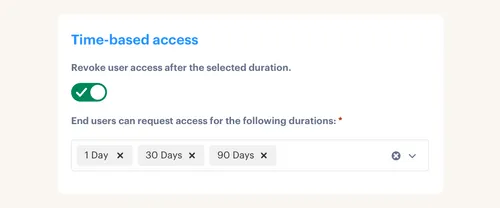
A stronger SSO integration with Jira treats elevated access like a timer, not a status. The requester chooses 1 hour, 6 hours, 24 hours, or whatever windows make sense for your team. Approval grants access by adding the user to the right identity provider group. When the timer ends, the system removes the group membership and writes the change back to the Jira issue.
Use a hard threshold. Any role with admin rights, production access, financial data, employee data, or customer data should be time-bound by default. If someone wants permanent access to one of those roles, require a stronger reason and a named owner. That doesn't block work. It makes standing privilege the exception instead of the default.
There's a real tradeoff here. Temporary access can annoy engineers or operators if the windows are too short. The fix isn't to abandon the model. Start with longer windows for high-friction teams, then shorten them once you understand the actual usage pattern. Better a 24-hour expiry that works than a 1-hour policy everyone tries to bypass.
Treat Access Reviews as a Workflow, Not a Quarterly Spreadsheet
Access reviews fail when they only produce decisions. "Keep" and "revoke" are useful, but they're not enough if the revocation becomes another task for IT to chase. The review has to connect the reviewer's decision to the identity provider change.
The diagnostic is easy. After your last access review, how many "revoke" decisions were completed within 5 business days? If the answer is below 90%, the review process is creating risk faster than it removes it. You found the stale access, but you didn't close the loop.
A better review flow starts with app scope, reviewer assignment, user context, decision, enforced change, and evidence. Reviewers need last login, department, title, group membership, and some kind of recommendation, because otherwise they rubber-stamp. The revoke action should remove the user from the mapped group and log the action back to Jira. Clean chain.
Luno had a version of this pain at scale. Nearly 1,200 employees, hundreds of routine access requests, and IT manually assigning Okta groups after chasing approvals. Once they put access requests through Jira and Slack with automated provisioning, they cut IT workload on access requests by 80%. That's not just faster tickets — it's fewer loose ends for audit and fewer manual chances to get it wrong.
Build the Rollout in Stages, Not as a Big Bang
The safest way to roll out SSO integration with Jira is to start narrow. Pick the highest-volume apps first, prove the request-to-approval-to-group-change flow, then expand into time-bound access and reviews. Trying to fix every app, role, and edge case at once usually creates a long project with no visible win.
Start with 10 to 20 sanctioned apps. Not 100. Choose apps with clear owners, known roles, and enough request volume to matter. Then set a weekly operating review for the first month. Look at request volume, approval time, failed provisioning, missing owners, and manual exceptions.
A practical 30-day rollout looks like this:
- Week 1: Build the catalog for the top requested apps.
- Week 2: Map roles to identity provider groups.
- Week 3: Route approvals through Jira and Slack.
- Week 4: Turn on provisioning for low-risk roles, then review failures.
When the first 20 apps work, you have a repeatable model. When every app is half-configured, you have a project plan and a lot of meetings.
How Multiplier Automates Access Governance
Multiplier makes SSO integration with Jira practical by keeping the request, approval, provisioning action, and audit trail in Jira Service Management. Employees request access through Jira or Slack, while provisioning runs through Okta, Entra ID, or Google Workspace groups.
Jira-Native Intake and Slack Approvals
Multiplier starts with the Application Catalog inside Jira Service Management. Employees browse approved applications, choose the right role, and submit the request from the JSM portal or Slack. The request starts with structured data instead of a vague ticket — app, role, requester, approver, and status all live together.
Multiplier approval workflows route requests to managers, app owners, or specific users. Approvers can act in Jira or Slack, and the decision stays connected to the Jira issue. For teams trying to stand up a self-service app catalog in days, that's the practical win. No separate portal training. No side-channel approval that someone has to screenshot later.
Once approved, Multiplier provisions through identity provider group mappings. The role maps to one or more Okta, Entra ID, or Google Workspace groups, and the group change is recorded on the Jira ticket. Login is connected to the access decision, not floating beside it.
Time-Bound Access, Reviews, and License Cleanup
Multiplier also supports Time-Based Access for just-in-time requests. A requester can choose a duration like 1, 6, or 24 hours, and after approval, Multiplier adds the user to the mapped identity provider group. When the window expires, it removes the group membership and records the change in Jira. That's how least privilege becomes an operating habit instead of a policy document.

Access Reviews run in Jira too. Reviewers see user attributes, groups, last login, and recommendations, then decide whether access should stay or be revoked. When revocation is selected for supported group-based access, Multiplier removes the user from the identity provider group and creates the Jira evidence trail. No spreadsheet handoff.
Auto Reclaim adds another layer for SaaS waste. On the Advanced edition, Multiplier uses identity provider login telemetry, inactivity thresholds, grace periods, and exclusions to revoke unused access and generate a Jira ticket. If you want the Jira-native version of the workflow instead of another portal beside it, Get started with Multiplier.
Make Access Governance Easier to Run
A step-by-step SSO integration with Jira should reduce access work, not create a prettier version of the same manual process. The real test is whether requests, approvals, group changes, expiry, reviews, and evidence stay connected without IT becoming the glue.
Start small. Pick your top requested apps, map the roles, route approvals where people respond, and make risky access temporary. Once that works, expand. The goal isn't a perfect governance diagram. The goal is a system where the right access happens fast, the wrong access expires, and audit evidence gets created while the work happens.
Frequently Asked Questions
How do I set up time-based access with Multiplier?
Check that the application is configured for time-based access in the catalog. When submitting the request, pick a duration — 1, 6, or 24 hours are standard options. Once approved, Multiplier adds the user to the identity provider group and starts the timer. When it expires, the access is removed and the change is written back to the Jira ticket automatically.
What if I need to revoke access quickly?
Find the Jira ticket tied to the access request. Use the access review feature to mark the user for revocation. Multiplier removes the user from the identity provider group and logs the change in Jira. The whole thing is done in minutes and leaves a clean audit trail without any manual cleanup.
Can I customize the approval workflow in Multiplier?
Yes. In the admin settings inside Jira Service Management, you can map workflow statuses to specific approvers — app owner, manager, or a named security reviewer. You can set defaults globally or override them per app. So a low-risk SaaS tool routes to a manager, while a production system goes to the security team.
When should I use the Application Catalog in Multiplier?
Use it when access requests are still coming in as free-form tickets or Slack messages. The catalog gives employees a clean way to pick an app, choose a role, and submit a structured request. It's especially useful when you have multiple apps with different access levels, because it makes sure every request has the right context before it hits an approver.
Why does my access request need to be routed through Jira?
Because Jira is where approvals actually happen, which means the request, decision, provisioning action, and audit evidence all live in one place. If approvals happen in Slack and evidence lives somewhere else, those records get out of sync. Keeping it in Jira means reviewers can see the full history without chasing anyone.


