


72 hours before an audit, your access process tells on you. And if you were Googling steps to prepare for an audit this week, there’s a good chance the real problem isn’t policy at all — it’s that approvals, provisioning, and evidence are living in four different places and pretending to be one system.
If you're looking for steps to prepare for an audit, or steps to prepare for access reviews, the instinct is usually to tighten policy docs first. I think that's backwards. Most teams don't fail audits because they lack policy. They fail because the evidence trail is broken in practice.
Key Takeaways:
- The fastest steps to prepare for an audit start with workflow mapping, not policy rewriting
- If access requests live in more than 2 systems, audit prep will get painful fast
- A simple 4-layer prep model works best: intake, approval, provisioning, evidence
- Time-bound access should be the default for elevated roles if you want least privilege to hold up under review
- Access reviews break when ownership is vague, reviewer data is thin, or revocations stay manual
- Audit readiness gets easier when governance lives in Jira instead of a separate portal
- You can cut a lot of prep work by making evidence a byproduct of normal work, not a quarterly scramble
Why Most Audit Prep Starts in the Wrong Place
Audit prep usually goes sideways the moment teams treat policy language like the main event. It isn’t. The real issue is whether requests, approvals, provisioning, and revocations happen in a way you can actually prove later without opening six tabs and reconstructing history like a detective with bad coffee.

A lot of teams assume the hard part is documenting controls. Fair. You do need that. But the pain usually shows up somewhere much less glamorous — when somebody asks, "Who approved this access, when did it expire, and where is the evidence?" and the answer is split across Slack, Jira, Okta, and a spreadsheet that no one wants to admit still exists.
Picture a pretty normal Tuesday. At 8:14 AM, an IT admin gets a Slack message from an engineering manager asking for Jira, GitLab, Figma, and a production read-only role for a new hire starting at 9. Approval happens in a DM. The admin makes the Okta group changes manually, plans to update Jira later, then gets pulled into two other tickets. Three months later, during review season, nobody can tell whether the production access was temporary or permanent. That’s not a control failure first. It’s a workflow failure wearing a control costume.
I’ve seen this pattern over and over in high-growth teams. The service desk works in one place. Identity changes happen somewhere else. Evidence gets rebuilt at the end. At 50 employees, that feels annoying but survivable. At 400, it behaves more like a badly wired circuit panel — one extra load and the lights flicker everywhere. One fast-growing AI company processed more than 3,800 access requests in a year and only got 75% of them fully automated after standardizing the flow. Before that, the team was burning time chasing approvals through Slack and Notion.
And look, there’s a reason teams tolerate the mess. Separate governance tools really can offer stronger policy controls, richer certifications, deeper segregation logic. That’s valid. In complex environments, those features matter. But if the day-to-day work still starts in Jira and ends in your identity provider, another portal often adds one more handoff instead of one more control. More knobs. More drift.
The Prep Surface Model is a simple way to think about this. If you have a gap in any of these four layers, audit prep gets ugly:
- Intake: where the request starts
- Approval: who signed off and where
- Provisioning: what changed in the identity provider
- Evidence: what record ties it all together
Miss one, and you're stitching history together by hand. That’s the hidden tax. So if those are the fault lines, what are the actual steps to prepare for an audit in the right order?
The Steps to Prepare for an Audit Actually Matter in This Order
The steps to prepare for an access audit work best when you sequence them by evidence risk, not by org chart. Start where proof breaks first. Then fix the operating model underneath it. That’s how you stop audit prep from becoming a quarterly archaeology project.
Map the request path before you touch policy docs
Start with diagnosis, not doctrine. Before rewriting anything, run the Five-Point Trace on five recent requests: one new hire bundle, one privileged request, one contractor request, one app request with approval, and one offboarding or transfer.
For each one, answer five questions:
- Where did the request start?
- Who approved it?
- Where was provisioning executed?
- Was there a time limit?
- Where does the evidence live?
What usually happens? Drift shows up immediately. Teams say intake happens in Jira, but two of the five requests started in Slack. They say approvals are standardized, but an app owner waved one through in email. They say provisioning is tracked, but only if the admin remembered to leave a comment. Basic? Sounds that way. Diagnostic? Absolutely.
Here’s the threshold that matters: if 20% or more of your sample can’t answer all five questions cleanly, stop. Don’t rewrite policy yet. Fix the workflow first. Because if the request path is fuzzy on a sample of five, it will be chaos at scale.
A mid-market fintech team hit exactly this. They were manually processing hundreds of routine access requests, chasing managers for approvals and then logging into Okta to make changes one by one. Before: fragmented intake, slow approvals, thin evidence. After they standardized the flow, the audit conversation changed from “can we prove this?” to “how quickly can we pull it?” Big difference. If you want real steps to prepare for an audit, this is where the honest work starts.
Identify standing access that should have expired already
Next, go hunting for access that outlived its reason to exist. This is where least privilege usually stops being a principle and starts becoming a cleanup project.
Sure, review admin roles. But go wider. Look at any access granted for a project, an incident, a migration, a contractor engagement, or some “temporary” business need that quietly turned permanent because nobody circled back. Having been granted for a short-term reason, it should carry a short-term lifespan too. If it has no expiry, assume it’s standing access until proven otherwise.
The 24-Hour Rule works well here. If elevated access is rarely needed for more than 24 hours, it should default to time-bound access. If it’s needed daily for normal work, classify it as a permanent entitlement and put it on a scheduled review track. If X, then Y. Simple. Useful.
One fintech company cleaning up privileged access after acquisitions had the classic problem: long-lived privileged roles stayed in place because manual cleanup was annoying, and annoying tasks are the first ones to get postponed. Once they moved to a just-in-time model, privileged access dropped by 85%, and more than 1,300 requests were auto-revoked after approved windows. Better security, yes. But also much better proof.
Now, fair warning. Time-based access only works cleanly when provisioning runs through identity provider groups. If your process still relies on manual grants in oddball systems, auto-revocation won’t magically save you. Still, that’s the point of this step: it shows you exactly where your control boundary actually is, not where you wish it was.
Assign review ownership by app, not by committee
Then fix ownership. Because access reviews don’t fail only from bad tooling. They fail from social ambiguity.
Here’s how that usually plays out. Security thinks IT owns the review. IT thinks the app owner owns it. The business manager assumes someone else is checking usage. Then the quarterly review turns into a committee meeting without decisions, which is really just a slower version of nobody owning it.
Use the App Owner Rule:
- If app risk is low and user count is high, route the review to the app owner
- If access is role-based and tied to a team manager, route the review to the manager
- If the app is sensitive or cross-functional, assign a named reviewer, not a team alias
Named ownership beats shared responsibility every time. Committees generate comments. Owners generate dispositions.
And give reviewers context or the whole exercise becomes theater. A username and app name won’t cut it. Group membership, department, title, and last login will. NIST’s least privilege definition is clear on the principle, but principles don’t revoke access — informed reviewers do. So one of the smartest steps to prepare for an audit is making sure reviewers can actually see enough to make a defensible call.
Build an evidence chain that survives the "prove it" question
Now decide what counts as evidence. One system. One chain. One record an auditor can follow without needing a narrated tour from your team.
This is where separate IGA portals often lose me. Not because they never work — they can, and in some enterprises they’re the right choice. But if your operating reality is Jira for requests and your identity provider for execution, then a separate evidence layer can turn into one more reconciliation task. And reconciliation is where confidence goes to die.
Use the Evidence Chain Rule:
- The request record should show who asked
- The approval record should show who approved
- The provisioning record should show what changed
- The revocation or review record should show what happened later
If one of those exists only as a screenshot, you don’t really have evidence. You have a souvenir.
That distinction matters more than people think. Screenshots are like taking a photo of a server light and calling it observability. Nice to have? Maybe. Verifiable system evidence? Not really. Good evidence is event-based, timestamped, linked to the originating record, and difficult to dispute. CIS Controls keeps coming back to that same idea: implemented controls need to be verifiable, not just described.
Run a mini review before the real review
Before the real campaign, run a small one on purpose. Pressure testing beats optimism.
Use the 10-10-10 drill:
- 10 users
- 10 apps
- 10 revoked or challenged entitlements to inspect closely
Small tests are useful because they expose failure points without creating a full-blown mess. Broken routing. Missing owners. Stale group mappings. Thin reviewer data. You’re not trying to prove completeness yet. You’re trying to find where the process tears under tension.
One advertising company that grew from 100 to 500 employees ran into a familiar Monday-morning problem: new hires started, access requests piled up, and IT got flooded with tickets missing the details needed to act. After centralizing sanctioned apps in a Jira-native catalog and tightening the request flow, they processed 500-plus app requests in six months and saved more than 70 hours of IT time. That’s efficiency, sure. But it’s also upstream audit prep. Cleaner intake leads to cleaner evidence.
And yes, a mini review won’t catch everything. That’s true. But if your sample already shows missing approvals, vague ownership, or access that should have expired, scaling the same broken process won’t make it mature. It’ll just make it louder. So once you know the steps to prepare for an audit, how do you make them stick without adding another layer of admin theater?
A Better Way to Prepare Without Adding Another Portal
The cleanest prep model doesn’t pile on another system. It puts governance inside the system your team already uses. That’s the shift. Not more process. Better placement of the process, so the proof gets created while the work happens.
Keep intake and approvals where work already happens
Identity governance should live where people already do the work. For a lot of teams, that means Jira. Strong take, I know. Still think it’s the right one.
When employees already use Jira Service Management for requests, and approvers spend most of their day in Slack, sending access governance into a separate portal creates friction exactly where friction does the most damage. People route around it. They DM instead. They say they’ll log it later. Later never has great attendance.
You can see the pattern in fast-growing companies. One team scaled to more than 420 employees with a four-person IT Ops group after standardizing access through an app catalog, approvals, and automated provisioning. The point isn’t just speed. It’s fewer breakpoints. Fewer places for the evidence trail to snap.
The Jira-First Rule is pretty straightforward:
- If employees already use JSM for requests, keep access intake there
- If approvers are easier to reach in Slack, approve there but anchor it to the ticket
- If the identity provider is authoritative, execute changes there
- If evidence matters, write the trail back to Jira
That’s the loop. Tight. Traceable. Way harder to mess up. And if you’re serious about steps to prepare for future audits, reducing handoffs is usually more valuable than adding another dashboard.
Use the identity provider as the execution layer
This is another place teams get themselves in trouble. They treat the service desk like the system of action. It isn’t. It’s the system of coordination.
Your identity provider should be the execution layer for provisioning and deprovisioning. When role mapping is group-based and those groups control downstream app access, the change becomes authoritative. Faster, too. Cleaner from an audit standpoint. Cleaner from an operations standpoint.
Now, there’s a legit exception. Some environments have weird legacy apps, edge-case systems, or manual grants that don’t fit neatly into group-based provisioning. That’s real. Nobody should pretend otherwise. But that’s an argument for isolating exceptions, not for making the exception the operating model.
Use the 25% Split Rule. If more than 25% of your in-scope apps still rely on one-off manual provisioning, break your prep into two tracks:
- Track A: apps provisioned through the identity provider, where automation and stronger evidence are realistic
- Track B: manual or non-SSO apps, where approvals and reviews still apply but follow-up needs to be explicit
That one split keeps teams from overestimating how automated they really are. False confidence is worse than visible debt because it passes the meeting and fails the audit.
Turn least privilege into an operational default
Least privilege fails when it stays philosophical. Everyone agrees with it. Very few teams build it into defaults.
The better move is operational. Elevated access should expire unless there’s a clear case for permanence. Reviews should happen in the same system where the request and approval were logged. Revocation should be a workflow outcome, not a reminder task somebody sees three weeks later and swears they’ll get to after lunch.
Think about it like airport gate control. You don’t rely on a written memo to stop someone from walking onto a plane. The gate, the scanner, the boarding logic — that’s what enforces the rule. Access governance works the same way. If your team has to remember the control every single time, the control is already on borrowed time.
If your team has to remember the control, the control is weak. That’s the whole game.
Prepare for audits by making evidence a byproduct
This is the shift that changes the emotional texture of the work. Audit prep stops feeling like archaeology and starts feeling like retrieval.
When evidence gets produced as the work happens, audits get boring. In a good way. No heroics. No late-night spreadsheet cleanup. No one screen-sharing Slack threads and hoping the timestamps line up. Just records.
The best test is brutally simple: if an auditor asks for one access request, one privileged grant, and one quarterly review decision, can you show the full chain in under five minutes? If not, your issue isn’t really the audit. It’s workflow design.
That’s why I think the old split between ITSM and IGA can become such a drag in practice. One side owns the ticket. Another owns the policy. A third handles the identity change. Then somebody has to stitch the story together later. You can run it that way. Lots of teams do. But the better steps to prepare for an audit usually involve fewer disconnected systems, not more.
How Multiplier Makes These Prep Steps Easier in Jira for Steps to prepare for
Multiplier makes these prep steps easier by keeping requests, approvals, identity changes, and evidence tied to the Jira workflow your team already uses. That’s the real value. You don’t prepare for audits in one place and run operations in another.
Standardize intake, approvals, and provisioning in one flow
Multiplier's Application Catalog gives employees a Jira-native self-service way to request sanctioned apps and roles through JSM or Slack. Small detail on paper. Huge deal in practice. Standardized intake is where cleaner steps to prepare for an audit begin, because the request starts in one repeatable flow instead of five improvised ones.

Then the Approval Workflows route decisions to the right person, whether that's a manager, app owner, or specific user. Approvers can act in Jira or Slack, and the decision stays tied to the ticket. Multiplier's Slack App keeps the approval step fast without breaking the record. That solves a very old problem: approvals happen in chat, but evidence shouldn’t disappear there.

Once approved, Multiplier can use Automated Provisioning via Identity Provider Groups to add or remove the user from mapped groups in Okta, Entra, or Google Workspace. That matters because provisioning isn’t left hanging as a separate manual task. The ticket, approval, and change stay linked. If you’re trying to improve the steps to prepare for an audit, that linkage is the whole point.
Enforce expiry, run reviews, and keep the evidence trail clean
Multiplier also helps on the back half, which is usually where least privilege gets fuzzy and review evidence gets thin.
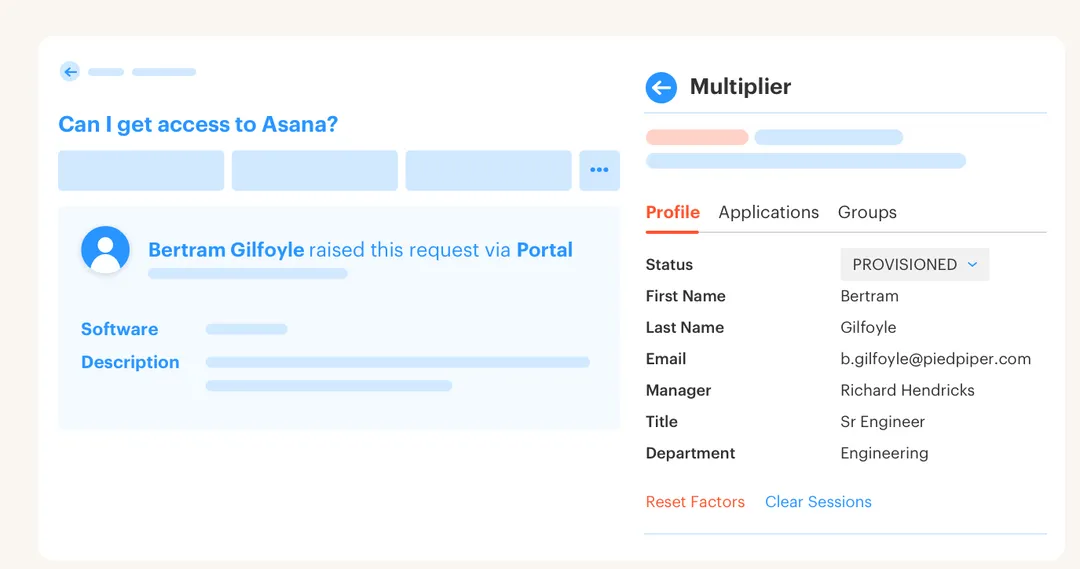
Time-Based Access makes temporary access operational instead of aspirational. A requester can choose a duration like 1, 6, or 24 hours, and when the window expires, Multiplier removes the user from the mapped identity provider group and records that change in Jira. That directly addresses the standing-access problem that tends to show up during reviews.
For certification cycles, Access Reviews run in Jira instead of spreadsheets. Reviewers get context like user attributes, groups, department, job title, and last login, then mark Keep or Revoke. Revocations can execute automatically through the identity provider group mapping, and campaign progress stays visible. Multiplier can also support Auto Reclaim for license reclamation based on identity provider login telemetry, which helps when part of your steps to prepare for an audit is proving you actually remove unused access instead of just saying you do.
If you want to see what that looks like in your own Jira environment, Get started with Multiplier.
The Teams That Prepare Best Usually Changed the Workflow Months Earlier
The best steps to prepare for an audit are boring on purpose. Map the request path. Kill standing access where it doesn’t belong. Assign named owners. Make the identity provider do the change. Keep the evidence chain in Jira.
That’s why I don’t think audit prep is really an annual project. It’s a workflow design problem that finally gets noticed when the auditor shows up.
If your access process already lives in Jira, Slack, and your identity provider, governance should too. Not beside it. Inside it.
Frequently Asked Questions
How do I streamline access requests for new hires?
To streamline access requests for new hires, you can use Multiplier's Application Catalog within Jira Service Management. Start by setting up a self-service portal where new employees can browse approved applications and roles. This allows them to submit requests directly through Jira or Slack, ensuring all necessary context is captured upfront. Once requests are submitted, Multiplier automates the approval workflow, routing decisions to the right approvers without leaving Jira. This reduces manual overhead and speeds up the onboarding process.
What if I need to revoke access quickly?
If you need to revoke access quickly, consider implementing Multiplier's Time-Based Access feature. This allows you to set temporary access durations during the request process. Once approved, access is automatically provisioned and will expire after the specified time, eliminating the need for manual follow-ups. If a user requires an extension, Multiplier can automatically extend access without requiring re-approval, making it easier to manage access efficiently and securely.
How do I ensure evidence is captured during access requests?
To ensure evidence is captured during access requests, leverage Multiplier's integration with Jira. Every request, approval, and provisioning action is logged within the Jira ticket, creating a complete audit trail. Make sure to use the Approval Workflows feature to route decisions through Jira or Slack, as this keeps all evidence tied to the original request. This way, when an auditor asks for proof, you can easily provide a verifiable record without needing to stitch together information from multiple sources.
Can I automate access reviews with Multiplier?
Yes, you can automate access reviews using Multiplier's Access Reviews feature. Start by creating an access review campaign in Jira, selecting the applications you want to include. Assign reviewers for each app, and launch the campaign. Reviewers will receive notifications and can mark access as 'Keep' or 'Revoke' directly within Jira. Multiplier will automatically remove users from relevant identity provider groups based on the reviewers' decisions, ensuring that the process is efficient and the evidence is documented in one place.


