


79% of access work at high-growth companies is repetitive, and you probably felt that this week. New hire starts Monday, by Tuesday your Jira queue is jammed, Slack is full of pings, and somebody on the team is still clicking around Okta like it’s 2018.
When people talk about the importance of automation in IT, they usually frame it as a speed story. That’s incomplete. The real importance of automation in access management is control at scale. Automation changes the kind of IT org you can run: leaner team, tighter least-privilege enforcement, cleaner audit trails, less human cleanup debt.
Key Takeaways:
- The importance of automation in access management is not just faster fulfillment. It’s tighter control with less operational drag.
- If approvals live in chat, provisioning lives in the IDP, and evidence lives in spreadsheets, the process is already split-brain.
- Use a simple rule: if a request is repeatable, low-risk, and group-mapped, automate it.
- Chat bots and SaaS tools can improve intake, but without expiry and evidence they don’t deliver real governance.
- Teams that automate the bulk of access requests can stay lean even as headcount climbs fast.
- Access reviews get dramatically better when reviewers see usage context and revocation happens in the same workflow.
- Least privilege only holds at scale when revocation is automatic, not dependent on someone remembering later.
Why Most Access Processes Break as Headcount Grows
Access workflows usually break long before anyone says the system is broken. Not at 5,000 employees. Usually around that messy middle, when growth is real, headcount is rising, and the same two people in IT are suddenly doing traffic control all day.

The queue problem shows up before leadership notices
An access problem rarely starts as an “access problem.” It starts as fragmentation. Requests come through Jira, Slack, email, hallway messages, and manager drive-bys. Approval happens somewhere else. Provisioning happens in Okta or Entra. Audit evidence gets patched together later, usually by the person who should be doing higher-value work.
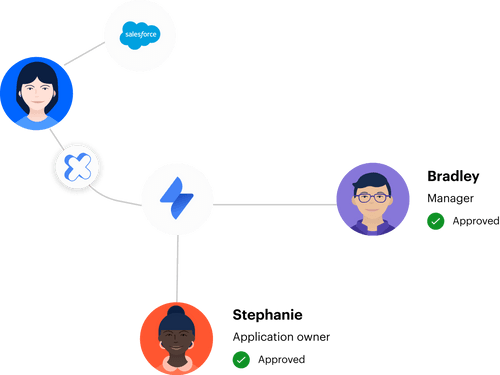
That setup can survive for a while. Then growth hits and all the seams start showing. Synthesia, for example, scaled from roughly 100 to 400+ employees in about two years, and the IT team still had to keep security and compliance intact while request volume climbed. That’s where the importance of automation in access management becomes painfully obvious. Too many handoffs. Too many chances for the process to go soft.
Picture a workplace tech lead at 9:12 a.m. They’re triaging 14 fresh Jira tickets, answering three Slack nudges from managers, and digging through a spreadsheet because audit still wants proof from last quarter. By 12:03, no systems work is done. No process improvement. Just routing, copying, checking, pasting. The role has quietly turned into air traffic control for permissions.
And that’s the real tell: once access work starts consuming your builders, the process is no longer administrative. It’s architectural debt. So where, exactly, does it start compounding?
The hidden tax is context switching, not approval itself
Four tool touches is the line I’d watch. Above that, the process starts bleeding time in places leadership never sees.

The approval itself? Often under a minute. The expensive part is the switching. I’d call this the Context-Switch Tax. Count every system a person touches for a standard request. If a normal request takes more than 4 tool touches, don’t kid yourself — it won’t scale cleanly.
Here’s the usual ugly pattern, step by step:
- Employee asks in Slack or a portal
- Manager approves in email or chat
- IT checks the right group in Okta or Entra
- Admin provisions manually
- Someone drops evidence into a ticket comment
- Nobody sets expiry
Six touches. Before exceptions. Before escalations. Before someone picks the wrong group because the naming convention is a crime scene.
Now, fair point: manual handling can feel safer when the request volume is still low. That instinct isn’t irrational. Human review does catch edge cases. But once you cross roughly 25 to 40 recurring access requests per week, manual work stops being careful and starts being inconsistent. Same people. Same intentions. Lower reliability.
Manual access is like running a relay race where every baton pass happens in a different building. Nobody drops it on purpose. Doesn’t matter. Enough handoffs, and the whole thing slows down anyway. Which is why the next failure mode is even more dangerous.
Manual governance creates standing access by accident
Standing privilege usually isn’t a deliberate policy choice. It’s leftovers.
An engineer gets admin access during an incident. A finance analyst gets temporary billing access for quarter-end. A contractor gets elevated rights for “just this week.” In theory, somebody removes it later. In reality, later is a fake country. People never get there.
That’s why the importance of automation in governance is bigger than fulfillment speed. Slow fulfillment is annoying. Security drift is expensive. A fintech team like Stavvy saw this after growth and acquisitions increased the amount of long-lived privileged access in the environment. They moved toward a just-in-time model and reduced privileged access by 85%. That doesn’t happen because someone writes a cleaner policy PDF. It happens because the operating model changes so expiry is enforced by the system, not memory.
And yes, there are exceptions. Core platform operators may need standing access in specific environments. That’s valid. But exceptions should stay exceptions. If your temporary access routinely becomes permanent, you don’t have a governance model. You have cleanup debt with branding. So what does the better model actually look like?
The Importance of Automation in Access Management Is Control, Not Just Speed
Here’s the answer to that question: the importance of automation in access workflows is that it makes control repeatable. Speed is the visible outcome. Control is the operating advantage underneath it.
The 3-Bucket Rule tells you what to automate first
Before you automate anything, diagnose the request mix. Ask four questions: Is the request repeatable? Is risk low or moderate? Is there a clear approver? Is the entitlement mapped to an IDP group? Your answers tell you which bucket you’re really in.
That’s the 3-Bucket Rule.
- Bucket 1: low-risk, repeatable, group-mapped access. Automate end to end.
- Bucket 2: moderate-risk access with a clear approver. Automate routing and provisioning after approval.
- Bucket 3: high-risk, temporary, or messy exceptions. Keep human review, but keep the workflow in one system.
Before this model, teams tend to treat all requests with the same caution level, which sounds responsible and creates waste. After it, the shape changes. Bucket 1 flows automatically. Bucket 2 moves with guardrails. Bucket 3 gets the attention it deserves.
If a request sits in Bucket 1 and you still handle it manually, you’re spending senior IT time on clerical work. If it’s in Bucket 2 and approvals happen across scattered channels, you’re building audit gaps. If it’s in Bucket 3 and nobody applies a time limit, you’re manufacturing standing privilege.
That’s the part people miss when they talk about the importance of automation in access management. Automation doesn’t mean removing humans. It means reserving humans for judgment and letting systems handle repetition. Big difference.
Good automation uses the identity provider as the enforcement layer
A cleaner front door without automated enforcement is just nicer-looking manual work.
This is where a lot of teams stall. They improve intake. They maybe improve approvals. Then they stop before the actual enforcement layer. Result: prettier requests, same back-office clicking.
The better model is IDP-first enforcement. If access maps to Okta, Entra ID, or Google Workspace groups, automation becomes authoritative. Approval happens. Group membership changes. SAML or SCIM pushes entitlements downstream. Ticket records the outcome. Done.
If access doesn’t run through the identity provider, revocation gets ugly fast. Not impossible. Just ugly. Fair to say some legacy apps won’t cooperate and some environments still need manual intervention. That limitation is real. But that’s exactly why the identity-provider-first model matters so much: it concentrates automation where enforcement is actually durable.
Luno ran into this shape of problem too. Hundreds of routine access requests came through multiple channels, admins chased approvals manually, then logged into Okta to assign the right group. Same request volume, but too much swivel-chair work. Once request path and provisioning path are connected, toil drops because the mechanism changes, not because people suddenly work harder.
Workflow theater looks automated from the portal. Enforcement tells the truth. And the place weak enforcement gets exposed fastest? Reviews.
Access reviews are where weak automation gets exposed
What happens every quarter tells you what your real operating model is.
If reviews still depend on CSV exports, screenshots, and manager memory, the system is already confessing. Reviewers see a flat list of names and roles, have no confidence to revoke, and default to “keep.” That’s not certification. That’s administrative nostalgia.
A stronger review model needs three things:
- usage context
- clear reviewer ownership
- revocation from the same workflow
I use a simple decision rule here: if a reviewer sees no usage signal and no business context, they will keep access by default. If they see inactivity of 90+ days, department, manager, and last login in the same view, revocation rates improve for the right reason — confidence.
The before/after shift is dramatic. Before: exported spreadsheet, side-channel questions, slow follow-up, no guaranteed execution. After: reviewer sees the context, makes the decision, and the same workflow executes the revoke action and stores evidence. That’s why the importance of automation in review cycles is bigger than compliance theater. Reviews become an operating control.
Chat-first workflows need governance attached to them
Slack is where work happens. Slack is not, by itself, governance.
That’s the contrarian point worth keeping. A bot that captures the request but doesn’t tie it to approval logic, provisioning, expiry, and evidence is just a faster way to create a cleaner mess. Useful? Sure. Sufficient? Not even close.
Contrast the two models. In the weak version, a manager approves in Slack, IT gets pinged, someone provisions later, and the evidence trail fractures. In the stronger version, Slack is just the approval surface while the workflow record, enforcement action, and audit evidence stay connected behind it.
If your team approves in Slack, fine. That can work extremely well. But if the system of record lives somewhere else and nobody can reconstruct the chain without detective work, you haven’t solved governance. You’ve redistributed friction. So how do lean teams automate 75%+ of requests without lowering the bar?
How Lean IT Teams Automate Without Losing Governance
The short answer: they collapse the workflow. Not into one giant vendor stack. Into one operating system where request, approval, provisioning result, and evidence all stay tied together.
Start with a single intake lane and a hard approval map
A single sanctioned intake lane sounds boring. It’s not. It’s the move that stops automation from amplifying chaos.
Use the Intake-to-Enforcement Framework:
- one intake path
- one mapped approver rule
- one enforcement method through the IDP
- one evidence record
Miss one piece and the process gets mushy. Especially approval mapping. If nobody can answer “who approves Figma Admin for a contractor in Finance?” in under 30 seconds, the system is not ready to scale.
VideoAmp hit this exact wall as they grew from 100 to 500 employees. Monday: new hires start. Tuesday: the queue fills with app access requests because ownership is fuzzy and context is incomplete. Wednesday: escalations. Thursday: cleanup. That pattern repeats because the intake lane is acting like a suggestion, not a rule.
Airports don’t work because pilots are talented. They work because every plane uses the same runway logic. Access governance is similar. If every request lands on a different strip, don’t be surprised when delays become your normal state. Which brings us to the next lever: approval speed without evidence loss.
Use the 15-Minute Threshold for approval design
If an approver can’t act from the tool they already live in within 15 minutes, cycle time starts expanding for dumb reasons.
Not because the decision is hard. Because the request disappears from their field of view.
That’s why the 15-Minute Threshold matters. A manager sees the request in Slack or Jira, gets enough context right there, approves or denies, and the workflow advances. No hunting across tabs. No “can you resend that?” No request falling into the black hole of good intentions.
Some teams will say email approvals are fine. And honestly, sometimes they are. If request volume is low and approvers are disciplined, email can work. But in a fast-growing company, latency matters more than the format. Fast approvals with weak evidence are risky. Slow approvals with good intent still create backlog. You want the decision and the traceability in the same motion.
Make time-bound access the default for elevated roles
Here’s the cleanest if-then rule in the whole article: if the role is elevated, temporary, or production-related, make it time-bound by default.
Not optional. Default.
That one rule changes behavior fast. People stop treating privileged access like a permanent entitlement and start treating it like a temporary work condition. That shift sounds subtle. It isn’t.
A practical baseline looks like this:
- 1 hour for incident access
- 6 hours for short maintenance work
- 24 hours for broader admin tasks
- permanent access only when the role truly requires ongoing ownership
There’s a tradeoff here, and it’s worth admitting. Time-bound access creates more re-request activity for some users, especially power admins. That friction is real. But it’s cheaper than cleaning up months of unnecessary privilege later. And there’s a useful exception: if more than 20% of elevated requests in a quarter end up permanent, review the role design itself. Odds are the access pattern is telling you the job needs redesign, not longer temporary grants.
Run reviews with usage context, not just entitlement lists
Entitlement-only reviews make reviewers passive. Usage-context reviews make them decisive.
The mechanism is simple. A reviewer looking at a bare list has no confidence, so they preserve access to avoid breaking work. A reviewer seeing last login, department, manager, group membership, and a recommendation can actually judge necessity.
I use the Revocation Confidence Rule: if the user shows 90+ days of inactivity and the reviewer sees business context in the same screen, revocation rates rise and false keeps drop. Before, the review is paperwork. After, it becomes operational housekeeping with teeth.
This is where the importance of automation in review cycles becomes obvious again. The review shouldn’t end with a spreadsheet that somebody later hands to IT. If the reviewer says revoke, the system should execute the revoke and write evidence back to the record. If it doesn’t, the review is advisory, not real.
Measure automation by percent of requests, not by number of workflows
Twelve automated workflows can still mean you automated almost nothing useful.
That’s why I’d track Request Automation Coverage instead: automated requests divided by total requests in a period. If you’re below 50%, you still have too much operational drag. If you’re above 75%, lean teams can usually absorb growth without losing governance.
Synthesia is a strong example here. They processed 3,800+ access requests in a year, and 75% were fully automated while a four-person IT Ops team supported 420+ employees. That’s not a tooling vanity metric. That’s operating leverage.
And don’t make the classic mistake of chasing 100% automation on day one. Bad target. Start with high-volume, low-risk requests. Earn trust. Expand from there. Automation works best when credibility compounds before scope does.
How Multiplier Makes This Model Work Inside Jira
This is where the model gets practical. Multiplier keeps access governance inside Jira Service Management so the request, approval, enforcement, and evidence all stay connected in the same operating flow.
Multiplier turns requests into mapped, enforceable workflows
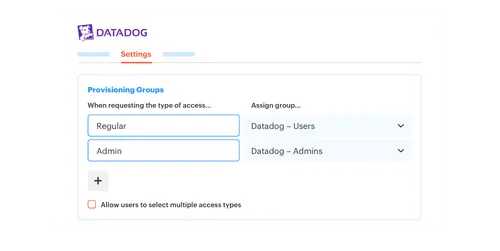
Inside Jira Service Management, Multiplier starts with an Application Catalog. Employees request sanctioned apps through the Jira portal or Slack, choose the right role, and generate a Jira issue as the system of record. Because those roles map to identity provider groups, the request is already structured for enforcement instead of forcing IT to decode free-text later.
That sounds small until you’ve lived the alternative. Structured requests remove interpretation work. Multiplier also supports Approval Workflows inside Jira and Slack, so managers, app owners, or named approvers can act without breaking the trail. Once the issue hits the approved state, Automated Provisioning can trigger through mapped groups in Okta, Entra ID, or Google Workspace, and Jira records the outcome.
Before, an admin reads the ticket, looks up the group, clicks around the IDP, and hopes the evidence trail is good enough later. After, the workflow itself carries the intent through enforcement. That’s the practical importance of automation in a Jira-centric environment: less interpretation, fewer handoffs, better control.
Multiplier enforces least privilege with expiry and reviews
Revocation is where manual systems get exposed, and certification is where they usually pretend not to be exposed.
Multiplier handles both. Time-Based Access lets requesters choose durations like 1, 6, or 24 hours, then automatically removes the mapped IDP group membership at expiry. That closes the cleanup gap that creates standing privilege in the first place.
On the review side, Access Reviews run in Jira instead of spreadsheets. Reviewers get user context — groups, departments, job titles, last login — then mark keep or revoke directly in the campaign workflow. If access should be removed, Multiplier can revoke the mapped IDP group membership and document the action in Jira.
Auto Reclaim adds another layer for teams trying to cut SaaS waste. It uses last-login telemetry from the identity provider to identify inactive users, warn them, and revoke access after a grace period if they still don’t log in. That won’t fit every app, and it depends on decent IDP telemetry. Fair limitation. Still, where it fits, it turns cleanup into a system behavior instead of a quarterly side project.
Why Automation in Access Management Changes the Whole IT Operating Model
The importance of automation in access management isn’t that tickets move faster. It’s that your team stops living in the gap between systems.
If governance sits in one place, approvals in another, provisioning in a third, and evidence in a fourth, the process will always cost more than it should. More time. More standing access. More audit pain. More pressure to hire just to keep up. That’s the old model, and honestly, it looks normal right up until it doesn’t.
The better model is simpler. Put governance where work already happens. Route approvals cleanly. Provision through the identity provider. Make elevated access expire by default. Run reviews with usage context and enforce revocation from the same workflow.
That’s the real importance of automation in this whole category. Not prettier tickets. Not a faster queue. A different operating model. And once you see it that way, the question stops being whether to automate. The question is what manual step you’re still defending that the system should already own.
Frequently Asked Questions
How do I set up automated access requests in Multiplier?
To set up automated access requests with Multiplier, start by creating an Application Catalog in your Jira Service Management (JSM) portal. 1) Add the applications you want employees to request access to, ensuring each app has the correct roles mapped to identity provider groups. 2) Next, configure approval workflows so that requests automatically route to the appropriate approvers, such as managers or app owners. 3) Finally, ensure that automated provisioning is enabled, which allows Multiplier to handle group assignments in your identity provider once requests are approved. This streamlines the entire process and reduces manual overhead.
What if I need to revoke access quickly?
If you need to revoke access quickly, use Multiplier's Access Reviews feature. 1) Launch an access review campaign in Jira, selecting the applications in scope and assigning reviewers. 2) Reviewers will see user context, such as last login and department, which helps them make informed decisions. 3) Once a reviewer decides to revoke access, Multiplier automatically removes the user from the relevant identity provider groups and documents the action in Jira. This ensures that access is revoked efficiently and that you have an audit trail for compliance.
Can I automate time-bound access with Multiplier?
Yes, you can automate time-bound access using Multiplier's Time-Based Access feature. 1) When employees submit access requests, they can select a duration for their access, such as 1, 6, or 24 hours. 2) After approval, Multiplier provisions the access and sets an automatic timer to revoke the user from the mapped group once the time expires. 3) This feature helps enforce least privilege by making sure elevated access is only temporary, reducing the risk of standing privileges.
When should I conduct access reviews?
You should conduct access reviews regularly, typically every quarter, to ensure that user access remains appropriate. 1) Use Multiplier's Access Reviews feature to streamline the process. Create a campaign that includes all relevant applications and assign reviewers. 2) Ensure that reviewers have access to user context, such as last login dates and department information, to make informed decisions. 3) This approach not only keeps access in check but also helps maintain compliance and reduces the risk of unauthorized access.
Multiplier connects to your existing JSM setup in minutes. Try it free on the Atlassian Marketplace.


