


75% of access requests can be automated. And yet most IT and security teams still run identity governance across Jira tickets, Slack pings, their identity provider, and a sad little spreadsheet that becomes "audit evidence" later.
That split is why the importance of security and access governance gets misunderstood. People treat it like a policy problem. It’s really an operations problem. If work starts in Jira but governance lives somewhere else, you’ve already created delay, confusion, and risk.
Key Takeaways:
- The importance of security and access governance shows up in day-to-day operations, not just audit season.
- If access requests start in Jira, governance should stay in Jira or you create handoff failure.
- A good rule: if standard access takes more than 15 minutes of human work, your model won’t scale.
- Least privilege only works when revocation is automatic, not when someone promises to clean it up later.
- Separate IGA portals often add friction instead of control because approvals, provisioning, and evidence get split across tools.
- High-growth teams should aim to automate 75%+ of access requests before headcount growth turns routine work into backlog.
- Slack approvals are useful, but only if Jira stays the system of record and the identity provider executes the change.
If you want to see what that looks like in practice, you can Learn more about Multiplier.
Why the Importance of Security and Access Governance Gets Missed
The importance of security and access governance is easy to talk about in theory. It gets real when a company grows from 100 people to 400, or 400 to 1,200, and suddenly access requests are everywhere. New hires need apps. Managers need approvals. IT needs evidence. Security needs least privilege. Finance wants fewer wasted licenses. Nobody wants another portal.

The old assumption is that more governance means more process. More forms. More review layers. More software. I think that’s backwards. The real problem isn’t lack of policy. It’s fragmentation. When requests live in Jira, approvals happen in Slack, provisioning happens manually in Okta or Entra, and evidence gets reconstructed later, the process is broken before it even starts.
A day in the life makes this obvious. An IT admin opens Jira at 9:07 AM and already has 14 access requests sitting there. Three more came in through Slack overnight. Two came by email because someone didn’t know the process. By 11:30, that admin is still chasing a manager for approval, checking an old spreadsheet for the right group, and manually assigning access in the identity provider. By the afternoon, they’ve handled maybe eight requests. They feel busy all day. But the system itself is doing almost none of the work.
That’s the trap. Activity looks like control. It’s actually drift.
Security breaks first when growth speeds up
A small company can survive bad access operations longer than it should. That’s why a lot of teams think their setup is "fine." It isn’t fine. It’s just under stress less often. Once hiring picks up, the cracks show fast.
We saw versions of this with teams like a fast-growing AI company that had a four-person IT Ops team supporting 420+ employees. They weren’t drowning because demand disappeared. They got out of the mess because 75% of access requests became fully automated. That’s a huge difference. Not a minor efficiency tweak. A completely different operating model.

And there’s a fair point here. Separate IGA tools can be strong on policy depth. That’s true. If you’re a giant enterprise with a long implementation window and a team willing to live in another system, you can make that work. But most mid-market and high-growth teams don’t have that luxury. They need control that fits into the way work already happens.
The hidden cost is not just delay
People usually focus on wait time. Someone needed Figma, GitHub, Snowflake, or Jira project access and had to wait a day. That’s annoying. But it’s not the whole cost.
The bigger cost is what delay does to behavior. Teams start overprovisioning because it feels safer than becoming the bottleneck. Managers approve broad roles because they don’t want their people blocked later. IT stops enforcing expiry because manual clean-up never wins against the queue. Then audit season shows up and everyone acts shocked that standing privilege has piled up.
That’s why the importance of security and access governance is operational before it’s regulatory. Bad operations create bad security. Every time.
The question is what replaces it.
The Real Bottleneck Is the ITSM and IGA Split
The bottleneck isn’t approvals. It isn’t your identity provider. It isn’t that employees ask for too much access. The bottleneck is that the work is split between systems that don’t share enough context.
Security and access governance works best when the record of the request, the decision, the change, and the evidence stay tied together. If those pieces get separated, you get reconciliation work. And reconciliation work is where teams lose hours, miss revocations, and create audit gaps.
This matters because the importance of security and access governance is not abstract. It shows up in the chain of custody. Who asked. Who approved. What was granted. For how long. When was it removed. If any part of that chain lives outside the core workflow, trust drops.
Use the Chain-of-Custody Test
I like simple filters. The Chain-of-Custody Test is one of them.
Ask five questions:
- Where does the request start?
- Where does the approval happen?
- Where is the access change executed?
- Where is expiry or revocation tracked?
- Where is the evidence an auditor will actually review?
If your answers involve three or more systems plus manual screenshots, your governance model is weaker than it looks.
That’s not theory. It’s the daily reality a lot of teams end up with. A manager approves in Slack. IT provisions in Okta. Someone comments in Jira. Later another person exports a spreadsheet. All of that "works" until you need a clean answer fast. Then nobody’s confident.
Why separate portals slow people down
A separate portal sounds clean on paper. Specialized tool. Dedicated controls. Nice story. In practice, adoption gets weird. Employees don’t live there. Managers don’t live there. IT lives partly there and partly in Jira. So every request picks up friction.
A 500-person company felt this during onboarding spikes. Tuesdays became a pileup because new hires would start on Monday, then spend Tuesday requesting the extra apps and elevated permissions they needed. The queue filled up because the requests lacked the right context and ownership was fuzzy. Sound familiar? That’s not a staffing problem. That’s a system design problem.
If your request flow sends people to one place, approvers to another, and IT to a third, don’t expect speed.
Why governance should sit where work already happens
Governance belongs inside the service desk workflow because that’s where the work begins. Jira already handles intake, ownership, SLAs, and workflow state. Slack already handles fast human response. The identity provider already knows the authoritative groups. So the winning model is pretty straightforward.
If the request starts in Jira, approvals should stay attached to that Jira issue, even when they happen in Slack. If approval happens, provisioning should run through the identity provider. If access is temporary, revocation should be automatic. If review happens later, the same record should hold the evidence.
That sequence matters. If request, approval, execution, and proof stay connected, the importance of security and access governance becomes obvious. You’re not adding process. You’re removing failure points.
So what does a better model look like when you actually build it?
What High-Functioning Teams Do Differently
A better model for security and access governance is not more meetings, more policy docs, or more headcount. It’s tighter system design. The teams that run lean don’t just work harder. They reduce the number of human decisions required for standard access.
That’s the shift. Governance stops being a side process and becomes part of the operating system.
Start with the 15-Minute Rule
Here’s a simple threshold. If a standard access request takes more than 15 minutes of total human effort, your process won’t scale. That includes reading the request, figuring out the right approver, checking the right group, making the change, updating the ticket, and leaving evidence behind.
Most teams underestimate this because the work is fragmented. They think the Jira part took two minutes, the Slack follow-up took one minute, the Okta update took three minutes. But the switching cost is the killer. Open tab. Find owner. Wait for response. Recheck status. Paste comment. Repeat. It adds up.
So start here:
- Identify your top 10 most common requests.
- Measure actual human minutes per request.
- If 70% of them require manual provisioning, fix that before buying more policy.
That’s the 15-Minute Rule. If the request is common and low-risk, the system should do most of the work.
Build a three-lane model for access
Not every request deserves the same treatment. This is where teams get themselves in trouble. They either lock everything down and create backlog, or they loosen everything and create standing privilege.
A better model is what I’d call the 3-Lane Access Model.
Lane 1 is standard access. Low-risk apps, known roles, repeatable approvals. Goal: automate aggressively.
Lane 2 is elevated but time-bound access. Admin roles, production systems, sensitive data. Goal: approve quickly, grant temporarily, revoke automatically.
Lane 3 is edge-case or manual access. Non-SSO apps, odd exceptions, weird entitlements. Goal: still route and document centrally, even if execution is manual.
This matters because security and access governance falls apart when teams use one process for everything. If a request is standard, don’t treat it like a high-risk investigation. If it’s privileged access, don’t let it become indefinite because someone forgot to clean it up.
One fintech team reduced privileged access by 85% by pushing elevated access into a just-in-time model with automatic expiry. That’s a huge governance improvement. But the deeper lesson is the model itself. Permanent access should be the exception, not the default.
Put expiry into the request, not the cleanup
Least privilege sounds good in a policy doc. It’s much harder in practice when nobody owns revocation. That’s why time-bound access matters so much.
The rule is simple. If access is elevated, temporary, or incident-driven, the duration should be selected at request time. Not later. Not "we’ll remember to remove it." Right there in the workflow.
This is one of those spots where the importance of security and access governance gets very practical. If you don’t collect duration upfront, you almost always create standing access by accident. Not because anyone meant to. Just because cleanup loses.
I’ve seen teams resist this because they think it adds friction. Sometimes it does. Fair point. A duration dropdown is still one more field. But that tiny bit of friction is much cheaper than months of unnecessary privilege sitting around.
For most companies, the rule should be:
- Standard business app access can stay persistent if role-based and reviewed.
- Admin or sensitive access should be time-bound by default.
- If manual revocation is required, treat that as a design flaw, not normal operations.
Run reviews with context, not spreadsheets
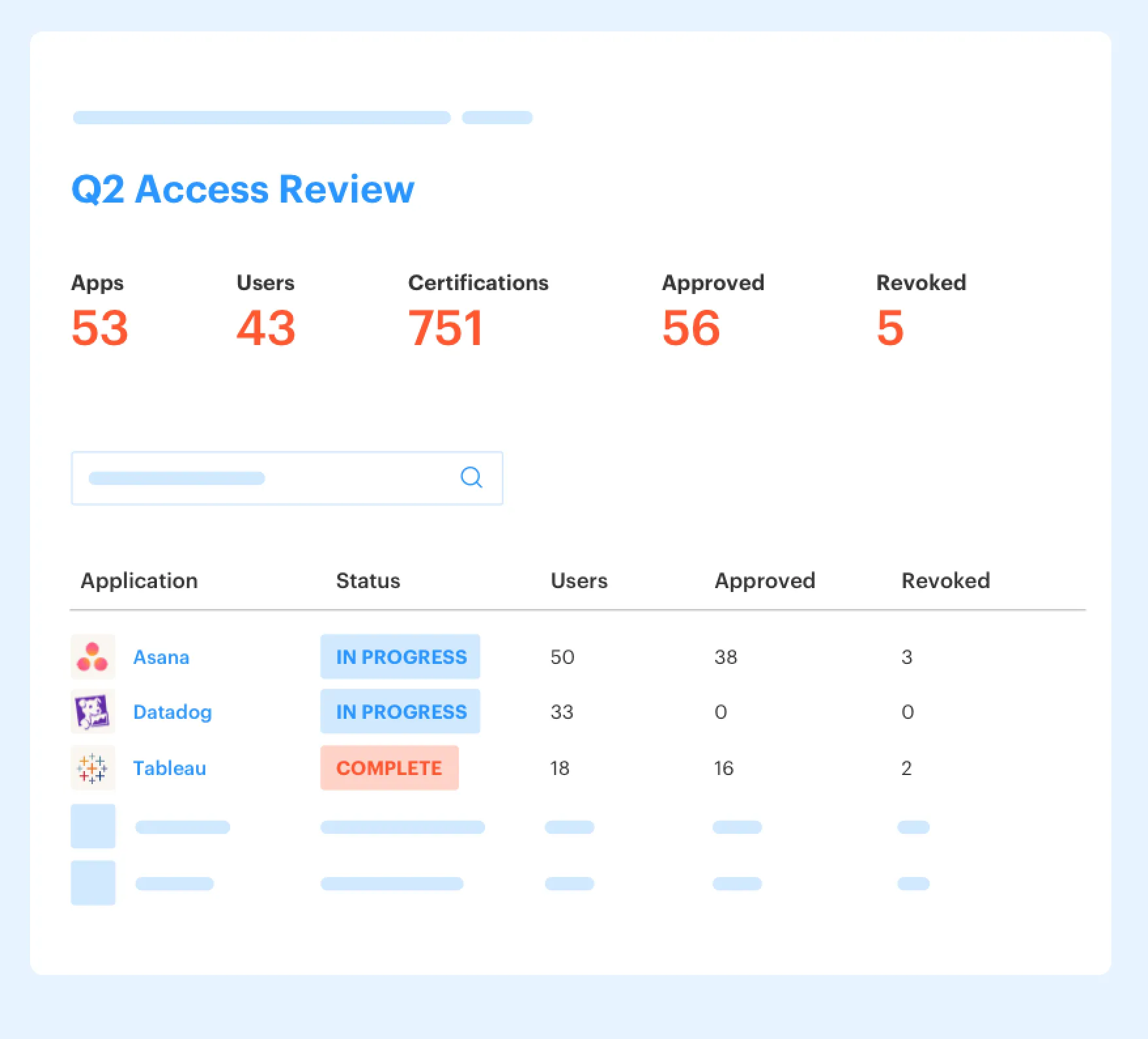
Quarterly access reviews are one of those jobs everybody claims to do and nobody enjoys doing. Spreadsheet-driven certifications are a mess because the reviewer lacks context. They see names and apps, but not enough signal to make good calls.
Good reviews include enough context to make revocation easy. Last login. Group membership. Job title. Department. Recommendation logic. If a user hasn’t logged in for 90+ days, that should be visible right there. If revocation is the obvious answer, make it the easy answer.
That’s a meaningful shift in security and access governance. Reviews stop being theater and become operational cleanup.
There’s also a concession worth making here. Quarterly reviews alone are not useless. They still catch problems. They still matter for compliance. But if you rely on quarterly reviews to fix what your day-to-day workflow keeps creating, you’ll always be behind. Reviews should confirm control, not compensate for broken intake and provisioning.
Treat license waste as a governance signal
This one gets overlooked a lot. People separate SaaS spend from access governance. I don’t think they should.
Unused licenses are often a symptom of weak governance. Someone changed roles. Someone left a team. Someone kept access they no longer needed. Nobody noticed because revocation depended on manual follow-up. So the company keeps paying.
If last-login telemetry shows no activity for 30 days, that’s not just a finance opportunity. It’s a governance signal. The user likely shouldn’t still hold the entitlement unless there’s a clear exception. That’s where automatic license reclamation can clean up both cost and risk.
And yes, not every inactive user should be removed. Executives, contractors on pause, or critical teams may need exclusions. That’s fine. The rule still holds. If there’s no policy around inactivity, you’re paying for drift.
If you want to see how this model maps to a real Jira-native workflow, See how Multiplier works.
Why Jira-Native Governance Changes the Math
Jira-native governance changes the math because it cuts out the handoff tax. That’s the part most teams don’t measure. They count tickets. They count approvals. They count maybe time to resolution. They don’t count the cost of splitting the same request across tools and humans.
When you keep governance inside Jira and use Slack for action while the identity provider executes the change, the flow gets tighter. Fewer places to lose context. Fewer missed approvals. Fewer screenshots. Fewer "who owns this app?" moments.
A request should become its own evidence
The strongest pattern in security and access governance is this: the request should generate the evidence as a byproduct of doing the work. Not after the fact.
That means the Jira issue should hold the requester, the role, the approver, the status changes, the provisioning result, and any revocation or review outcome. If your audit evidence requires a second process, you’ve built a leak.
This is why separate systems weaken audits even when they look more sophisticated. The more evidence has to be rebuilt, the more room there is for gaps.
Fast approvals only matter if execution is authoritative
Slack approvals feel fast. But speed without authoritative execution is just a better-looking bottleneck. Somebody can click approve in Slack in 20 seconds, and then IT still has to manually make the change 4 hours later. That’s not automation. That’s a prettier front end.
The rule is: if approval happens, the next system action should be deterministic. If a role maps to an identity provider group, approval should trigger that group change. If access is time-bound, expiry should trigger the removal. If a review says revoke, the system should remove the group membership and log it.
That’s how security and access governance gets both faster and stronger. Not by pushing approvals into chat alone. By connecting approval to execution.
Run lean IT by shrinking routine work
One of the better proofs here came from a company that processed 3,800+ access requests in a year and automated 75% of them. That’s why a four-person IT Ops team could support 420+ employees without falling apart. Not because they had superhero staff. Because the system absorbed routine work.
A different fintech team saw an 80% reduction in IT workload on access requests after centralizing requests and automating approval and provisioning. Again, same lesson. When standard work becomes system work, IT gets time back for actual IT.
That’s the bigger payoff. Security and access governance isn’t just about reducing risk. It’s about making lean teams viable.
How Multiplier Makes Jira-Native Governance Real
Multiplier makes this model real by embedding access governance directly inside Jira Service Management instead of asking your team to adopt another portal. That matters more than people think. The request starts where employees already ask for help, the approval stays tied to the Jira issue, and the actual access change runs through your identity provider. That’s a cleaner chain of custody, and it cuts a lot of waste.
A catalog, approval layer, and provisioning flow that stay connected
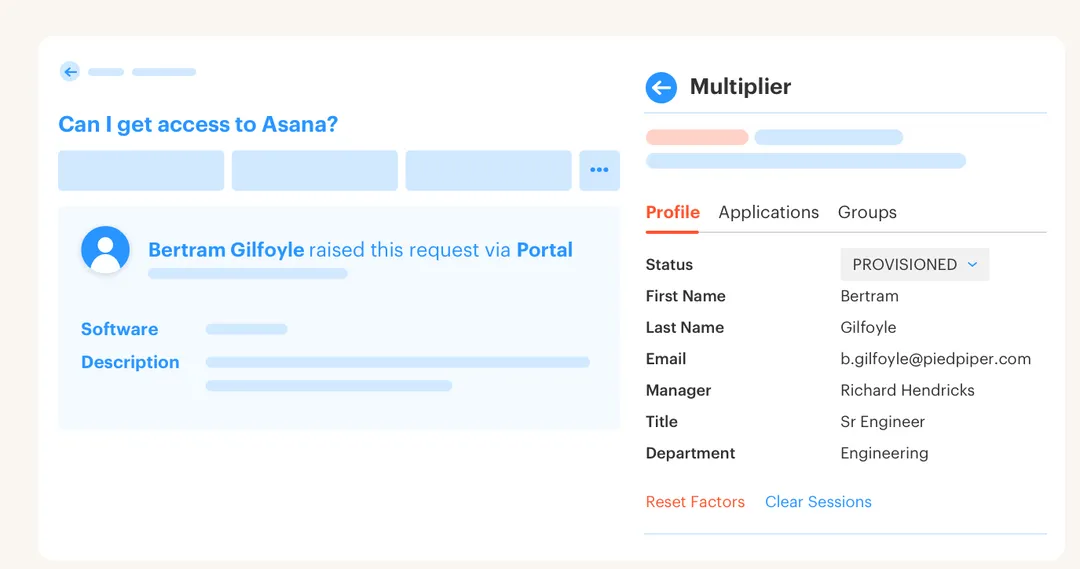
Multiplier’s Application Catalog gives employees a Jira-native place to request approved apps and roles through JSM or Slack. Each role maps to an identity provider group, which is the key design choice. Once a request is approved, Multiplier can use Automated Provisioning via Identity Provider Groups to add or remove the user from the mapped groups in Okta, Entra ID, or Google Workspace.
That combination matters because it removes the manual copy/paste step that slows teams down. The request, the role, the approver, and the provisioning result all stay connected to the Jira issue. Multiplier also supports Approval Workflows so requests can route to a manager, app owner, or specific user in Jira or Slack. If your standard access still requires humans to babysit every handoff, this is the part that changes the math.
Least privilege works better when expiry and reviews are built in
Multiplier also closes the gap most teams leave open after approval. Time-Based Access lets requesters choose a duration like 1, 6, or 24 hours, then removes the mapped group membership automatically when the window expires. That’s how you reduce standing privilege without creating manual cleanup work.
For periodic cleanup, Multiplier’s Access Reviews run in Jira with reviewer context like last login, user attributes, group memberships, and recommendations. Reviewers can mark Keep or Revoke, and revocations can execute automatically through the identity provider. If SaaS waste is part of the problem, Auto Reclaim can identify inactive users based on identity provider login data, notify them, and revoke access after a grace period. Multiplier even supports Post Functions for no-code lifecycle orchestration from Jira workflow transitions, plus a Slack App so requests and approvals can happen in chat while Jira remains the system of record.
If you’re trying to automate 75%+ of access requests and keep audit evidence tied to the workflow, Get started with Multiplier.
The Next Step Is Simpler Than Most Teams Think
The importance of security and access governance is not that auditors care. It’s that your operating model either creates least privilege by default or fights it every day.
Most teams don’t need a bigger policy library first. They need to stop splitting one workflow across four systems. Put the work where it already happens. Keep Jira as the record. Let Slack speed decisions. Let the identity provider execute the change. Then make expiry, reviews, and reclamation part of the same flow.
That’s when governance stops being overhead and starts acting like infrastructure.
Frequently Asked Questions
How do I automate access requests with Multiplier?
To automate access requests with Multiplier, start by using the Application Catalog within Jira Service Management (JSM). Employees can browse approved applications and select the roles they need. Once they submit a request through JSM or Slack, Multiplier will handle the approval workflow. Make sure to configure the roles and identity provider groups so that provisioning happens automatically after approval. This streamlines the process and reduces manual workload significantly.
What if I need to revoke access quickly?
If you need to revoke access quickly, utilize Multiplier's Time-Based Access feature. When submitting an access request, specify a duration for the access. Once approved, Multiplier will automatically remove the user from the mapped group when the time expires. This ensures that elevated access is temporary and minimizes the risk of standing privileges without requiring manual follow-up.
Can I track access reviews in Multiplier?
Yes, you can track access reviews in Multiplier using the Access Reviews feature. Admins can create review campaigns directly in JSM, selecting the applications and reviewers involved. Reviewers will receive notifications and can easily mark users to keep or revoke access based on context like last login. This process is integrated, ensuring that all decisions are logged and linked to the original requests, making audits easier and more reliable.
When should I consider using Auto Reclaim?
Consider using Auto Reclaim when you want to optimize your SaaS spend by identifying and reclaiming unused licenses. This feature automatically tracks user activity based on login data from your identity provider. Set inactivity thresholds and grace periods to notify users before revoking access. This proactive approach helps ensure that you're not paying for licenses that are no longer needed, making your access governance more efficient.
Why does Multiplier integrate with Jira?
Multiplier integrates with Jira because it allows for a seamless experience in managing access requests and approvals. By keeping governance within Jira, all requests, approvals, and provisioning actions are tied to the same record, reducing fragmentation. This integration helps eliminate delays and ensures that audit evidence is automatically generated, making it easier for teams to maintain compliance and control.


