


If your access review only finds stale permissions after 90 days, the real risk has already been sitting there for months. The review matters, but the workflow after the decision matters more, because a Keep/Revoke choice means nothing until access actually changes. That's why the better move is to automate identity reviews around the Jira ticket, where the approval, revocation, and proof all stay tied to the same request.
Most IT teams already have the pieces. Jira has the request, Slack has the approval, and Okta or Entra has the group. The decision, the change, and the evidence live in different places, so access reviews become archaeology every quarter.
And honestly, I get why it happens. You start with a few apps, a few users, a few approvals. Then the company grows, the queue grows, security asks for tighter controls, and suddenly your access review process is a spreadsheet with feelings.
Key Takeaways:
- Automating identity reviews only works when approvals, provisioning, revocation, and evidence are tied to the same workflow.
- Chat approvals are fast, but they don't solve governance unless the decision writes back to a system of record.
- Time-bound access is the fastest way to reduce standing privilege without slowing people down.
- Identity provider groups should be the control point for access, because they make revocation enforceable.
- Risk-based review beats quarterly spreadsheet cleanup, especially for privileged roles and sensitive systems.
Why Identity Reviews Fail When Evidence Lives Outside Jira
Identity reviews fail when the request, approval, access change, and audit evidence live in different systems. The work looks complete because every tool has a partial record. The risk sits in the gaps between those records, especially when revocation depends on someone remembering to clean up later.

The audit problem usually starts with the access request
A product manager submits a Jira ticket at 9:12 AM Tuesday asking for access to NetSuite. Her manager approves it in Slack at 9:47 AM before a standup. IT adds her to the right Okta group at 1:14 PM and comments "done" on the ticket. Pretty normal.

Now fast forward 87 days. The auditor asks who approved the access, what role she received, whether it was still needed, and when it was removed. The Jira ticket has some of it, Slack has some of it, and Okta has the actual state. Nobody is wrong, but nobody has the full story either.
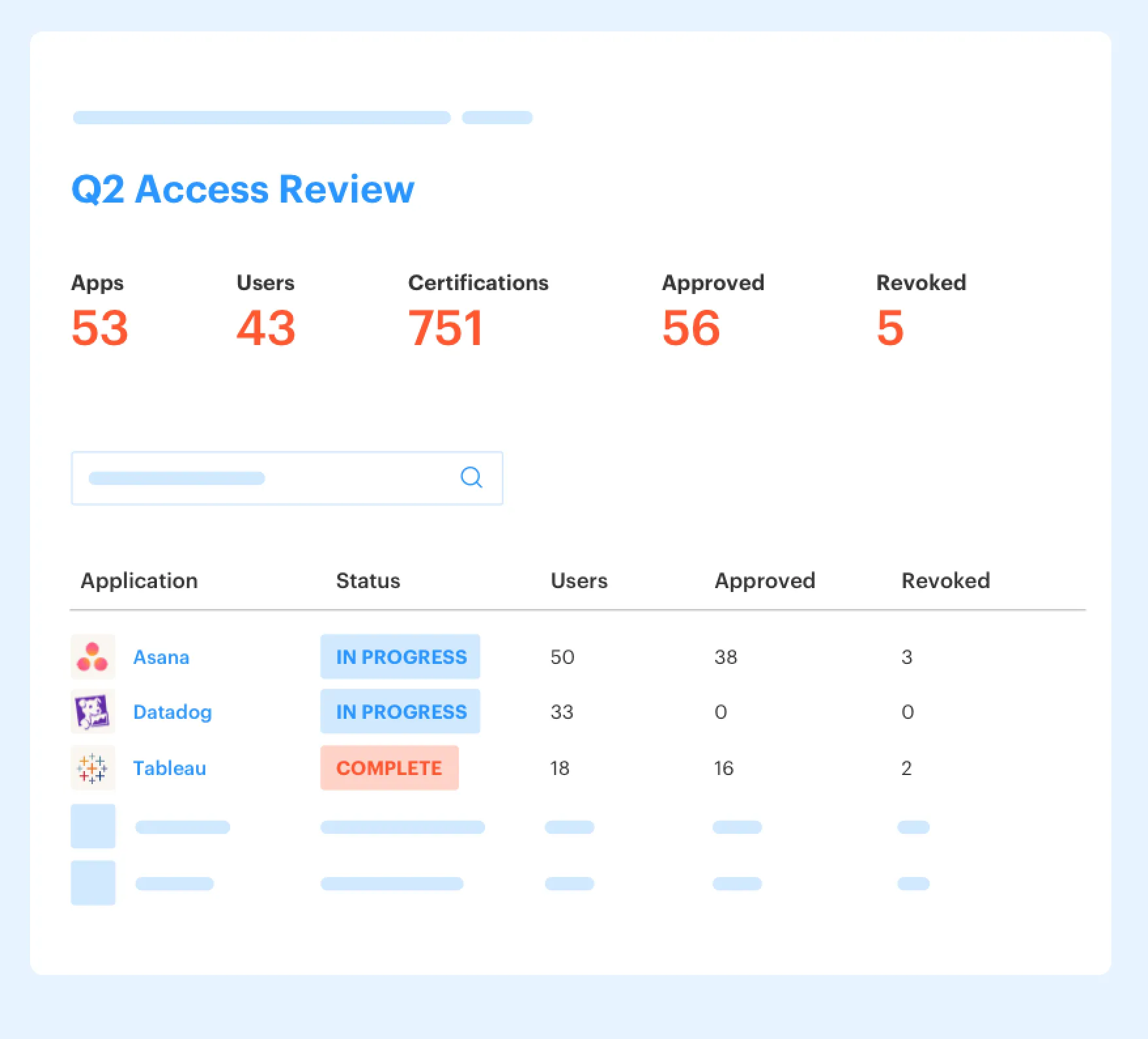
That's where identity reviews start to break. Not because IT is lazy. Not because security doesn't care. The workflow was never designed to preserve the chain from request to decision to access state to revocation. To automate identity reviews to reduce risk, the review can't be a separate cleanup motion. It has to be built into the way access gets granted in the first place.
A fintech team we've seen had this exact issue during fast growth. Hundreds of access requests were coming through Slack, email, and Jira, and each standard request could take 5 to 30 minutes once you counted approval chasing and group assignment. At that volume, the access queue becomes like a warehouse with three loading docks and no shared inventory system. Packages move. People stay busy. Then someone asks what shipped last quarter and everyone starts checking separate logs.
If your Jira queue already looks like that, the cleaner path is to see the governance pattern in context: Learn more about Multiplier.
Chat approvals create speed without control
Slack approvals feel like progress because they remove friction. And to be fair, they do. Nobody wants every request trapped in email, waiting for a manager who missed the thread. Chat is where people work, so approvals should absolutely show up there.
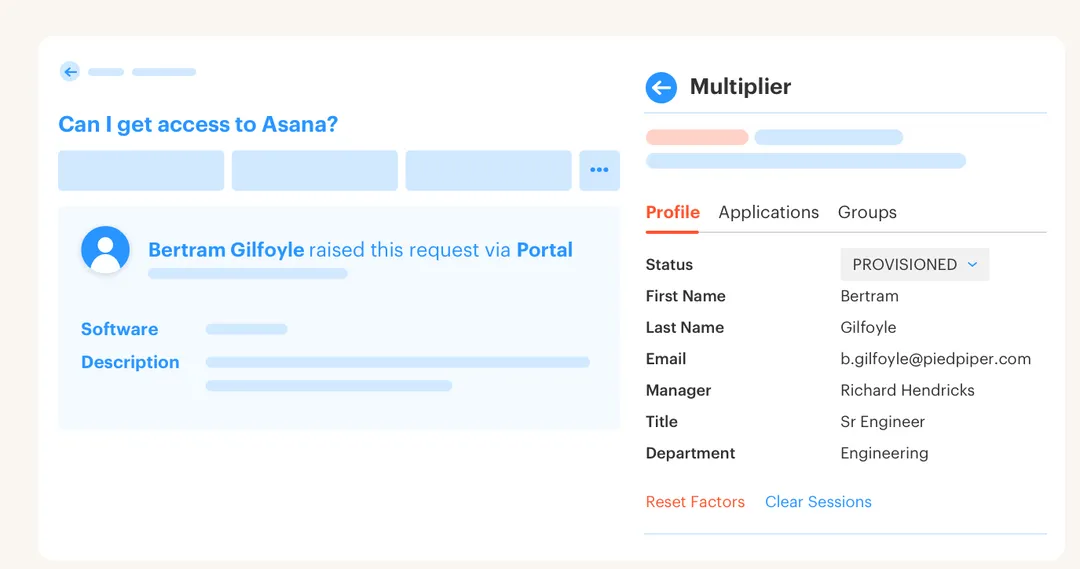
The mistake is treating the chat approval as the governance system. It isn't. Slack can capture a decision, but unless that decision is tied to the ticket and the identity provider change, you still have to rebuild evidence later. Fast approval without enforceable follow-through is just a faster way to create standing access.
A useful test is simple. Pick 10 approved access requests from the last 30 days. For each one, can you answer four questions in under 2 minutes without opening more than two systems?
- Who requested access?
- Who approved it?
- What exact role or group was granted?
- Was it removed, reviewed, or given an expiry?
If you fail that test on more than 2 of the 10, the problem isn't your access review cadence. The problem is broken evidence capture. Quarterly reviews won't fix that, and they'll only make you notice it later.
Standing privilege is a cleanup failure, not a policy failure
Least privilege usually fails after the approval, not before it. Someone asks for temporary admin access, gets it, uses it, and moves on. The team agrees it should be temporary. Everyone has the right intent. Then the cleanup step gets buried under new tickets.
That's why standing privilege is so hard to fight with policy alone. A written rule saying "admin access should be temporary" does nothing unless the workflow can enforce expiry. People are busy. Incidents happen. Managers change roles. App owners leave. Access remains because removal is manual, and manual work always competes with whatever is on fire today.
Stavvy is a good example of the pattern going the other direction. After funding and acquisitions, they needed to reduce long-lived privileged access and move toward just-in-time control. They cut privileged access by 85% and automatically revoked 1,300+ access requests after approved windows. The interesting part isn't the number by itself. The interesting part is that the revocation wasn't a reminder. It was part of the access grant.
That's the reframe. Identity reviews aren't mainly a review problem. They're an access design problem.
How to Automate Identity Reviews to Enforce Least Privilege
To automate identity reviews to enforce least privilege, start by making access decisions executable inside the same workflow that captures evidence. The practical sequence is request, approve, provision, expire, review, revoke. If any step happens outside that chain, your team inherits manual cleanup later.
Find the review gaps before the quarter closes
Pull your last 25 access requests for high-risk apps before changing tools or workflows. Focus on admin roles, finance systems, production systems, and customer data tools. Then trace each request from intake to current access state. Not the ideal path. The real one.
I like this exercise because it removes opinion fast. You'll see whether the process actually works or only works when the same senior admin babysits it. You'll also see which apps are governance-ready and which ones are held together by tribal knowledge. Painful, but useful.
Use these questions to sort the requests:
- Can you identify the requester, approver, role, and business reason from the ticket alone?
- Can you prove the identity provider group changed after approval?
- Can you tell whether access was meant to be permanent or temporary?
- Can you show when access was revoked or reviewed?
- Can a new IT admin understand the workflow without asking the original owner?
If 80% of the answers are yes, you're ready to automate more of the review cycle. If less than 50% are yes, fix intake and evidence capture first. Automation on top of vague requests creates faster confusion. Frankly, this is where a lot of teams go wrong. They try to automate identity reviews to speed up certification, but the underlying request data is too messy to trust.
Treat every approval as future audit evidence
Every approval should be written as if an auditor will read it 6 months from now. Not in a scary way. Just in a practical way. The approval needs enough context that someone can understand why access was granted without hunting through Slack, email, and memory.
A strong approval record has five fields: requester, application, role, business reason, and approver. For privileged or sensitive access, add duration. The duration matters more than people think because it changes the review burden later. A 6-hour production access grant shouldn't be reviewed the same way as permanent access to a finance admin role.
The status quo has one real advantage. It's flexible. People can ask in Slack, explain the need casually, and get moving. That matters during an incident or a deadline. Flexibility becomes expensive when you need proof later, though. The better approach is to keep the speed but force the decision into a structured record.
Before approving any request, check whether the ticket would make sense if the requester left the company tomorrow. If the answer is no, don't approve it yet. Ask for the missing context before access is granted. That one habit prevents a surprising amount of review pain later.
Put expiry dates on risky access before users receive it
Make temporary access the default for risky roles. Not everything needs expiry. A designer probably needs ongoing Figma access. A finance analyst may need a stable role in the billing system. Admin access, production access, database access, and sensitive customer data access should almost always have a time limit.
The threshold I'd use is pretty direct. If access would create a security concern during offboarding, merger activity, or an audit sample, add an expiry. If the user only needs it for a task, add an expiry. If the requester says "just for today," add an expiry. Don't rely on the reviewer to remember that sentence next quarter.
There's a fair counterpoint here. Too many expiries can annoy people, especially engineers during incidents. That's valid. If someone has to re-request access every 20 minutes while fixing production, you've created a different problem. The answer isn't permanent access, though. The answer is duration options that match the work. Give people 1 hour, 6 hours, or 24 hours depending on the risk and task.
A practical model looks like this:
- 1 hour for emergency production or database access
- 6 hours for sensitive admin work or investigation tasks
- 24 hours for migration, finance close, or project-based cleanup
- Permanent with review for normal role-based access
Once expiry becomes part of the request, identity reviews get lighter. You're no longer asking reviewers to find every bad grant months later. A lot of the risky access already removed itself.
Use identity provider groups as the control point
The identity provider should be the control point because it's where access can actually be enforced. Jira can capture the request. Slack can capture approval. The SaaS app may receive the entitlement. But the identity provider group is usually the cleanest place to add, remove, and prove access.
This is where the architecture matters. If each app role maps to a group in Okta, Entra, or Google Workspace, then approval can trigger group assignment. Revocation can remove group membership. Review decisions can be enforced instead of copied into a spreadsheet. The workflow gets much easier to reason about.
A simple rule: don't automate a review decision unless you know the exact group that controls the access. If "Salesforce Admin" maps to three possible groups and nobody knows which one matters, stop. Clean up the mapping first. If "GitLab Maintainer" maps to one group and the app owner is known, automate that path.
There's a case to be made for direct app-level provisioning. Some apps have weird roles. Some don't behave cleanly through SSO. That's real. For most standardized access, identity provider groups give you the cleanest audit trail and the most reliable revocation path. Start there before building custom one-off automations.
Review by risk tier instead of alphabetical app lists
Quarterly access reviews often fail because they treat every app the same. The review campaign includes 40 apps, reviewers get a giant list, and everyone starts clicking "keep" because the task feels too broad. Rubber-stamping isn't a personality flaw. It's usually a workflow design flaw.
Risk tiering fixes that. Put apps into buckets based on what bad access would cost. Production systems, finance tools, customer data, security tools, and admin consoles go in the top tier. Collaboration tools and low-risk apps go lower. Then review the riskiest access more often and with more context.
A workable cadence:
- Review privileged and sensitive access monthly.
- Review business-critical SaaS access quarterly.
- Review low-risk access twice a year.
- Auto-reclaim inactive licenses where login data is reliable.
- Trigger off-cycle reviews after role changes, manager changes, or team transfers.
The key is not review frequency by itself. It's matching review effort to risk. If a user hasn't logged into a low-risk tool in 90 days, reclaiming the license may be enough. If a user has admin access to a production system, last login is only one signal. You also need manager context, role context, and a clear revocation path.
Close the loop by revoking access in the same workflow
A review decision without revocation is just a recommendation. That sounds harsh, but it's true. If a reviewer clicks "revoke" and someone else has to open the identity provider, find the group, remove the user, update the ticket, and document evidence, the process is still manual where it matters most.
The clean version is much tighter. Reviewer marks "revoke." The workflow removes the user from the mapped identity provider group. The ticket records the action. The campaign status updates. Done. That's what it means to automate identity reviews to actually reduce access risk.
I'd argue this is the most overlooked part of identity review automation. Teams spend a lot of time making the reviewer screen nicer. Better filters. Better columns. Better exports. All useful. If revocation still requires manual follow-up, you haven't fixed the control. You've only improved the inbox.
The operational test is simple. After a review campaign ends, count how many revoke decisions are still waiting on someone to execute them after 48 hours. If the number is more than zero for high-risk access, the review process is leaking. And those leaks become audit findings, security exceptions, or just another Friday afternoon cleanup project nobody wanted.
How Multiplier Automates Access Governance in Jira
Multiplier automates access governance in Jira by tying requests, approvals, provisioning, expiry, reviews, and evidence to Jira Service Management workflows. It works through identity provider group mappings across Okta, Entra ID, and Google Workspace. The access decision and the access change stay connected.
Time-bound access that removes itself
Multiplier's Time-Based Access is built for the standing privilege problem. A requester can choose a duration, like 1, 6, or 24 hours, when asking for access. After approval, Multiplier adds the user to the mapped identity provider group and starts the timer. When the window expires, it removes the group membership and writes the change back to the Jira issue.
That matters because the cleanup step is where least privilege usually falls apart. In the old process, someone grants admin access for a short task and plans to remove it later. Then the queue moves on. With Multiplier, the expiry is part of the grant itself, as long as the access is controlled through identity provider group membership. Purely manual or non-SSO access still needs a manual path, which is worth saying plainly.
Multiplier also supports approvals through Jira Service Management and Slack, so managers or app owners can approve without creating a separate side record. The Slack action is anchored to the Jira issue. The provisioned group change is tied back to the same issue. For the access patterns we talked about earlier, that's the difference between "I think we removed it" and "the record shows it expired."
Jira-native reviews with evidence on the ticket
Multiplier's Access Reviews move certification campaigns into Jira Service Management. Admins create campaigns, select approved applications, assign reviewers, and give reviewers context like user attributes, groups, last login, and recommendations such as revoking inactive access. Reviewers mark keep or revoke, and Multiplier removes users from relevant identity provider groups when revocation is selected.
The product also supports an Application Catalog for Jira-native intake, Automated Provisioning through identity provider groups, and Auto Reclaim for inactive SaaS licenses on the Advanced edition. Those features matter because identity reviews get stronger when the upstream request data is clean. If the app, role, approver, group mapping, and ticket all connect from the start, the review isn't trying to reconstruct history later.
Once the Jira issue becomes the record for request, approval, grant, expiry, and revocation, the whole access governance motion gets easier to run: Get started with Multiplier.
I wouldn't claim every company should automate every app on day one. Some apps don't have clean SSO mappings. Some teams need to start catalog-only and build toward automation. That's a real constraint. The direction is still clear, though. Automate identity reviews to enforce least privilege where the control path is reliable first, then expand as your mappings improve.
Make Identity Reviews a Workflow, Not a Quarter-End Cleanup
Identity reviews work better when they become part of the access lifecycle instead of a quarterly scramble. Request the access in Jira. Approve it with context. Provision through the identity provider. Add expiry for risky roles. Review by risk tier. Revoke in the same workflow.
That's the whole game.
If your team is still rebuilding evidence from tickets, Slack threads, identity provider logs, and spreadsheets, the process isn't just annoying. It's costing you control. The better path is to automate identity reviews to remove standing access before it becomes a review problem.
Frequently Asked Questions
How do I set up time-based access in Multiplier?
Submit an access request through Jira Service Management or Slack, pick the application and role, then choose a duration — 1, 6, or 24 hours. Once approved, Multiplier provisions access and starts a timer. When it expires, access is removed automatically and the change is logged back to the Jira ticket.
What if I need to revoke access quickly?
Find the Jira ticket tied to the access. Select 'Revoke' and Multiplier removes the user from the relevant identity provider group, then documents the change on the ticket. No manual follow-up needed.
Can I automate approvals for access requests?
In JSM admin settings, map workflow statuses to 'Waiting for Approval' and 'Approved,' then assign default or per-app approvers. Once approved, Multiplier transitions the ticket and triggers provisioning — evidence stays linked to the Jira issue throughout.
When should I conduct access reviews?
Base your cadence on risk. High-risk apps — finance tools, production systems — warrant monthly reviews. Business-critical SaaS gets quarterly. Low-risk tools can go twice a year. The goal is spending review effort where bad access actually hurts.
Why does my team struggle with access request tracking?
Probably because requests are coming from multiple channels — Slack, email, Jira — with no unified system of record. Multiplier with JSM centralizes requests, approvals, and provisioning so the evidence chain lives in one place instead of three, which makes audits a lot less painful.


