


The Role of Automation in Access Governance: How to Reduce Manual Errors Without Adding More Process
Manual access governance usually breaks the same way a lot of internal systems break. It feels fine when the company is small. Then headcount grows, apps pile up, approvals start bouncing between Slack, email, Jira, and the identity provider, and the role of automation in access governance goes from “nice idea” to “we literally can’t scale this manually anymore.”
Most teams think they have an access control issue. A lot of the time, they actually have a workflow issue. And once that workflow gets split across four tools, it turns into a security problem, an audit problem, and a time sink for everyone involved.
Key Takeaways:
- The role of automation in access governance is to remove manual handoffs that create delays, standing access, and weak audit evidence.
- Most access failures come from fragmented execution, not bad policy.
- Least privilege only works at scale when approvals, provisioning, reviews, and revocation happen in a connected flow.
- Jira-native governance changes the operating model because the request, decision, action, and evidence all live in one place.
- High-growth teams should automate routine requests first, then time-bound access, reviews, and lifecycle changes.
- If auditors still need screenshots and spreadsheet stitching, the workflow is already telling you what’s broken.
Why Automation Matters More as Access Governance Gets Harder
The role of automation in access governance keeps expanding as companies grow. More people. More apps. More exceptions. More reviews. Same lean team. That math stops working fast. What used to feel manageable turns into delays, broad permissions, stale access, and missing proof. The issue isn’t that demand exists. It’s that demand outruns the way the team operates.

Growth turns small cracks into real risk
When a company is smaller, teams can get away with a lot. Someone asks for access in Slack. A manager reacts with a thumbs up. IT adds a group in Okta. Everybody moves on.
Messy, yes. But survivable.
Then the company doubles. Then SaaS sprawl shows up. Then onboarding volume jumps. Then security wants tighter controls. Then compliance wants evidence. Now the same loose process that once felt practical starts falling apart in public.
Luno is a good example. They onboarded 387 new employees in a little over eight months, a 32% increase, and their team was still handling hundreds of routine access requests manually. That’s not just annoying admin work. That’s a signal the operating model is under strain. Read the Luno case study if you want to see what that pressure actually looks like.
The real issue is fragmentation, not policy design
A lot of teams assume the hard part is policy. Who should approve what. Which app needs what level of oversight. Those questions matter. But they usually are not the biggest source of waste.
The bigger problem is fragmentation.
The request starts in Jira. Approval happens in email. Follow-up happens in Slack. Provisioning happens in Okta or Entra. Audit proof ends up in a spreadsheet. Reviews happen somewhere else. Revocation may or may not happen at all.
That’s where time gets burned. That’s where context gets lost. That’s where people start routing around the process because the system is too annoying to use.
And this is exactly where the role of automation in access governance becomes obvious. It’s less about doing things faster for the sake of speed. It’s about connecting the workflow so requests, decisions, actions, and evidence stop living in different places.
Manual work quietly creates standing privilege
Standing privilege usually isn’t the result of bad intent. It’s the result of bad follow-through.
If access is painful to request, slow to approve, and easy to forget to remove, teams start defaulting to broad permissions just to keep work moving. That’s the hidden cost of manual operations. You don’t just get slower fulfillment. You get overprovisioning, delayed cleanup, and a bunch of “can someone remove this old access?” messages weeks too late.
What’s Actually Broken in Most Access Programs
Most access programs don’t fail because teams lack policy. They fail because governance gets separated from where work already happens. The requests are in Jira. The nudges are in Slack. The actions are in the identity provider. The evidence is rebuilt later. That split is exactly why the role of automation in access governance matters so much. It makes the control model executable, not theoretical.
Separate governance portals create duplicate work
A separate IGA portal sounds great on paper. Dedicated controls. Dedicated workflows. Dedicated place for governance.
The problem? Employees and managers usually don’t work there.
They work in Jira. They work in Slack. That’s where requests start. That’s where questions happen. That’s where approvals get chased. So now your team is bridging two worlds all day long. One tool for intake. Another for governance. Another for identity changes. Another for evidence.
That split creates drag. And once friction goes up, people bypass process. Then the audit story gets shaky fast.
This doesn’t mean dedicated governance tools never make sense. Some environments absolutely need them. But for a lot of mid-market and high-growth teams running on Atlassian, adding another portal often introduces more operational friction before it adds real control.
Audits get painful when evidence is rebuilt later
Audit readiness should fall out of the workflow naturally. It shouldn’t require a cleanup project every quarter.
But a lot of teams still run the same play: request comes in, approval happens somewhere, provisioning happens somewhere else, then someone takes screenshots, exports logs, and tries to stitch together a story after the fact.
That’s brittle. It’s time-consuming. And honestly, it’s a sign the system was built to finish tasks, not to create evidence by default.
Atlassian has written about extending Jira Service Management into employee workflows, and that pattern makes sense. When work stays in the system people already use, the trail gets cleaner.
Least privilege without execution is mostly a slogan
A lot of teams say they enforce least privilege. Fewer actually operationalize it.
Policy doesn’t remove access. Good intentions don’t set expiries. Quarterly reviews don’t fix months of unnecessary standing access if revocation still depends on somebody remembering to go do manual cleanup.
That’s why the role of automation in access governance matters so much. It turns “we should” into “it happened.” If the system can’t approve, grant, expire, review, and revoke access reliably, then the policy is just a document with nice formatting.
How Automation Changes the Access Governance Operating Model
The role of automation in modern access governance is pretty simple. It turns governance from a queue into a system. Requests become structured. Approvals route correctly. Provisioning follows the decision. Evidence gets captured in the same motion. It doesn’t replace judgment. It removes the dead space between judgment and execution.
Start with one intake path and one system of record
This first step is not flashy. That’s why it works.
You need one intake path for access requests. Not five. If employees can ask through Slack, email, forms, DMs, and hallway messages, your team is basically choosing future cleanup work.
A single request path creates consistency. It also creates a usable record.
In an Atlassian environment, that usually means Jira Service Management becomes the system of record. Not because it’s trendy. Because the workflows, approvals, and service operations are already there.
Once requests are standardized, you can finally automate something useful:
- Capture the app and role up front
- Route the request to the right approver
- Trigger provisioning after approval
- Preserve the full record for audit and review
Without that structure, automation just speeds up chaos.
Discover how leading IT teams automate access workflows in Jira
Push execution through the identity provider
This is where teams often miss the point. They automate the ticket. But not the access change itself.
The better approach is to let the service desk drive the workflow and let the identity provider execute the entitlement change. Okta, Entra ID, Google Workspace. That should be the authoritative execution layer.
Why does that matter?
Because it cuts manual copy-paste work. It makes changes more consistent. And it gives you a cleaner rollback path when someone changes roles, leaves the company, or no longer needs access.
Microsoft Entra documentation and Okta’s identity governance resources both point to the same bigger idea: authoritative identity changes create consistency downstream.
That’s the real role of automation in access governance. Not automation for show. Automation tied to the source of truth.
Make temporary access the default for elevated permissions
If access is risky, it shouldn’t become permanent just because nobody remembered to remove it.
This is one of the clearest wins in the whole operating model. Elevated access. Admin permissions. Sensitive data access. Production access. Make those time-bound by default whenever possible.
Request a duration. Approve it. Grant it. Remove it automatically when the window ends.
Simple.
That reduces standing privilege, obviously. But it also removes future admin cleanup. No more calendar reminders. No more forgotten follow-up tickets. No more contractor access lingering around long after the project is done.
Some teams think manual control equals tighter control. I get the instinct. But a lot of manual control is fake control. If revocation gets skipped, you didn’t gain more oversight. You created more exposure.
Bring access reviews into the same workflow
Access reviews tell you a lot about how mature the operating model really is.
If quarterly certification still means exporting data, assigning reviewers manually, chasing responses, and then separately revoking access, the process is broken. Maybe functional. But broken.
Reviews should live in the same governance workflow. Same records. Same ownership logic. Same evidence trail. Same revocation path.
A stronger review model usually includes:
- Reviewer context like title, department, groups, and last login
- A clear keep or revoke decision
- Logged reasons for revocation
- Automatic execution of that revocation
- Exportable evidence tied back to the workflow
That’s when governance stops being episodic and starts becoming continuous.
Use automation to support lean teams
A lot of high-growth companies have tiny IT teams relative to the business they support. That’s normal now.
Synthesia talked about running IT Ops for a much larger business with a team of four because routine work was automated. Their story is worth reading.
That’s what the role of automation in access governance should look like in practice. Less manual provisioning. Less chasing approvals. Fewer exceptions. Cleaner evidence. More time for design, risk decisions, and process improvement.
How Multiplier Makes Jira-Native Governance Work
Multiplier makes the role of automation in access governance real by keeping the request, approval, provisioning action, and evidence in one connected operating flow. Instead of splitting governance across a separate portal, chat threads, spreadsheets, and your identity provider, it uses Jira Service Management as the working layer and the identity provider as the execution layer. Cleaner model. Less glue work.
One request path, one approval flow, one audit trail
Multiplier’s Application Catalog gives employees a Jira-native way to request sanctioned apps and roles through JSM, and that same catalog can show up in Slack through the Slack app. That matters because intake is where the mess usually starts.
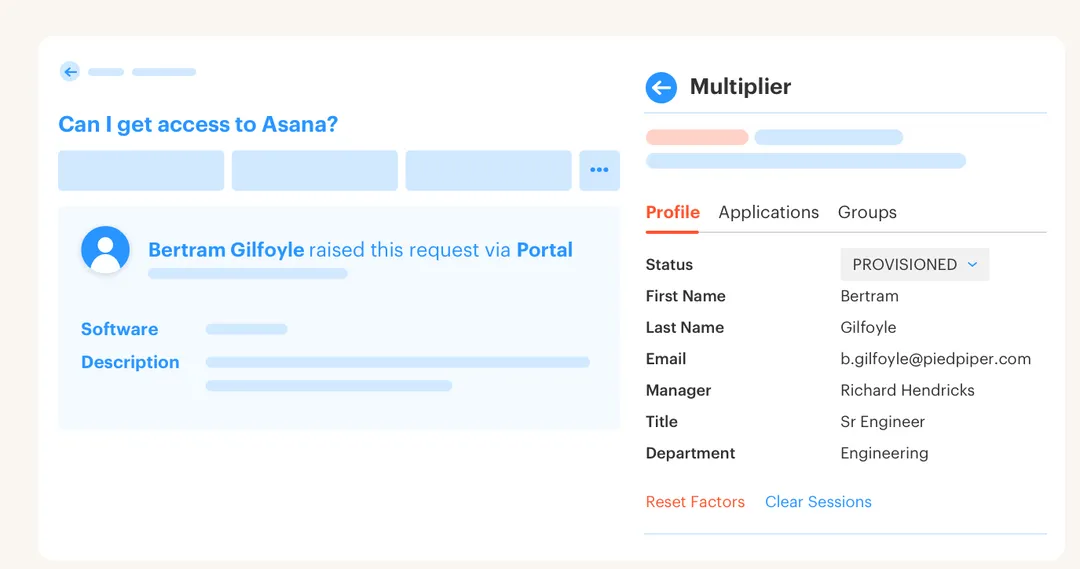
People ask in too many places. Details get missed. Tickets need rework. Approvals drag.
With Multiplier, the request is structured up front. The app and role are selected at the start. Only approved apps appear in the catalog. Each role maps to identity provider groups, which makes downstream execution more predictable.
Then Approval Workflows route requests to a manager, app owner, or designated approver in Jira or Slack. That removes a lot of routine back-and-forth.
Then the important part: once the Jira issue reaches the approved state, Multiplier provisions through identity provider groups. So the decision and the action stay linked. And the evidence writes back to Jira instead of being rebuilt later.
That’s a much more practical expression of the role of automation in governance. Not just workflow speed. Workflow integrity.
Least privilege gets enforced instead of talked about
This is where the product gets very concrete.

Time-Based Access lets requesters choose a duration like 1, 6, or 24 hours. Once approved, access is granted through the mapped identity provider group and removed automatically at expiry.
That’s a big deal. The removal step no longer depends on memory.
Access Reviews also stay inside JSM. Reviewers can see user attributes, groups, last login data, and recommendations, then decide to keep or revoke. If they revoke, the change can execute through the same identity-provider-backed path, while the record remains tied to Jira.
And if SaaS waste is part of the problem, Auto Reclaim uses last-login telemetry from the identity provider to flag inactive users, warn them, and revoke access after a grace period if they remain inactive. It’s available on the Advanced edition, so teams should evaluate it in that context, but the operating logic is strong.
Start automating access approvals and provisioning with Multiplier
Lifecycle work can be orchestrated without another disconnected layer
Multiplier also supports Post Functions inside Jira workflows, which means onboarding, transfers, and offboarding actions can trigger identity changes without custom scripts. That matters if you want lifecycle orchestration in the same workflow engine as the request and approval process.

The Slack app makes the whole thing more usable. Employees can request access in chat. Approvers can approve or deny in chat. But Jira remains the system of record underneath it all.
That balance matters. Chat-first work is real. Governance still needs a durable trail.
Ready to transform access governance in Jira? Get started with Multiplier
Why Jira-Native Governance Is the Smarter Next Step
The role of automation in access governance is not complicated when you strip away all the category noise. It makes least privilege executable. It makes approvals faster. It makes provisioning more consistent. It makes audit evidence show up as part of the work instead of as a cleanup exercise three months later.
If you’re already running Jira Service Management with an identity provider like Okta, Entra, or Google Workspace, the smarter move usually isn’t adding another portal. It’s fixing the split between request, approval, action, and evidence.
Put governance where the work already happens. Then use the role of automation in that workflow to handle the repetitive parts humans are bad at doing over and over again.
Frequently Asked Questions
How do I set up automated access requests with Multiplier?
To set up automated access requests using Multiplier, follow these steps: 1) Integrate Multiplier with your Jira Service Management (JSM) instance and your identity provider (like Okta or Google Workspace). 2) Use the Application Catalog to display approved applications for employees to request access. This catalog allows users to select roles and submit requests directly through JSM or Slack. 3) Configure Approval Workflows to route requests to the appropriate approvers, ensuring decisions are made quickly and recorded in the same system. This streamlines the entire process and reduces manual errors.
What if I need to revoke access for multiple users at once?
If you need to revoke access for multiple users, consider using Multiplier's Access Reviews feature. You can create a review campaign in JSM that allows you to select multiple applications and assign reviewers. Each reviewer can mark users to keep or revoke access, and Multiplier will automatically execute the revocations based on their decisions. This approach is efficient and ensures that all changes are documented in the same system, reducing the risk of errors and maintaining compliance.
Can I automate time-based access for sensitive applications?
Yes, you can automate time-based access for sensitive applications using Multiplier's Time-Based Access feature. When submitting an access request, users can select a duration (like 1, 6, or 24 hours). Once approved, Multiplier provisions the access and automatically revokes it when the time expires. This helps minimize standing privileges and ensures that access is only granted when necessary, reducing potential security risks.
When should I consider using the Auto Reclaim feature?
You should consider using the Auto Reclaim feature if your organization wants to optimize SaaS spending and minimize unused licenses. This feature automatically identifies inactive users based on login activity and can revoke access if users remain inactive beyond a set threshold. By implementing Auto Reclaim, you can ensure that your licenses are only allocated to active users, helping to reduce costs and improve overall access management efficiency.


